Thursday, 11 January 2018

Day three: from Diawling to Rosso

On New Year's Day, Mohamed Vall and I returned to Nouakchott the long way round. We detoured by following the Senegal River up to Rosso before heading north.

We took all day to return. We passed both fishing hamlets in Diawling on the way out of the National Park for one last time but not without stopping at both.

We were still looking for giant kingfisher which is known to like these locations. Again we failed to spot one.

pied kingfisher

Some sort of compensation was had by the sight of three pied kingfisher in one bush.

three pied kingfisher

We got our best views of African spoonbill at the first hamlet too. Though these were still distant.

African spoonbill

In contrast a group of great white pelican came up close to shore.

great white pelican

The big attraction for the birds at the hamlets is clearly fish. For the gulls it is dried fish.

grey-hooded gull

The fishermen didn't seem to bother as a grey-hooded gull walked over some drying catch.

juvenile black-crowned night heron

Two other birds were seen eating live fish. The first was a juvenile black-crowned night heron.


long-tailed cormorant

The second was a long-tailed cormorant which was fishing in shallow water.

many African swamphen

Between the two hamlets, we found an area with a high density of African swamphen.

At the second hamlet, this time there were far closer views of a yellow-billed stork than elsewhere on the trip.

yellow-billed stork (left)

There was also an opportunity to see several black crake for longer than before.

black crake

The best bird came from an unexpected quarter. It was an African reed warbler which was foraging around and in a tamarisk bush.

African reed warbler 1

African reed warbler is difficult to separate from Eurasian reed warbler which winter in Diawling. While the bird looks very short winged supporting African reed warbler, it is the yellow juvenile gape that is also critical information. A bird born in Europe in May should not show this much gape but a bird born in the African rainy season in September would do so.

African reed warbler 2

Whilst these factors are already enough to clinch its identification, the fact that it chose tamarisk to spend 15 minutes while next to extensive reed beds is also of some import. African reed warbler will take to drier terrain than Eurasian reed warbler. I saw several  African reed warbler (and some tawny-flanked prinia) in similar Tamarisk just the other side of the Senegal River in Saint Louis in early May 2017.

African reed warbler 3

Sadly, the African reed warbler had a bad skin infection around the neck.
.
African fish eagle

Also at the second hamlet, we spotted a sub-adult African fish eagle.

African mourning dove

We got one last good close look at African mourning dove which is the dominant dove of the wetter parts of the park.

There is one final open stretch of water before the terrain becomes marshland, then grassland then semi-desert over a few kilometres (along the north east road out of the park).

black stork

Here we had our best views of wintering black stork.

Eurasian spoonbill and pied avocet

There were very large numbers of both Eurasian spoonbill and pied avocet. The numbers were the highest I have ever seen in my life for both species.

garganey

Try as we might, we never found any Palearctic small or medium duck other than garganey. The larger ones were common shelduck, northern shoveller and also northern pintail but on day one only.

gull-billed tern

Still no marsh terns were seen either, although Caspian tern, gull-billed tern and a small number of sandwich tern were regularly seen.

Finally outside the national park, we elected to take the river road to Rosso rather than the more northerly route through Kaur Macene. 

Much of the route to Rosso consisted of semi-desert with tamarisk on the left and impenetrable reed beds on the right.

It was only when we reached within 25 kilometres of Rosso that irrigation channels and farming began to provide a landscape amenable to most birds. At the very beginning of this new habitat we found a row of tall trees next to the River's reed beds. We managed to accidentally flush over 100 sleeping black-crowned night heron. It was also the only one of two places over the weekend where we found red-billed firefinch.

Our only other stop in this area west of Rosso was at an abandoned palm plantation where land remediation is not really complete. 

Despite this, we flushed no few than six long-tailed nightjar having just got out of the car. 

long-tailed nightjar 1
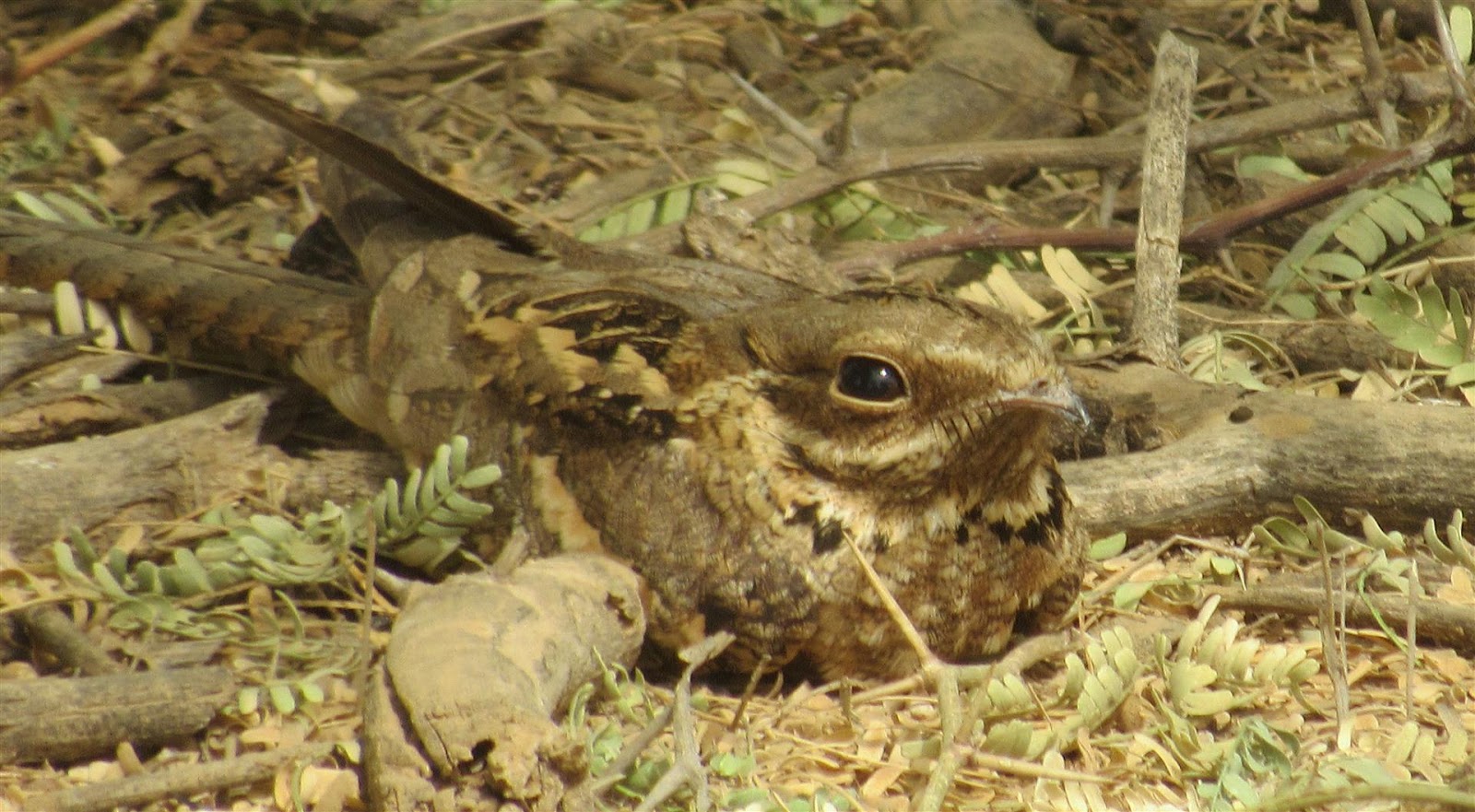
That made a total of nine birds in two different places on the weekend trip. I don't know whether we were just lucky.

long-tailed nightjar

The pools and very close by to them were the best places for birds at the old palm plantation. Other areas are still too degraded. More red-billed firefinch were observed. In the water, little stint, greenshank, ruff and marsh sandpiper were found. Marsh sandpiper is a Russian bird and not many come through Nouakchott from this very eastern breeding area. Yet in the south west corner of Mauritania they proved not uncommon. 

marsh sandpiper

Our final stop for the weekend was made after a light lunch in Rosso. It was just 12 kilometres north of the town on the Nouakchott road. Here is the limit of continous woodland out of Rosso. Further north there are increasingly isolated patches of natural woodland.

short-toed snake eagle (photo:Mohamed Vall)

The area from Rosso and eastward along the Senegal River is a major wintering place for short-toed snake eagle. Though we were at the extreme western edge of this strip, we saw one.

At our stop, we came across a watering hole which was almost dry but which is fairly obviously quite large in the rainy season and had lasted over three months since it finshed.

African silverbill

African silverbill were frequent drinkers there. A small flock of white-billed buffalo weaver were hiding in the adjacent trees.

Elsewhere laughing dove and Namaqua dove were numerous and obvious.

Namaqua dove
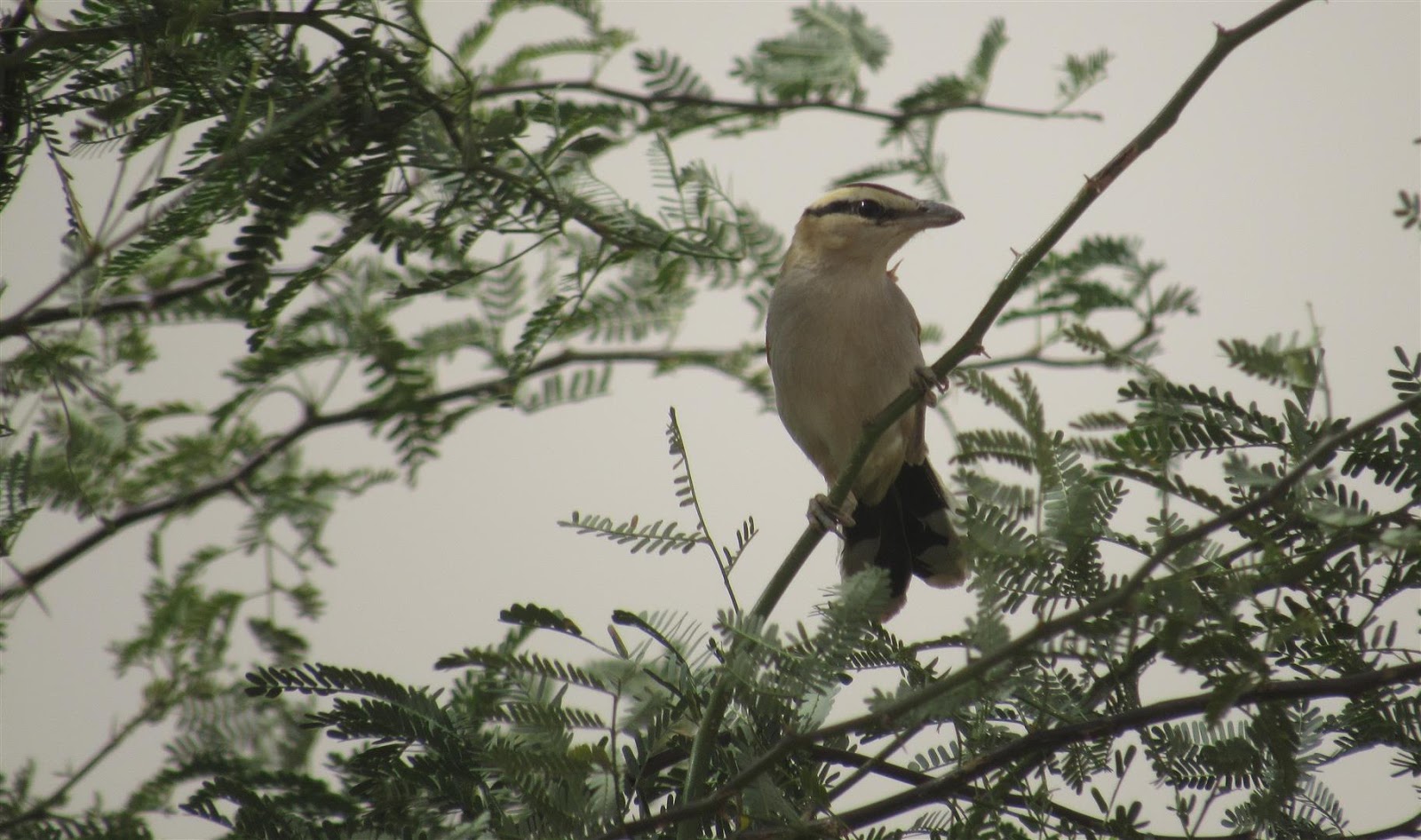
Interesting birds included black-crowned tchagra.

black-crowned tchagra

We got close and prolonged views of a group of cricket longtail.

cricket longtail 1

This was effectively the last bird we sighted on an eventful long weekend south. I ended up with a Mauritanian list twelve higher at 292. The so called "line of shame" of 300 species (as invented in the UAE as the name of a target which proves one has extensively birded a Middle Eastern North African country) is within my grasp.

cricket longtail 2

I got even closer to the line of shame in Nouakchott last weekend. For the first time in months I added two birds to my country list in the city. I will blog about that next.

Monday, 8 January 2018

Day two around Diawling

New Year's Eve was a big day in my birding achievements in Mauritania. I had six addtions to my country list the day before and was thinking that there was little that could be added on the second day in Diawling National Park.

I was very wrong. Mohamed Vall and I saw 114 species that day. Furthermore, five were additions to my country list taking it up to 291.

Things started quite slowly. We elected to bird straight out of the lodge in the morning and that took us into woodland.

African wattled lapwing

An early bird was African wattled lapwing. It wasn't new for me but it was for Mohamed. It was barely light so views weren't the best.

zebra waxbill

Also in the early light, a flock of zebra waxbill were observed.

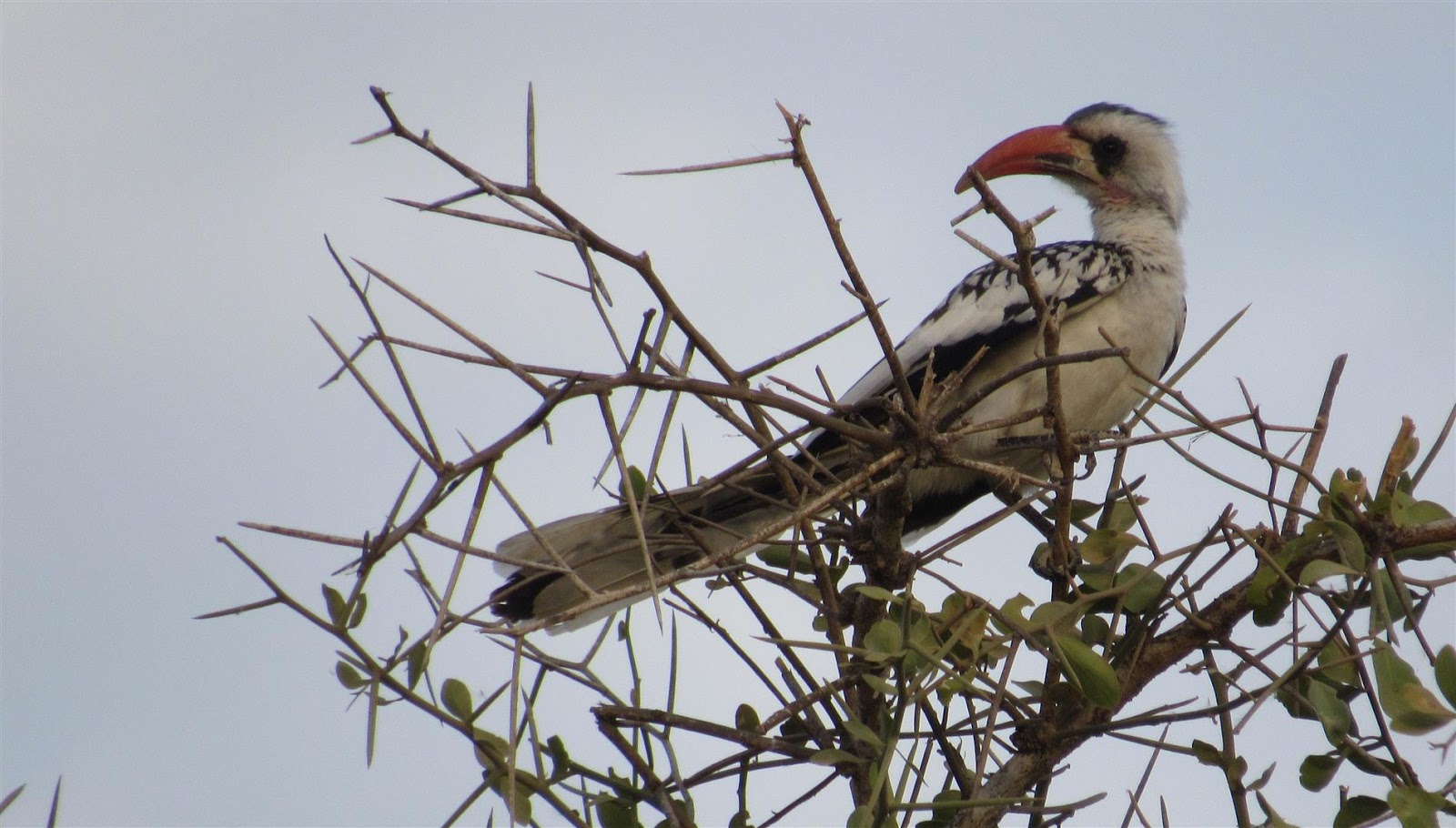
Western red-billed hornbill

Western red-billed hornbill were noisy a long time before the first one was seen.

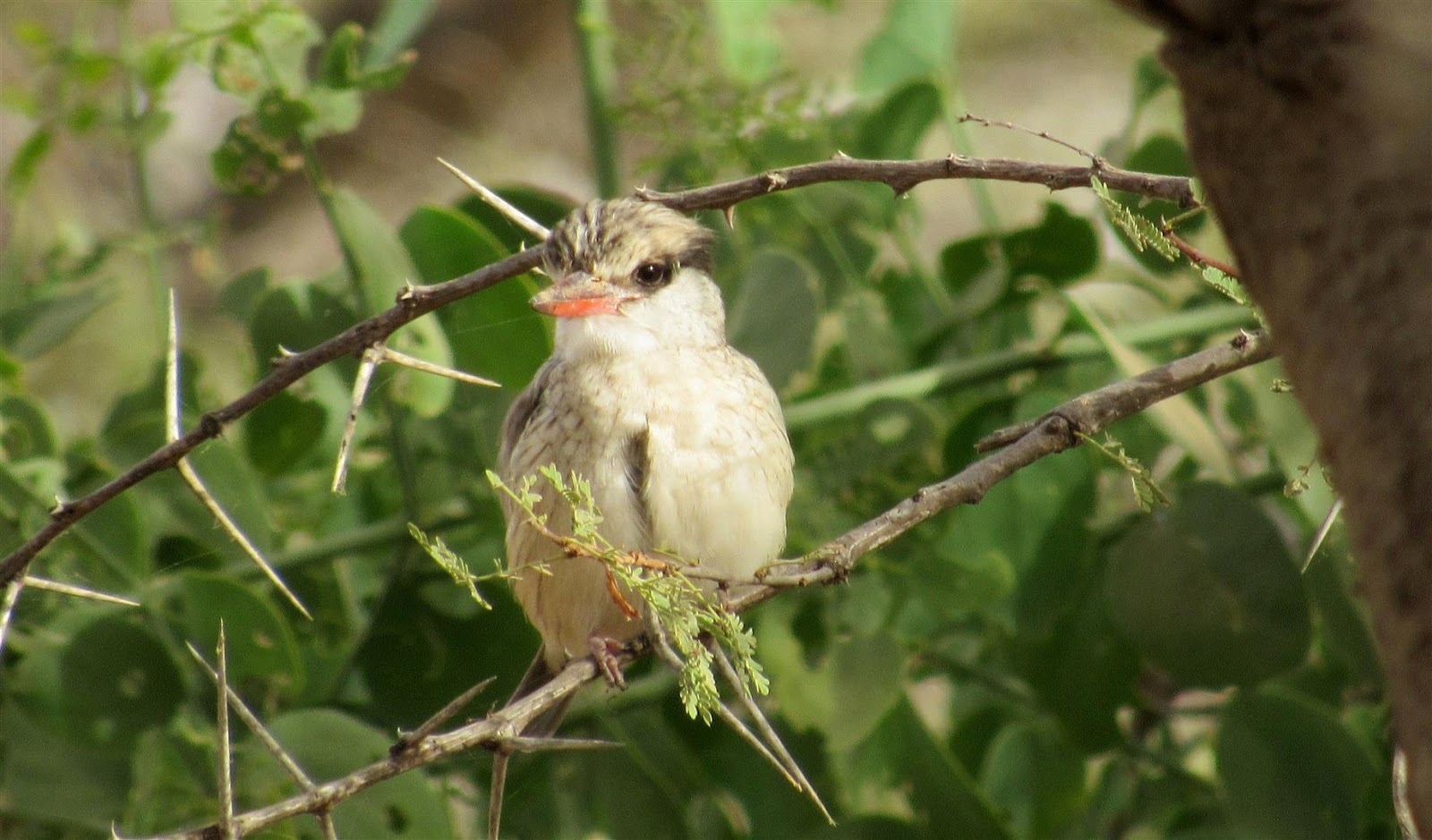
striped kingfisher

Striped kingfisher proved every bit as common as our fast encounter with two the evening before had suggested.


goat up a tree

As a diversion from birding for a couple of minutes, we were amused by a goat eating from the top of a tree.


black-billed wood dove

Black-billed wood dove is only found in the very south of the country and then only in fairly densely wooded areas. However, it quite common in one patch of the woodland walk.

Once again, I failed to find a village weaver among the various weavers in the woodland.

After more than half the morning in the woodland near the lodge, we ventured westwards towards the sea on foot. The terrain soon turned into salty semi-desert. Our best bird out of the very few there was a cream-coloured courser.

Retruning to the lodge and then into the car we drove south west towards the border crossing with Senegal at Diama. We didn't get very far before deciding to bird one or two spots just off the road.

northern ant-eater chat

New birds for the day came thick and fast. They included northern ant-eater chat and little bee-eater.

little bee-eater
I also spotted a wryneck.

In another place further down the road, we accidentally flushed three Long-tailed nightjar.

Long-tailed nightjar

You can't really go out looking for nightjars in daylight so this was a lucky find. It was also the first of five new birds on my Mauritanian list that day.

Thanks are due to Fretback in near-by Senegal for alerting me to my original but wrong identification as Eurasian nightjar. In my defence the distribution map in the first edition of Birds of Western Africa shows Eurasian nightjar as an isolated northern place for wintering Eurasian nightjar while long-tailed nightjar all move well south. It appears that both pieces of information are untrue. Some long-tailed nightjar stay in the Senegal River Delta area while all Eurasian nightjar are well south in winter. The moral is to identify first and trust judgement against maps.

As Fretback also pointed out this bird was resting on the ground which Eurasian nightjar seldom do.

We arrived at Lake Biretta. This is the last lake before the border bridge over the Senegal River at Diama.

some white-faced whistling duck

The best sighting here was over 500 white-faced whistling duck on the lakeside. We were hampered from birding an attractive looking grass field by surrounding marsh. I still wonder what birds that different habitat might have held.

After a quick lunch, we made a decision to go back east to Bell Basin, which we had visited the day before with Abdullah. It turned out to have been the right decision. 

African skimmer with Caspian tern

New birds came quickly once again. Looking way out into some of the open water, we spotted three African skimmer on a small sandbank.

African pygmy goose

In water between the two fishing hamlets, we found a small group of African pygmy goose

At the second hamlet we finally made a positive identification of a yellow-billed stork though we failed to get a photo. The stork, goose and skimmer were all new to my country list.

African stonechat

We headed north east towards the grassland areas we had briefly noticed the day before. African stonechat was once again common in the tamarisk we passed.

Warthogs are a frequent sighting in the park but most don't hold their ground on the road like this brave one. It waited for its partner who got separated from it when we drove by.

warthog

I wish we had had time to search the grassland more thoroughly. However, time was not on our side.

black crowned crane

Nevertheless two black crowned crane were too obvious to miss despite the distance between us and the crown acting as clever camouflage. This was the final addition to the list of the day.

It was not the end of the birding though as we turned off west towards the village of la dune de Ziré.

A yellow-billed stork provided the picture of the species we failed to get earlier.

yellow-billed stork

The scattered woodland in the dunes gave us the only blue-eared glossy starling and green-backed camaroptera of the trip within Diawling.

green-backed camaroptera

Turning back from the village towards the lodge, it was a race to get as far as possible before nightfall.

adult African fish eagle

We stopped just once to get good views of an adult African fish eagle.

It had been a very successful day. The next day, New Year's Day was not an anti-climax. I will blog about that next.


Sunday, 7 January 2018

Day one on Diawling trip

During the long weekend over New Year, I went birding with Mohamed Vall to the south of the country.

The centre piece of the trip was a two-night stay in Diawling National Park. It was my first visit there. 

The whole journey was a total success. Over 135 species were seen including more than 125 in the park. Twelve species were added to my Mauritanian list increasing it from 280 to 292 using the ebird-Clements count.

We started out at dawn on Saturday 30th December.

We had an early and unexpected result. Barely 90 kilometres out of Nouakchott and near the side of the road was a barbary falcon.

barbary falcon 1

It is relatively rare in Mauritania though breeding has been reported sporadically in parts of Banc d'Arguin to the north as reported in The Birds of Banc d'Arguin. The Atlas of Muaritanian birds has it more widespread. Both sources are in stark contrast with The guidebook "Birds of Western Africa" which shows just three records in country. Though two of these records are very close to where this bird was seen. It was, of course, an addition to my country list.

barbary falcon 2

At the 130 kilometre mark, we halted the car a second time for a second bird of prey.

dark chanting goshawk

It was a dark chanting goshawk. Indeed it is one of the furthest north records of this bird in Mauritania. These were two good birds and we hadn't even started birding yet.

Our first birding stop was short and it was at Kaur Macene.


african jacana

For someone new to Mauritania it could be seen as a good place but for Mohamed Vall and it was only so-so this time round. It is the first large fresh water in the south nearest to Nouakchott. It has plenty of species but we had expected a wintering duck population. For some reason there were none.

I suspect the water body has competition from near-by Diawling and Chott Boul.

Of course, there were plenty of other water birds including African jacana.


dark morph western reef heron

Despite its name western reef heron can be found inland.  Here there were a few.

squacco heron 

Squacco heron winters in very large numbers in the south west corner of Mauritania. It was certainly very common in Kaur Macene.

Hamerkop

In constrast, we only observed one hamerkop

yellow-billed kite

Yellow-billed kite are semi-migratory in Mauritania, they receed south with the water and that recession continues way past December. Nevertheless at this time of year, there were plenty at Kaur Macene.

blue-cheeked bee-eater

The book "Birds of Western Africa" says blue-cheeked bee-eater are resident in Mauritania. I have been saying on this blog that they all migrate by early December and come back in July. We are both wrong. They are definitely migratory in Nouakchott and all the way down south to Kaur Macene but from then on in the south west, we kept seeing them. I may still be right about the central south and south east though as trips there in late winter did show any.


African mourning dove

African mourning dove is the dominant dove of the wetter parts of south west Mauritania. 

The road from Kaur Macene to Diawling is not good. We travelled slowly and were birding as we moved. We noticed that yellow-billed kite were soon replaced by marsh harrier as the default medium sized bird of prey.

osprey

We picked up an osprey.

We arrived at the eco-lodge at Diawling at around 1.30 pm where we met up with a ranger called Abdullah who is a mutual friend of Mohamed Vall. The cooking of a late lunch was arranged for 4pm so we went out birding straightaway.

We headed back the way we came but slowly. The main area of birding that afternoon is known as Bassin Bell (or Bell Basin in English).

greater flamingo

One of our target birds was lesser flamingo. However, at first, at least only greater flamingo were seen.

Egyptian goose and Spur winged goose

It is immediately apparent that Diawling at this time of year has great diversity of water birds. Spur-winged goose and Egyptian goose were observed as we drove by.

black-headed gull and grey-hooded gull

There are two very small fishing hamlets where local people bring the catch in to dry. These are a magnet for very many birds. A mixed group of black-headed gull and grey hooded gull was seen at the first hamlet. I will write more about what can be seen at these hamlets in this blog and the next. They are important places.

After the hamlets there are expanses of open water at the moment. They mostly dry up by spring. However, they held thousands of ducks last weekend.

common shelduck with a shoveller

Eight common shelduck were observed. This is a major rarity in Mauritania but it appears there has been an irruption of them in West Africa this winter. Two have been observed as far south as Dakar.

hundreds of garganey

The diversity of ducks wasn't high despite the large numbers. The vast majority were northern shoveller and especially garganey.

Despite careful scrutiny, I couldn't find a single teal with garganey.

In another stretch of open water, Abdullah pointed out some distance flamingos. They turned out to be lesser flamingo. Along with the common shelduck, this was another addition to my country list.

distant lesser flamingo

Closer to the shore were twenty or so pied avocet.

pied avocet

Going eastward from Bell Basin, open water gives way more to marshland and some grassland. 

marsh harrier

Marsh land here meant several marsh harrier.

African darter

On a pile of deadwood in one of the marshes, several African darter came and went. African darter was also new for me in Mauritania. This period of the session was a purple patch of birding.

black heron

Eventually we turned round and headed back towards the eco-lodge. We made a short stop at one of the hamlets to admire the large number of black heron. We thought we had seen a yellow-billed stork flying above there but didn't get a good enough view to be sure. These hamlets are apparently good places to see giant kingfisher but we didn't get any joy with this one.

Nile crocodile at Diawling

Abdullah pointed out a Nile Crocodile on the edge of the water on the way back. We kept a safe distance and it vindicated my earlier birding when I had been avoiding the water's edge throughout.

African stonechat

African stonechat is common especially in tamerisk along the road. This was another addition to the country list. It had been a very productive session.

We arrived back at the lodge a little after four p.m to find our pre-ordered late lunch waiting for us. The cooking and the service at the lodge was seriously good.

common bulbul

After eating and a shower we had about one hour's day light. We elected to bird in the woodland around the lodge. A family of common bulbul were right outside our chalet and two striped kingfisher were in the nearest large tree.

female Senegal batis (photo: Mohamed Vall)

Arguably the best bird in this short walk near the lodge was a Senegal Batis.

little weaver

There were weavers around but none of the elusive village weaver which has evaded me in Mauritania so far. It is only found in the far south. Among the weavers we did see and which were identified was little weaver. Note the small size and the greenish hues to the crown and back.

The Saturday had given me six additions to my country list. I would have settled for one more on the Sunday. Instead there were five. I will blog about that next.