Wednesday, 19 March 2014

Further up the wadi, Muhayil

On Saturday, I decided to walk out of the hotel  and bird while in Muhayil in South West Saudi Arabia. However this time I chose to walk much further north and up the main town wadi. I walked more than 3 kilometres further north than on previous visits. 

For the most part, the birding was very enjoyable except when I nearly got ravaged by a pack of stray dogs which was very frightening and also when the temperatures got too hot after midday.

Dusky turtle dove with a Ruepell's weaver


Like in the more central parts of the wadi, there were hundreds of doves, mostly African collared dove and laughing dove as well as a few feral pigeons. The big surprise was the sighting of  three dusky turtle dove. This is normally found above 1000 metres but the main guide does say some move lower in winter. This location was at 650 metres.

African collared dove

The Nile Valley sunbird seen elsewhere in the wadi were supplemented by shining sunbird here.


chiffchaff

I decided to spend considerable time within the thickets looking for my main nemesis bird: black crowned tchagra.Once again I failed to see this elusive species. Instead I discovered that the more shaded thickets contained warblers I had failed to see any where else on the trip. 

There were a few chiffchaff.

Blackcap

However the most common warbler was lesser whitethroat. A single female blackcap was also seen with one small lesser whitethroat group.

Lesser whitethroat

Other western palearctic birds were present too. A female Siberian stonechat was found in an small arable field.

Siberian stonechat

Later on, three passage tawny pipit were observed on scrubby land.

Tawny pipit

No less than five masked shrike were seen along with one Daurian shrike.

Daurian shrike

Once again the wadi held both white wagtail and grey wagtail. The latter is more surprising as I didn't see any running water.


grey wagtail

As said  in a previous blog, little green bee-eater isn't very common.

little green bee-eater

In the air, the two birds of prey this time were long legged buzzard and yellow billed kite.

long legged buzzard

Also in the air were many little swift which are probably resident as well as a few passage red-rumped swallow and alpine swift (which are either summer visitors or resident).
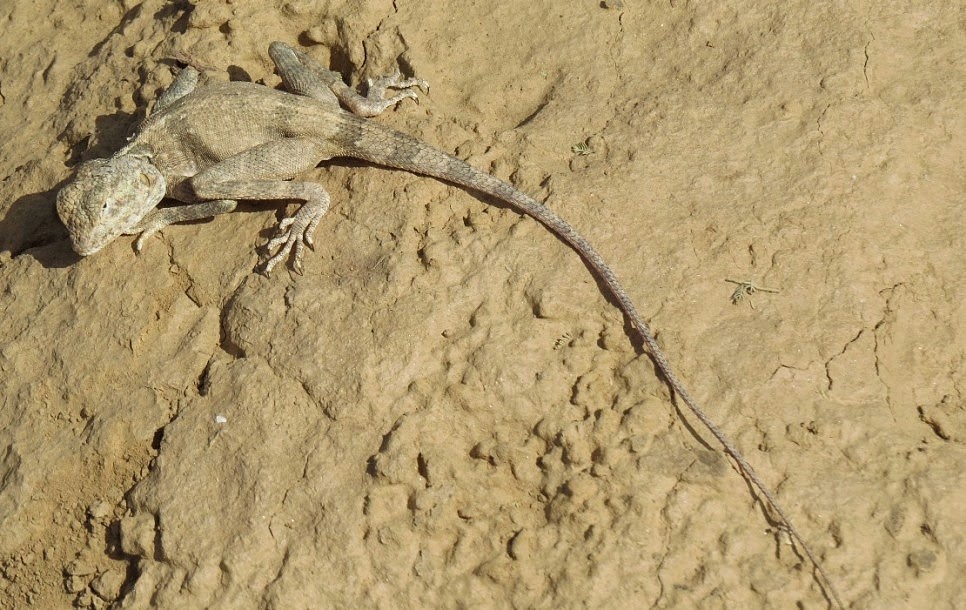
lizard in Wadi Muhayil

I feel I am only scratching the surface at finding good birding places in the Muhayil area. I will keep widening my search every time I visit.


Tuesday, 18 March 2014

Al Birk

On Friday, Shane Nghere and I made the journey from Muhayil to Al Birk on the Red Sea coast thanks to some of his students who acted as guides.

The road is subject to major works so the journey was slow. The birding on the way was mostly uneventful apart from where we saw 5 eagles eating a carcass. Unfortunately we notice them late. We stopped late and too close to them so they flew off. Nevertheless I am quite confident they were a mix of tawny eagle, steppe eagle and one booted eagle.

This area is within the know residential range of tawny eagle and I regret missing the chance to see them up close. 

Pink backed pelican

This was my first time at Al Birk and its quite a remarkable place. There are the most extensive mangroves in the whole of Saudi Arabia. 

Not knowing how to tackle the terrain we started at the southern end of the mangroves and moved north. Views were not always good and the tide was out. 

Despite these hardships, we saw a good selection of birds. Pink backed pelican were glimpsed from time to time. Both grey heron and purple heron were easily seen though sadly goliath heron was not. 

Goliath heron is a known resident here. 

grey heron

Waders were plentiful. Whimbrel was abundant in front of the mangroves on the landward side but most waders were seen either in the mangroves or in gaps in the mangroves next to the sea.  In the mangroves themselves mangrove reed warbler was spotted on more than one occasion. It was heard almost continually.

common redshank

Common redshank was arguably the commonest wader.

green sandpiper with a common redshank

A Green sandpiper group was seen resting. Some of the birds were asleep. 

Terek sandpiper

One Terek sandpiper was observed. This bird is easy to pick out from a group of mixed waders.

curlew sandpiper

Other noticeable waders included a flock of five curlew sandpiper. Some were just starting to produce their purple bellies.

lesser sand plover

Ringed plover, Kentish plover and lesser sand plover were all observed but no greater sand plover were seen. 

grey plover

Grey plover was the other plover in the area.

sooty gull

Unlike during my Yanbu visit (much further north on the Red Sea coast) three weeks before, only one large white headed gull was spotted all day. This was probably a Caspian gull. In contrast, many tens of sooty gull were present. They proved very tame and were coming very close to people picnicking in the beach areas.

lesser crested tern

Surprisingly only one tern was seen and it proved to be a lesser crested tern.

osprey

Three osprey were seen as a single and later a pair. 

hoopoe lark

Once again on the red sea coast I observed hoopoe lark very close to the sea in saline scrub. We saw the well-known courtship diving flight on three occasions.

Singles of three different wheatears were also observed: black-eared wheatear, northern wheatear and desert wheatear.

hamerkop

While the eagles mentioned earlier were the highlight of the travel to and from Al Birk there were some other interesting observations.

Among them, on the way out, was a hamerkop sighting where the road crossed a stream at Wadi Tadba.

brown necked raven

Much later near the place the eagles were seen were brown necked raven and a long legged buzzard.

long legged buzzard

On the way back just before dusk, we came across four Bruce's green pigeon perched on a wire.

Bruce's green pigeon

The regional guide says it is chiefly found from 500 to 2400 metres but we were at 300 metres. Furthermore I have never seen them on wires before but usually deep in trees.

The guide does say they are partial migrants and this location and behaviour is consistent with that. I suspect these were summer returners from Africa. 

An interesting end to a very full day.

Monday, 17 March 2014

Wadi Muhayil revisited

I visited my good friend Shane Nghere in Muhayil, south west Saudi Arabia last weekend. 

On Friday we travelled with some locals to Al Birk on the Red Sea coast. However before we set off, I had time to bird Wadi Muhayil near the hotel.

This was the second time I had done this. The last time was two months before. 

booted eagle

The birding was a bit rushed but worthwhile nevertheless.  

Early on, three birds of prey were flushed from their roosts on tree tops. Two were booted eagle and one was a yellow billed kite. The eagle is on passage and the kite is resident.  Each time I visit this valley there is a good and varied selection of birds of prey.


yellow billed kite

There were clear signs that this is the breeding season for several birds.  Ruepells weaver was busily building nests.

Incidentally the breeding season for Ruepells weaver is dependent on altitude. The ones in Abha, 1500 metres and more higher isn't for another two months.


male Ruepells weaver

This male weaver had clearly attracted a mate.

female Ruepells weaver

The Nile valley sunbird were in breeding plumage though I saw no nests.

male Nile valley sunbird

I am not sure whether the bird below is a female or juvenile. The bill is particularly short making me think in terms of a juvenile.

female or juvenile Nile valley sunbird

African silverbill were still roaming in flocks suggesting it isn't breeding at the moment. 

African silverbill

The density of Arabian babbler here is very high.

Arabian babbler

In contrast  little green bee-eater were n't common.

little green bee-eater

African collared dove were very numerous. They are almost certainly here all year round and probably re-enforced in the cooler months by ones who come down from the mountainous Abha and Baha areas.

Laughing dove and Namaqua dove are common too.

Namaqua dove

I saw masked shrike on my last visit and saw three in this part of the valley this time. It's a fairly common wintering bird in the south west but these could also be passage birds.

Masked shrike

The same goes with Daurian shrike.

Daurian shrike

grey wagtail

At a small artificial pool both a grey wagtail and white wagtail were observed.

Isabelline wheatear

A single Isabelline wheatear was the only wheatear seen.

male Violet backed starling

Violet backed starling is a summer visitor to the mountains and foothills which winters in Africa.  A pair was seen in the wadi on the same tree. It is one of several "intra-African migrants" which breed in south west Saudi Arabia.  

female violet backed starling

These "intra-African migrants" form a large number of my remaining target birds in the country. 

 Birds seen in Wadi Muhayil on Friday morning

Helmeted guinea fowl
Arabian babbler
Yellow billed kite
White spectacled bulbul
Booted eagle
Pale crag martin
Rock pigeon
Graceful prinia
African collared dove
Violet backed starling
Laughing dove
Black bush robin
Namaqua dove
Nile valley sunbird
White browed coucal
House sparrow
Little swift
Ruepells weaver
Hoopoe
African silverbill
Little green bee-eater
Grey wagtail
Masked shrike
White wagtail
Daurian shrike


Wednesday, 12 March 2014

The last days of the farm

The university farm on my walk to work is being relocated. Unfortunately the new farm will not be a walk away from me.

I had some excellent birding last spring and autumn there so I have been very sad seeing it dismantled.

However for the past three evenings I have visited the 15% of the farm which still remains to see if there is any useful birding left.

first wryneck

On Monday, I came upon two passage birds almost straight away. This site has always been good for wryneck and sure enough I spied one on one of the remaining trees. 

second wryneck

A few minutes later after I had moved over to an corner of the remaining farm I came across another wryneck

first wryneck revisited

Just to make sure it was a different wryneck, I quickly doubled back to the original area and soon located the original wryneck on an adjacent tree making sure there were at least two wryneck present.

farm clearance

On Tuesday evening, I didn't spot either nor any other passage bird.

common redstart

This evening I was a little luckier. A common redstart was easily seen. Sadly I also saw that another part of the farm had been cleared and a lot of house sparrow were looking lost.

second view of common redstart

The resident birds seem to be employing different coping strategies. The crested lark and black bush robin have moved off all together.

Indian silverbill

The Indian silverbill seem to have dispersed into the surrounding area.

white eared bulbul and white spectacled bulbul

The white eared bulbul and white spectacled bulbul were seen fighting over the remaining trees.

common myna

The common myna don't seem affected yet.

little green bee-eater

 The little green bee-eater have become commuters. They roost away in a less disturbed area but are drawn back by the bee-hives that still remain.

Eurasian collared dove 

Collared dove numbers haven't changed yet and two rose-ringed parakeet paid a visit on Monday.

I will continue to visit the farm until the garden area goes. It could be a month. It could be tomorrow.