Showing posts with label Asian koel. Show all posts

Thursday, 10 December 2015

Indo-Malay and other birds on Masirah

Last Thursday was my first full day on Masriah island and I spent all of it in or around the sewage works at Hilf. I did however take an early afternoon break.

It started well with the sighting of two Asian koel before 7am. Hilf sewage works is the best place in Oman to see these birds in winter. This Indo-Malay species is rare elsewhere in Oman.

an Asian koel

At first I thought I was looking at just one bird as it was more exposed. The second bird was a little below it. The first bird appears to be an immature one while the lower bird looks female.

two Asian koel

The female is more uniformly dark (with spots).

One koel flying over another

For on moment the birds almost touched as one flew in front of the other.

common moorhen

On arrival at the set of man-made pools, I visited the back one on the coastal side as it has the most cover and shade. I had thought it might be best for any truly shy birds. My only rewards was a group of moorhen keeping to the sides.

teal

Ducks in the back pool were pintail, shoveller and teal.

black-necked grebe

I saw no little grebe while at Hilf but instead there was a much less common black-necked grebe. Not so many make it all the way down to Oman in winter.

mallard (left)

Thursday morning was the only time I saw a duck which wasn't teal, shoveller, pintail or garganey. There was a mallard drake in one of the largest pools.

chestnut-bellied sandgrouse

After an hour and a half or so checking the pools, I decided to visit the forested area for the first time.

As I started to walk round, a small flock of chestnut-bellied sandgrouse flew over. I don't know whether they had found a quiet corner of the site to drink or whether they were coming from elsewhere.

Moments later I had the first of many encounters with a marsh harrier.

marsh harrier

The woods are magical. On an island with so little greenery, this heavily shaded mixed woodland is special and many special birds have been reported over time. For example it has seen the more reports of olive-backed pipit than anywhere else in the country.

the woods at Hilf

I didn't see any but I did see and I looked hard and long. There were however several warblers. Most were Siberian chiffchaff but there was also a Menetries's warbler and a Clamorous reed warbler. Both alerted me to where they were by their distinctive calls.

red-breasted flycatcher

A little further in than the Menetries's warbler and Clamorous reed warbler was a red-breasted flycatcher.

red-breasted flycatcher 2

This bird was seen in several places during my look around the woods but seemed to be in a distinct "territory" with quasi boundaries.

Deeper in the woods, I almost walked into an adult male Asian koel. This was the third koel of the day.


laughing dove

Laughing dove were arguably the most numerous bird on the site both in the woods and near the pools.

male marsh harrier

A male marsh harrier became the second marsh harrier sighting of the day.


white wagtail
After a very long time in the woods I returned to the pool area. I was still looking out for olive-backed pipit but only came across the very distantly related white wagtail.

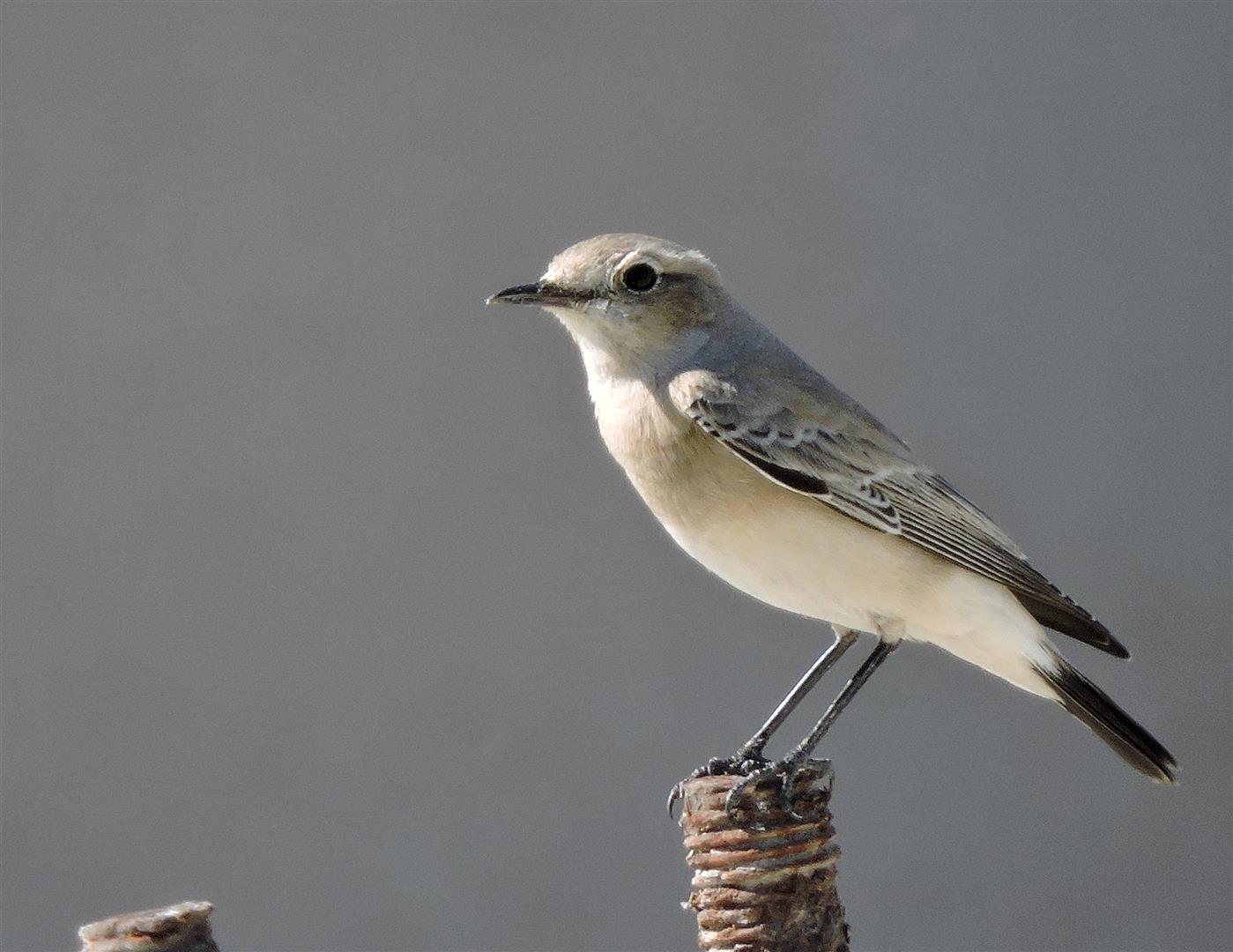
desert wheatear

A desert wheatear was present near-by.

purple heron

While grey heron were more numerous, a young purple heron was regularly seen on the inland side of the site.

oystercatcher

Outside the works there is short a run off stream which empties out into the sea 50 metres away.  It is worth looking there for waders. This time oystercatcher was the most interesting and two grey plover were also observed.


grey plover

After the look at the coast, I retired for a mid-afternoon break.

Indian pond heron

As well as the Asian koel another sign of the Indo-Malay influence here was the presence of more Indian pond heron than squacco heron.

blue-cheeked bee-eater 1

A late blue-cheeked bee-eater arrived. Small numbers migrate as late as mid December. 

blue-cheeked bee-eater 2

Even during the day the bird cast could change. There were no glossy ibis in the morning.

glossy ibis

By 3pm a couple of swallows had arrived and were hawking for insects over the water. I knew they weren't barn swallow almost immediately. They were faster and more direct. It was also possible to see in flight that they had light throats.

two wire tailed swallow

They were two wire-tailed swallow. These made four wire-tailed swallow sightings for me in under a week. These Indo-Malay species are still officially vagrants in Oman though this year they appear to be more frequent.

The next day, Friday, I saw three different officially vagrant species at Hilf. It was quite a special day for me. I will write about this next.


Species at the sewage works on December 3rd

Mallard 1
Northern Shoveller 10
Northern Pintail 8
Garganey 8
Eurasian Teal 3

Black-necked Grebe 1
Greater Flamingo 5
Western Reef-Heron 2
Cattle Egret 5
Squacco Heron 1
Indian Pond-Heron  3
Glossy Ibis 4
Egyptian Vulture 4
Eurasian Marsh-Harrier 2
Common Moorhen 5
Eurasian Coot 1
Red-wattled Lapwing 1
Common Sandpiper 4
Green Sandpiper 1
Wood Sandpiper 8
Little Stint 3
Common Snipe 2
Slender-billed Gull 4
Black-headed Gull 5
Whiskered Tern 6
Chestnut-bellied Sandgrouse 15
Laughing Dove 30
Asian Koel 3   
Eurasian Hoopoe 1
Blue-cheeked Bee-eater 1
Brown-necked Raven 2
Crested Lark 4
Wire Tailed Swallow 2
Common Chiffchaff 5
Clamorous Reed-Warbler 1
Menetries's Warbler 1
Red-breasted Flycatcher 1
Desert Wheatear 3
Isabelline Wheatear 1
White Wagtail 4

Thursday, 12 March 2015

Early March in Salalah

During the two mid-weeks either side of last weekend's long desert trip, I have birded very close to the city of Salalah.

Indeed I have only been to three sites because of work pressure. These were Raysut cliffs (twice), Jarziz farm (twice) and Ayn Hamran (three times).

The visit to Raysut cliffs was solely to look for one bird: red-billed tropicbird.

It comes to the shore in March and April to breed. This is exactly the same time as is recorded for the Farasan Islands in Saudi Arabia and earlier than previously published for Oman.

Another birder recorded seeing 10 in the area a week ago. 

Having said that I went out on Sunday evening and saw none. Indeed there were only sooty gull, Hueglin's gull on the sea, Tristram's starting on the cliffs and common sandpiper, Abyssinian white eye, Ruepell's weaver and Indian house crow in a cove.

Not to be deterred, I returned in an earlier part of the afternoon and three days later to the same spots to look again.

red-billed tropicbird 

This time I counted 23. They were spread out all the way from the lighthouse to the quarry either side of the Oasis Club looking out to sea.

another red-billed tropicbird

This was bird 260 on my Oman list and a lifer.

I will be back again in the next two months to get better pictures.

The visits to Ayn Hamran have not yet provided any new passage species but birding has been interesting as always there.

masked shrike

The male masked shrike that has been present all winter is still there.

second view of masked shrike

I have spent a lot of time looking for passage warblers with limited success though it is still early.

Arabian warbler

In an area which Arabian warbler like, I have come across a lesser whitethroat and a common whitethroat.


second view of Arabian warbler

The former bird winters in small numbers in Dhofar so the common whitethroat has a higher probability of being on passage.

Asian koel

I have seen a second Asian koel there. This bird was very shy and lighting wasn't very good. Nevertheless I can make out it is an immature male with incomplete dark blue plumage and a bill which is only just starting to turn yellow.

close up of head of Asian koel

Otherwise the birds at Ayn Hamran were the same mostly residents with a few winterers such as a an ever-present greenshank hanging on.

blackstart

These residents include a large number of blackstart and cinnamon-breasted bunting. Although I need to check each bunting so as not to miss the few ortolan bunting which fly through the area.

cinnamon-breasted bunting

My third venue has been Jarziz farm within the city. This is another prospect for ortolan bunting.

I confirmed my suspicions that the small heron which has been sitting next to the holding tank on every visit is indeed an Indian pond heron.

Indian pond heron

Otherwise much of my time has been spent at the very large pivot field. So far migrants have been restricted to northern wheatear (seemingly already all gone through), yellow wagtail and barn swallow in large numbers. Though the common quail I keep flushing may be migrants too and the Richard's pipit and tawny pipit could be either winterers or on passage.

barn swallow

The barn swallow were closely inspected as red-rumped swallow is still a target for me in Oman. I am confident I didn't miss any this time.

second barn swallow

Also in the field on all visits so far have been chestnut-bellied sandgrouse and singing bush lark.

rosy starling

On my last visit I stayed until close to dusk and as it got close 50 or so rosy starling arrived. This was a good view as I approached the car to leave.

Wednesday, 25 February 2015

Asian koel at Ayn Hamran

A late afternoon trip yesterday to Ayn Hamran turned out to be very successful despite the wind and dust.

In the middle section of the Ayn I came across a male Asian Koel. It was not only new to my Oman list making species 255 but also a lifer.

male Asian Koel

The bird is apparently rare but possible all over Oman in winter. However, there a concentration on Masirah island. I presume this particular bird is passing through as it hasn't been seen at Ayn Hamran before.

close-up of Asian Koel

Elsewhere at Ayn Hamran, most of the regular wintering birds were still there including a greenshank and a grey wagtail which have been present since November.

male masked shrike

The male masked shrike has been an ever-present bird too. It is looking particularly fine in its spring plumage.

second view of masked shrike

Furthermore, the song thrush was still around too though it has moved away from the largest shaded area. This is probably because it is very popular with picnickers and can be quite disturbed even at night.

song thrush

There is another Turkestan shrike there at the moment which I believe is different from the last one I observed. Nevertheless I struggled with this bird to find 6 primary tips recalling that a brown shrike has 4 or 5.

Turkestan shrike

Despite the count of primary tips, it doesn't look short winged and must be a Turkestan shrike.

back of the shrike

Many of the usual resident birds were seen including Arabian warbler, Abyssinian white-eye and plenty of African paradise flycatcher.

long-billed pipit

Long-billed pipit is a less regular visitor to the public areas of the Ayn. 

At night, fruit bats are seen in large numbers. However I observed one for the first time in daylight.

Egyptian fruit bat

I presume they roost far away from the centre of the Ayn but this one was hanging right in the middle. 


back of an Egyptian fruit bat

The Asian koel and the bat made the visit quite special.