Showing posts with label Caspian tern. Show all posts

Sunday, 18 January 2015

Terns on the beaches

Having now seen 246 species in Oman with all but 4 in the Dhofar area, I have not been expecting many new additions before the spring migration.

Indeed this has been the first full week with no additions and there will probably be plenty more.

I have decided to take a more relaxed approach to local birding for a month or so though some reported twitches might tempt me.

In the last week, I have spent a significant proportion of my birding time on beaches.

Caspian tern with one lesser crested tern

This blog looks at some of the terns I have seen on the beaches among the literally thousands of gulls.

On the beach at Khawr Soly were several Caspian tern (also seen at Taqah and East Khawr during the week).

lesser crested tern with one sandwich tern

Very close by was a group of lesser crested tern. Within that group was one sandwich tern. These two birds are very closely related and sandwich tern often associate with lesser crested tern if their own type are not around.

whiskered tern

There was a single small tern next to them but not associating with any of the other terns.


sideways look at whiskered tern

I couldn't identify this small tern immediately. The bill was too short and strong for a Saunders's tern or a little tern.

preening whiskered tern

I am not used to seeing whiskered tern or any other marsh tern on a beach but that is what it is.


Actually the beach at Khawr Soly is straight in front of the sand bar separating the freshwater lagoons and so the bird wasn't out of place.

sleeping whiskered tern

Caspian tern were also seen at East Khawr (Khawr Dahariz) as were gull-billed tern.

gull-billed tern

What surprised me was that one of the gull-billed tern was in breeding plumage already.

gull-billed tern in breeding plumage

Although this blog is primarily about terns, I got distracted for a short time by a bathing grey plover at East Khawr. 

bathing grey plover

I accidentally caught the moment when it raised its wings and showed its underwing black patch.

underwing of a grey plover

This is very useful to differentiate between juvenile golden plovers and grey plover in autumn when some of the former birds have very little golden sheen.

Saunders's tern

On Friday morning I visited Taqah beach and saw more terns. However my main motive to be there was to twitch the skimmers that have been seen twice along the front. Sadly, although I scanned over 2000 water birds, no skimmer was among them. I did see 12 Pallas's gull and other scarcer birds among about 1100 Hueglin's gull and 600 sooty gull.

During this scan I added Saunders's tern to the list of terns seen over the past few days.

The bill is thinner and longer than in a whiskered tern. The winter head pattern usually includes a small amount of black in front of eye too. The legs are often lighter as well.


three Saunders's tern

My regional guide says Saunders's tern can doubtfully be separated from little tern in winter. I am not sure that is true. In summer the white on the crown of a little tern reaches the back of the eye. If it doesn't manage that in winter when there is less black and even more white its not going to do it in summer. So I believe many winter Saunders's tern can be identified by the white not reaching the back of the eye. The problem is identifying little tern. Some winter Saunders's tern have white reaching the back of eye and all little tern.

If I have gauged this correctly all my birds are Saunders's tern with the possible exception of the one towards the bottom right in the first picture.

white winged lapwing

Once again I got distracted from my main tasks while birding. I found a single white-winged lapwing at Taqah. I suspect it may be the same bird I saw for a month or so at near-by Khawr Soly but whose chosen area has since dried up during the winter.


Thursday, 25 September 2014

Long-toed stint and more

I found time late yesterday afternoon to visit my local at East Khawr but taking in the near-by Dahariz Park for the first time.

This was a successful session with four new additions to my Oman list including a lifer.

Caspian tern

Even on arrival as I first scanned the birds at the seaward end of the Khawr, I immediately pick out some Caspian tern. This was new to the country list.

Caspian tern and others

Right in front of me while I was scaning more widely were four dunlin including a stocky-looking juvenile.

first year Dunlin

Meanwhile out near the Caspian tern were several great crested tern. Saunders's tern, white-cheeked tern and white-winged tern were also present elsewhere.

great crested tern

Just behind the Caspian tern my attention was drawn to a frenetic wader. 


marsh sandpiper turning

It was a marsh sandpiper which was eating vavaciously and turning often. It was clearly hungry. Either way it was another first for me in Oman.

marsh sandpiper

Further away from me a large group of glossy ibis and ruff were sharing some of the area with taller grass.

glossy ibis with ruff

There were a larger number of sooty gull at the khawr and off the beach than usual.

sooty gull

Seven Heuglin's gull were swimming in the khawr too.

garganey with wood sandpiper

There were plenty of Kentish plover, lesser sand plover, greater sand plover and common redshank. Smaller numbers of wood sandpiper, Temminck's stint, sanderling and greenshank were around too. Garganey duck number still seem to be rising and they are getting tamer.

Dahariz Park

After an hour or so I left form the near-by Dahariz Park which is less than 200 metres away and should have been visited before.

Rufous bush robin

It had an almost exactly the same cross section of bird species as the larger Salalah Park last weekend. One small difference is that there were no golden oriole but there was a Bruce's green pigeon.


Scaly-breasted munia

These parks are the only places I have seen scaly breasted munia. Hoopoe like the place too.

Hoopoe

Almost as an after-thought I decided to return to the khawr to see if anything had changed in the intervening 45 minutes.

It had. two whimbrel had turned up as had a fast walking wader which I didn't immediately recognise. I knew it was different though. 

 a wet long-toed stint

The bird was very wet initially. I assume it had taken a bath. It was now walking off the water and kept away from the water line all the time I tracked it. 


a dried out long-toed stint

With a long neck, upright stance and of course long toes on dull yellow legs, I worked out it was a long-toed stint. This apparently is quite scarce in the gulf even in Oman. It was certainly a lifer.

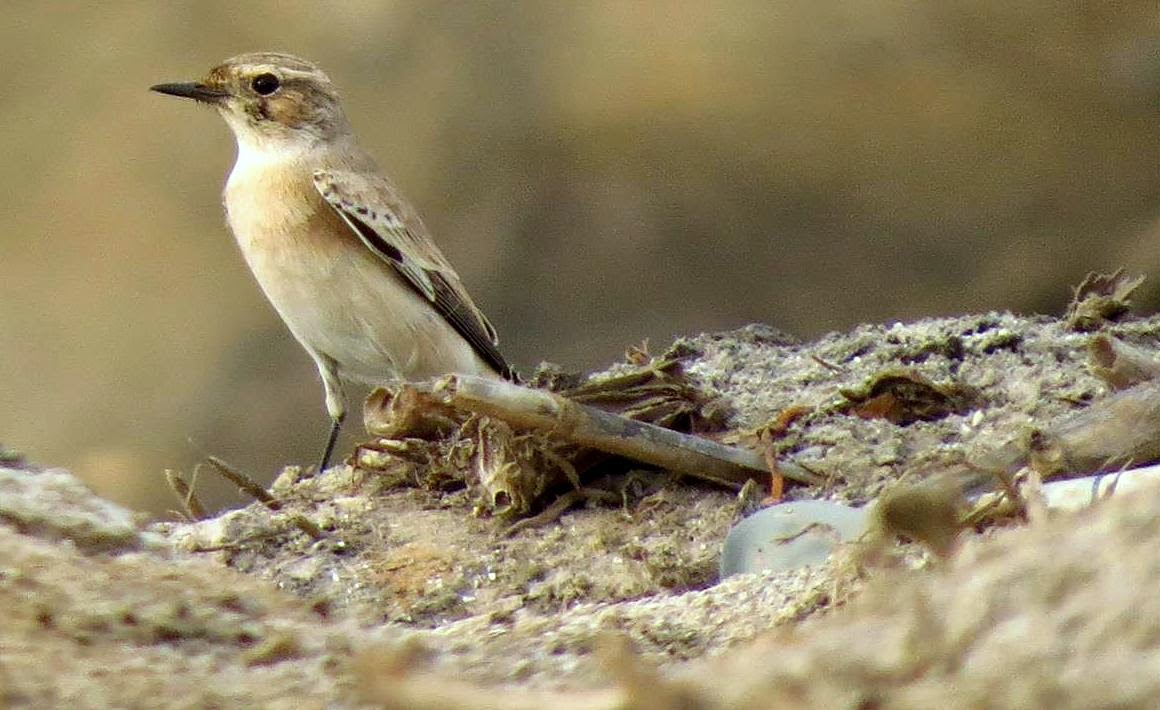
desert wheatear

To top the afternoon off, I came across a desert wheatear a few minutes later on the edge of the khawr. Excluding blackstart (which really is a wheatear), this was my first sighting of wheatear in Oman.

I was very pleased with yesterday afternoon.