Showing posts with label Pallas's gull. Show all posts

Saturday, 19 March 2016

Wintering birds still showing at Raysut

On Wednesday afternoon last week, I paid a call to Raysut visiting both the settling pools and the lagoons.

The overall theme was that important wintering birds were still around when I had been expecting more passage.

The highlight was three white-breasted waterhen up a bare tree just outside the perimeter fence at the settling pools. This equals the record number of this species seen in Oman.

I didn't even notice there were three until they moved. I had seen one towards the top of the tree. Whether it was me or something else that disturbed them, the bird I was watching flew off a short distance into a larger and more foliated tree. The surprise was that one more and then another followed it from lower down the original bare tree.

white-breasted waterhen

This species is known as a winter migrant however the bird I could see longest had the colouration in its bill, only seen in the breeding season.

steppe eagle

Most of the hundreds of wintering eagles around Raysut have one departed. However I easily found an Eastern Imperial eagle and two steppe eagle.

pheasant-tailed jacana

Earlier at the lagoons, pheasant-tailed jacana were present at the inland stretches. This bird is more numerous in winter but is known to occasionally opportunistically stay and breed. The longer they stay the more likely this is to happen.

Eurasian coot

The same goes for the less glamorous Eurasian coot though I only observed one at the lagoons on Wednesday.

common moorhen

In stark contrast its relative the common moorhen will breed in large numbers almost where ever there is water and some cover.

pheasant-tailed jacana (l) and pin-tailed snipe (r)

Of course not all wintering birds will consider the option of staying and breeding. The pin-tailed snipe above will surely leave soon.

grey heron

Grey heron is in another category, although it doesn't breed here a few of the non-breeding birds will over-summer. There are very large numbers at the lagoons currently. They will soon thin out.

marsh sandpiper

Other notable migrants at the lagoons included marsh sandpiper and garganey duck. Both winter here but there is noway of knowing if they are passage birds on their way through or those that wintered.

garganey

Pretty much all the ducks are in full breeding plumage now and the big majority are either shoveller or garganey.

osprey

Although this blog is mostly about wintering birds I can't ignore the osprey scattered all up and down the lagoons even though most other birds of prey have gone.

ruddy shelduck

Ruddy shelduck does not visit Dhofar every winter. However, this year originally six and now five have been faithful to the lagoons site for months. This wintering bird will soon be gone.

Pallas's gull

Yet another late leaver is a Pallas's gull seen there on the last two visits. It is seriously late. 

I suspect on my next visit to Raysut the bird cast will have changed quite radically as the winterers move on.

At the weekend I went into the desert again to try to catch part of the passage. I am very pleased with the results. I will use the next three blogs to explain what I saw.

Sunday, 13 March 2016

Whistle stops around Salalah

Two Saturdays ago, I birded for a second day with Jolynn Van Duffelen. We only had the morning so we made whistle stop tours to birding sites near the city (of Salalah).

We picked out some of Jolynn's target species.

Early on at Raysut lagoons, we were lucky enough to see a large group of white stork drop in before moving on presumably to the rubbish dump where they often stay the day in winter.

white stork 1

They didn't stay long and started to thin out after about 10 minutes.

white stork 2

If you look very closely at the above picture, they are ruddy shelduck on the far bank. They have been around all winter but they certainly don't visit this far south most winters.

Jolynn was interested in glossy ibis and they were readily seen at the lagoons.

Pallas's gull

A beautiful Pallas's gull in summer plumage stood out among the resting gulls and terns.

tufted duck and garganey

At the inland end of the lagoons, tufted duck were among the waterfowl. This species doesn't usually arrive until at least November and doesn't stay long either before heading north.

tufted duck

I suggested we head to Ayn Razat to find Bruce's green pigeon which Jolynn had not seen before. However on arrival we managed to find the masked shrike which has wintered there first. One wintered at Ayn Hamran the year before. The vast majority though are passage birds.

masked shrike

Bruce's green pigeon was soon picked out though they can be surprisingly well camouflaged despite their bright colours.

Bruce's green pigeon

Our last stop was the reed beds ar Khawr Rori to look for malachite kingfisher. That day the area was very disturbed by an unusual visit of a herd of cattle. They were eating through a huge amount of the reed. Cattle are rarely brought down from the mountains.

I believe this disturbance contributed to our inability to find a malachite kingfisher.

Khawr Rori reed bed

Three days later I went again, this time on my own. The place was quiet and the cattle had gone seemingly without any further inroads into the reeds.

As luck would have it I found not one but two malachite kingfisher seeing them both at the same moment. No one yet knows whether they are a pair.

Malachite kingfisher

I managed some video of one of them. Please note this video is best viewed without enlargement. The resolution is not meant for full screen.

I am sure Jolynn would have loved to have seen this bird but birding has no certainties! I believe she enjoyed the trip nonetheless.

Sunday, 14 February 2016

Coastal Raysut

Last Thursday afternoon, I visited Raysut again but not the most regular parts.  There are five or six distinct places to go to there all with a different cross section of birds.

This time I toured the fishing harbour and the rocky beach next to it.

I was still on the look at for a common gull which had been reported 10 days before but only seen by one observer.

The large majority of birds in the harbour were Heuglin's gull, Sooty gull and slender-billed gull.

Unfortunately for me there was once again no sign of a common gull.

First Pallas's gull

Nevertheless there were two Pallas's gull. I used to see this gull on passage in eastern province of Saudi Arabia. It is apparently quite common in northern Oman in winter.

Second Pallas's gull

Only a few make it down to Dhofar and that tends to be only in mid-December through to mid-February.

black-headed gull

Another minority gull in the harbour was black-headed gull in stark contrast to the numbers at the settling pools inland.

Terek sandpiper

One Terek sandpiper was also in the harbour and three more were seen on the rocky beach.

Terek sandpiper on the move

Whimbrel are regular here except in summer.

whimbrel


It's good place to have a chance of seeing a striated heron too.

striated heron

Furthermore, it by far the best place to see oystercatcher. There are so few other coasts with the right habitat in Dhofar.

oystercatcher

In winter there are usually a variety of terns. In contrast in summer there usually only resident great crested tern and over-summering sandwich tern.

Caspian tern

Caspian tern and gull-billed tern were also present this time.

On Friday I took a long day trip to Mazyunah with visiting birder Markus Craig. Mazyunah is on the border with Yemen and in the desert. It was my second trip there. I will blog about this next.

Tuesday, 5 January 2016

Raysut at New Year

From mid-morning onwards on New Year's Day I was in Raysut. I went to the settling pools first. My main idea there was to observe the hirundines for rarities of which there have been two different species recently.

I was not exclusive to this task however.

flamingo at Raysut settling pools

Before reaching the pool which is best for viewing hirundines, I had already noticed a larger number of greater spotted eagle on site than usual.

A group of greater flamingo waded through one of the pools.

tawny pipit

In the corner of the site a dark looking pipit was standing. Initially I thought it was too dark for a tawny pipit. However it cannot be a Richard's pipit despite it overall colour and stance.

The lores were dark not pale and a close view of the hind claw showed it was not long.

claws of the tawny pipit

I concluded that it must be a tawny pipit afterall.

barn swallow

On arrival at the pool which hirundines prefer, there were about 30 barn swallow.

They are most easily identified when they periodically come to rest on some part submerged dead bushes that are at the pool. I could tell that the vagrant wire-tailed swallow and streak-throated swallow seen before Christmas were no longer present.

So I concentrated on the four sand martin also flying around. Pale martin is always a possibility in winter. I believe it is over-looked.

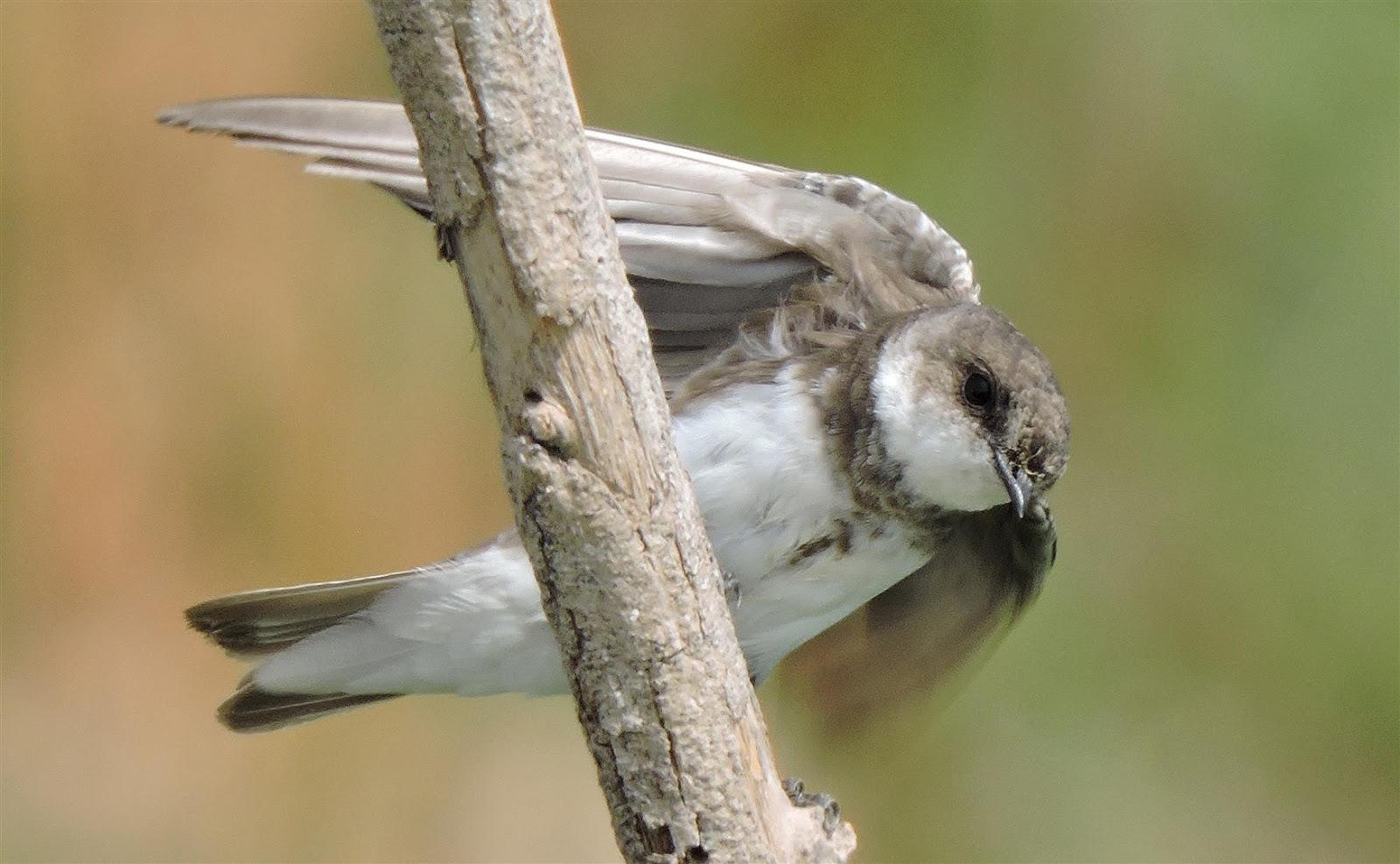
sand martin

Two of the birds were most probably sand martin. Their upper parts were darkish and the throat band was heavily marked. One of those birds is pictured above.

There is apparently considerable overlap in the strength of the throat markings between the two species. Pale martin's marking can be almost as strong as sand martin. However if the markings are very weak this points strongly towards pale martin.

sand martin - bird 3

The third sand martin was a candidate for pale martin. It was the palest and had a weak throat band.  

sand martin - bird 3

However I did not get a good enough views of its tail to be sure. Apparently the surest way to differentiate between the two birds is the degree of fork in the tail. A sand martin is more highly forked and a pale martin is just a notch.

sand martin - bird 4

The fourth bird has the lightest throat markings of all yet it had dark wings. Its tail was noticeably forked too.

sand martin - bird 4

The tail was probably too forked too.

In short, I find the separation of these two species really difficult and I cannot convince myself that any of the four birds were definitely pale martin.

Elsewhere on the site, the vagrant spur-winged lapwing which was first seen 15 months ago was still present. It now has four red-wattled lapwing to associate with.

spur-winged lapwing

There are large numbers of wagtails and pipits around the grassy areas of the site.

Many of the wagtails are starting to change into breeding plumage.

male black-headed wagtail

The red-throated pipit are generally less advanced. The head of the one below is going red but the throat shows no sign yet.

red-throated pipit

The Abdim's stork are also beginning to look more attractive as they head towards their breeding season.

Abdim's stork

This species is one of the earliest winterers to leave, in mid February.

Pallas's gull

After I left the settling pools I headed to Raysut lagoons. There was not much visible change to the birds since last time. The star birds are arguably the ruddy shelduck and they were still present.

One chance was the presence of a Pallas's gull. Just as Abdim's stork is one of the first leavers in winter, Pallas's gull is one of the last regular arrivals.

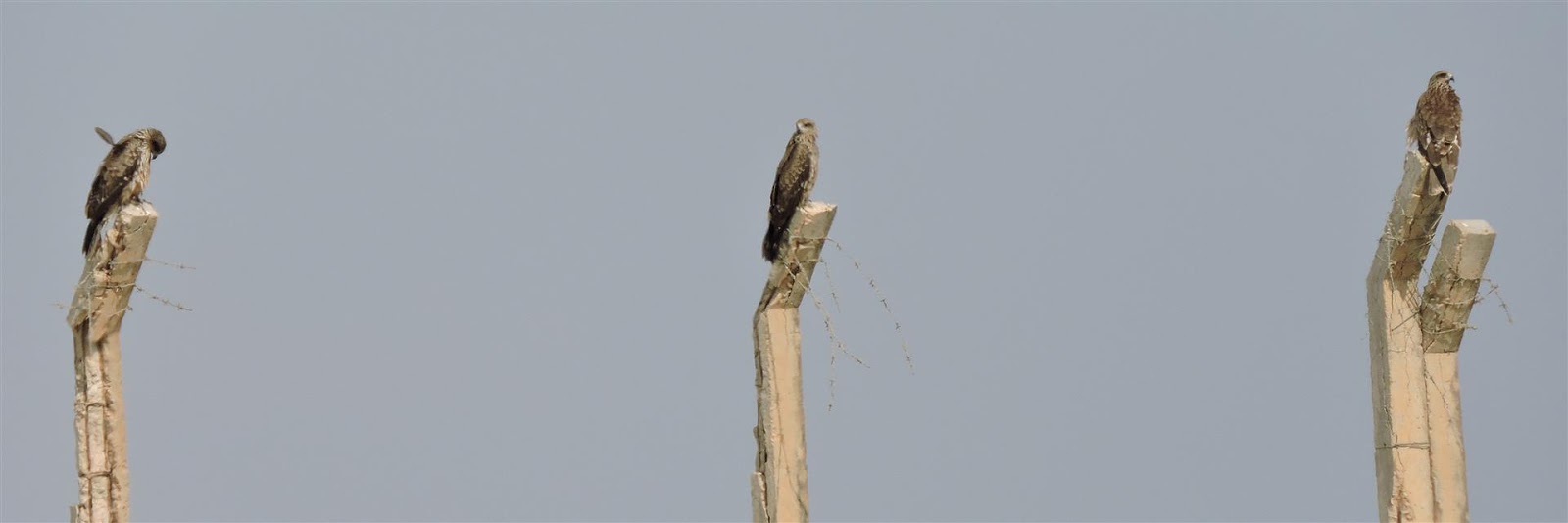
three black kite

To round off my trip to Raysut, I visited the beach area. Just like last mid-winter this is the place to see black kite (as opposed to yellow billed kite) in Dhofar. I have no real idea why they roost here and spend much of the day here too.

closer view of black kite

It was other birds of prey that were more active though. An Eastern Imperial eagle was eating a large black headed gull in a tree with two steppe eagle watching on in other branches. On the ground near-by a greater spotted eagle was also eating another gull. It had been a bad day for gulls there.

Wednesday, 4 February 2015

Far south west Oman

I drove out west to the border with Yemen on Saturday. I wish I had started out earlier as I didn't give myself enough time to explore the area properly.

The area around the two coastal villages of Rakhyut and Dhalkut is very green and wooded particularly near Dhalkut.  Indeed the hillsides above Dhalkut are the greenest I have seen in Oman outside the khareef season.

Rakhyut is more easily reached. It is a farming and fishing village. I was surprised it had a khawr (freshwater) lagoon) but unfortunately there is virtually no cover for birds as the camles have eaten everything down.

Nevertheless I did see some birds there.

blue rock thrush 

A blue rock thrush was perched by the khawr's side.

the khawr at Rakhyut

On the khawr were three pintail, one teal, one western reef heron and a few moorhen.

moorhen

A lone sooty gull was swimming there too.

sooty gull

On the beach were plenty more sooty gull and also Hueglin's gull. These were alongside both great crested tern and lesser crested tern.

gulls and terns on Rakhyut beach

There was also a solitary Pallas's gull.

Pallas's gull (at the back)

These birds are beginning to show their summer head plumage.
Tristram's starling

I have never seen such as high density of Tristram's starling as in the centre of the village. The sound they made was like the last few minutes of a football match when the home fans are blowing fake whistles to persuade the referee to end the game.

fan-tailed raven

Above the village on the hillside were a number of small cattle farms and plenty of birds. Fan-tailed raven was common.

long-billed pipit

Both long-billed pipit and tree pipit were easily seen too.

tree pipit

Though the density of birds was high, the variety was virtually the same as in the Salalah area. The 110 kilometres further west had made little apparent difference at least near Rakhyut.

white spectacled bulbul

This meant white spectacled bulbul were plentiful.

blackstart

Blackstart were in the wooded and the drier areas.

cinnamon-breasted bunting

The woods were ringing with the sound of cinnamon-breasted bunting.

desert lark

The plateau at the top of the hillside is drier than the slopes and species such as desert lark were observed.

Although Rakhyut and Dhalkut are only about 12 kilometres apart by boat, the journey by road is much longer. They are separated by a very deep wadi called wadi sayq. It has steep slopes too. Indeed, the road from the plateau to Dhalkut which first goes down the north side of the wadi and then up the south side before again going down to the sea is a feat of engineering.

Dhalkut is the real treasure at the end of the journey. The woods are very green and the area has an ever greener micro-climate than the rest of Dhofar. It is well worth a prolonged visit to see if the species are much different.

kestrel at Dhalkut

I had far too little time there. A hint of the diversity of species was the sighting of a yellow-billed kite which otherwise is highly localised to Taqah in Dhofar. Kestrel of course are common everywhere in Dhofar including Dhalkut.

the harbour at Dhalkut

Another hint of the possibilities was the sighting of a booted eagle over the village.

booted eagle

I spent the last 15 minutes of daylight in the one of the woods above the village but before the descent into wadi sayq (on the way back).

African paradise flycatcher above Dhalkut

There was a bird of prey that flashed by me which looked like a gaber goshawk? Surely not? but I am left wondering if that this small area on the border with Yemen holds species not found elsewhere in Oman.