Showing posts with label Upcher's warbler. Show all posts

Wednesday, 8 April 2015

Strong passage at Ghaftayn

I started birding on Saturday morning in the gardens of Al Ghatayn resthouse where I had stayed two nights and used as a base to go north. It is surrounded by desert but has a good reputation for birds.

There was a break in the sandstorms so the light and views were good. It took me only about two minutes to realise there had been a very big fall of passage birds over-night into the gardens. It was so big that I saw more passage passerine in two hours there that morning than the whole of the rest of the passage season up to that moment.

By 8.30 am I had seen seven different types of warbler and two types of passage shrike.

It started with a gentle walk around some of the trees next to the main building.

Eastern Olivaceous warbler

The first thing I noticed was the large numbers of barn swallow both hawking for insects but also just resting in trees. Then I homed in on a small group of warblers in small cluster of large trees. Two of the warblers were Eastern Olivaceous Warbler while the other was a Willow Warbler.


Barn swallow

Then I realised that there was fourth warbler present. It was shyer but for a short moment I got a straight view of a barred warbler. Even it the picture of a peeping bird you can clearly see its yellow eyes.

barred warbler peeping

This was my first sighting a barred warbler in Oman and it became bird number 265 on my country list.

Tawny pipit

Elsewhere in the garden I picked up on a passage tawny pipit and a desert wheatear. In another tree was a female blackcap.

Desert wheatear

At this stage I decided to make towards the pool and associated trees behind the garden. The garden is walled and the pool is very close to the wall but not accessible from the garden. 

Instead I drove to the front of the hotel and walked round the side towards the pool.


Black crowned sparrow lark

While walking round I came across the resident black-crowned sparrow lark and hoopoe lark.

Hoopoe lark

I then arrived at the back of the garden but on the other side of the wall. This was only to find interesting bird activity taking place within the garden I had just left. 

Yellow wagtail

By standing on a sand heap, I  peered back into the garden. Two yellow wagtail were walking around. However the more exciting bird was masked shrike flying between trees in the corner of the garden.

Masked shrike

On the ground next to the wall but on the other side again, a rufous bush robin came up to a patch of water and started drinking. He had chosen his over-night stop well. Not many other places have clean water or even any water for 150 kilometres in any direction.

Rufous bush robin

After a while I finally turned my attention to the pond area outside the garden. 

At the front of one of the main trees was a woodchat shrike. 

Woodchat shrike 1

This was my first woodchat shrike in Oman and so my country list increased for the second time before breakfast up to 266.

Woodchat shrike 2

I looked up to the top of the highest tree in the cluster and there was second masked shrike.

A second masked shrike

Around the pool were plenty of resident house sparrow. The whole site was heaving with birds.

female house sparrow

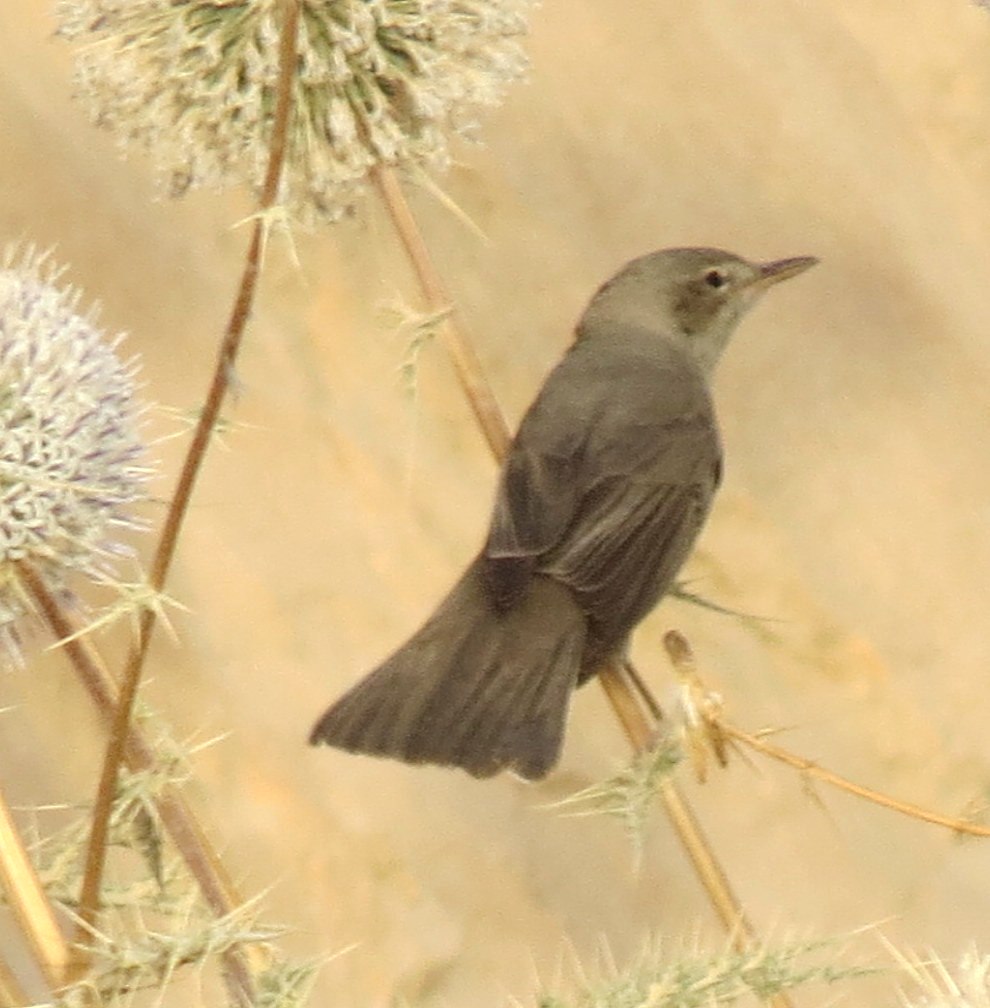
In some tamarisk trees at the back of the pool were five types of warbler: eastern olivaceous warbler, chiffchaff, willow warbler, lesser whitethroat and an Upcher's warbler.


Upcher's warbler

It's possible there were even more birds around. However eventually I decided I  needed to start the journey home with an early stop to find something to eat. I had not eaten since the early evening the day before.

Upcher's warbler deeper in trees

I didn't want to leave this site behind. I thoroughly recommend this resthouse for other reasons than the birding too. The managers, Kumar and Felix, were perfect hosts. My room was clean and large. They had put on BBC World on the TV as well as the aircon before my arrival. The water for the shower was piping hot. The restaurant is fine too. 

This blog page is five years old but all the information including the telephone number to make reservations is still current http://alghaftainrest-houseoman.blogspot.com/2010/04/al-ghaftain-rest-house-oman.html


the pond

I had birded the site the morning before on Friday. This had been a quite different experience.  For a start, there was a sandstorm.

lesser whitethroat

The only obvious passage birds had been a few lesser whitethroat, less barn swallow and rather strangely a white-winged black tern making passes over the pond for insects.

brown-necked raven

Through the dusty haze I also picked up two brown-necked raven, one of which was squawking continually.

local fox

The biggest highlight that morning was not a bird at all but two Ruppell's foxes resting in the garden and then at the pond.

After Ghaftayn, my route home was Muntasar Oasis-Qatbit rest house- Al Beed farm. I will blog about that next. 

Wednesday, 7 May 2014

One late afternoon at the university farm

We had unseasonably hot temperatures two weeks ago which reached 42C for almost a week. This is fully 8C higher than usual for late April. I thought the passage had finished early but in fact it looks very much like it was halted. Now the temperatures have dropped right back and there are signs that a backlog of passage is trying to make up for lost time.

This might explain so many sightings at Al Hayer and East Salbukh over the weekend.

It could also explain why my walk home through the half-closed university farm was so successful on Sunday evening.


female rufous tailed rock thrush

I visited the garden area first. Up one of the four tall trees was a rufous tailed rock thrush. I have never seen one in a tree before never mind such a tall one. It's supposed to like rocks.

It could be the same bird as the one seen 6 days before near-by.

spotted flycatcher

In the next tree along and also up high was a spotted flycatcher. I also observed a common redstart shoot across the grass towards the tree but lost sight of it.

In the small grove next to the garden was a red backed shrike which was similarly shy.

willow warbler

Four willow warbler were seen at the far side of the bushes which turned out to be an omen as to what was to come a few minutes later.

Having finished with the area in front of the buildings I moved to the back where there are now only two tomato patches and an area where very small scale cereals are grown like an allotment. 

tree pipit

On the way I found a tree pipit.  

common whitethroat

In the small allotment itself was a bonanza of warblers.  There were at least six willow willow, three common whitethroat and Upcher's warbler as well as fifteen or so house sparrow.

The warblers spent a lot of time perched on the wire fence separating the allotment from the tomato patch.

head of an Upcher's warbler

I tried hard to get a straight photograph of the Upcher's warbler. The trouble was not that it was shy, far from it. Instead the problem was it kept perching half through the wire, half on one side and half on the other. All the time it was pumping its tail in typical Upcher's fashion. 

Upcher's warbler clinging to a fence

For a while this was the best photo I managed.

common whitethroat

In the allotment itself the cereals often obscured the birds. This was true of the common whitethroat too. Eventually both species came out into the open.

Upcher's warbler on the ground

I then went scouting around the cereal patch in the hope rather than expectation of seeing a locustella warbler. I wasn't that lucky. Though I did pick up a whinchat which I had previously missed

whinchat

The picture below shows the allotments. It makes them look larger than they are.

"allotment" at the farm


All in all, it was a very good hour's birding at the end of a work day. Just as I was leaving I heard European bee-eater. Another flock had arrived to gorge on the local experimental bees.

Thursday, 18 April 2013

The mid April walk to work

After a lull in activity at the beginning of the week, another wave of migrants appeared in the urban farm on my walk to work.

I saw my first spotted flycatcher of the spring there a couple of days ago. This is one of the later migrants.

spotted flycatcher

Two of late passage shrikes: masked shrike and red-backed shrike also put  appearances.

masked shrike

The bird below refused to show his red back for the camera.

red backed shrike

On the other hand, woodchat shrike have been coming through for over a month now and there still seems no end. There were two of them on the farm yesterday evening.

woodchat shrike


I saw a single ortolan bunting there two days ago. This is the first time I have seen them in the Riyadh area outside al Hayer.

ortolan bunting

The waves of European bee-eater "visiting" the bee research unit and its bees seems endless. 
European bee-eater


Still no sight of a blue cheeked bee-eater though.


A tree full of European bee-eater

I have now seen a total of three Upcher's warbler at the farm this spring. 

Upcher's warbler

These two pictures show you just how different they can look from different angles. However, the behaviour is a big clue with the endless pumping of the tail and in a much more vigorous manner than eastern olivaceous warbler.


second view of Upcher's warbler

I haven't observed any lesser whitethroat for a few days but there is still a trickle of common whitethroat.

female common whitethroat

willow warbler

Willow warbler is currently the most common warbler. 

Interestingly I saw graceful prinia on this site for the first time yesterday evening.

male redstart

Both male and female common redstart continue to show.

Rufous bush robin

Rufous bush robin are still being chased around and off by territorial and bigger black bush robin.

tree pipit

I saw two tree pipit and the one remaining wryneck for the last time on Monday evening after about two weeks presence for both species. these birds have finally all moved on.

wryneck

However it was hello again to two (different) whinchat. Their appearance and the number I have seen this spring  has fully vindicated by view that it is a regular passage bird. This is opposed to scarce or uncommon as previous observers had thought and which I had agreed with until this season's volumes. 

whinchat seen yesterday

Although this article is meant to be primarily about migrants, I can't resist mentioning two resident birds.

Indian silverbill

This Indian silverbill is clearly exhibiting nesting behaviour.

rose ringed parakeet

And I seem to only see rose ringed parakeet at the farm when its about to rain which it did. I wonder if this is coincidence?

I am off to eastern province today to look at some farms. I'll report back what I see. 

Friday, 24 August 2012

SW Saudi Arabia trip report part 2 - North of Baha

The continued report on the trip from Taif to Baha and south looking at the area north of Baha on or near route 205.

Brian James and I travelled south through this area towards Baha on the afternoon of Saturday 18th August and again when heading north from Baha back towards Taif on the morning of Monday 20th.

Route 205 in this area is typically about 1900 metres above sea level. It is traversed by several wadis, some shallow and some steep. 

Much of the area is within the juniper zone or in a mixed acacia and juniper zone depending on altitude.  

It was in this area on the way down that we spotted our first arabian babbler, eastern olivaceous warbler (the first of several on the trip)  african silverbill,  palestine sunbird, arabian wheatear, kestrel and fan-tailed raven. These were all seen either from the car or on stops very close to the road.

Fan-tailed raven proved to be extremely common in this area. More about this later.


gambaga flycatcher

From the road (about 100 kilometres north of Baha) we spotted a  cluster of  juniper and acacia on the edge of a small village. We took a small detour to explore it. This was fortuitous. This small spot provided us with gambaga flycatcher. This was a lifer for me although by the end of the trip it seemed like  I had known it for ever. It is very common in almost all the areas visited but especially as we went south.

However this small cluster of trees and their surrounds had more to offer. Here I saw my first semi-collared flycatcher in Saudi Arabia (first of several seen) and my first thrush nightingale in Saudi Arabia too (the only one seen!). 

These were two more passage birds helping to impress in my mind just how important the western highlands must be for passage.

Also in the same place were southern grey shrike, steppe grey shrike, hoopoe, rufous bush robin, crested lark, desert lark, african crag martin, pallid swift, and white crowned wheatear,  alpine swift, swift, blackstart and white throated robin.  

This last bird was one of the surprises of the trip. We encountered over 100. They  were in almost every place we stopped which had any cover!

collared pratincole

We tried to find varied habitat on our stops. On one we chose some fields on the edge of another small village with several bushes as make-shift hedgerows. Here we saw two more collared pratincole to match the two seen near al Fatat water course earlier on in the day.

male cinnamon-breasted bunting 

An hour and a half later and much nearer to Baha (50 kilometres north) we pulled off the road and entered a valley with some scattered juniper. This proved productive too. There were more white throated robin but also yemen linnet, lesser whitethroat, short toed lark, Arabian woodpecker and yemen serin. The woodpecker was a lifer for Brian and the serin was a lifer for me.

On the grassland near-by were a small number of cinnamon-breasted  bunting. Although I have seen this species in Africa this was a first for me in Saudi Arabia.

female cinnamon-breasted bunting

The male is easy to identify with its deep cinnamon underparts and its black throat. the female looks quite similar to a striolated bunting. However the striolated bunting has rufous,  mostly unpatterned sides.

Closer to Baha we saw our first brown necked raven of the trip who were in the process of trying to mob a long legged buzzard as we drove by.

At our last stop on Monday before the fog closed in we added masked shrike, Ruepells weaver, European bee-eater, African collared dove, grey wagtail and Abyssinian white-eye to the trip list.


Ruepell's weaver

On the return journey to Taif out of Baha on Monday we initially stopped at a different set of places from those on the journey out.  These included the wadi valley at Doos and later at four roads off right once we had entered Mecca province (leaving Baha province).

The first three roads off were chosen because they rose upwards to mountain top villages. I am sorry I can't give you the names which we only saw in Arabic!  This is unusual because in many parts of the country, both English and Arabic names are presented.

The Ruepells weaver above was photographed at Doos where the extensive woodland and farming areas also had Tristram's starling,  little rock thrush, common whitethroat, eastern olivaceous warbler and upcher's warbler as well as the ubiquitous white throated robin.

European bee-eater

On the upland side roads, new additions to the trip list were red rumped swallow, tawny pipit, daurian shrike, shining sunbird (a lifer for me), Arabian partridge (a lifer for Brian), house martin, turkestan shrike (only one seen on the trip), whinchat and chiffchaff.  

Hoopoe in a very high mountain village

Other notable birds were hoopoe, rufous bush robin and one of only three Isabelline wheatear seen on the trip.

rufous bush robin

Indeed only two types of wheatear were seen over the four days. These were Arabian wheatear and Isabelline wheatear. I was disappointed that despite extensive efforts no red-breasted wheatear were seen.

Isabelline wheatear

We had some trouble identifying some of the daurian shrike. It appears that the female in breeding plumage has a dark brown, almost black tail which belies the fact it is one of the two so called "red-tailed shrikes". I have seen many of them in winter in the Riyadh area. Having arrived in Saudi Arabia only 11 months ago, I have presumably missed seeing this particularly plumage feature before.

female daurian shrike

One bird we had no such trouble with was fan-tailed raven and we got a lot of practice seeing it. In one place with a very steep escarpment dropping down directly to the coastal plain, there were vast numbers in the air.

some of well over 100 fan-tailed raven in the same area

We also got a lot of practice at seeing and differentiating between eastern olivaceous warbler and upcher's warbler. I was pleased to catch an Upcher's warbler on camera making its characteristic circular tail-pumping action. This is one of the ways to differentiate these birds.

Upcher's warbler pumping tail

The next blog will look at the birds seen close to the city of Baha itself.  There was a lifer among them!