Showing posts with label bar-tailed godwit. Show all posts

Tuesday, 19 May 2015

Crab plover west of Muscat

A week ago Saturday was my last day in the Muscat area and it was once again very hot. I headed out west towards the Batinah coast and more specifically to Ras As Sawadi. 

I know that European bee-eater breeds in the Batinah area and that sooty falcon can sometimes be seen at Ras As Sawadi. I was especially on the look out for these two birds.

On the way I stopped first at a manicured area near the airport at Seeb. This heavily watered areas can sometimes throw up something exotic or rare.

This time I was unlucky though I did get closer views of Indian roller than I have had before in Oman.


Indian roller

It was stretching its wings to keep cool though the day was not quite as hot as the day before.

manicured lawns at Seeb

Ironically better birds were seen in the adjacent scrub land. I followed a run off channel from the landscaped area which fed into a small pool on the wrong side of the fence in the scrub land. This area is out of bounds but the pool and surrounds could be seen from the green side of the fence.

chestnut-bellied sandgrouse

A small number of chestnut-bellied sandgrouse had turned up to drink.

two chestnut-bellied sandgrouse

I believe at least one of them was not an adult bird (see left above). These birds walked to the pool and walked away. I suspect they breed in the scrub land protected by the airport authority.

grey francolin

A grey francolin arrived too.

little green bee-eater

Little green bee-eater were sitting on the fence a short distance away from me.

After this I headed to Batinah but failed to see any European bee-eater of which a small number breed in the area and more pass through. European bee-eater is arguably the strangest omission from my country list.

Ras As Sawadi

Ras As Sawadi is the string of rock jutting into the gulf which becomes an island at high tide. Sooty falcon can be found here but I suspect I came two weeks or so early. The trees on the main path are good for plain leaf warbler in winter but they left weeks ago.

In short it looked like my targets would be missed.

As I scanned the waders that were present, suddenly I realised that there was a crab plover on the mudflats.

crab plover with bar-tailed godwit

This is a long way from any breeding grounds in UAE or Masirah Island in Oman. However the shore is peppered with crabs and their burrows. I don't know whether this is an over-summering bird or more likely a dispersed young bird. Either way my luck was in. This was precisely the bird I had planned a long drive to Duqm from Salalah the next weekend to try to find. Duqm is the closest place to salalah that they are commonly seen.

crab plover walks in front of ill gull

Like the day before, I found a small number of ill looking gulls which never made it back to their summering quarters. Most here were Heuglin's gull.

oystercatcher

Another highlight of this trip was the presence of a flock of oystercatcher.

bar-tailed godwit

The solitary bar-tailed godwit showed no sign of attaining summer plumage.

great crested tern and sooty gull

The most common bird at the shore was actually great crested tern with sooty gull close behind. There were also two white-cheeked tern.

black-crowned sparrow lark

I had a long walk back to the car along the beach and only two extra birds were seen. Both were perched on the fence separating the shore from a big development which is being built that will reshape the area. Those birds were black-crowned sparrow lark and little green bee-eater.

I had finished all birding before lunchtime having learnt a lesson about the heat the day before. It was a good morning though.

In the next blog, I will give a round up of all the birding done in Salalah in the following week.

Tuesday, 9 October 2012

High tide roost, Khobar

At the crack of dawn on Friday morning, Lou Regensmorter and I started our second full day's birding in Eastern Province.

We headed straight to the so called high tide roost between Khobar and Dammam on the coast. There is an inlet from the sea here which fills up with water at high tide causing the birds to move up into a small area.

For us this meant seeing eight or so western reef egrets together but when we looked more carefully there was more activity.

At least two Eurasian curlew were there but there were flighty.  This was another first for me in Saudi Arabia.

bar-tailed godwit

Much less flighty was a bar-tailed godwit which allowed close view as it was so busy feeding. This was yet another first.


great crested grebe

Although the number of birds was less than we might have expected the types exceeded my expectations. Swimming in the high tide water was a single great crested grebe. Once again another first for Saudi Arabia. So this shortish stop at a seemingly minor part of the coast provided 3 out of the 10 additions to my Saudi list which increased from 228 to 238 during the trip as a whole.
 

Western reef heron

In the immediate urban area we also saw house crow, red-vented bulbul and house sparrow.  It is quite remarkable that we didn't see a single white eared bulbul all weekend as this is the most common bulbul in the east of the country.

House crow

The rest of the birding day was spent along the coast at Dammam in a variety of habitat including mangroves and mud flats. It turned out to be a very rewarding day as I will show in the next blog.

Monday, 9 April 2012

Jizan bay

I visited the shoreline in the centre of Jizan twice over last weekend. The first visit was to an area of mud flats. The second was a walk along a rocky piece of coast next to the flats. It was very productive. They were large numbers of waders and I added three "lifers".

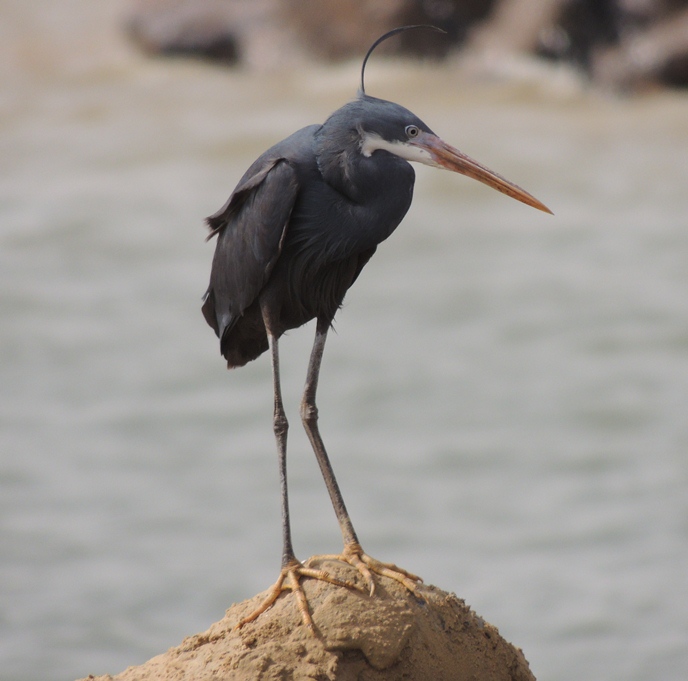
western reef heron

Herons weren't the most common birds but they were among the most photogenic. I saw one western reef heron and one striated heron. The former was very tame allowing me to within 3 metres with prolonged viewing. 

striated heron

There were much larger numbers of waders. As is often the case, dunlin was the most abundant. Common sandpiper was also common.

There were several curlew sandpiper which I misidentified as dunlin at first. Through correspondence on BirdForum, I have learned the best way to tell these birds in winter plumage apart is that curlew sandpiper have longer necks and longer legs. Actually the length and shape of the bill is not the best guide. 

curlew sandpiper

On the mud flats, there were a range of plovers and two were "lifers".  

crab plover

A single crab plover was caught eating a small crab. This wasn't my lifer though. I had seen this bird previously in Jeddah.

grey plover

Neither was grey plover a lifer either. 

pacific golden plover

One "lifer" was a pacific golden plover which was resting on the rocky shoreline with other waders. It was the only one I saw during the weekend.

ringed plover

There were three types of small plover on the mud flats. Two were kentish plover and ringed plover.

lesser sand plover

The third was lesser sand plover. This was my second "lifer" plover of the weekend. I knew greater sand plover from Azerbaijan where it breeds and one wintering bird in eastern Libya but had never seen a lesser sand plover before.

greater flamingo

There were significant numbers of larger water birds on the mud flats. A lay person would probably have noticed the six greater flamingo first. All of them were first cycle birds.

bar-tailed godwit

There were also three bar-tailed godwit in different stages of plumage. The one above was part way to its summer plumage.

whimbrel

There were several whimbrel seen as well though never in groups of more than three. 

three whimbrel on the beach

On a sandbank in the middle distance was a solitary oystercatcher.

oystercatcher

I only saw two different members of the tern and gull family here. Nevertheless, the good news is that the tern was another "lifer".

white-cheeked tern

Thanks to my posting pictures on the BirdForum website, without their help I would never have been able to to identify the tern above (as a white-cheeked tern). Apparently they breed on most of the west side of the Red sea coast but surprisingly few places on the western side. Is this a case of under-reporting?

white eyed gull

The final bird for this blog was white eyed gull. There were several at the seaward end of the mud flats and on rocks. I knew this bird from a visit to Jeddah last Eid.  

There were 5 more types of tern and gull at a different location which I'll blog about in the coming days.

Friday, 5 November 2010

Yet more new water birds in Benghazi

In the same place where I saw the short-eared owl there were plenty of interesting water birds too.  


The most common water birds were dunlin and black-winged stilt but there were several other (arguably more exotic) species.

ringed plover and curlew sandpiper, north of Garyounis

This was close to where I reported ferruginous duck last week. However they have moved on. The pochard were still there and I saw my first black-necked grebe of the winter.

black-necked grebe, north of Garyounis

Black-necked grebe are common across most of the Libyan coast in winter.

golden plover, north of Garyounis

Although dunlin were the most common wader, there was lots of variety.  Several ringed plover and curlew sandpiper were present (see picture at the top of the blog). The latter bird was a bit surprising as it mostly winters south of the Sahara. I think the unseasonably warm weather has persuaded it to stay a while. I also saw one curlew.

There was also at least one golden plover (shown above) and three grey plover (not shown) which are both probably wintering birds..

common snipe, north of Garyounis

Once again it was easy to see common snipe. Why did I ever think this was difficult!

bar-tailed godwit

I also saw my second bar-tailed godwit of the winter. This is another candidate for the guide books to put on the map in Libya. Its missing from the maps at the moment.

whiskered tern with dunlin, north of Garyounis

This is another place where whiskered tern are abundant. I saw them on the wetland itself and on the sea near-by.

tree with starlings

Finally as I walked towards the city centre looking for a taxi I came upon a tree with hundreds of starling resting. I have blogged recently about the huge numbers here at the moment. The tree reminded me of a bee hive with starling coming and going in uncountable numbers.