Showing posts with label corn bunting. Show all posts

Wednesday, 23 December 2015

Birding for larks in Sohar

There is substantial flat land with plenty of seed bearing plants in the Sohar area. It looks good for larks and so it proved to be on Saturday.

Hanne and Jens Eriksen took me to this area which we had also visited for a shorter time late on Thursday. 

On Saturday we were out birding early hoping for plenty of larks. Instead of larks the first species we saw apart from myna and house sparrow around the hotel was grey francolin.

grey francolin

The most important place to find was a water filling station for trucks where spillage meant small but effectively permanent small pools.

crested lark

Parking up and just waiting for larks to appear was a good strategy. The crested lark with the very large crest above was actually seen on the Thursday visit.

All the other birds pictured on in this blog were observed on Saturday.

black-crowned sparrow lark

Crested lark and black-crowned sparrow lark were about equally numerous in this area and made up the majority of birding visitors to drink.

bimaculated lark (back) with greater short toed larks

The third most common lark is a winter visitor unlike the previous two which are probably resident. It was greater-short-toed lark.

However a much more interesting lark joined one small group of greater short-toed lark at one of the pools. This was a bimaculated lark.

bimaculated lark

It was not unexpected as it had been reported in the area. Nevertheless it was another addition to my Oman list in what was becoming a very good weekend for the list.

house sparrow and Indian silverbill

A couple of times we moved away from the pools to search for a putative tree sparrow which has been reported but not confirmed. If confirmed it would be a first for Oman. Unfortunately our search found only house sparrow and Indian silverbill despite our best efforts.

skylark 1

On our return, a skylark was among the visitors to the pool. We had seen two briefly on Thursday afternoon but these views were much better. It was yet another addition to my list.

skylark 2

Larks were not the only birds drinking. From time to time Namaqua dove and laughing dove would arrive too.

Namaqua dove

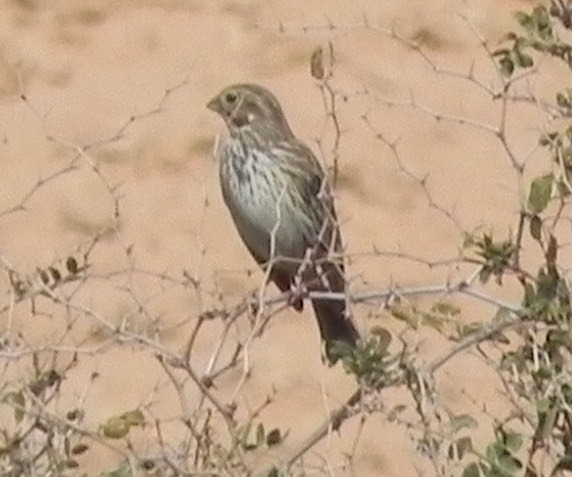
A final non-lark sighting was a single corn bunting which came to drink twice.

corn bunting 1

This was the seventh new bird for me in Oman over the weekend. This left me feeling the trip was highly successful.

corn bunting 2

I am indebted to Hanne and Jens Eriksen for their company and help on this trip. They chose the sites and I could not have hoped for better on one of my rare northern visits.

Monday, 7 February 2011

Courting corn buntings and other land birds

There is more to Old Marj than water birds. For one thing many of my students say that the area is haunted since the 1962 earthquake killed so many and even those who don't believe it's haunted won't go near the lake at night. 


The other thing Old Marj has got is land birds. They may not be so prominent as the water birds but they are interesting too. 

two corn bunting sharing a tree

I'm dedicating this blog to the land birds of Old Marj. I've blogged once before about the land birds here so this blog will hopefully cover only new ground. 

First new observation was that the area has corn bunting. This is not surprising as I have seen flocks at two Wadis 30 -70 kilometres to the south and south west of Marj respectively.  However I think corn bunting may breed here.

left hand corn bunting at Marj

The two corn bunting in a tree stayed in the same position for over five minutes staring at each other. I don't know whether this is courting behaviour but it certainly looked like it.


right hand corn bunting

In breeding plumage corn bunting takes on a yellow look which makes them more like a non-breeding yellowhammer than at other times. Luckily we don't get yellowhammer here so there was zero chance of confusion.  Furthermore the bill on these birds was very heavy so they could only be corn bunting anyway.

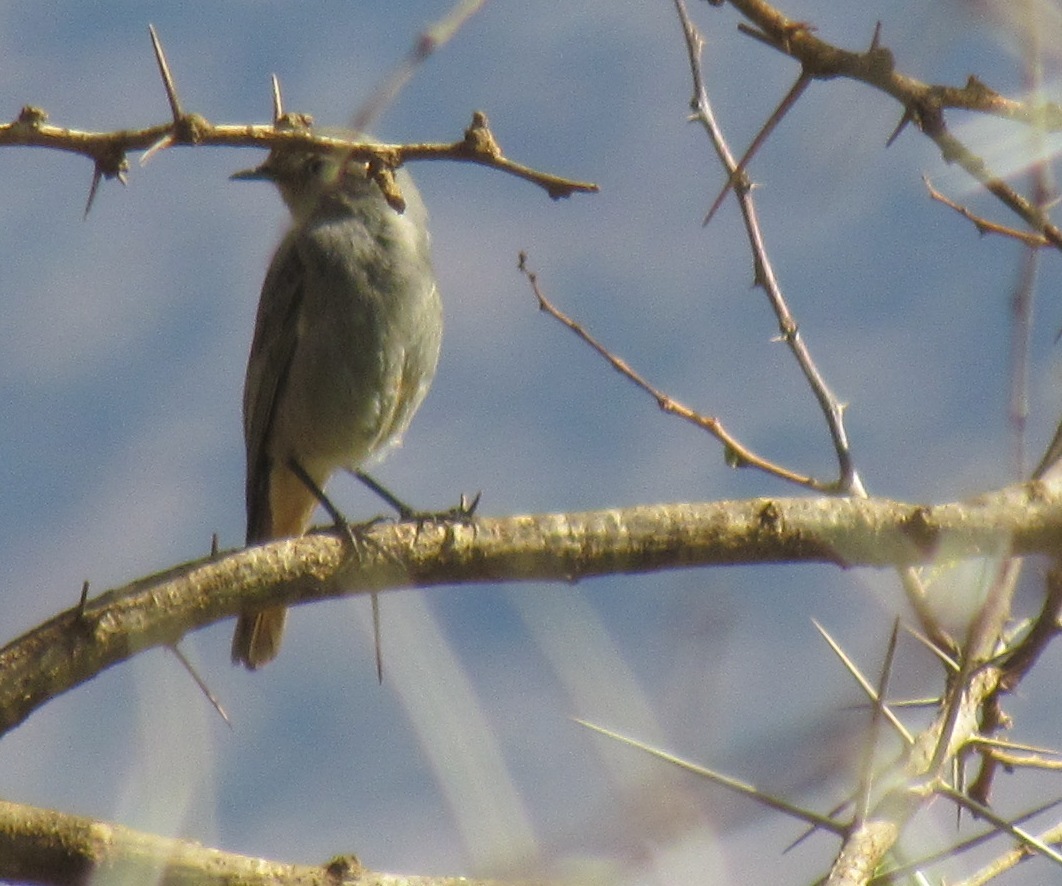
black redstart

I managed to get quite close to a black redstart which I watch closely now to see if they are European or Turkish sub-species. The one above is European.

goldfinch and linnet together

The goldfinch and linnet I had seen on previous visits were in a super-flock of mixed species this time. I have seen this before (at Jardinah farm in the summer). At other times in Libya I have also seen goldfinch mixed with house sparrow (Jardinah again) and with greenfinch (at Farwa last winter).

hoopoe on a wire

Hoopoe was again easily seen at Old Marj.

white wagtail

Plenty of white wagtail and grey wagtail were around too. They are nearly all now in breeding plumage. Spring is very close now. I expect to see the first passage birds very soon.


Wednesday, 15 December 2010

Finding dotterel for the first time

On Friday afternoon I decided to try the birding equivalent of finding a needle in a haystack. 


The Collins guide map shows dotterel winter on the higher southern parts of Jebel Akhdar.


Furthermore the write up says they (dotterel) prefer flatter ground.


flatter ground on the southern side of Jebel Akhdar

So I headed to land a few kilometres east of Wadi al Haserim which I had visited a couple of weeks before (see blog called another wadi, more corn buntings). The area east of Wadi Al Haserim meet the books criteria.


red spot marks area visited searching for dotterel (blue spot is wadi al haserim)

Now here's the funny thing. I actually saw six birds within two minutes of searching!  The book is absolutely right. I am left to wonder why its so accurate on this. Why would someone report on dotterel locations and yet 30 more species which are more obvious remained unreported so Collins had no information to go on.

Before you think this was all a wall in the park let me tell you it was very, very windy and though I saw the birds fly into a field I couldn't see them on the ground. Three times I walked round the field and three times they flew off before I had even noticed them.  I spent an hour looking for them.

I gave up and went to Wadi Al Haserim for solace. I'll blog about what I saw there further down. 

Anyway after Wadi Al Haserim I returned to the field for one last look. I picked them out immediately so I now have more than a landscape photo to show you. 

dotterel in a field on southern high part of Jebel Akhdar

Below is a second more blurred picture but which does show the head stripe on a dotterel.

second blurred picture of a dotterel

Overall I was very satisfied because dotterel was a "lifer" for me and I have some sort of photographic record.

wadi al haserim

In between visits to the dotterel field, I re-visited wadi al Haserim which I had seen two weeks before.

local chaffinch

The local chaffinch were still there but they seemed more confiding allowing me better pictures.

two corn bunting, one flying, one perching

The large flock of corn bunting were still there two weeks on. However they were mostly sheltering from the fierce wind. It looks like they may stay a greater part of the winter at Wadi Al Haserim especially as more rain is forecast so the wadi will refill and the fields will hold food.


Thursday, 2 December 2010

Another wadi, more corn buntings

Given my good birding at Wadi Al Bab, the week before I decided to visit another wadi south of Jebel Akhdar (mountain range) last Friday and see what it had to offer.

map showing position of of wadi al hasarim (blue) and wadi al bab (red) -from google earth

There are a large number of wadis in a rain shadow area south of Jebel Akhdar. As far as I know none have been birded before. The map above shows Wadi Al Bab (red) and Wadi Al Hasarim (blue). At this time of year there usually have some water.

part of wadi al hasarim

I had only about an hour before dusk at Wadi Al Hasarim because I visited two other sites earlier in the day so things were a bit rushed.


corn bunting, Wadi Al Hasarim


However, one thing was obvious, Wadi Al Hasarim had its own flock of wintering corn bunting just like Wadi Al Bab 75 kilometres way. As I said last week we can safely change the map of the winter distribution of corn bunting in Libya to include the wadis south of Jebel Akhdar as well as the land on and north of the mountain.


corn bunting on look-out

I love the way each corn bunting wants a look out post just like in spring except here they have to share their bushes with a few others!

local chaffinch

There was another flock sharing the wadi with the corn bunting.They were chaffinch. They were from the local sub-species -africana. This is not residential territory for them. They are resident 25 or 30 kilometres north on the Jebel Ahkhdar in the cypress woods. Clearly they roam a bit in winter.

I think this is a new observation because the guide book distribution map does not reflect this.

great grey shrike

Other than the chaffinch and the corn bunting, most of the "usual suspects" were there. The shrike was great grey shrike (probabaly aucheri) rather than desert grey shrike (elegans).

stonechat

Of course, stonechat was present and a small number of chiffchaff.

Just as I left as dusk was approaching I saw six curlew fly over and it looked like they landed just over the hill ridge. I presume they had come home to roost for the night.  I had no idea curlew fly so far away from the coast to roost.

Thursday, 25 November 2010

Wadi Al Bab

I return to Libyan birds after a few days writing about Jordan.  Last Saturday morning I ventured south of the Jebel Akhdar. The idea was to visit (for the first time) one of the wadis that runs off the Jebel on its dry southern side. These wadis only have water after heavy rain on the hills. They get most of their water from run off rather than direct rainfall. It rained for three days on the hills and near Benghazi during the previous week so I thought prospects might be good for water and birds.


Wadi Al Bab, west of Saluq

I was in luck. Nearly all the wadis run across the  road which goes westerly out of Jardas Al Abar (see map below). However,  I chose to take a more minor (and southerly road) out of Saluq instead. It was on this road that I came across Wadi Al Bab (see pin on map). This is the most southerly and westerly of all these wadis.

map (from Google earth) showing geography south of part of the Jebel Akhdar

The first good news was that the wadi did, indeed, have water.

I didn't know what to expect in terms of birds. This was my first look at this class of habitat. I hadn't even visited similar wadis south of Jebel Nafusa when I lived in Tripoli.

flock of lapwing, Wadi Al Bab

As soon I arrived I saw a flock of six northern lapwing. I took a hasty picture before they moved away from my camera range. Apologises for the quality.

I was very excited by this discovery. Northern lapwing is a rare sight in Libya. Take a look at your Collins guide. The bird is completely missing from Libya according to the book. Actually I saw one before at Wadi Zaret dam in Tripolitania last winter.

As far as I can tell this is the second largest sighting in recent years in the country. The largest was by the UN winter wetland census team. They saw 20 (more than in all the other years added together) at Al-Abyar. Take a look again at the map above. Al-Abyar is close to Wadi Al Bab. This area seems to be the Libyan hotspot for this bird.

corn bunting, Wadi Al Bab

The second surprise was a very large flock of at least 200 corn bunting scattered around all the wadi's bushes and trees.

Again the Collins guide doesn't have them south of the Jebel Akhdar but I think this is almost certainly down to lack of reporting on the southern run-off wadis.

I wonder how much birding has ever taken place in these wadis?

some of the corn bunting flock, Wadi Al Bab

Down stream the wadi after it crosses the road changes complexion. Its more like a meadow with high grasses.  

downstream at Wadi Al Bab

The main occupants of the wadi downstream were wintering stonechat and chiffchaff. These birds along with white wagtail (also seen by the road) winter in vast numbers throughout Libya.

stonechat and chiffchaff downstream at Wadi Al Bab


Despite all these wintering birds, there were locals too. Both desert grey shrike and great grey shrike were present right next to each other. This may well mark the boundary of the two species.

desert grey shrike, Wadi Al Bab

I suspect any further south or east and I would see only desert grey shrike.

great grey shrike, Wadi Al Bab

The other obvious residient (or at least non-foreign) were trumpeter finch. Once again the  Collins guide distribution map is worth looking at. Wadi Al Bab  is exactly half way between two isolated areas where the book says the bird should be. It now looks like the two areas aren't isolated at all and trumpeter finch is in the areas in between. 

trumpeter finch coming to drink at Wadi Al Bab

Finally as we left Wadi Al Bab and started to head back to Saluq, I was reminded that the wadi was the only break in otherwise semi-desert by the presence of two brown-necked raven near the road.

brown-necked raven between Saluq and Wadi Al Bab

Tomorrow I'll write about another new habitat. I birded a rubbish dump! See what I found.