Showing posts with label little bee-eater. Show all posts

Friday, 6 January 2017

Dagana (Mauritania)

Mohamed Vall and I travelled east of Rosso on the Boghe road on the afternoon of New Year's Eve. We turned right, off the main road, towards the Senegal River after 30 kilometres into the Jidr El Mouhguine district.

Just after the turn off was a large lily pond. We birded it and not surprisingly two African jacana were seen. It is not given the nick-name of lily-trotter for nothing.

African jacana 1

This was another addition to my country list.

African jacana 2

All around the pool was a mobile flock of Sudanese golden sparrow and a few laughing dove.

long-tailed cormorant

Almost hidden under the largest tree at the pool side was a young long-tailed cormorant.

We moved on towards the Senegal River itself but stopped off at the edge of the small town of Jidr El Mouhguine. At a small water course, we came across both little bee-eater and little green bee-eater. However the prize bird was a striated heron. This was my first in Mauritania.

We carried on closer to the Senegal River. The last settlement before the river is called Dagana locally which is the same name as the much larger town on the Senegalese side.

We didn't bird the riverside itself but just short of the village are two water inlets and the area around these was intensively birded.

We had only just parked up when an adult African fish eagle flew over.


African fish eagle

This village felt more like savanna Africa than anywhere else I have visited in Mauritania so far.

Warthogs were grazing on the far side of one of the inlets. A monkey was hiding in a tree. Two crocodiles were sunning themeselves before sliding into the water and finally a large snake was swimming.

warthogs at Dagana

A walk into a small woodland provided vinaceous dove. It's call is very distinctive and we realised we had heard it on a previous trip to the south without seeing and establishing the identity of the bird.

vinaceous dove

Apart from its call, it's dark eye and pink-grey head as opposed to fully grey head help separate it from African mourning dove.

little bee-eater

In more open land we saw a woodchat shrike and several little bee-eater. Unlike at Rosso views of this species were sustained. The odd yellow wagtail was in the same area.

tree pipit

Other western palearctic migrants included a couple of tree pipit.

After Dagana, we doubled back to the main Rosso-Boghe road and travelled on eastward.

yellow wagtail

Main road birding was not so fruitful. Birds of prey were the same as on previous trips that is mostly yellow-billed kite, marsh harrier and short-toed eagle.

Flooded burnt stumble fields had a concentration of birds but mostly were restricted to yellow wagtail, yellow-billed kite, wood sandpiper, cattle egret and a few ruff. Two collared pratincole were the most interesting.

spur-winged lapwing with a wood sandpiper

Our next stop was barely 12 kilometres further east of Dagana and was once again south of the main road on the Senegal River. This was arguably the best birding of the whole trip. I will blog about this next.

Thursday, 3 March 2016

West shore, Tuti Island

Sunday was my biggest day birding in Khartoum, Sudan. I visited Tuti Island from eight onwards. This island is at the confluence of the two Niles and is mostly farmland in the middle of an urban area of six million people.

I started out at the south west corner of the island near the one bridge to the city. Then I walked along the western shore until I moved inland into the farms.

This blog is about the walk along the shore line.

The best moment of this part of the session was undoubtedly coming across an Egyptian plover and close up.

Egyptian plover

These birds are not shy. When I got too close it just sat down at first presumably as a hiding technique.

Egyptian plover sitting

Later it chose to simply walk away.

Egyptian plover walking away

Later I saw two more birds but this time in flight. 

Spur-winged lapwing

Once again the shore line held spur-winged lapwing.

common sandpiper

It was here that common sandpiper and Temminck's stint were added to my growing Sudan list.

pied kingfisher

Much better views were had of pied kingfisher than three days before at Sunut Forest.


Little ringed plover

I usually associate little ringed plover with man-made habitats. However there were several on the banks of the White Nile on Tuti.

laughing dove

Doves were coming down to the water's edge to drink. These were both laughing dove and African mourning dove.

African mourning dove

Little bee-eater was seen all over Tuti Island but clearly gravitates towards bushes next to the rivers.

little bee-eater

Red-billed firefinch is not a shore bird but that didn't stop a female hopping on to the shoreline.

red-billed firefinch

In the next blog I will report on the farms on Tuti and give a full list of the 42 species seen on the Island.

Tuesday, 15 October 2013

Sodere resort, Ethiopia

I am now back in Saudi Arabia having flown back from Ethiopia today. The four-day trip there was intense. I travelled with Roger Butler whose main interest is lizards so we were looking for terrain that suited both tastes. 

Birds are so easy to find compared with Saudi Arabia and it was a little over-whelming trying to digest information on so many species in a short time, many of which were new to me.

Even the hotel garden in Adama was a challenge with 30 different species seen on two pre-breakfast walks.

Our first serious trip outside the hotel was to Sodere resort and village. This is 25 kilometres from Adama and is a hot spring resort, forested area and also has the Awash river running through. Apparently the river contains crocodiles but I didn't see any.

It was good day, even between the main entrance and the ticket inspectors the birding was good.


Blue-breasted bee-eater (Ethiopian bee-eater)

Parties of Blue-breasted bee-eater were making forays into the air to catch insects before resting very close to me without any alarm. 

I initially misidentified this bird as a little bee-eater. However its blue supercilium extends over the bill and in another photo, the throat is stretched and the blue band is more clearly seen.  I am not finding African birding ID easy!

location of Sodhere

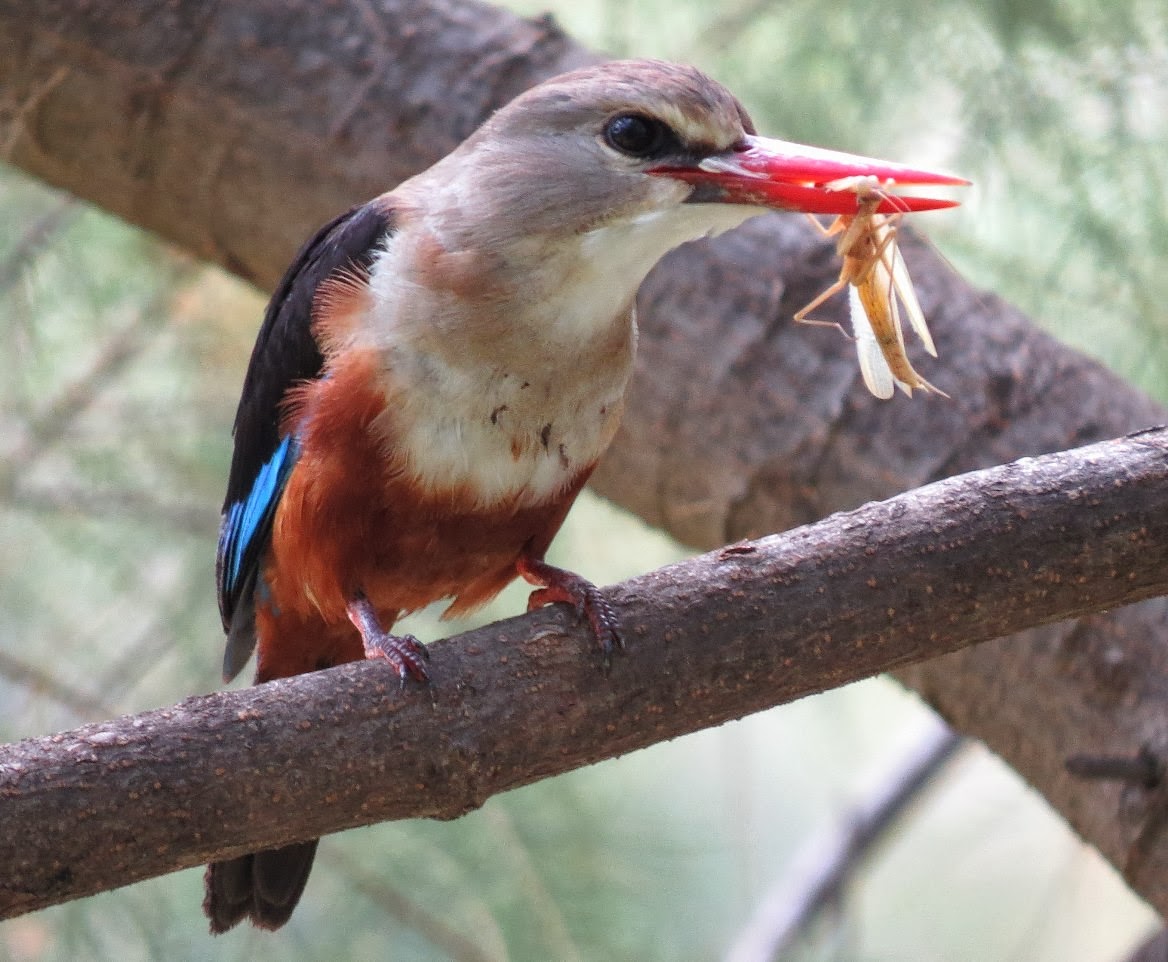
Very near the little bee-eater, a grey headed kingfisher was sitting ready to eat.

grey headed kingfisher with food

I saw a second one much later without a catch.

another grey headed kingfisher

Most people stayed close to the entrance which has swimming, spa and eating facilities.

Vervet monkeys

Vervet monkeys mixed freely with the people there. There seemed to be no signs of aggression or indeed fear by the monkeys.


Fan-tailed raven

Fan-tailed raven were also abundant in this area and they were incredibly tame too.

Fan-tailed raven with partially brown neck

I saw fan-tailed raven with a partially brown neck. This confused me for a while but they are no brown-necked raven in this part of Ethiopia so it must be within the spectrum of fan-tailed raven possibilities.

Hadada ibis

Hadada ibis browsed in this patch too. This was a lifer for me. They seem to like shaded areas near water.

eastern plantain eater

Another noisy bird around the peopled section were eastern plantain eater. This was another lifer though I had previously seen the closely related western plantain eater in Senegal.

African pied wagtail

Another notable bird here was an African pied wagtail. We watched one during lunch which had perfected the art of grabbing insects which had fallen into the water of a swimming pool and were struggling on the top surface.  

Yellow billed kite is a ubiquitous bird near people sub sahara and Sodere was no exception. There were several in recreational areas.

yellow-billed kite

Walking away from the recreational areas and from most people produced a different set of birds. 

Egyptian goose

Two Egyptian goose were relaxing in a small fish pond.

Hamerkop

I walked straight passed a hamerkop within feet and only noticed it first time round when it flew after I had passed it on a path running alongside a stream. 

Tawny eagle

Close-by a tawny eagle was resting in a tree and refused to move however close I got.

Two birds I didn't get to photograph here were African grey hornbill and red-headed lovebird. The latter was another lifer. It is a particularly beautiful but also nervous bird.

cattle egret

The area just outside the resort were also interesting. Cattle egret there were following the cattle and goats as you might expect.

greater blue-eared glossy starling

Greater blue-eared glossy starling were in a bush outside the main entrance.

However the main attraction for the bird watcher outside the resort is a wetland next to the village of Sodere. Water birds were sharing the place with locals doing their washing and bathing. 

three-banded plover

Here I saw my first ever three-banded plover.

common sandpiper

There were some western palearctic wintering birds too. I saw several common sandpiper

spur winged lapwing

Spur-winged lapwing is a bird of grassed wetland here just as it is in Saudi Arabia.

Ethiopian swallow

Both barn swallow and Ethiopian swallow (another lifer) were flying in numbers over-head.

yellow wagtail

And last but not least, the wetland was teeming with wintering yellow wagtail.

This trip was our shortest day trip, made possible using public transport with the locals - a great experience.

On the two next days we travelled a little further afield and visited two national parks thanks to Roger's research. Both we discovered are on the commercial bird tours circuit.

I'll write about them in forthcoming blogs.