Showing posts with label little grebe. Show all posts

Sunday, 6 November 2016

Return walk from North Nouakchott

On the way back from my long walk in north Nouakchott on Saturday, I walked three blocks further east than I usually do. 

It was fortuitous as I stumbled across a very large fresh water area right in the city.  Furthermore it is public.

Until this, birding on the way back had been uninspired with a couple of hoopoe lark being the best birds.

hoopoe lark

I hit the western edge of the water without realising how large it was.

What caught my attention were four little grebe. These were my first in Mauritania and species 163 on my list.

young little grebe

Two of the grebes were juveniles so I suspected immediately that they had bred there. I also know that little grebe like water at least one metre deep.

This lake was turning out to be quite different from any other water body I had seen in Nouakchott. It is fresh water and is both large and deep.

adult little grebe

Scanning around I could see this west side had some reeds and sedge which is different vegetation to other water bodies. However the sheer size of the place was not yet apparent to me.


north Noaukchott lake

The white building in the centre left of the picture is surrounded by water. There are pockets of tall bull reeds all around the site.

I started to walk round. I saw bluethroat within the reeds and spur-winged lapwing dotted all over the site.

bluethroat

The water had historically clearly flooded five or six old buildings where only some lower walls remained. On some of these were a few scattered waders such as wood sandpiper, green sandpiper and common ringed plover.

common coot

Over 20 common coot were in the water or on the sunken walls. This was another addition to my country list. It is species 164. I found no evidence of any red-knobbed coot despite a thorough look.

common moorhen

A similar number of common moorhen were observed. They were not easily frightened suggesting no hunting goes on here.

northern shoveller

One disappointment was the ducks. Once again the only species of duck seen in Nouakchott were northern shoveller and northern pintail.

northern pintail

I will return to this lake as soon as I can. I was very tired on arrival and will almost certainly have missed quite a lot. For a start Sedge warbler and crakes must also surely be possible at the moment. Furthermore, I would expect mallard and teal sometime this winter. 

It was only 20 minutes more walk to arrive home. However I adopted a precautionary approach on Sunday and rested my blistered feet. I was really itching to return to this lake though.

Sunday, 21 September 2014

Baleed Park, Salalah

On late Thursday afternoon, I made my first visit to Baleed Archaeological Park. It consists of a crescent shaped Khawr with undisturbed flat land near-by. Although part of the site is landscaped, the other part is arguably better for birds than my normal local patch at East Khawr simply because it is more private and unapproachable by cars.

Quite remarkably I saw six birds which I hadn't previously seen in my three weeks in Oman despite the superficial similarity in habitat with East Khawr.

Indian pond heron with grey heron

One of these was an Indian pond heron. I actually found it quite different to a squacco heron. It almost looked just two tone. Either the colour was white or dark brown.There didn't seem to be many intermediate shades. I understand this distinction is not so simple in winter.

closer look at Indian pond heron

The dark loral stripe, present on the pond heron but not on a squacco heron, was obvious too. In short it was easy to identify.

grey heron

The birds seem very relaxed at this site. I particularly liked the attitude of the grey heron.

Purple heron

The two juvenile purple heron which were present weren't shy either.

sooty gull bathing

I don't think that you will find as many sooty gull on fresh water in many other places lie at Baleed.

close up of sooty gull

The sand bar and near-by marsh areas that separate khawrs from the sea are often among the most interesting areas on these types of sites.

Heuglin's gull with sooty gull and greater crested tern

Some of the Heuglin's gull seen flying WSW of East Khawr a couple of days before didn't make it too far before landing. There were six seen at Baleed.

gull billed tern with Pacific golden plover and collared dove

At the end of the khawr near the sand bar were many birds including a single gull billed tern, my first in Oman.

First winter Saunders's tern

There were Saunders's tern there and also all along the Khawr. Strangely there were no adults only first winter birds. This was another first for me in Oman.

Pacific golden plover

I solved the mystery about where the big flock of Pacific golden plover went which were seen at East Khawr. It looks like they moved just 3 kilometres down the coast to Baleed.

Greater sand plover

Baleed was also the first place I saw a greater sand plover in the country. 

Moorhen

Moorhen didn't have the water to themselves. Five little grebe were seen, yet another first. 

little grebe

One bird wasn't a country first but it was still a notable bird. There was a spotted thick-knee sitting calmly under a palm tree as I walked past.

Spotted thick-knee

Elsewhere on the land was a red-backed shrike. This was final country first of the visit.

red backed shrike

This male caught itself a big fat spider.

Turkestan shrike

The only red-tailed shrike was yet another Turkestan shrike. They are clearly much more common here at least at this time of year than Daurian shrike.

Male shining sunbird

There is a rudimentary botanical garden in the park. It was here that I observed a pair of shining sunbird.

female shining sunbird

After leaving the park, I walked part way back to my home through plantations. I suspect if I were to spend some time in the banana and coconut areas I might see some different but from the side of the road it was more African silverbill, Ruepells weaver, rose ringed parakeet and house crow.

Ruepells weaver

Some (but my no means all) of the weavers look like they are starting to loose their breeding plumage as the khareef season ends.

house crow


I birded both Friday and Saturday. I'll blog about that next. 

Sunday, 25 May 2014

West and north sides of East Salbukh wetland

On Saturday, I returned to East Salbukh wetland near Riyadh for the first time in three weeks. As it is now summer in Saudi Arabia, I birded from 5.30 am until 11.30am which is my typical summer birding pattern.

I was lucky that partial cloud kept the temperatures below 40C at the time of finishing.

The wetland is roughly rectangular. As always I started at the south west corner and walked the west side followed by the north side and then east and so on. 

This blog is about the west and north sides visited before about 9 am.

I didn't have high expectations as I suspected the passage would be mostly over.

Namaqua dove

All four resident doves were easily seen though the density is quite low here: feral pigeon, laughing dove, collared dove and Namaqua dove.

Kentish plover

On the west side, the resident Kentish plover were flocking and not seemingly defending any ground. No distraction rituals were seen unlike previous visits. I presume their breeding season is over.

Terek sandpiper with Kentish plover

However close inspection of the birds while wading showed a single Terek sandpiper with them. This was one of the signs that some late passage was still taking place.

Terek sandpiper

The Terek sandpiper was only loosely associating with the Kentish plover and when they left it stayed behind.

crested lark

Once again I saw desert lark on the walk from the car to the wetland with several crested lark observed all morning on all sides of the wetland. I also saw a hoopoe lark which I believe is a new bird for me at this site. Minutes late I spotted a hoopoe.

Black winged stilt 

Black winged stilt were more in evidence than on any previous visit. I can surmise they have breed in the inaccessible centre of the wetland and are now dispersing. This seems more likely than having a late influx of passage birds.

graceful prinia

Several warblers were seen especially on the west side. These were not all the resident graceful prinia though they were the most common. 

There was a lot of noise from European reed warbler which are almost certainly breeding here.Two were glimpsed. There are still great reed warbler present and a sedge warbler was also seen. The former could also be a breeder. It would not be the first time in central Arabia.

willow warbler

Four or five willow warbler were present. Like the Terek sandpiper these are late passage birds.

little grebe

The north side of the wetland is arguably the best for birding. On the edge, it has more low lying reeds and some grass-based marsh land with some small streams too. There is also some deep water areas a little further into the wetland where little grebe were once again seen. There were some young birds among them. 

One problem with the north side is that to see most birding action, I have to face south and that means into direct sunlight.

moorhen on the north side

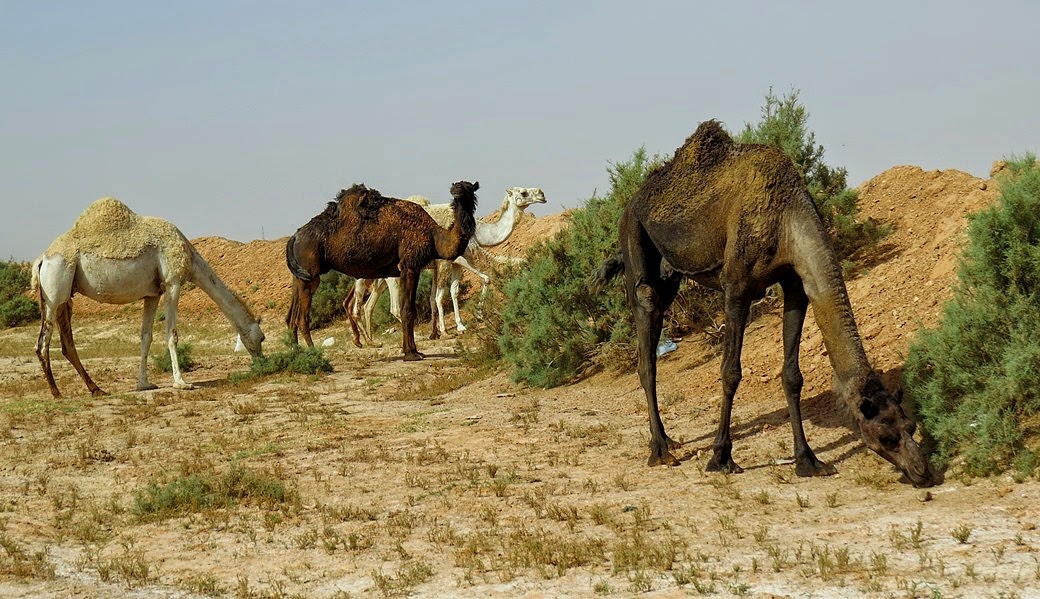
This time there was an additional problem. A herd of camels was parked right in the middle of the area. It stayed for a long time. Furthermore the herder's need for water was greater than mine so I gave him my last water on his request. This made things challenging for the rest of the morning as the temperatures rose.

one of two herds of camel

I did get to see little bittern on three occasions. Each time a bird flushed well before I would have seen it. I have seen them in this area on every visit to the wetland over the past three months.

Another notable sighting was of two wood sandpiper. These are more signs of some lingering late passage.

In the next blog, I'll write about the walk round the east and south sides.

Monday, 24 March 2014

Lakeside views, Riyadh

On Saturday morning I tagged along with Bernard Bracken's trip to the lake near the Riyadh cricket ground. Bernard is taking a masters degree in ornithology and is studying the little grebe population at the lake at the moment.

I spent some time with him at the lake before wandering off into the hinterland to carry on with more general birding.

black winged stilt

The first thing I noticed was that the water level is still lowering. It has been for over a year now since the waste water from the industrial city has been diverted. It used to flow into a near-by field and seeped into the lake through rocks coming out as clean water into the lake. 

little grebe

At the moment, only the moorhen population has deserted the lake. Bernard counted 140 little grebe who so far have stayed on.

the lake

The black winged stilt population is very large currently. Whether this is because numbers are swollen by migrants or because the water levels are actually better for them than previously I don't know.


coot, black winged stilt, little ringed plover

Most birds are very timid and move straight to the far end of the lake as soon as anyone arrives. The coot are based there anyway. The distance was a big test of my camera and binoculars so the pictures aren't that good. Nevertheless I could make out there were plenty of little ringed plover and green sandpiper as well as a lesser number of ruff and common sandpiper at the far end on the mud flats.


little ringed plover, black winged stilt, ruff

The spur winged plover joined them as soon as we arrived even with caution. 

spur winged plover

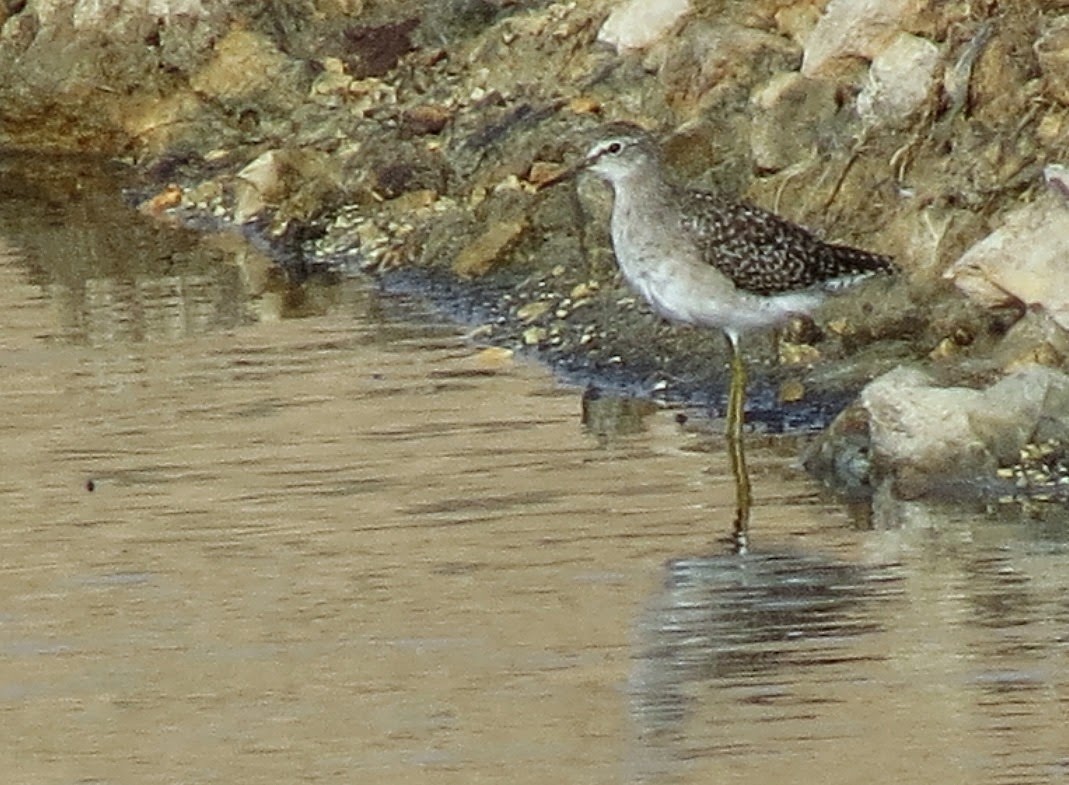
In the pools at our end of the lakes, two species were a little braver. These were wood sandpiper and common redshank.

wood sandpiper

If you look at the main regional guide, you will see that it does not show common redshank in central Saudi Arabia. The map shows it closer to the coast. However, this is not the first time I have seen it at the lake. 

common redshank

After a while, some of the common sandpiper and green sandpiper drifted back across to us.


common sandpiper

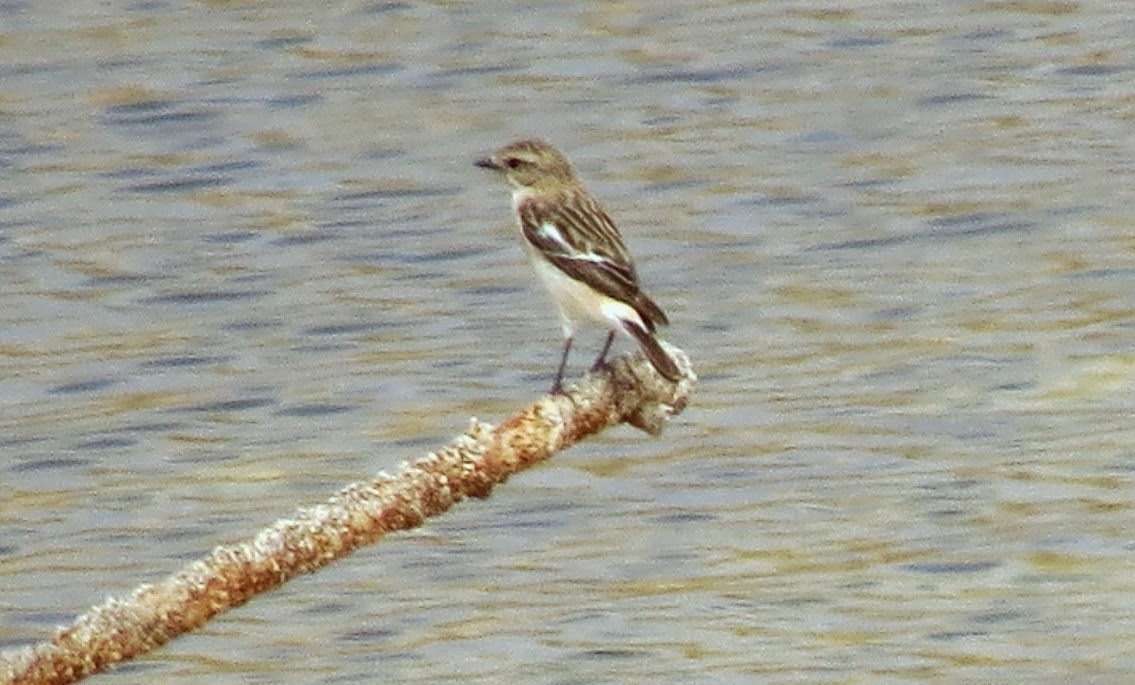
A few other birds were seen over the water. A Siberian stonechat was resting on a metal rod.  Form time to time, barn swallow drifted over.

Siberian stonechat

An other bird was a marsh harrier which was immediately mobbed by black winged stilt and eventually forced off.  the little grebe didn't react at all. We surmise their defence would have been to dive if necessary.

Marsh harrier

While Bernard remained watching the little grebe, I moved off into the adjoining area. I'll blog about what I saw there next.