Showing posts with label northern pintail. Show all posts

Wednesday, 4 January 2017

New site but no new birds

I have not posted for two weeks because of work commitments rather than the festive season that most westerners worldworld have had.

I have a few blogs to catch up with concerning a trip down south over the New Year weekend but first here is one from Nouakchott from Christmas Eve.

These days birding around the city must include a visit to the large freshwater lake in the north of the citty. It is in Sukok district.

One reason to go there is to look for any new duck arrivals. The bad news on Christmas Eve was that though numbers were again up there were no additional species.

In these blog I have tried to show pictures from there of species not shown in the previous blog from the area.

African swamphen is one such species.

African swamphen

Little grebe is another although the two black-necked grebe were also still there.

little grebe

Many of the male ducks were moving out of their eclipse plumage into breeding plumage. This was most apparent with the northern pintail.

northern pintail

Indeed northern pintail was the species of duck with the biggest increase in numbers since the last visit.

female northern pintail

Wigeon numbers maintained a high of six.

wigeon

Wood sandpiper is the most numerous wader. The one spotted redshank was still there.

wood sandpiper

Over the weeks, an occasional western reef heron has turned up. This was the first time a dark morph bird was seen.
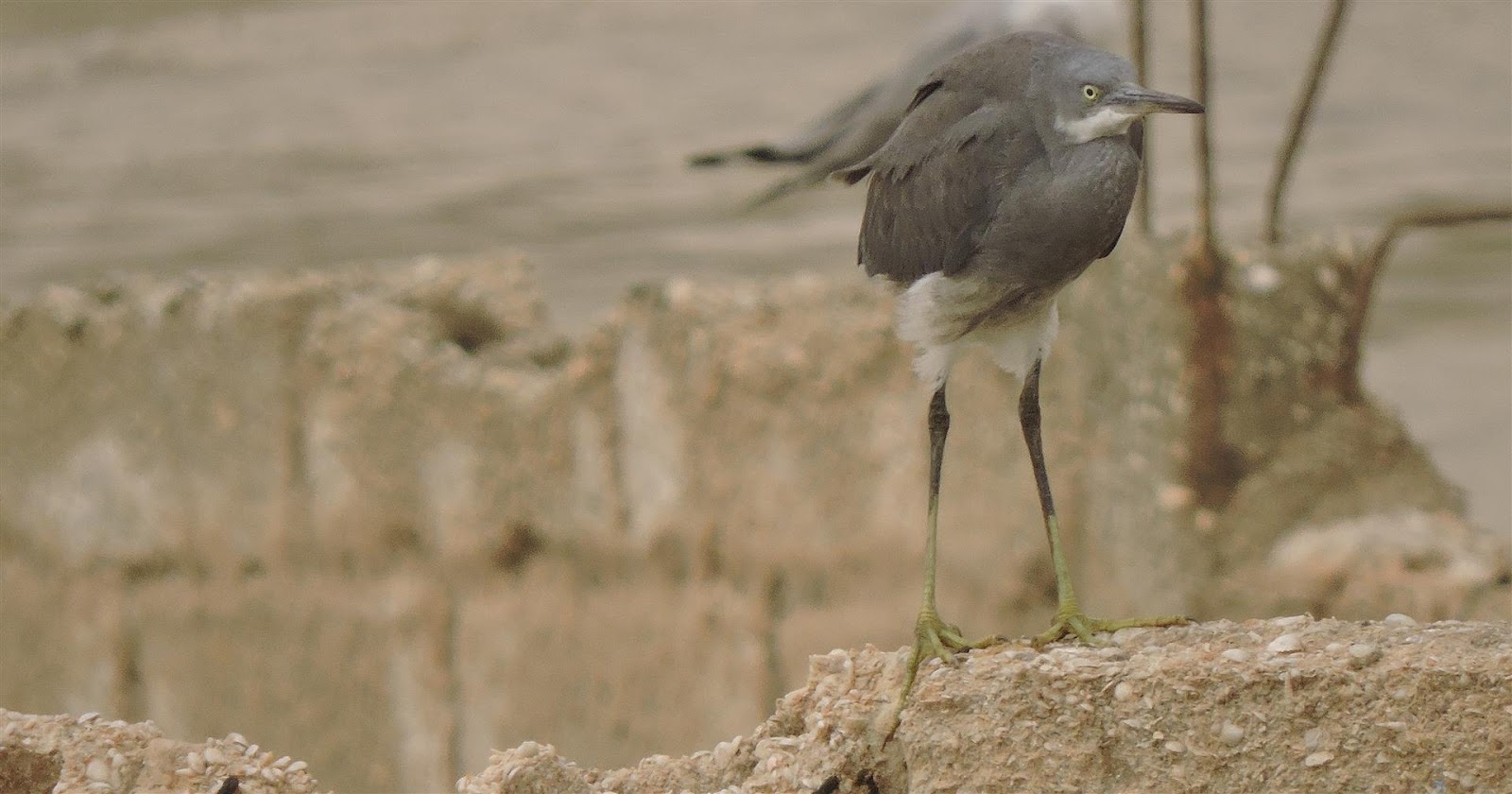
western reef heron

Part way through my visit to the lake, I met up with Dr. Mohamed Vall. Together we next went south out of the city.

There is a right turn just past the gendarmarie check-point that leads to a coastal fishing village. We investigated this for the first time.

Waders were mostly sanderling, red knot and grey plover

Kentish plover 1

However the best wader was Kentish plover which is surprisingly uncommon compared with what I was used to in the Gulf.

Kentish Plover 2

After this, we made it to another new site. This was one was the side of the water company which supplies tap water to Nouakchott. Friends of Mohamed Vall had told him that there was a water body at the back of the works.

The water was a lake and had attracted a good cross section of birds. Indeed I suspect it is going to be very interesting during the spring passage.

We were hampered by poor visibility caused by a sandstorm coming off the Sahara.

Nevertheless, we could see flocks of both Sudanese golden sparrow and of house sparrow.

Sudanese golden sparrow

There were waders including a common snipe and at least two little ringed plover.

little ringed plover

Three male black-crowned sparrow-lark came down to drink while we were there.

black-crowned sparrow-lark

Late on one green sandpiper was seen although wood sandpiper and little stint were more numerous.

little stint

This site will be regularly visited from now on.

wood sandpiper

A week later, over the New Year weekend, Mohamed Vall and I made a two night trip to Rosso on the Senegal River. It was highly successful. I added 14 birds to my country list including three lifers. A series of blogs on this trip will be published next.

Sunday, 16 October 2016

Central lake, Nouakchott

A colleague at work tipped me off that there was a lake with reeds near the Tunisian embassy. He also said it was full with birds. 

I took the first opportunity to visit it on Friday afternoon. 

The first bit of bad news is that it is now quite disturbed as it is being redeveloped as the site for a new Senegal embassy. Sadly it looks like the only fresh water lake in the city is about to disappear. Furthermore I was asked to leave the site (very diplomatically by the way) by the authorities as it is embassy land.


All the other news is good. The site is currently still teeming with birds and I was asked to leave just as I finished my session anyway. 

It was the first time I have seen any ducks in Mauritania. 

northern pintail

 Northern pintail were  numerous.

four northern pintail

However careful looks among the ducks showed that two northern shoveller were there too.

Having looked at my set of photos of this group, I realised there was a Temminck's stint with them. These species has a stronger preferrence for fresher water than little stint and sightings of it in Nouakchott are few.

northern shoveller

This is classic habitat for spur-winged lapwing and several were dotted around the area.

spur-winged lapwing

However the site is best remembered for the sheer volume and variety of waders.

mixed waders

The picture above illustrates some of the variety. There are: ruff, sanderling, little stint, dunlin, common redshank, wood sandpiper and common sandpiper all in close proximity.

common redshank with little stint

I checked all the common redshank but couldn't find a spotted redshank among them. I was hoping for the latter species given the habitat is better than most in the city for it.

Kittlitz's plover

Among the less numerous birds were two Kittlitz's plover.

pied avocet

Two pied avocet and a Eurasian spoonbill also appeard briefly.

ruddy turnstone

Only one ruddy turnstone was seen but the terrain is not perfect for them.

white wagtail

Moving away from the main lake to the surroundings, many white wagtail were on the ground. They are arriving for the winter down here  in big numbers now.

reed beds

At the back of the lake are some thick reed beds. It is difficult to see what is in them and impossible to walk into them. However I found three common snipe and a common moorhen with perseverance. These were the first of either species I have encountered in Mauritania.

It is shame I am not allowed to visit this site again. I suspect more varied ducks in particular will arrive for the winter soon.

Wednesday, 29 October 2014

Mughsail in late October

I made a short trip to Khawr Rori afeter Khawr Swali on Saturday. Here I came across Bart the Birder from Belgium.

He spoke about the first three days of his two week visit to Dhofar and five excellent birds he had seen at Mughsail. I had seen none of them.

After a short time at Khawr Rori, I decided to get in the car and drive all the way across the city and out west to Mughsail. His birding had sounded so exciting there.

Well, I spotted none of his birds!

However in the end I wasn't too unhappy.

intermediate morph western reef heron

The coastal pools were no that great this time. There were plenty of western reef heron and grey heron as well as the same lone flamingo as at my last visit.

black-tailed godwit and black-winged stilt

A black-tailed godwit was the most interesting of the waders there.

I soon decided  to cross the road and go to the two inland pools.

osprey

An osprey flew overhead as I did this.

European roller

An adult European roller was darting about the fields.

northern wheatear

On the way to the second and most inland pool, I came across several wheatears. Finally one of them was a definite northern wheatear. This was another first for me in Oman and my fourth addition to the list on Saturday. Some features that mark it as northern are: strong supercilium, ear coverts darker than crown, no isolated dark alula, grey crown and a tail that reaches the ground. The last feature is new to me following research. It appears Isabelline wheatear are so short tailed that even when standing erect, their tails don't quite make it to the ground.

The back pond was previously unknown to me but thanks go to Belgian Bart for informing me about it. I spent 90 minutes there waiting for some action. Bart had seen a Baillion's crake

I wasn't so successful. There were fifteen or so moorhen.

female northern pintail

As some sort of compensation, I saw my first northern pintail in the country.

gadwell
There were more gadwell there too.

northern shoveller

It is becoming obvious that these khawr are going to attract many ducks and other waterfowl this winter. One of the last birds I saw before I left for the day was a northern shoveller on the main pool.