Showing posts with label oriental turtle dove. Show all posts

Monday, 5 October 2015

Local farms

Having made desert trips every weekend and during Eid since I came back from the summer, I will now concentrate on more local birding in October.

The desert stops give the best potential for new additions to my country list as the migration is concentrated and also better further north. However, I rent a car with annual maximum mileage and I have to make shorter journeys for a while.

On Thursday evening and parts of Friday, I visited local farms. 

It turned out that doves became an important feature of what I saw.

Indeed two of the early birds seen at Sawnaut farm on Friday morning were turtle doves.

Oriental turtle dove

There were two but one was an Oriental turtle dove while the other was a European turtle dove.
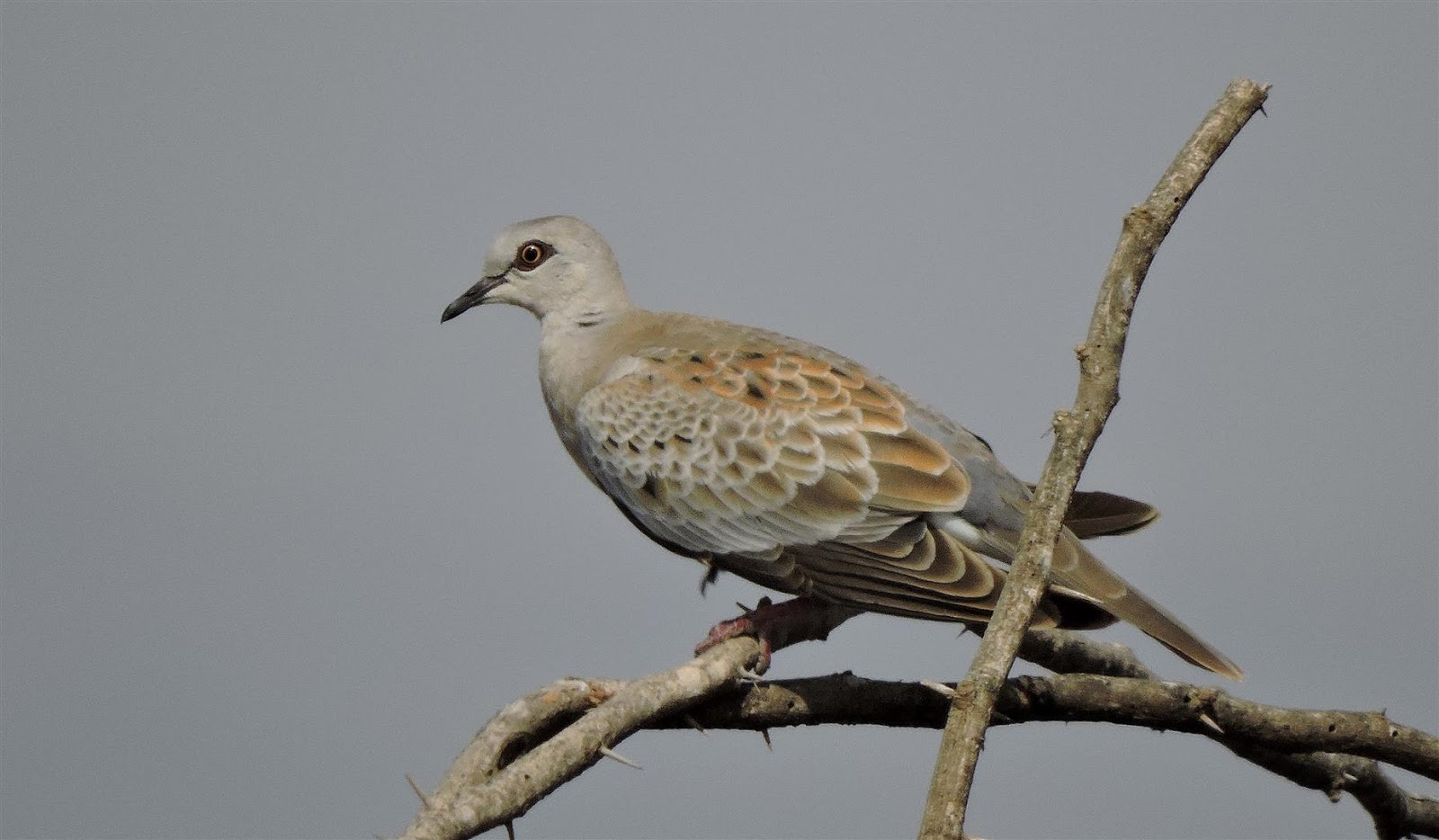
European turtle dove

From the poorly marked throats it can easily be seen that both are young birds.

both turtle doves together

It's not often you can get close to one of each and do such a direct comparison. However, apart from other features the oriental bird is distinctly larger.

female Namaqua dove

Along the same stretch of the farm's western perimeter, I came across nine Namaqua dove. This is the largest number I have seen in Oman where they are much less common than in some parts of Saudi Arabia.

male Namaqua dove

Eurasian collared dove is the most abundant at the farm but it was the only one I didn't photograph.

laughing dove

Laughing dove is the second most common. On some days I can count both species at the farm in their hundreds.

laughing dove taking off

Actually, I managed to count another species in their hundreds at the farm on Friday and that was chestnut-bellied sandgrouse.

The evening before, I had checked out the small farm at Taqah.

Doves or more exactly a dove became my primary interest there.

unidentified dove 1

There was one bird among the European collared dove which was different and obviously so. It was more uniformly more earthy-brown coloured.

unidentified dove 2

I have not managed to positively identify it though some sort of miscoloured European collared dove or escaped dark form of a barbary dove are most likely.

distant shots of the dove by Michael Immel

My birding friend Michael Immel also took photos and is kindly allowing me to show his crops of them.


another distant shot by Michael Immel

Even with these extra photos a positive identification is not certain.

spotted flycatcher

I haven't visited the farm at Taqah before. Other notable birds apart from the residents were yellow wagtail and spotted flycatcher.

The third farm that was visited was Jarziz farm in the city. Doves were not a feature there.

European roller

Six European roller were counted on the main pivot bar which straddles the huge field.

Montagu's harrier

Two Montagu's harrier and one marsh harrier were patrolling the field for locusts and presumably any tired birds. They must be a constant danger to the many singing bush lark which reside there.

red-backed shrike

Other notable birds included a male red-backed shrike and a golden oriole.

In some ways it was good to be back at local locations but I already miss the desert birding.

Thursday, 18 December 2014

Sociable lapwing and two types of turtle dove at the farm

I have a little bit more time on Wednesday afternoons to go birding than on other weekdays. I chose to stay local and go to Sawnout farm.

On my drive out as I was travelling down the main road which cuts the farm in two, I saw a large flock of sociable lapwing fly directly over my car. This was an auspicious start. There was no chance to stop and for some reason they had flown from the arable and beef section of the farm to the smaller plantation and marketing gardening section.  This southern section has no easy lines of sight.

Nevertheless I decided I ought to go looking for them. Indeed I spent all the next 3 hours looking for them.

Oriental turtle dove

Early on in the search as I was scanning I came across three turtle doves on adjacent wires. One was an Oriental turtle dove but the other two were European turtle dove.

First European turtle dove

The European turtle dove is noticeably lighter, This is mostly caused by the much broader orange scapulars. There are other major differences too which I wont go into as the identification is clear. However I did check on birdforum where the verdict was unanimous. I did this because others have only reported oriental turtle dove at the farm this year.  Both species are known but rare winterers to the Dhofar region.

Second European turtle dove

Returning to the search for the sociable lapwing: I first took a quick look at the southern perimeter of the cereal farm where I could see interesting species such as chestnut-bellied sandgrouse and cream-coloured courser but no lapwings.

male chestnut bellied sandgouse on the farm

I then decided to drive to the coastal side of the southern section of the farm to see if there was line of sight and to pick up the sociable lapwing, This is a two kilometre drive past east Khawr.

This proved fruitless. The best birds I saw were more chestnut bellied sandgrouse near the coast.

chestnut bellied sandgrouse near the coast

I then decided it was best to go to the western perimeter of the northern (main section) of the farm and wait. It was on the way to that point that I saw the turtle doves.

European roller

So it was on the western perimeter than I spent over two hours waiting and watching. On a near-by pivot bar was a dark European roller and on near-by dead palms were both rose ringed parakeet and on another was kestrel.

rose ringed parakeet

However for the most part I was looking into the farm.

kestrel

There was the odd distraction for example when eight greater white fronted geese flew over.

greater white fronted geese

As I watched I could see there were two main areas of large scale bird activity. One was next to me  where part of a field had been very recently cut. The other was over 500 metre away where a pivot bar was spraying water on some high crops. The white winged black tern were mostly over there. The cattle egret went from one to the other.

common myna

Large numbers of common myna and yellow wagtail were also seen on the cut field near me.

cattle egret

I had no sign of the sociable lapwing until a pallid harrier went to the spraying area about an hour before sunset. Suddenly the cattle egret and white winged black tern bolted 500 metres to field next to me. However there was third flock and as it took to the air I realised it was sociable lapwing. They had probably been in among that high crop being sprayed for some time.

yellow wagtail

Unfortunately for me they moved off to another field of high crops almost as far way. 

black crowned sparrow lark

With a few minor distractions such as the sight of a black-crowned sparrow lark on the edge of my field, I kept my eye on the lapwings at great distance.

sociable lapwing on the move

Fifteen minutes before dusk they suddenly and at great speed left the farm westward presumably to roost. They came a little closer for moments as they left. I managed one distant shot in the gloom of the leading group. 

I should get better views this winter as they are likely to stay here on past record.

I have now seen them in three countries: Azerbaijan, Saudi Arabia and Oman. 

List and numbers of species seen at the farm

Greater white fronted geese 8
Cattle Egret 110
Squacco Heron 4
Greater Spotted Eagle 1
Eastern Imperial Eagle 1
Eurasian Marsh-Harrier 1
Pallid Harrier 2
Sociable Lapwing 32
Cream-coloured Courser 2
White-winged Tern 40
Chestnut-bellied Sandgrouse 6
Feral Pigeon 20
European Turtle-Dove 2
Oriental Turtle-Dove 1
Eurasian Collared-Dove 260
Laughing Dove 120
Namaqua Dove 5
European Roller 1
Common Kestrel
Ring-necked Parakeet 22
Daurian Shrike 2
Asian Grey Shrike 1
House Crow 6
Crested Lark 5
Black-Crowned Sparrow-Lark 1
Sand Martin 6
Barn Swallow 25
Graceful Prinia 2
Desert Wheatear 5
Isabelline Wheatear 2
Common Myna 35
Yellow Wagtail 90
White Wagtail 8
House Sparrow 6
Ruppell's Weaver 14
African Silverbill 38

Wednesday, 4 July 2012

A walk round the block in Tokyo

As I hinted in my last blog, I have travelled east to go birding for the large part of my summer break. My main birding destination are three south pacific islands but I am taking chances to do a bit of birding en route.


I don't like long haul flights. Who does? So I decided to break the outward journey with a two-night stop over in Tokyo. It is there that I am now. 


I am completely jet lagged. I literally don't know what time of day it is. A couple of hours ago I decided that a walk round the block with some birding thrown in was my best chance of staying awake until the evening and hence to sleep during the proper cycle tonight.

oriental turtle dove

Even in my semi-comatose state I got four lifers in forty minutes. I suppose this shouldn't have been unexpected since I have never birdied in the far east before. Things were helped by the fact that birds in parks here seem even tamer than in the UK.

The oriental turtle dove was a lifer and quite frankly it would almost have let me touch it!

This is actually an extremely rare but possible bird in Saudi Arabia where most of my birding is currently done. Though I haven't seen it there. There is lots written on how to tell the European turtle dove and oriental turtle dove apart. The most persuasive one for me is that the black centres of the wing coverts are more extensive on the oriental bird making it look darker.

tree sparrow

Actually, only a few birds were immediately identifiable today and they were pretty much restricted to tree sparrow and feral pigeon.

white cheeked starling

I didn't know what the flocking starling or myna was until I looked it up on the internet (since I only have a bird guide for the south pacific on me - nothing for Japan). Apparently these birds are white cheeked starling. It appears I am not the only one who thinks they look like a type of myna.

very sociable birds

Like all starlings they were very gregarious.

jungle crow

I saw two corvids, neither of which I have seen in my life before. The first is jungle crow which for good reason is sometimes called thick-billed crow. The sub species found in Tokyo is as large as most ravens.

azure winged magpie

The second new corvid was azure winged magpie. It is found in Spain but I have't birded there. I had to go all the way to Japan to see it for the first time.

Two birds which escaped identification was a type of cormorant (I am close to the sea) which was seen flying over head a few times and also a very loud cuckoo type bird which evaded prolonged viewing. 

Let's see what tomorrow brings when I am better rested and more focussed.