Showing posts with label pied flycatcher. Show all posts

Friday, 1 September 2017

Back at the waste water site

We have a long weekend this week for Eid. I took advantage of this yesterday with a Thursday morning visit to the waste water site north of the city.

There was plenty of passage and I recorded the most species I ever have at this site.

The first bird seen was a Namaqua dove which is resident. 

Namaqua dove

Moments later the fun started. I spotted a a hepatic (brown) common cuckoo. Sadly, I moved towards it too quickly and it disappeared not to be traced again. This form of cuckoo is quite common in the Middle East but much rarer in West Africa apparently.

I walked on along the south side of the avenue of trees which run west to east towards the waste water. This is my habitual route. It allows me to see towards the trees with the sun behind me. I save going under the trees until the way back when the temperatures have risen. 

spotted flycatcher

A spotted flycatcher was another sign of passage and I had barely walked 30 metres.

first year willow warbler

The first of many willow warbler was a bright first-year bird. I counted  at least 20 willow warbler by the end and yet ebird has this species down as rare in Mauritania at this time. I had to add the species to the list. Indeed more generally ebird doesn't think many types of warbler come through Mauritania in August. 

female black-crowned sparrow-lark

On my walk, as usual,  I deviated from the avenue of trees to get to the water's edge. Just before the first water is a grassy area where I can see larks and hopefully pipits and wagtails later in the year.

This time I only came across a female-type black-crowned sparrow lark.

On the way there, a European roller flew over. This was the second really good bird which escaped my camera.

spur-winged lapwing

Even before I reached the water's edge, the spur-winged lapwing had raised the alarm.

This caused a chain reaction with some common redshank panicking loudly.

black-tailed godwit

Other waders have a more placid temperament. I observed my first black-tailed godwit since retruning from my summer break. 

blue-cheeked bee-eater

Walking round the water, allowed me good views of the site's blue-cheeked bee-eater.

glossy ibis

Once again, the site held glossy ibis. This time there were two.

common ringed plover

On this visit, there were no Kentish plover or little ringed plover. A single common ringed plover was in the muddy areas. They can be many of all three species at different times in the muddy and sandy areas next to the main water.

western bonelli's warbler

By far the most numerous warbler was willow warbler, both in the trees and in the euphorbia bushes near the water. One exception in the bushes was a lone western bonelli's warbler. This was one looks to be late as that warbler was the most numerous three weeks ago.

purple heron

There were no grey heron this time but there was a purple heron. It was the first time I had seen one in the Nouakchott area.

whimbrel

At the eastern side of the site are three or four smaller pools. Here I finally caught up with an extremly wary whimbrel. At this eastern side, I normally turn round to walk westward along the avenue of trees. This is when I will go under the trees in places.

I have just turned to head west, when a great spotted cuckoo flew over. This was the third good bird of the day which escpared my camera and wasn't seen again. 

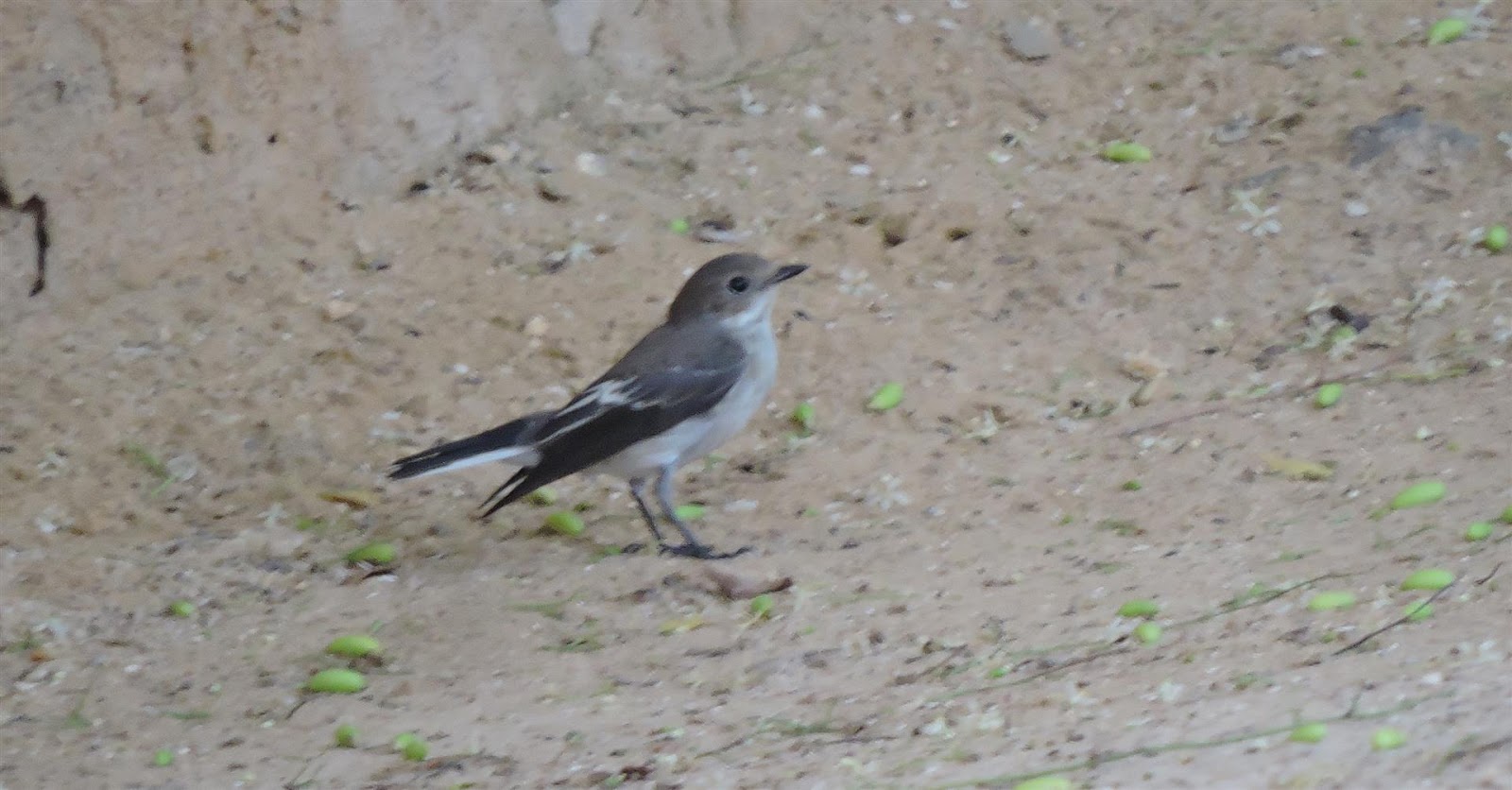
pied flycatcher 1

In among the trees it became obvious that several pied flycatcher were on site.

pied flycatcher 2

From the tail pattern, none of them were candidate Atlas flycatcher or even the Iberian sub-species of pied flycatcher. These birds most likely came from the UK or France.

willow warbler 1

There is a small pool actually in the avenue of trees. This continues to be a good place to stop and patiently look for warblers to appear. Willow warbler were well seen and close up.

willow warbler 2

There was at least one European reed warbler and three western olivaceous warbler there too.

western olivaceous warbler 1

The longer I stayed and without moving, the more the warblers came out. A western olivaceous warbler gave the best views of all.

western olivaceous warbler 2

I was checking all the willow warbler for the possibility of Iberian chiffchaff. All the population of this species apparently winters in West Africa yet there have been very few positive identifications.

It has a leg colour intermediate between a typical willow warbler and common chiffchaff. It has intermediate face pattern and wing length too though in all cases, on average it is closer to common chiffchaff.

Apparently it has much less buff tones on its upper parts than nominate common chiffchaff. It often has a distinctive bright yellow aspect to the front of its supercilium.


probable willow warbler 1

I understand it always has a yellow undertail and the belly is usually lighter than surrounding underparts.

The bird in the pictures above and below was a candidate for Iberian chiffchaff to me. However I really don't like the apparently pale undertail. It is in all probability a willow warbler with dark legs.

probable willow warbler 2

Having said this, either they overfly Mauritania-Senegal-The Gambia or the species is being overlooked.

Continuing my walk under the trees, a nightingale was observed. I find this bird is much easier to see on passage than in its breeding areas.

nightingale

It was another good day at the waste water site. If the water stays as large an area as it is at the moment and doesn't get poisoned, the next few months could be very interesting.

Species seen at the waster water site on August 31st
Great White Pelican  
Purple Heron  
Glossy Ibis  
Black-winged Stilt  
Spur-winged Lapwing  
Common Ringed Plover  
Whimbrel  
Black-tailed Godwit  
Ruff  
Little Stint  
Common Sandpiper  
Wood Sandpiper  
Common Redshank  
Speckled Pigeon  
Laughing Dove  
Namaqua Dove  
Great Spotted Cuckoo  
Common Cuckoo  
Pallid Swift  
Eurasian Hoopoe  
Blue-cheeked Bee-eater  
European Roller  
Woodchat Shrike  
Black-crowned Sparrow-Lark  
Crested Lark  
Barn Swallow  
Willow Warbler 
Western Bonelli's Warbler  
Western Olivaceous Warbler  
Eurasian Reed Warbler  
Western Orphean Warbler  
Common Whitethroat  
Spotted Flycatcher  
Common Nightingale  
European Pied Flycatcher 
House Sparrow  

Sunday, 4 September 2016

Central Nouakchott

Very few birders come to Mauritania and those that do tend mostly to visit the two national parks. These are Banc d'Arguin and Diawling. The former is coastal wetland containing millions of waders while the latter is semi-tropical rain forest on the border with Senegal. A handful of birders visit the far north to add to their western palearctic list.

I will go to these places in good time though transport will be an issue. However I am not a visiting birder. I have started work here and will bird in any spare time I have.

At the moment I am based in central Nouakchott in the leafy district of Taveragh Zeina. 

In the first two days, I have restricted myself to walking round the neighbourhood in the early morning. It is seriously hot during the day.


Iberian pied flycatcher 1

It is almost immediately obvious that the bushes and trees are teeming with early migrants from western Europe. I believe this should not be a surprise because Nouakchott is the first greenery south of the Sahara and very close to the Atlantic coast.

Pied flycatcher is relatively common. The one in the first two pictures is of the Iberian sub-species. The tail is all black ruling out nominate but the lack of a very large white patch and lack of the strong second white wing bar rules out Atlas flycatcher (sub species as far as e-bird is concerned). This bird is an Iberian pied flycatcher.

Iberian pied flycatcher 2

The bird below is of the nominate sub species. Please note the white edges to the tail.

nominate pied flycatcher

Remarkably spotted flycatcher is less common at least at the moment.

spotted flycatcher

For me, the main story of this birding so far is the volume of warblers in the trees and bushes.

first year willow warbler

The most numerous warbler at the moment is willow warbler. While western olivaceous warbler is the second.

under the first year willow warbler

I have also seen two western Bonnelli's warbler.

first western Bonnelli's warbler

All doubts of the birds nature were dispelled when it flew. The yellow rump magnifies the yellow-green in the wings and makes it distinctive.

second western bonnelli's warbler

I have also seen singles of lesser whitethroat, Eurasian reed warbler and chiffchaff so far.


I am working off the first edition of Birds of Western Africa and the Atlas of Mauritanian birds. The blue-cheeked bee-eater I am seeing are most likely resident birds.

The guide book shows them resident just south of Nouakchott but I suspect these birds are too.

blue-cheeked bee-eater flying off

As well as wires they seem to like to perch on high tamerisk.

a settled blue-cheeked bee-eater

Another resident bird is blue-napped mousebird. Nouakchott is at the extreme north of it breeding range.

blue-napped mousebird

Interestingly, the first editon of Birds of Western Africa doesn't have an entry for European collared dove yet the book covers Nouakchott. Conversely the Atlas of Mauritanian birds has no records of African collared dove. 

European collared dove

Both sources only show half the picture. The city contains both. European collared dove is the more common. 

One way of separating them is the colour of the lower belly and vent. It is almost white in African collared dove and grey in European collared dove.

Underside of European collared dove

African collared dove was more difficult to find though I heard it twice before seeing one.

African collared dove

Other doves observed so far are: laughing dove, feral pigeon (rock dove) and Namaqua dove.

Namaqua dove

There are probably hundreds if not thousands of house sparrow in the city but the e-bird database is querying my records of above 20 each walk. I think this is symptomatic of the recent expansion of this species into sub-saharan Africa.

house sparrow

Another invasive species is rose-ringed parakeet and they were soon found.

More blogs will follow as I am here for the duration. It has been an interesting start.

Saturday, 30 April 2011

A wet day on the way to General Kandardjievo

It's been a miserably wet and cool April in my part of Bulgaria. That's not just the view of a man who is used to Libyan heat. Statistics show it is the coldest for a decade.

Nevertheless, I went on one of my favourite walks on Wednesday afternoon. The road between my village of Klimentovo and the next one of General Kandardjievo is straight, quiet and tree lined. There are ploughed, planted and unploughed fields either side of the road and a pleasant wood just before Kandardjievo. Its also on a plateau at 350 metres. The habitats usually generates a variety of birds.


When I do this walk its usually to my friends' house in Kandardjievo and with any luck I get a lift back. This was the case on Wednesday.


part of the road to Kandardjievo

In the summer you are guaranteed to see golden oriole flitting around. This year there are no leaves yet and very little cover for such a shy bird!  


The rain died down a bit on Wednesday afternoon though it was still spitting during my walk.


The corn bunting weren't put off and were everywhere.  Starling and jay were in the trees on the edge of my village. Many birds were probably skulking because of the wet. However in the fields either side of the road there were very large numbers of active skylark.

a wet looking skylark

The field below may look deserted but every minute or so a skylark or two would soar into the air, singing their hearts out presumably to attract females.

\
local damp field

On two occasions I was watching one species and by the time I took out my camera another species was accidentally around which got snapped instead.!  I was following two blue tit with my binoculars. As I took out the camera they flew off but on the same tree was a pied flycatcher.


pied flycatcher

This was very lucky since this is a passage bird. The closely related semi-collared flycatcher is a summer breeder in this area but pied flycatcher only breed in countries further north. 

another view of pied flycatcher

I got three shots of the bird and can see its collar is too short for a semi-collared flycatcher and it had two white dots above the bill not one.


chiffchaff

This chiffchaff was the second accidental bird to be photographed. This time I was following a northern wheatear sitting on a stone near a bush. By the time my camera was out, it had flown over the bush but I snapped the other bird on the bush out of instinct without even seeing what it was before hand. I am quite pleased because warblers are more difficult to photograph than wheatears.


whinchat en route

My final shot is of a whinchat. It wouldn't look me in the face however its a good picture to show you how spotted-looking their lower back can be. The supercillium differentiates it from a stonechat anyway but even without seeing that characteristic its "spottiness" is a dead give away.

Three other notable birds also seen en route but poorly photographed were hoopoe, common buzzard, magpie and cuckoo.

Next time I review this walk I challenge myself to bring you back photos of golden oriole.