Showing posts with label spotted crake. Show all posts

Monday, 22 February 2016

Tudho and Mazyunah

Travelling towards the Yemen border, midway between Mudhai and Mazyunah but 12 kilometres west off the main road is Tudho. It is at top of Wadi Aydam but it is possible to get down in this widest and deepest of wadis in Dhofar.

The wadi is apparent a stronghold of Oman's trumpeter finch. This species is still a target for me in Oman and was the main reason for my detour.

It was recommended that I stake out a 10 metre long water trough where the finch is known to come down to drink. After a walk around the area especially looking up the cliffs a stake out is exactly want I did.

I waited patiently for two and half hours under a tree but no finches arrived. Perhaps it wasn't hot enough, perhaps it was the wrong tine of day. I will try again some time and later in the afternoon on a hotter day.

The place was not without other birding attractions. There were plenty of both Nile Valley sunbird and Palestine sunbird about. Not many birds find a use for Sodom's apple bushes but they do.
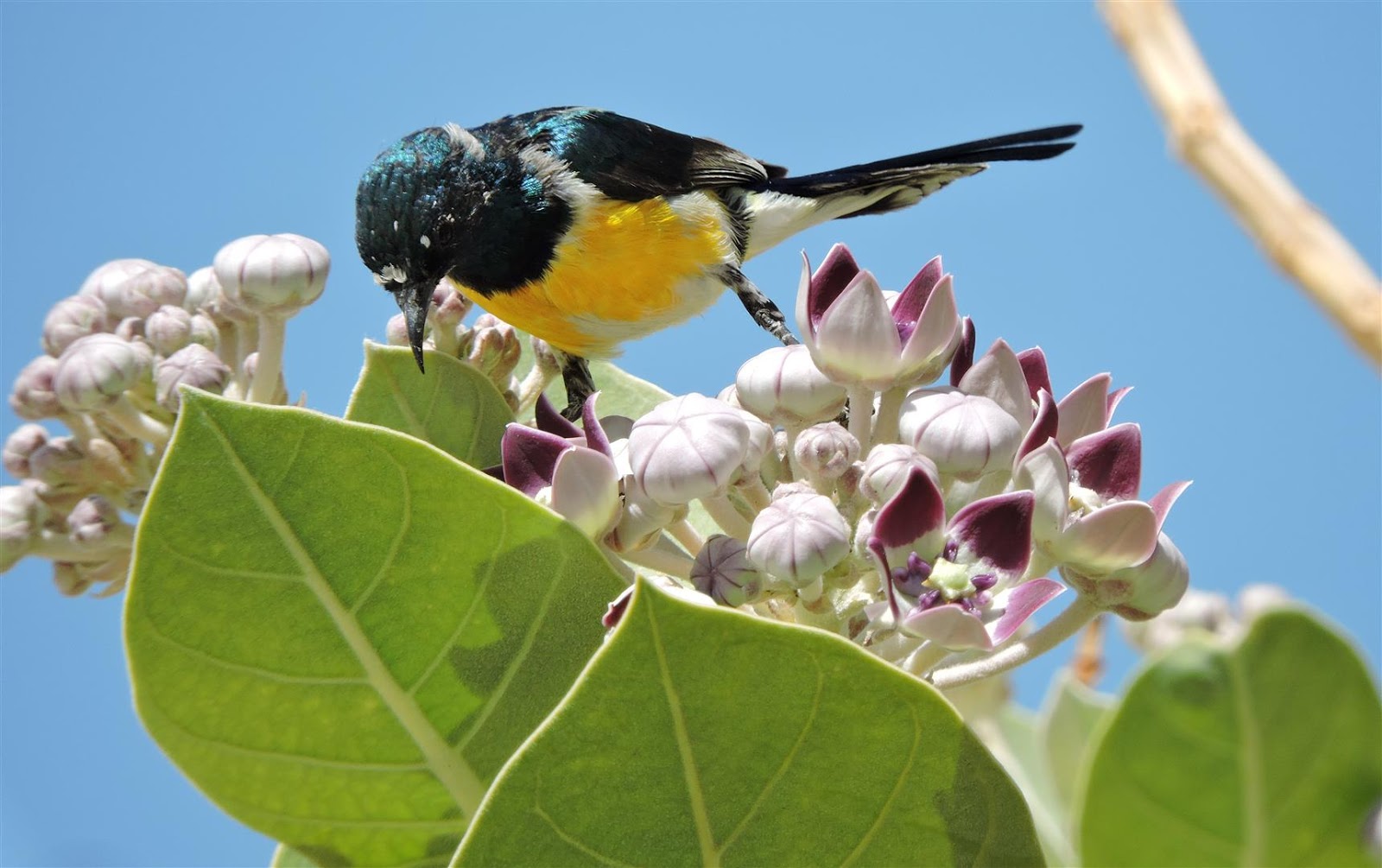
Nile Valley sunbird 1

The best observations and pictures of them were taken as I sat under the tree. Being totally still often works. The male Nile valley sunbird are close to attending their full breeding plumage at the moment.

Nile valley sunbird

Palestine sunbird also visited the same bushes and often at the same time as the Nile Valley sunbird.

Palestine sunbird on Sodom's apple

Palestine sunbird but not Nile valley sunbird was also seen drinking. They didn't drink from the water trough but from a leaking tap and its pool. I never underestimate the birding value of leaking taps in Arabia.

Palestine sunbird moving in to drink

The water trough did attract some birds to drink. The most regular was a desert wheatear.

desert wheatear at the water trough

The most numerous were desert lark and laughing dove.

desert lark

Indeed the density of desert lark in the area was one of the highest I have ever seen. In the near-by camel pens they were crawling around like a flock of sparrows.

laughing dove

White spectacled bulbul were drinking from both the trough and leaking taps.

white spectacled bulbul

After Tudho, I pressed on to Mazyunah and arrived at the Old Sewage pond around 3.30pm.

There was very little change since the week before and so this extension of the trip turned out to be unproductive. I expect this to be different once the passage season starts in earnest. 

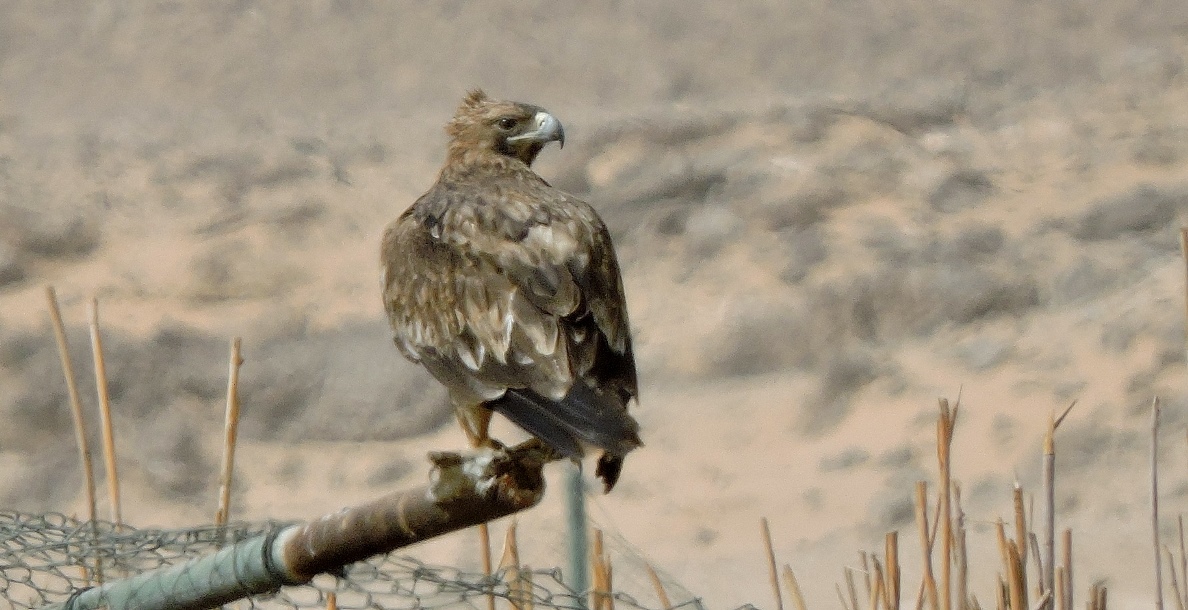
Eastern Imperial eagle

Two eastern imperial eagle were actually wading in pool.

bluethroat

Passerines including white wagtail, water pipit and bluethroat were easily seen around the reeds and near-by water.

spotted crake 1

A spotted crake was walking out in the open as soon as I arrived at 3.30pm. I parked up and watched it from the car. This was surprising and yet I didn't see a little crake at all. Even though it is now on my Oman list, it is still a difficult bird for me.


spotted crake 2

Friday afternoon was not as successful as the morning where the Cretzschmar's bunting was seen en route. However I will certainly be coming this way again during the passage. I believe Mudhai, Tudho and Mazyunah have great potential then. I might even finally pick up the resident trumpeter finch too.

Thursday, 18 February 2016

Mazyunah in late winter

A week ago Friday I made the long day trip to Mazyunah on the border with Yemen with visiting birder Markus Craig. 

It is sufficiently different from Salalah to give me prospects of new additions to my Oman list. Notably I had Dunn's lark, golden eagle and little crake (at the small wetland there) on my mind. All three are tricky birds. Indeed any bird not already on my country list is tricky. The list is too long now to have any "easy" left.


To get to Mazyunah you have to travel to Thumrait and then via Mudhai. The stretch of road between Thumrait and Mudhai is about the only place in recent years where the elusive Dunn's lark has verifiability been seen (though there have been more doubtful reports from Al Beed farm). 

We studied every lark we came across there causing us to "lose"all the early morning. Every one was a desert lark. Dunn's lark is tough.


Desert lark by Markus Craig

As we finally pressed on towards Mazyunah we stopped briefly at a hamlet called Qafa on a dirt side road marked towards Shisr. I had seen European turtle dove and a crowned sandgrouse there on a previous stop.

Black redstart

This time the best bird was a black redstart assumed to on passage as the habitat there is very open. The small water tank is a big attraction.

As we neared Mazyunah we noticed the town's rubbish dump on the left hand side about 5 kilometres out. 

Scattered on the hill tops around it were several large birds of prey which all turned out to steppe eagle with one griffon vulture which soon departed.

steppe eagle perched

The steppe eagle were all adult or near adult.

steppe eagle 1

They approached closely on occasion.

steppe eagle 2

We stayed some while as it was always possible that a golden eagle might be around. It proved not to be the case.

Egyptian vulture

Nevertheless by staying we noticed the arrival of six Egyptian vulture.


Spotted sandgrouse

Twenty spotted sandgrouse also flew over.

Close to Mazyunah we divided our time during the day between the old sewage pond just to the north of the city and the smaller new sewage works to the south off the Tosinat (dirt) road.

The latter had few birds except on our first arrival where three birds of prey were drinking. These were two Eastern Imperial Eagle and one steppe eagle.

Eastern Imperial eagle at new sewage works by Markus Craig

The old sewage pond with its reeds and overflow creating a long stream is the best birding location though.

Eastern Imperial eagle at old sewage pond

Here several Eastern Imperial eagle came and went to drink all day long. Ducks and waders included pintail, teal, garganey, mallard, ruff, Temminck's stint, wood sandpiper and more. All these were in a desert location.

Desert wheatear were scattered around but there was also one red-tailed wheatear. It is right at the south westerly edge of its known wintering range.

red-tailed wheatear

From four pm onward birding came frenetic. Bird activity rose substantially. It began as we spotted a wintering whinchat. This follows on from one seen at Muntasar oasis a few weeks ago.

whinchat by Markus Craig

Four water pipit hadn't been seen during the day either.

water pipit by Markus Craig

Both Eurasian collared dove and African collared dove started to gather around the reeds where we assume they roost at night. The numbers that can be seen here are the highest in Oman.

African collared dove (l) and Eurasian collared dove (r)

To finish the day we looked for crakes and found two very quickly. One was a spotted crake which was seen first and was more open.

spotted crake

The second was more problematic. We had trouble with quaity of our photographs and separating the possibilities of adult Baillon's crake from adult male little crake.

We saw the bird had clean deep blue underparts with little barring on the flanks and the shape including primary projection supported little crake. However we struggled to see any red on the bill. This left us in some doubt.

Luckily Hanne and Jens Eriksen visited four days later and cleared the mystery up. From their observations and pictures it can be seen the the red at the base of the bill is very small. This was a lifer for me and instructive in what features can and can't be used in the field to separate the adult male birds.


little crake at Mazyunah by Hanne and Jens Eriksen

Little crake and particularly adult birds are uncommon in Oman. Mazyunah is about as close to their main migration route (a little north and west of Oman) as there is in the country. 

close up of little crake at Mazyunah by Hanne and Jens Eriksen

I am grateful for Markus Craig's company on this trip and permission to reproduce some of his photographs. I am equally grateful to Hanne and Jens Eriksen for permission to reproduce their photographs of little crake. Ownership of all these photos remains with them.

Wednesday, 13 January 2016

Two vagrants still at Khawr Rori

I visited Khawr Rori on Tuesday afternoon for the first time in two weeks. There are two distinct birding areas and I went to both. 

One is the north west off-shoot of the main Khawr and which contains a large reed bed. It is approached from the main road.

On arrival there I immediately came across the vagrant Malachite kingfisher in the very first (and very small isolated clump) of reeds. I didn't notice it until I had nearly walked into it. I managed one quick photo before it flew off.

However I met it again about 100 metres away and I wasn't even looking for it. Again I was only about 3 metres away but this time it didn't fly off. I felt very lucky and privileged to not only get a second change but a good one too.

Malachite kingfisher 1

Tommy Pedersen and I saw one here in June. The same one or another was seen in October and it is presumed this is the latter bird as it has been seen continually since. Our record was the eighth record and this one is recorded as the ninth as there were no sightings in the summer.

One pair of birders say they recently saw two together and I believe I may have glimpsed that too (but not on Tuesday). 

Malachite kingfisher 2

Although the bird is very attractive it is difficult to get good pictures primarily because it is considerably smaller even than a house sparrow.

Malachite kingfisher 3

Elsewhere in the reeds I observed several bluethroat, citrine wagtail, clamorous reed warbler and a Namaqua dove alongside the more common Ruppells weaver and white spectacled bulbul.

Bluethroat

I also observed two common snipe

common snipe

This is a good place to see crakes especially after five in the evening.

spotted crake

I had excellent views of two spotted crake and one Baillon's crake but little crake has still evaded me in Oman.

lesser flamingo

Earlier I had been in the main section of the Khawr. Seven lesser flamingo had been there on December 28th but that had diminished to two on Tuesday. This still meant that along with the Malachite kingfisher there were two vagrant species present.

lesser flamingo with black-tailed godwit

The collection of ducks and waders was similar to the late December visit too although  I didn't see a marsh sandpiper that time.

marsh sandpiper (foreground)
'
This time last year, 25 greater white fronted goose were present. This year only one has been seen. Diving ducks are far fewer too. The weather has been warmer to the north and this may well be the main reason.

greater white fronted goose

Larger numbers of great cormorant are no real compensation.

great cormorant

It was however overall a very rewarding afternoon.

In other news, on Sunday I had hosted some a non-birding friend and his family around one or two nature sites. I was not birding and yet I saw an Arabian golden winged grosbeck and masked shrike at Ain Razat in passing. We also visited Al Balid. This time I did get the camera out and found three spotted thick-knee while they visited the frankincense museum.

young spotted thick-knee

One of the birds was a juvenile while the other two were adults.

first adult spotted thick-knee

Along with the Crowne plaza golfing range and surrounding area, this is one of the better bets to see this bird.

second adult spotted thick-knee

Next week I am taking a winter break in Spain. It is not a birding break but I hope to do a little. I will report on this.

Thursday, 31 December 2015

Lesser flamingo and more at Khawr Rori

I had dinner with visiting German ornithologists Heidi and Jens Hering on December 28th. The last time we had met was in Benghazi in 2011 days before the revolution started. It was good to see them again.

In passing Jens mentioned he had seen and photographed a lesser flamingo at Khawr Rori the day before.

I knew it was a vagrant. Indeed there have only been five previous records. However one was of a flock of 270! birds back in 1995.

I took my first chance to go to Khawr Rori and I was there at 3.30 pm the next day. I didn't want to miss my chance.

What I saw surprised me in a very pleasant way.

four lesser flamingo

Jens had seen his bird near the dhows exhibit. I scanned the banks close-by and found not one but four. They appeared to be ravenously hungry and would almost certainly have allowed much closer approach than I risked.

two lesser flamingo

They were not venturing into the water but seemed happy to eat at the edge. I watched in awe for 10 minutes or so.

pintail resting

Eventually I pulled myself away and started scanning for any rare ducks. There were large numbers of shoveller in the water and a similar number of pintail resting on a far bank.

wigeon (back) with garganey

Diving ducks are much rarer so far this winter than last. However other than shoveller and pintail, there were several teal and at least one each of garganey and wigeon. Although garganey is the first duck to arrive in Dhofar in the autumn, its numbers drop (but not to zero) in mid-winter.


three more lesser flamingo

While still scanning for ducks, this time on a far bank I realised that among the resting shoveller and pintail were three more lesser flamingo making seven in total.

male and female teal

Most male teal now have their breeding plumage. 

Eurasian coot

In another part of the khawr on the north western spur, several coot were swimming. They were divided into two distinct groups.  Looking closely I noticed that the larger group contained Eurasian coot. However the smaller group were all red-knobbed coot.

Red-knobbed coot

The adult red-knobbed coot are supposed to lose the knobs outside the breeding season, yet I have yet to see a time when they are missing. They also have bluish bills rather than pinkish ones of Eurasian coot. The feathers which intrude on the bill are rounded compared with the sharp intrusion on Eurasian coot. The red-knobbed coot are also less shy at Khawr Rawri.

greenshank and redshank

A hard look at the waders around the khawr did not reveal any rarities. Black-tailed godwit were the most numerous by far followed by Dunlin, curlew sandpiper, greenshank and redshank

Since the sun was starting to fade, I decided to leave the main section of the khawr and head towards the north western reeds approached from the main road. I wanted to try to find crakes again.

One interesting bird seemed to be a possible marsh warbler. It's habits, plumage and structure seem closer to that species than reed warbler.

Most marsh warbler stop-over for a couple of months in east Africa before heading further south during December and January. If this is indeed a marsh warbler then it would be expected to move on too. In correspondence with Jens Eriksen he said it could be overlooked here.

potential marsh warbler

Two clamorous reed warbler were also seen and several more heard.

potential marsh warbler 2

Once again I had little difficulty in seeing crakes. There were at least two spotted crake and one Baillon's crake. Little crake is still alluding me.

spotted crake

The session was very productive. I saw 53 species in total in less than two and a half hours. Lesser flamingo also became species 319 on my Oman list.