Showing posts with label striated heron. Show all posts

Friday, 27 May 2016

The hottest time of year

It's hot and humid in Salalah at the moment. Indeed the humidity makes it feel ever hotter. Birders in the Middle East often give up or stick to short birding bursts from May to the end of August except for pelagics.

However Salalah is different. May is actually the hottest month. June is a little cooler as it can be cloudy especially in the afternoon. Then in July or late June the monsoon comes. Temperatures fall rapidly.


We have already had two evenings which were cloudy and birding was possible from 5 pm on wards. However this blog is about last Friday when it was fiercely hot and yet I felt the urge to bird.

I visited Raysut harbour and coast first. At the back of my mind I always have a dream target bird though with 327 species seen, the targets are all tough now. The target was white-eyed gull which is a vagrant from the Red Sea. 

I didn't see one but I checked an awful lot of sooty gull.

Raysut harbour is the best place I know for striated heron and sure enough one was seen. This time it was on the harbour wall.

striated heron

Western reef heron (eastern) were numerous. By the way isn't that a silly name that Clement's and e-bird uses. No wonder many people call it Indian reef heron.

dark morph Indian reef heron

Both pale morph and dark morph were present. So was one of the types of intermediate morph too.

intermediate morph Indian reef heron

There are large numbers of tern around now but the cast is different from winter. Wintering terns such as lesser crested tern and gull-billed tern have mostly left.

common tern

Common tern is mostly a passage migrant and some were still around last Friday. A few do over-summer.

sooty gull and great crested tern

By far the most common combination on the beaches in summer are great crested tern and sooty gull. These are the main residents.

Heuglin's gull

In any large group of sooty gull in summer you can usually find a sick or lost Heuglin's gull that has refused to fly back to Siberia.

gull-billed tern (r)

The same goes with gull-billed tern among the terns.

sandwich tern (m) and Caspian tern (r)

A few more sandwich tern over-summer too but there is no reason to believe these birds are sick or lost. 

By the way the picture above disappointed me in a way. I thought I had rigorously looked through all the terns on Raysut beach for any odd ones. However it was only when I got home and sorted through the photos that I realised a sandwich tern had been there. What else could I have missed? It was very hot though so concentration was difficult.

After a rest midday I moved over to the other side of the city to East Khawr. At least you can do some of birding in the car there.

squacco heron at East Khawr

From the car, lesser sand plover, squacco heron, moorhen, a few pacific golden plover and redshank were easily seen as has been the pattern in recent visits.

Saunders's tern

Continuing my look at terns: there was a nice group of Saunders's tern in breeding plumage present again.

sanderling

Other notable birds were three sanderling. Two were in near breeding plumage but one was still in winter plumage (see above).

white-eared bulbul

Braving the horrible conditions, I decided to get out of the comfort of the car and to walk round the top end of the Khawr. Some would call this foolish. 

However, sometimes fortune really does favour the brave. I spotted what I believe is the first ever white-eared bulbul in Dhofar. This invader has finally arrived or escaped here. Will it breed? Well I can tell you when I followed up with another visit midweek, there were two of them.

Sunday, 21 June 2015

Birding inside the city in June

On Saturday, I visited three sites but all were inside the city boundary. I went to East Khawr (Khawr Dahariz), Jarziz farm and West Khawr (Khawr Awqad).

The mountains are now shrouded in mist as the first effects of the monsoon are being felt. The sea is rough and the city is mostly overcast but visibility is still fine.

I have no idea whether the weather persuaded a juvenile barbary falcon to come to the edge of the city at East Khawr and at sea level too. Nevertheless one did.

barbary falcon at East Khawr

This was pleasent surprise at the start of my day's birding.

rufous nape prominent

I have seen adult birds on wires before but up in the Tawi Atair area.

barbary falcon looking straight ahead

A brave or foolhardy common myna tried to mob the falcon but very nearly got caught out when it flew.

barbary falcon with common myna

The khawr itself was a little disappointing. There was a mist over the water and few birds could be seen. These were mostly limited to squacco heron, moorhen and flamingo.

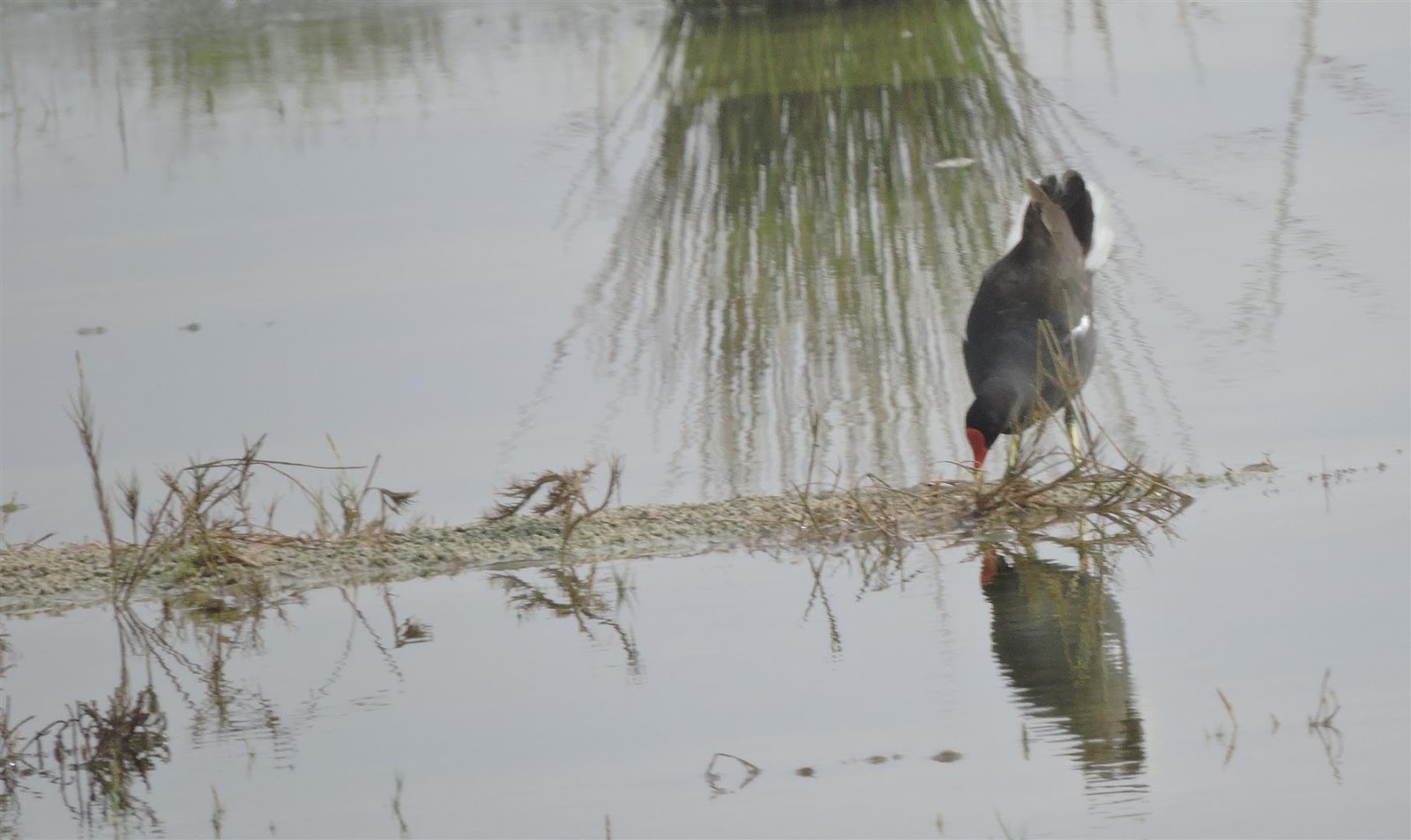
common moorhen

On the beach I could only see great crested tern, sooty gull and a few Kentish plover and lesser sand plover.

Later in the morning I returned to birding with another trip to Jarziz farm.

The eleonora's falcon which was present from June 12-14 has gone.

On the other hand, there are still Amur falcon coming through. I saw my first there on April 29th and on every subsequent visit except May 31st. Even on Saturday (June 20th) there were two.

immature male Amur falcon

I have now had over 35 sightings of this bird at the farm this "spring". otherwise I have seen only one elsewhere in Dhofar over Ayn Hamran.

perched immature male Amur falcon

On Friday there were also two Amur falcon and they were quite possibly the same birds. They usually stay 1 or 2 days but occasionally more. 

male Amur falcon in flight on Friday

The second bird was an immature female.


female Amur falcon

The previous female on site had a poorly left eye but it often possible to tell one individual from another by characteristics such as moustache length and density of streaking.

female Amur falcon in flight

Unusually there was a tern at the farm flying over the small water reservoir. The attraction for the tern was undoubtedly the fish than somehow have got in there.

common tern

My ability to identify terns is limited but improving since I moved to a coastal site with this job.

common tern

What helped me with the species identification  was the underwing. I understand the dark trailing edge on the outer primaries and translucent inner primaries are diagnostic for common tern.


common tern from the underside


The full black cap is a summer feature yet the very dark bill concerned me. Thanks to Bart de Schutter for pointing out that this is a feature of the Far Eastern sub species longipennis. Although another eastern sub-species minussensis is quite common here, my understanding is that longipennis is rarer.


I found out where the large flock of glossy ibis, which frequented East Khawr and Sahalnout farm for many months, have got to.

glossy ibis at West Khawr

There was one Eurasian spoonbill which was loosely associating with them too.

flamingo

Other birds included western reef heron and squacco heron.

However the most interesting member of the heron family seen here is striated heron.

Although they are most often seen on low lying rocks on the coast, they often breed in mangroves. Indeed one alternative name is mangrove heron. However mangroves are rare in the Salalah area but the largest patch is at West Khawr.

immature striated heron

So I wasn't totally surprised to see an adult bird and further along an immature bird which luckily was relatively confiding.

striated heron 2

It posed on a branch barely three metres from me.

striated heron 3

Elsewhere there were five whiskered tern which kept resting on the sand bar that separately the khawr from the sea. Kentish plover were there too.

common redshank

Wader numbers are at there lowest in Dhofar at this time of year but there were a few common redshank and common greenshank here.

intermediate morph western reef heron

As I returned to the parked car, there was one more chance to look at herons. All morphs of western reef heron were there from pure dark to pure white and morphs in between.

osprey

One of the last birds seen was an osprey perched on the fence close to the car.

Thursday, 9 October 2014

Around Salalah city

Yesterday I stayed close to the city of Salalah. All my sites were within 10 kilometres of the city centre.

I stated out with a visit to Ayn Jarziz then went to the khawr (lagoon) either side of the Hilton hotel and finally and very interestingly to the wadi just west of Raysut Industrial area.

Ayn Jarziz doesnt merit one of those brown cultural and leisure signs that many of the Ayns (springs) do and it is smaller than many of the better known ones but I am glad I went.

It had the basic land birds that I have been seeing at the others: Ruepell's weaver, grey-headed kingfisher, dideric cuckoo, african silverbill etc.

Like Ayn Hamran there were nightingales in the most shaded areas near water.


Thrush nightingale

However this time I had an even closer look at them. Previously at Ayn Hamran I struggled to identify them and concentrated on one bird which turned out to be an "eastern" nightingale. I now believe the issue is more complex.

The first bird I looked at at Ayn Jarziz is not an "eastern" nightingale. It doesn't show any pale fringes to the tertials and greater coverts. It doesn't have a pale supercilium either.  It is almost certainly a thrush nightingale.

This is described as a vagrant to Oman! However I have read several trip reports that quote it in the area and I used to see them in Riyadh on passage presumably heading in this direction.

Below is a real eastern nightingale seen in the same shaded area within metres of the thrush nightingale. Note that it does have white fringes in the right places and a pale supercilium.

"Eastern" nightingale from the rear

Now I regret not looking at the large numbers of nightingales at Ayn Hamran. I eouldnt be surprised if that included more thrush nightingale.

"Eastern" nightingale profile

Next I drove almost directly south to the khawr by the Hilton hotel. This was a little disappointing because it is surrounded by 4 metre tall mangroves except at the seaward exit. However this makes it very peaceful for any birds in there.

cattle egret

The highlight was a screaming striated heron which I must have flushed at the entrance which flew straight past me into the khawr as I was watching two cattle egret at the entrance. Of course there was no chance of a photo for this latest addition to my Oman list

little egret

Otherwise I only managed to see moorhen, little grebe, a little egret and sooty gull there.

sooty gull

The khawr is admittedly very attractive.

Khawr near the Hilton

My next and final stop for the day was the most prolonged and fruitful.

I spotted a wadi running just west of Raysut Industrial area from the main coast road. I had no idea whether it had any water. I parked the car and got out and walked inland. As  walked in the amount of water on the ground grew and when I turned a corner I was met by 75 white stork.These are probably the same birds I saw at the rubbish tip a couple of days before but this was still a surprise. The surroundings were much more pleasant too.

white storks

It got better. There were a dozen flamingo there.

Flamingoes

There were also plenty of associated waders as well as garganey and northern shoveller.

I pressed on inland until I met a very large sedge bed which turned into a reed bed further in.

However I couldn't see many birds in there. Nearly though was a mobile flock of over 50 pale rock sparrow which were enjoying the water and the cliff sides to the wadi.

Pale rock sparrow

This is the second time in under 10 days that I have seen a large flock of pale rock sparrow in the Dhofar region.

Plenty of pale rock sparrow

I had to turn round at one point as there was no way through the reeds.

lizard

 I took a chance to photograph the northern shoveller on the way back.

Northern shoveller

Instead of going back to the car, I decided to carry out up down the wadi, under the main road and to to the coast.

There was a ubiquitous European roller on the way.

European roller

At the sea edge the wadi is flat but rocky with a few rock pools. I know the shore birds would be different here.

There were over one hundred sooty gull and fifteen or so greater crested tern. There were also some waders including a whimbrel (which was smaller than usual and this caused me some identification headaches for a while).


striated heron

The different terrain produced dividends. I got my chance to photograph a striated heron after all.

Oystercatcher

The rocks were always going to be good habitat for oystercatcher and so they were there. This was the third and final addition to my Oman list of the day.

Saturday, 4 January 2014

Coastal lakes at Khobar

Yesterday I undertook a long day trip to the east coast centred on Khobar. I had in mind targetting two birds which I don't yet have on my Saudi list. I also more generally wanted to know what was there at this time of year.

My two target birds were great black headed gull and sandwich tern. Despite major efforts I saw neither. Yet I was not disappointed partly because of the variety and numbers of other birds seen but also because I picked up a different addition to my list quite expectedly. I'll explain this in detail in my next blog.

grey plover

When I arrived at Khobar's south corniche, I started out by inspecting the set of lakes which are 100 metres from the sea and separated from it by the corniche road.

Kentish plover

There were plenty of plovers on the lakes' "beaches". Most of them were Kentish plover and common ringed plover. A few were dunlin. two were different. One was grey plover (see photo above). The other was a broad-billed sandpiper. Note the broad bill base and kink in the bill toward the tip as well as head markings consistent with this species.

broad billed sandpiper at the back

There are common in this area on passage and they winter in "coastal Arabia" according to the main regional guide. It looks like at least one has lingered on this part of the Arabian coast though most must move further south.

striated heron

Another bird towards the edge of its range was a striated heron that I flushed as I walked round a lake. The regional guides map doesn't show it this far north on the east coast. The distribution in the map stops at UAE border. This is probably yet again more a function of under-reporting in Saudi Arabia than non-existence.

Unfortunately the bird flew into my direct sunlight so betters pictures weren't possible.


plenty of gulls

The lakes were full of gulls. About 80% were black headed gull with the balance nearly all being slender billed gull. Since I had come to Khobar looking for great black headed gull, I studied the groups intently.

Heuglins gull with black headed gull

There were two larger gulls among the many tens of medium sized gulls. Both of them were immature (probably third winter) white headed gulls and I believe Hueglin's gull because of the black sub terminal band and because the mantle is relatively dark.

another view of the Heuglins gull

Another feature of the lakes were the large number of herons. I came across at least eighteen grey heron.

grey heron

I hadn't realised the western reef heron roost together before though its not surprising. One cluster of bushes held at least fifteen of them of various morphs.

heronry of reef heron

There were also two little egret on site.

dark morph western reef heron

There were relatively few land birds in the adjacent scrub. House sparrow were the most numerous. Graceful prinia were the next.

Daurian shrike

Two Daurian shrike were seen there.

After two recent visits to the east coast in winter, I seen several Daurian shrike and not a single Turkestan shrike whereas in the Riyadh area both types of red tailed shrike winter. 

Finally one bird I didn't see at Khobar was white wagtail though they were easily seen on our stops on the way from Riyadh. Surely this local lack was just an oversight. 

white wagtail

Having finished with the lakes I moved on to looking at the sea and coast. This is where most of the day's action took place and where I got the 317th bird on my Saudi list. I will blog about this next.