Showing posts with label water rail. Show all posts

Sunday, 15 June 2014

East Salbukh settled down for the summer

Sometimes during a birding session, you can have one small area and moment which produces a totally disproportionate part of your birding enjoyment.

This happened to me as I birded East Salbukh early on Saturday morning.

One corner on the western side of the wetland was a treat to stop at, listen and observe.

little bittern

It was noisy but initially there seemed to be nothing to see. One of the noises was little bittern screaming calls. I soon saw both an adult and a juvenile.

little bittern screaming

Sounds lower down were competing with the little bittern calls. There were intermittent screeches which I suspected were water rail.

young water rail

When I finally saw one it wasn't an adult. The bill was not completely red but had some black. The underparts still had some mottling of a juvenile bird. The black and white stripes on the flanks were not fully developed. This bird was a young bird.

I am now confident that water rail breed there. I also saw four others scattered over the west, north and east side of this rectangular wetland. They aren't going anywhere and its mid June.

Evidence of breeding among little bittern and water rail was not all that I observed in this small patch of the wetland.

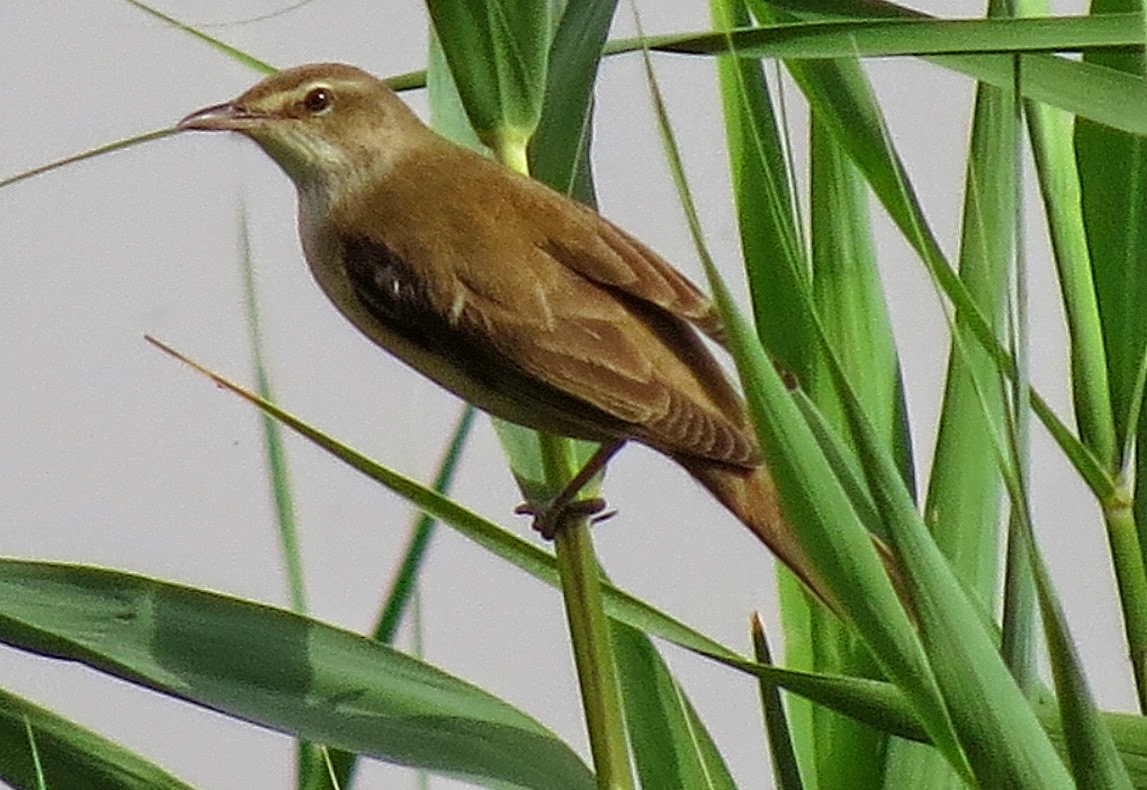
young Eurasian reed warbler

Young Eurasian reed warbler were darting around. Luckily they often rested on a small tamarisk bush in the middle of the low lying reeds making views easier than usual.

adult Eurasian reed warbler

I saw incidents of adult Eurasian reed warbler feeding young birds too. The picture below was taken from distance but you can see this happening.

feeding Eurasian reed warbler

Elsewhere in the wetland, there was other evidence of breeding. I was continually mobbed by black winged stilt over part of my walk even though I was nowhere near the water's edge in that area due to the deep mud that fringed it.

black winged stilt

In contrast both Kentish plover and little ringed plover breed earlier.


Kentish plover

There was little sign of adults still caring for young at least as far as feeding is concerned.

Little ringed plover

The overall picture is one of a wetland left for the summer with only the breeding birds left around. It should stay that way for about 6 or 7 weeks before the first birds are once again on the move.


moorhen

Funnily enough I don't recall seeing any young moorhen since I started visiting the wetland. However they are known to breed very early in central Arabia. 

graceful prinia

Likewise with graceful prinia. They are lots of old graceful prinia nests to see in the the tamarisk bushes.

Namaqua dove

Other sightings at the wetland  included hoopoe and a young Asian grey shrike.

hoopoe

The pink bill on the Asian grey shrike is one of many signs this is a young bird too.


young Asian grey shrike (Aucheri)

Other species seen at the wetland were: Eurasian collared dove, laughing dove, little grebe, crested lark. pale crag martin, house sparrow and perhaps surprisingly barn swallow.

lizard

As I left, an unknown lizard  with a distinctive blue face was seen sunning itself. 

In other news, earlier in the weekend, on Friday, I spent an hour in the early morning visiting a site within walking distance of my flat in the Nakheel district. I was acting on a tip off from a friend.

wadi at Nakheel

I had been missing an very good prospect so close to home. The wadi is a mix of orchards, grassland, trees and vines.
more of the wadi at Nakheel

In summer the birding won't be too exciting but in the passages seasons and in winter, I am sure it will be very good indeed.


young common myna

At the moment though birds were the most common birds were common myna, house sparrow, collared dove, laughing dove and black bush robin.

little green bee-eater

There were also little green bee-eater, white eared bulbul and rose ringed parakeet.


white eared bulbul


How could I have missed such a place under my nose?


Friday, 30 May 2014

Little bittern and more at East Salbukh

Since East Salbukh wetland was found on google earth back in February, it has definitely now superseded Al Hayer as my most visited "local patch". 

There are several reasons for this. First and possibly foremost, it is closer and quicker to reach. I don't have to travel through the city to the south. I live in a northern suburb and East Salbukh is north of the city. It takes less than half an hour door to venue. Second, it's also more compact. I can walk round it in 5 or 6 hours. Third it seems to have almost as much diversity of birds as Al Hayer. Though eagles may be a challenge come winter. Fourth, its less disturbed by fishermen and hunters. The latter because the mud bogs down any car that gets near.

So this morning I went there again. Birding started at 5.30 am and finished at 11.30 am which is a typical summer schedule.

young little bittern

This blog covers some of the sights on the west side of the roughly rectangular wetland.  

The first good news is I finally photographed one of the little bittern I have been seeing every time I have visited.

little bittern in different pose

There was an adult bird near by which never left this youngster far behind. 

It is on the west side that I have been seeing water rail (but not last weekend). There is more good news in that I saw two again and in different places. 

adult water rail emerging from the reeds

While all the birds have been adults, its looking more and more likely that this species spends the summer here and that should lead to breeding.

adult water rail swiftly returning to the reeds

If the birds are passage or wintering, its getting very late. Among the warblers, I observed no willow warbler or great reed warbler this time and only one sedge warbler. This is a sign that passage is near spent.

Graceful prinia and European reed warbler were common and not going anywhere.

a flock of Kentish plover

The west side is the best side to see Kentish plover which were flocking again now that breeding is over.

Black winged stilt

More and more black winged stilt are being spotted at the edge of the wetland as I walk round.

crested lark

Crested lark are every where.

unknown lizard

Yet another lizard was observed. They aren't on my list of new study areas I'm afraid. I'm beginning to take note of butterflies and would love to take up my childhood study of wild flowers again. Lizards,however, will have to wait though this one's name is of interest. 

The next blog recounts more on this morning's walk. It includes a look at a new bird for this site.

Monday, 5 May 2014

Water rail and much more at East Salbukh

I returned once again to East Salbukh wetland on Saturday. There was one major difference from the visit eight days before - the temperature. Not only was the daily high 34C against 40C but I also went out three hours earlier from 6 am to noon. As a result the birding was much cooler than the previous session. I was rewarded with many more birds. 

water rail

Arguably the highlight was seeing two water rail and in different places but more about that later.

In the meantime I'll recount the birding session in chronological order. 

male red-backed shrike

On arrival, I decided to do a clockwise circuit round the wetland as usual. This means starting in an area which has plenty of tamarisk bushes. 

Straight away it was obvious that there was a major wave of red-backed shrike on their way through. I counted five shrikes in these bushes.

Spanish sparrow

This part of the circuit is one of two areas with large numbers of house sparrow. However on Saturday I noticed quite a few Spanish sparrow there too.

barred warbler

Instead of the willow warbler and chiffchaff of recent times, I counted three barred warbler. The other warbler here was the resident graceful prinia 

little stint

As you go round, there is an area where water spills out from the reeds and grass giving the appearance in places of a stream.  Small groups of little stint were seen here. 

female red backed shrike

In the bushes and reeds were still more red backed shrike of both gender. In the reeds Eurasian reed warbler made fleeting appearances.

After an hours walk, at seven in the morning, I arrived close to a place one week before where I had flushed a bird back into the under-growth. At the time I instinctively felt wasn't a moorhen but I didn't get more than a fraction of a second's look.

This time, I approached slowly and from within cover I scanned the place I had seen it. I couldn't believe my luck. A water rail was standing there. Indeed it walked around for two or three minutes without noticing me.

Within Saudi Arabia, I have only seen them in Tabuk before.


water rail

Eventually it went into cover and I moved on. Less than 50 metres further round but closer to the impenetrable centre of the wetland there was some interesting activity in the reeds.  Two great reed warbler showed themselves and a sedge warbler popped up.


great reed warbler

I think the sedge warbler may have been pursued by the great reed warblers.  

second great reed warbler

After that flurry of excitement I continued walking round but very slowly. I noticed crested lark and Kentish plover to my left and away from the wetland.

crested lark

There was persistent squealing noise like a puppy begging. Indeed I thought it was just that. It wouldn't have been the first time for me in Saudi Arabia to come across wild puppies.

I scanned the edge of the reeds. It turned out to be a second water rail calling in an area at least 200 metres from the first.

a second water rail

This one never fully came out of the reeds but was in view for at least two minutes.

curlew sandpiper with little stint

The next area on the way round has lots of open but shallow water. Every time I have visited it has had some waders. This time there were curlew sandpiper and twice that number of little stint.  There was a single common snipe with them too.

purple heron

I have to move away from the main wetland in this area and walk behind some earth works to be able to get close to the waders without scaring them off. Next to the earth works are some pools with reeds. As I walked past one I accidentally flushed a resting purple heron.

two willow warbler

Once I passed the open water area, I moved back in towards the reed beds. There are several low bushes in this stretch. I saw several willow warbler and another barred warbler.


whinchat

Slightly further round, the main birds of note, also out near the bushes rather than by the reeds, were a whinchat and a spotted flycatcher.

spotted flycatcher

The wetland slopes very gently down from south to north. In the northern section there is some deeper water. It rained last week so the water levels were higher so other parts of the northern section have flooded.  These parts were teeming with yellow wagtail from five different sub species on Saturday.

lutea yellow wagtail

In the deeper water areas I once again saw moorhen, little grebe and little bittern.

male little grebe

Black winged stilt were common in many parts of this northern section.

black winged stilt

The overflow in the north creates a short stream which was longer than usual because of the rain.  Where it breaks out of the wetland is very green and has proven good for birds on every visit.  

squacco heron

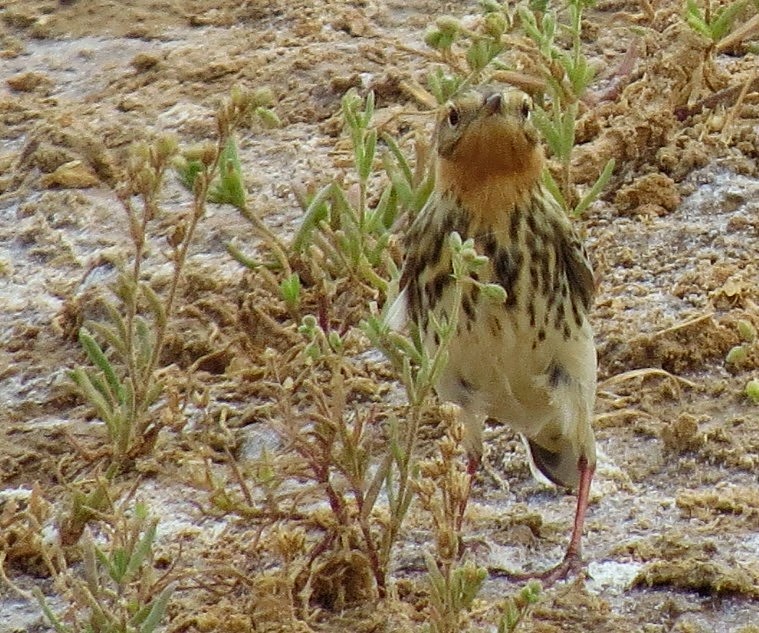
This time as well as more yellow wagtail, there were two squacco heron, twenty or so red-throated pipit and several wood sandpiper.

red throated pipit

I usually find the part of the circuit where I head back south towards the start is not such good birding. It certainly has a higher percentage of blanket reed beds than elsewhere. However I suspect an important reason is that I am always there at hotter times of day when bird activity has reduced.

Daurian shrike

Two observations of note here included a Daurian shrike which was the only one of the day.

wood sandpiper

I also managed to finally get a good view and photo of one of the wood sandpiper around.

Overall I was very satisfied with this birding session. I rank it within the top ten sessions I have had in the Riyadh area.

The wetland has some advantages over Al Hayer. There is less human disturbance and cars can't get near because they would simply get bogged down. Of course this means all birding has to be done on foot but this is my favoured approach anyway.


The full list of species seen at East Salbukh: 

Little grebe
Turkestan shrike
Little bittern
Red backed shrike
Squacco heron
Crested lark
Purple heron
Barn swallow
Water rail
Graceful prinia
Moorhen
Great reed warbler
Little ringed plover
Eurasian reed warbler
Kentish plover
Sedge warbler
Common snipe
Willow warbler
Green sandpiper
Barred warbler
Wood sandpiper
Black bush robin
Little stint
Whinchat
Curlew sandpiper
Spotted flycatcher
Collared dove
House sparrow
Laughing dove
Spanish sparrow
Common swift
Yellow wagtail
Daurian shrike
Red throated pipit