Showing posts with label zitting cisticola. Show all posts

Thursday, 5 January 2017

Return to west of Rosso

Over the New Year weekend, Mohamed Vall and I visted the Rosso area.

The weekend got off to a good start on the Friday evening when we walked to our restaurant in the town. It was after dark and three barn owl flew over us and then returned a couple of times. To me, this was an omen the trip was going to be good. It was.

Early on New Year's Eve we headed to the west side of Rosso and to the fields and as close as we could get to the Senegal River bank. Thick reeds prevent clear views.

However that morning was not a morning of large water birds but mostly of passerines.

Our first addition to our country lists was zebra finch

female zebra finch

A flock was in some long grass between the river and the arable fields.

male zebra finch

I was confused at one stage by the identification. This was because a flock of black-rumped waxbill crossed their path. I was picking up both birds without immediately realising I had two species.

The distribution map in my guide to Birds of Western Africa show these two species in only the small region between Rosso and Saint Louis (Senegal) on the Atlantic coast. 

black-rumped waxbill

Potential confusion involving two similar species in the same place was a recurring issue. A little while later I was looking at two cisticola resting very near each other. However, one dwarfed the other.
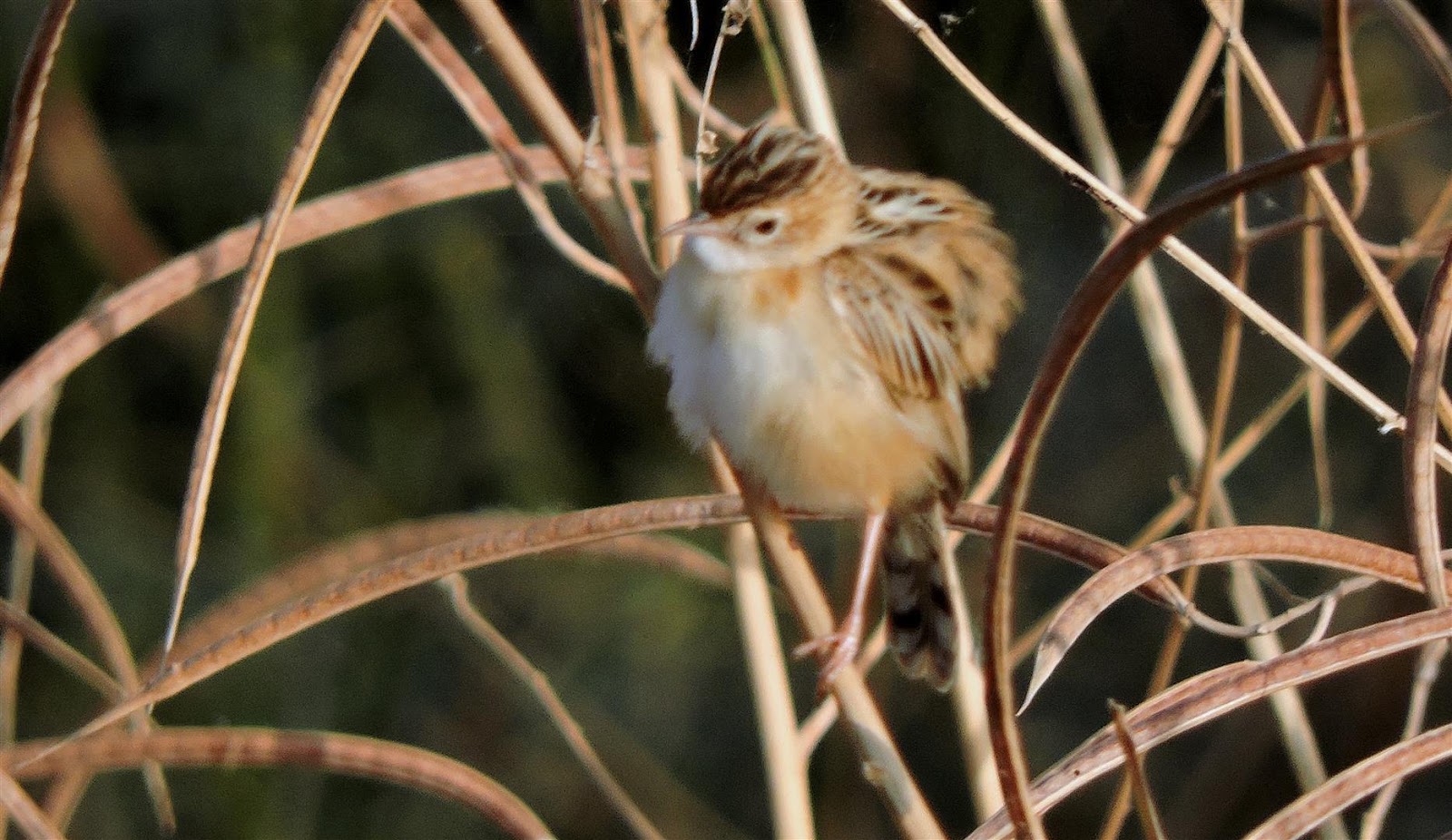
zitting cisticola

It only made sense if there were also two different species. Indeed the smaller one was zitting cisticola while the larger one was winding cisticola.

winding cisticola

Zitting cisticola was new to my Mauritanian list while winding cisticola had been common in fields north of the city on my previous visit to Rosso in September.

Namaqua dove

Also close to these passerines were several namaqua dove and more squacco heron in one place than I have so far seen in all my time in Mauritania. Purple heron, cattle egret and a few Eurasian spoonbill and long-tailed cormorant had been flying over all morning too.

squacco heron

However, another interesting bird near-by was a bee-eater. It was little bee-eater. It was another first for me in Mauritania and the fourth in the area.

We found a deserted palm plantation which has started to return to nature. However this has been hampered by the planting of non-native trees. These don't attract bird or other fauna. 

Nevertheless there were a few pools inside the area which had attracted some drinkers and waders.

Sudanese golden sparrow

Sudanese golden sparrow and little weaver were drinking visitors.

wood sandpiper

Wood sandpiper was the most numerous wader. I am sure if we had waited longer then more exciting species would have been picked up.

chestnut-backed sparrow-lark

As we doubled back towards the town of Rosso, four chestnut-backed sparrow-lark were on the track. We had seen them in first light on arrival in the area but views had been poor then. 

The early morning had been eventful for much more than the sparrow-larks even though it was a lifer. It had even been more eventful than the number of Senegal coucal we had seen.

Senegal coucal

The most eventful thing was the phenomenon of tens of thousands of red-billed quelea arriving in waves to meet farmers cutting fodder.

some of many thousands of red-billed quelea

On our return to the same spot three hours later we were hard put to see any at all.

white-rumped seed-eater

At the end of the day, next to our hotel in Rosso we saw our first white-rumped seed-eater of the trip. In the meantime we had spent the afternoon well out of town and well east of Rosso at new sites.

I will blog about those next. Once again the birding was excellent.

Monday, 18 February 2013

Between Jizan and Sabya

Just north of Jizan, the same fields that sociable lapwing (see previous blog) were attracted to last Thursday were popular with many other birds.

Indeed it was seeing the other birds from a distance that persuaded Lou Regenmorter and me to visit it.

three Abyssinian roller

The most apparent birds were cattle egret sitting in large numbers on the pivot bar and following a tractor around as it cut down fodder.


cattle egret

Abyssinian roller were perched on a pivot bar. This was the first time I had heard their call and its very crow-like. 

yellow wagtail

The cut grass was absolutely crawling with yellow wagtail. They out numbered the white wagtail by over 5 to 1.


white wagtail

When I visited these fields in late December with Mansur al Fahad we saw a zitting cisticola. I commented at the time that this is a long way north of the range given in The Birds of the Middle East map.

zitting cisticola

This time Lou and I saw half a dozen of them and I managed to get a picture to prove they are nearly 100 kilometres north of the map's distribution.

I have found it is a common feature of the Jizan area that birds which the maps say stop at or just north of the Yemen border are actually distributed well into south west Saudi Arabia.


Namaqua dove

Three types of dove were in the fields: African collared dove, Namaqua dove and laughing dove. The former bird is apparently resident by the coast according to my observations but vacates the highlands in winter. 

whiskered tern

One of the stranger features of the field that was being cut as we watched, was the presence of large numbers of both white winged black tern and whiskered tern. There was no standing water in sight.


unknown lark

In the area, were both crested lark and singing bush lark. Indeed this is the only place where I have seen the latter bird, both in late December and on this trip. 

I don't like posting birds I haven't identified. However I can't identify a mobile flock seen on the edge of the fields. They looked a little like lesser short toed lark by with a more rufous crown and no breast streaking. The general consensus now which I agree with is that they are either Greater short toed lark or Blanford's short toed lark.


second look at unknown lark

If it is Greater short toed lark then it has a more rufous top than usual particularly this far east of their range. However Blanford's short toed lark is normally a highland bird which is known to come down lower in winter. What I don't know is how far down as these fields are almost at sea level.

News flash - update
Since writing this, Brian Small who illustrated Blanford's lark in the Horn of Africa guide  has corresponded and he is confident the bird is (greater) short toed lark and I trust his judgement. Case solved.


In the next blog I'll look at how we got on visiting mangroves further north.


Saturday, 29 December 2012

A short first note on Jizan in December

Mansur Al Fahad and I have returned from an exhausting and intense two days birding in the Jizan area. We took in two of the main wadis (and smaller wadis off them) including a lake and some coast including mangroves. 

It was every bit as exciting and rewarding as I had hoped. We saw 105 species. 10 were new additions to my Saudi list and 4 were lifers. Although we saw virtually the same birds, Mansur added 15 to his Saudi list because this was his first birding around Jizan. The full list will be given later.

I will blog in detail over the next few days and I am sure you will be surprised by some of the species we saw. I also have some excellent pictures mostly taken by Mansur.


zitting cisticola taken by me near lake Maliki

As a taster, I can tell you we both saw zitting cisticola. This is supposedly only found right on the border with Yemen but we observed it once next to a lake and secondly in a grass field well north of Jizan. Both locations were north of the helms guide distribution map. And this was a major part of the story - birds were where you might not expect them.


second view of zitting cisticola

I have previously seen this bird in sub Saharan Africa and Ain Kaam in Libya. It was good to met an old friend.

third view of zitting cisticola

The bird at the side of a grass field near Sabya was a shock whereas the initial sighting near Lake Maliki was almost expected.

Lake Maliki is a real gem as I hope to prove over the next few days but the whole Jizan area is the most magical birding in the Kingdom. I am not the first one to use those words nor do I expect to be the last.