Monday, 11 January 2016

Desert stops around Ghaftain

On Friday I was based at Ghaftayn in the desert and visited Muntasar oasis, Qatbeet motel gardens to the west. Then on return I overshot Ghaftayn to the east (to collect some supplies) for a short stop at Haima which is the only town for 150 kilometres in any direction.

Ghaftayn is my preferred hotel over Qatbeet motel as the rooms are better and less expensive and, there is good food available. The staff are really friendly too.

Muntasar Oasis is often visited by birders for the sandgrouse that often come to drink in the early to mid morning. However I find Dowkah farm more reliable. I arrived at Muntasar a little too late for this potential spectacle.

Nevertheless I was more than compensated by finding a wintering whinchat

whinchat at Muntasar

Whinchat is an uncommon bird in Oman and seeing one in winter is ever more uncommon though not unheard of.

whinchat

Whinchat became species 321 on my Oman list.

Muntasar Oasis

Muntasar Oasis appears to be a better habitat once again. It is heavily grazed and there is water pumped away but it looks like the water table is higher than it has been. I suspect there have been winter rains. Also the camels have arguably helped in some ways by chomping back some of the thickest reeds.


mallard drake

A mallard seems to find the habitat satisfactory.

Asian desert warbler from the rear

There were at least three desert wheatear around the site. As is fairly typical at this time of year, one of them had an Asian desert warbler associating with it.

Asian desert warbler on the move

I failed to get good pictures as this one was so flighty.

flock of house sparrow

Earlier I had birded the grounds of Ghaftayn guesthouse where I was staying. It can be excellent in the passage seasons but can be thin in winter. I resorted to inspecting every house sparrow and collared dove on site for rarities.

desert wheatear

There was very little diversity. Only desert wheatear and brown-necked raven added to the mix.

After Muntasar I headed further west to Qatbeet.

male crowned sandgrouse

As I was speeding down the road, I passed a pair of sandgrouse and the roadside. A quick stop and turn and I discovered they were crowned sandgrouse

Although you can't see the characteristic black stripe at the front of the face from this angle, the brown crown surrounded by a blue-grey edge is obvious.

female crowned sandgrouse

A female crowned sandgrouse is actually more spotted than a spotted sandgrouse and some of the spots merge into blotches.

This is the species of desert sandgrouse that many visiting birders struggle to find. 

black redstart

Qatbeet was nearly very good. I came across an eastern leaf warbler. It had at least one yellow wing bar, was low-lying and not making a sound. I suspect it wasn't a Hume's warbler because of the latter two aspects. It is the one leaf warbler which I have seen at Qatbeet before. 

Unfortunately it moved away into another part of the heavily shaded area and just at the same time, a large group of men decided to have a picnic near-by. The disturbance made my chances too low to continue. This was one bird that got away.

Otherwise Qatbeet was not very fruitful this time though a black redstart had some interest.

After Qatbeet I retraced my route eastward back to Ghaftayn but had to overshoot to Haima to get some provisions. 

I took the opportunity to bird the small public garden and saw nothing but laughing dove and house sparrow.

hobby at Haima

As I moved on towards the shops, I looked up at a wire and a hobby was sitting undisturbed. 

facing hobby 

The desert stops can be very hit or miss in mid-winter. Haima was typical of how this can sometimes turn on a single bird.

Sunday, 10 January 2016

A vagrant common hawk-cuckoo

I birded in the desert over the weekend and started off on Thursday afternoon. As it was so late, I knew that the first possible desert stop at Al Beed farm was the only option to get some birding in before dark. This would allow me to reach my overnight base at Ghaftain by driving on after dark.

It was a fortuitous decision.

I headed straight to the small orchard on the farm which has a track record of rare sightings.

My sighting was one of the rarest of all. I found a common hawk cuckoo. Not only that but it was out in the open.

common hawk cuckoo frontal view

It was a first winter bird still in juvenile plumage. The only confusion species is large hawk cuckoo but that juvenile has horizontal barring not vertical spots and chevrons.

common hawk cuckoo

Another small difference is that the bill of a juvenile common hawk cuckoo has a yellow lower mandible compared with an all dark bill in large hawk cuckoo.

common hawk cuckoo sideways

It is rufous with dark barring on top like many cuckoos.

common hawk cuckoo showing white collar

Another characteristic of juvenile common hawk cuckoo is an irregular white collar at the back of the neck. This was obvious too.

common hawk cuckoo

At one stage it hopped into a small bush but its tail hung out.

tail of juvenile common hawk cuckoo

The tail pattern is a good fit for common hawk cuckoo too. The dark bars are broader in large hawk cuckoo.

There have only been two previous official records of this species in Oman. Both were from Masirah and one was found dead. As far as I know no other Gulf country has any records.

I have already submitted the rare bird report. 

kestrel in flight

When I first found the bird I accidentally flushed it but luckily a while later it landed in almost the same spot. When it originally flew up I thought I was seeing a sparrowhawk and then I thought shikra. I needed to find it again to confirm and that's how I found it was really a cuckoo which imitate a shikra.

The situation was confused as three kestrel were flying in the same airspace over a field.

resting kestrel

A male marsh harrier was also present.

marsh harrier landing

Other birds included an aucheri grey shrike which I prefer to call Arabian grey shrike though it taxonomic position keeps changing.

Arabian grey shrike

Otherwise the field had several desert wheatear and white wagtail.

red-tailed wheatear

One of the wheaters however was a red-tailed wheatear. This is at the far western edge of its normal wintering range. 

One was seen in the same field when I visited in November with Ellen Askum. Indeed her better photos helped me identify it. This could easily be the same bird.

red-tailed wheatear 2

I can rightly say the stop at Al Beed farm was the best possible start to my desert weekend.

Tuesday, 5 January 2016

Raysut at New Year

From mid-morning onwards on New Year's Day I was in Raysut. I went to the settling pools first. My main idea there was to observe the hirundines for rarities of which there have been two different species recently.

I was not exclusive to this task however.

flamingo at Raysut settling pools

Before reaching the pool which is best for viewing hirundines, I had already noticed a larger number of greater spotted eagle on site than usual.

A group of greater flamingo waded through one of the pools.

tawny pipit

In the corner of the site a dark looking pipit was standing. Initially I thought it was too dark for a tawny pipit. However it cannot be a Richard's pipit despite it overall colour and stance.

The lores were dark not pale and a close view of the hind claw showed it was not long.

claws of the tawny pipit

I concluded that it must be a tawny pipit afterall.

barn swallow

On arrival at the pool which hirundines prefer, there were about 30 barn swallow.

They are most easily identified when they periodically come to rest on some part submerged dead bushes that are at the pool. I could tell that the vagrant wire-tailed swallow and streak-throated swallow seen before Christmas were no longer present.

So I concentrated on the four sand martin also flying around. Pale martin is always a possibility in winter. I believe it is over-looked.

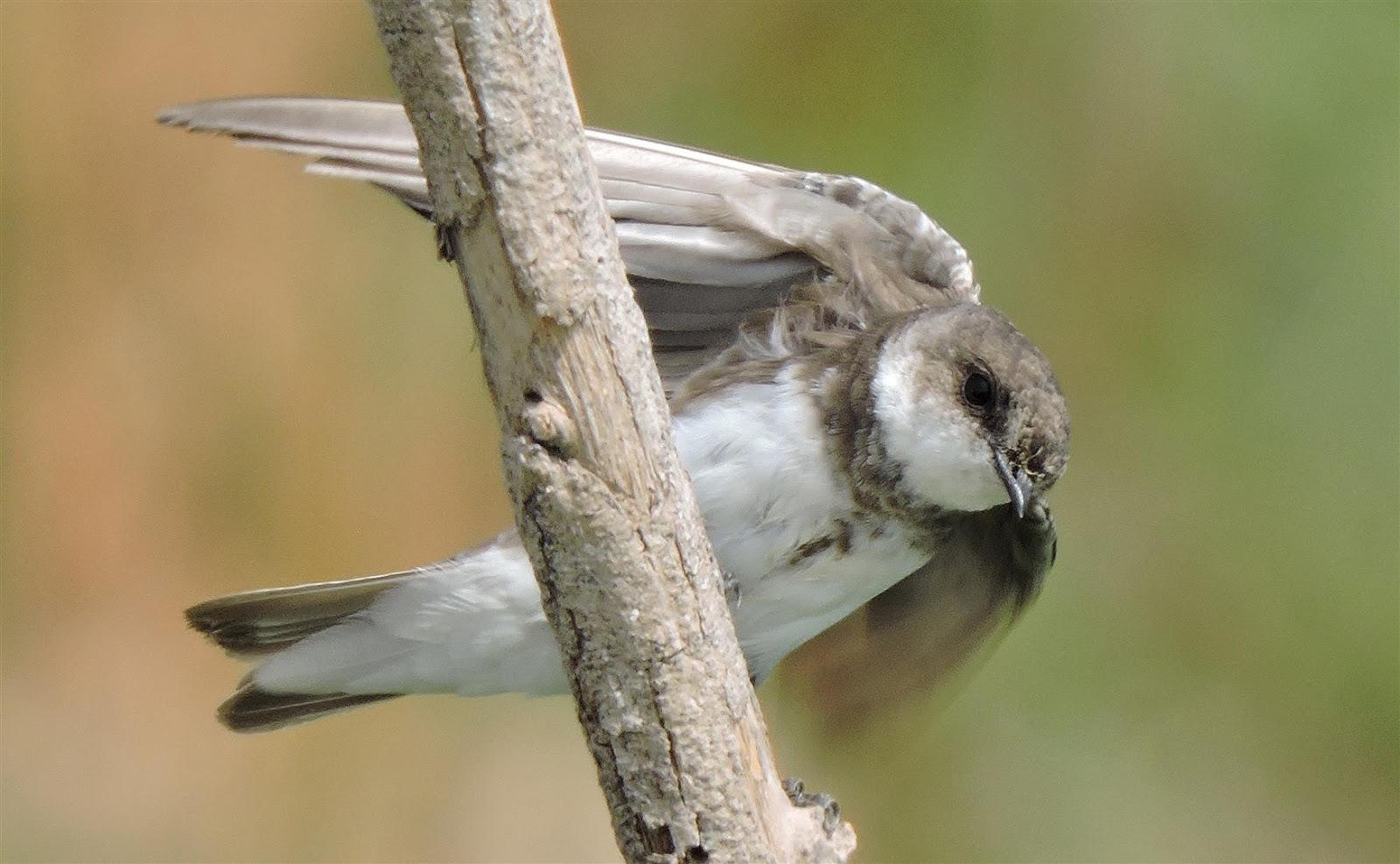
sand martin

Two of the birds were most probably sand martin. Their upper parts were darkish and the throat band was heavily marked. One of those birds is pictured above.

There is apparently considerable overlap in the strength of the throat markings between the two species. Pale martin's marking can be almost as strong as sand martin. However if the markings are very weak this points strongly towards pale martin.

sand martin - bird 3

The third sand martin was a candidate for pale martin. It was the palest and had a weak throat band.  

sand martin - bird 3

However I did not get a good enough views of its tail to be sure. Apparently the surest way to differentiate between the two birds is the degree of fork in the tail. A sand martin is more highly forked and a pale martin is just a notch.

sand martin - bird 4

The fourth bird has the lightest throat markings of all yet it had dark wings. Its tail was noticeably forked too.

sand martin - bird 4

The tail was probably too forked too.

In short, I find the separation of these two species really difficult and I cannot convince myself that any of the four birds were definitely pale martin.

Elsewhere on the site, the vagrant spur-winged lapwing which was first seen 15 months ago was still present. It now has four red-wattled lapwing to associate with.

spur-winged lapwing

There are large numbers of wagtails and pipits around the grassy areas of the site.

Many of the wagtails are starting to change into breeding plumage.

male black-headed wagtail

The red-throated pipit are generally less advanced. The head of the one below is going red but the throat shows no sign yet.

red-throated pipit

The Abdim's stork are also beginning to look more attractive as they head towards their breeding season.

Abdim's stork

This species is one of the earliest winterers to leave, in mid February.

Pallas's gull

After I left the settling pools I headed to Raysut lagoons. There was not much visible change to the birds since last time. The star birds are arguably the ruddy shelduck and they were still present.

One chance was the presence of a Pallas's gull. Just as Abdim's stork is one of the first leavers in winter, Pallas's gull is one of the last regular arrivals.

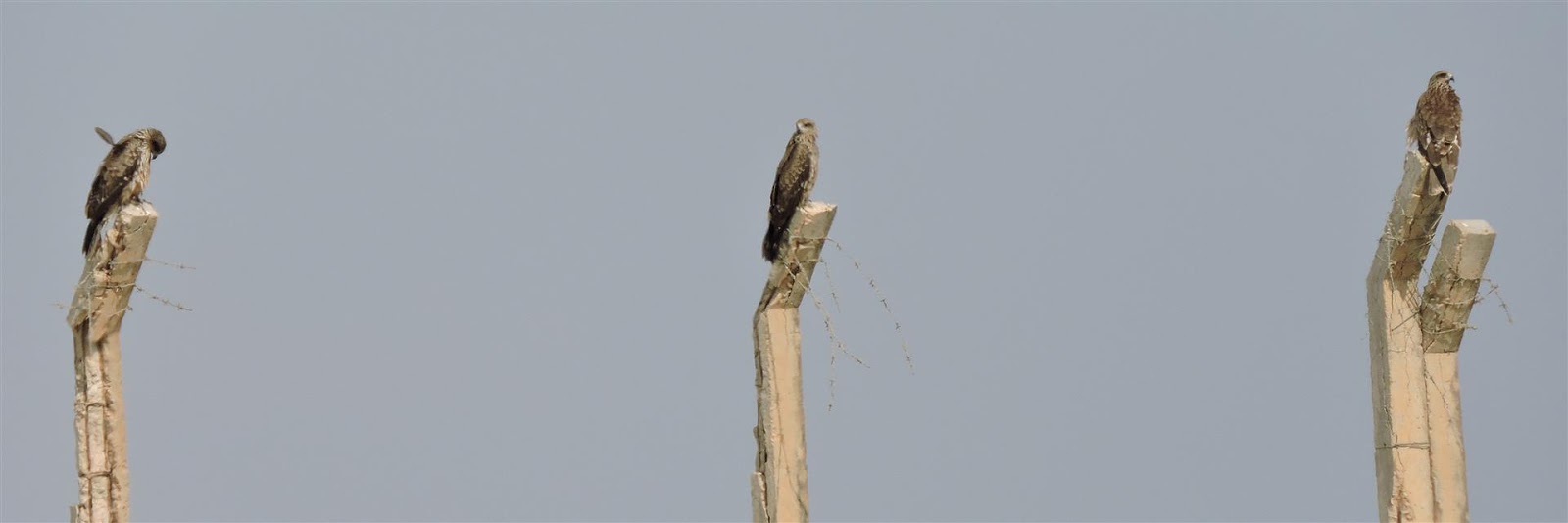
three black kite

To round off my trip to Raysut, I visited the beach area. Just like last mid-winter this is the place to see black kite (as opposed to yellow billed kite) in Dhofar. I have no real idea why they roost here and spend much of the day here too.

closer view of black kite

It was other birds of prey that were more active though. An Eastern Imperial eagle was eating a large black headed gull in a tree with two steppe eagle watching on in other branches. On the ground near-by a greater spotted eagle was also eating another gull. It had been a bad day for gulls there.

Sunday, 3 January 2016

Yellow throated sparrow on New Year's Day

On New Year's morning I did the rounds of sites within the city starting at East Khawr (Khawr Dahariz). 

I only gave East Khawr a quick inspection. Many birds were still asleep but I didn't see anything special. There are a small number of greater spotted eagle which sleep near the Khawr and they were just stirring.


Greater spotted eagle

The waders were just starting to move too though the ducks and moorhen seemed already to be active on the water.

common snipe (left)

A common snipe was preening. If all snipe showed their tails as well as this bird then snipe identification would be so much easier.

It has been a long time since East Khawr gave me a new bird even though it is a good place to start for visiting birders.

After East Khawr I moved on to Sawnout farm which is less than two kilometres away.

I walked along the western perimeter fence as I most often do. The light was now much better than at East Khawr.

As I stared over the fence into the farm, a group of cream-coloured courser were once again in a newly ploughed field. Over 150 collared dove were also there. An Eastern Imperial Eagle was perched near-by.

However I looked more carefully at the birds near the fence and on my side of the fence.

A sparrow was making sortie from a wire to catch flying insects. My instinct told me this was not a house sparrow.


yellow-throated sparrow

A weaver-like bill on a sparrow like bird means one thing: a yellow-throated sparrow.

They breed in the north of the country near the UAE border but they aren't present there in winter. It is presumed most migrate to India and records are few in Dhofar.

However, they may be over-looked. I saw three at Raysut at the end of November and now one at Sawnout.

yellow-throated sparrow on a dead bush

This female-type yellow-throated sparrow did not mix with any other bird.

yellow-throated sparrow

The fence is almost always good birding. Three bluethroat were seen at different points.

record shot of a bluethroat

Rosy-starling were resting on a section.

Rosy-starling

Plenty of African silverbill were around. Several had brown rather than black tails. I presume these are young birds.

African silverbill

In some of the taller fields, the singing bush lark were hovering and singing. I see this behaviour in the two city farms for 6 or 7 months from November until June ever year. It seems to die down for the second half.

singing bush lark

There is a very good chance of seeing one singing on the fence during this time.

male house sparrow

This is one of a very few places in the city to see house sparrow. They are a farm yard bird here and not found on houses. Even here Ruppell's weaver out number them heavily.

After the farm I went west over to Raysut to look there for the first time in 2016.

I would like to thank my readership for visiting in 2015 and wish everyone a happy and prosperous year ahead.

Special thanks to the people from countries below who have frequented my blog over the years. This is the top ten and any change in position from last year is highlighted. 


1. United States  NC
2. Saudi Arabia   NC
3. United Kingdom  NC
4. Russia   +1
5. Libya     -1
6. United Arab Emirates  +1
7. Germany  -1
8. Oman   +4
9. Poland  +1
10. France  +1