Showing posts with label European nightjar. Show all posts

Wednesday, 27 April 2016

Strong passage at Qatbeet

I arrived at Qatbeet at around noon. It was very hot and getting hotter.

For seven months of the year to extend birding beyond 11am, there is only two strategies that work in the Middle East. The first is to find yourself at 2,500 metres or higher such as in Abha, Saudi Arabia or Jebel Akhdar, Oman.

The second is to find shade or be in an air-conditioned car next to water and watch the birds come to you. This also requires you have plenty of drinking water too.

At Qatbeet I hide myself in some shaded bushes next to a pool and waited. I waited for nearly two hours in total. I knew the light in front of was either dappled or very strong but there was no choice.

After a few minutes I heard a crashing noise in the bushes next to me. I thought a cat had appeared. However when I looked hard at where the noise had come from, I found a European nightjar had landed two metres away from me and promptly fallen asleep.

European nightjar lengthways

I moved round the bushes to get a better view. It did not move. Only then could I see it lengthways.

first view of European nightjar

When it first appeared my view was front ways on as in the picture above.

Having satisfied myself with better views I returned to my hide and continued waiting. All the time the European nightjar stayed without moving.

house sparrow

House sparrow were the most frequent visitors to water probably because there are more of them than other birds.

rufous bush robin

Rufous bush robin were once again around. This bird is extremely common on passage.

willow warbler

However it was the warblers which held most of my attention. Willow warbler was everywhere around the bushes. Eastern olivaceous warbler was nearly as numerous but tended to be higher in trees. A female blackcap was a frequent visitor to the tallest tree.

lesser whitethroat

I struggled with the light throughout while trying to take pictures. This lesser whitethroat was very close but backlighting made a picture extremely difficult.

masked shrike

Other species diverted my attention away from the warblers from time to time. One time was when a masked shrike appeared on the scene. The dappling sunlight initially obscured the view.


masked shrike

Similarly one of the spotted flycatcher on site perched near the water for a while. It was in a dark patch and caused a different type of photographic problem.


spotted flycatcher

A male and a female common redstart also evaded my camera.

male blackcap

Though the female blackcap did the same, I did manage a record shot of a male blackcap.

By 2.30pm I could take the heat no longer and I walked back towards the car. I picked up a pied wheatear and northern wheatear on the way before seeing a barred warbler right next to the car. Not all the birds had gone to drink it seems.

Even though Qatbeet has been degraded and there are too many stray cats, it can still surprise.

Sunday, 4 October 2015

Return through the desert

A week ago Saturday was the last day of my Eid trip. I started the morning in Haima which is 480 kilometres from Salalah and visited four of the desert stops on the way back home.

The first one was Ghaftain which I arrived at while it was still very cool.

Like all of the smaller desert stops, the passage can be very variable from day to day. This time it was at best average.

There were the first lesser whitethroat I had seen there. There were also several Daurian shrike and Turkestan shrike. There was also at least one citrine wagtail and one yellow wagtail but there was nothing extraordinary. It can't happen every time.

hoopoe at Ghaftain

Other notable birds there were hoopoe and a single rosy starling.

rosy starling at Ghaftain

I saw only one golden oriole this time at Ghaftain.

golden oriole at Muntasar

In contrast there were at least eight at my next stop which was Muntasar oasis.

There are always moorhen there now and they must be breeding in this remote watering hole. The other two local breeders are Eurasian collared dove and house sparrow.

kestrel

A very tired looking kestrel was on site.

spotted flycatcher

Other evidence of passage included a couple of spotted flycatcher.

Qatbeet was the next stop but there was nothing special.

Dowkah was my last stop and is the largest desert location. It has never failed me for interest.

Once again there were signs of heavy passage including a variety of waders and passerines. For example 25 collared pratincole were observed in one field. I would have missed them altogether if a Montagu's harrier hadn't moved in and created panic. In the same field I counted 10 European roller and 9 golden oriole on the pivot bar. 

Ocassionally a warbler perches on a pivot bar but not often. This time a common whitethroat was out in the open doing so.

common whitethroat

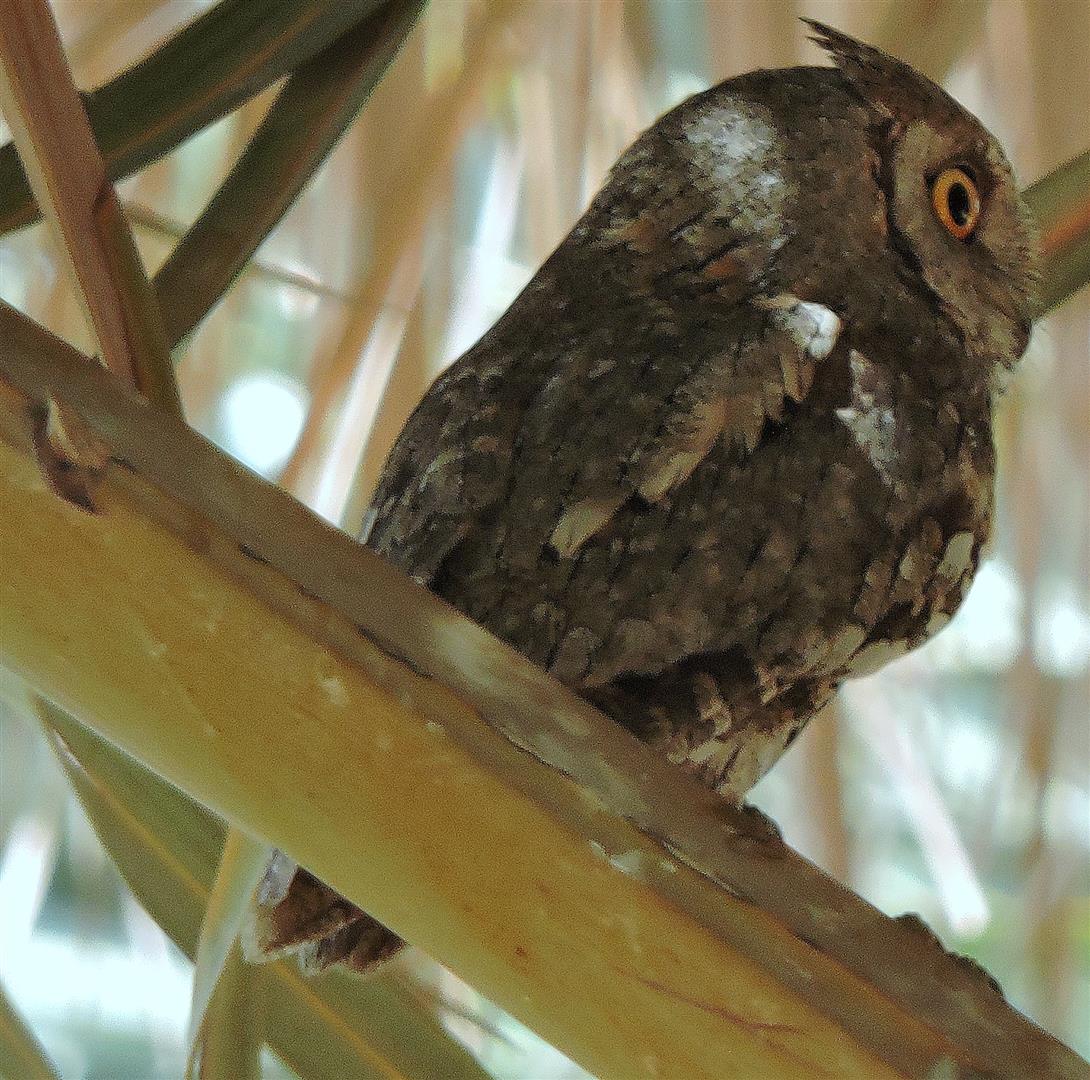
The shaded patch with its palm trees and bushes is where I often get the best results of all. This time for example two European scops owl were accidentally flushed almost as soon as I entered the area.

One went into a neighbouring palm and afforded excellent views though it knew I was there and spent most of its time looking directly at me.

European scops owl looking at me

At one moment, a group of Eurasian collared dove decided to panic and flew off with great noise. The European scops owl stayed rooted but swivelled it head for a moment in their direction before returning its gaze at me.

European scops owl looking aside

The waves of common rock thrush seen in this patch in recent visits is seeming over. However a blue rock thrush was there.

blue rock thrush

Likewise the large wave of European nightjar is apparently mostly over but I still managed to observe two late ones.

European nightjar

While I was on site, a small flock of 9 white stork dropped into the farm. Sometimes white stork stay all winter at these farms. It remains to be seen if these will do so.

white stork

Soon after this sighting I headed on towards to Salalah but this was my last stop on an exhausting and rewarding Eid break.

Sunday, 20 September 2015

Full blown passage at Dowkah

I left home in Salalah at 4.30 am on Friday once again for a desert trip centred on Dowkah farm. Each time I have been this autumn the birds have been changing as a different wave of migrants comes and goes.

There is no doubt the shear volume of birds was the highest so far and I finally added a migrant to my Oman list here which is a main part of why I have been going.


As usual I started with a tour of the eastern pivot fields. A good passage bird was seen here. Five pied wheatear were there. It's not as common in Oman as in Saudi Arabia as Oman is a little south of its main passage route but Dowkah farm is as good a place as any to see it.

pied wheatear

Another notable bird observed at first light out in the fields was a steppe grey shrike. This is a migrant and reasonably easy to separate from the resident aucheri sub species sometimes called Arabian grey shrike or in the past southern grey shrike

Steppe grey shrike has a buff front not grey and a much larger amount of white in the wing which can be seen when flying. There are several other differences too.

E-bird and Clements count conservatively and one allow me one species for these two.

Steppe grey shrike

The third pivot field I walk past was absolutely soaked in water in places just like it was last week.

Also just like last week, it had attracted Montagu's harrier. I positively identified two and the third ring-tailed harrier photographed below is probably a third.


ring-tailed harrier

As expected in a wet field at this time of year, there were yellow wagtail and waders such as ruff were present too.

More surprisingly I saw a flock of 20 garganey flying that way just after I left it.

There were a few spotted flycatcher scattered around the fields but they became more numerous as I reached the bushes and trees in the centre of the farm. 

This is the place where many of the rarities have been found in the past.

spotted flycatcher

There were several Daurian shrike and Turkestan shrike.

Turkestan shrike

Rufous bush robin keep coming. Each time I have visited this autumn there have been plenty.

Rufous bush robin

The shaded area is perfect for sleeping European nightjar on passage. I counted seven.

European nightjar

Strangely there were no whitethroat this week but four eastern olivaceous warbler were seen. European roller and golden oriole flitted around the trees.

garganey

Two of the farm's visiting garganey dropped in briefly.

Right next to the shaded area is a pivot field which is being heavily watered.

This was good for birds last time and excellent this time.

The pivot bar and path running by it were especially good.

European roller

I counted ten European roller on the bar at one time.

female rock thrush

I saw three rock thrush there.

Male rock thrush
One was male.


common cuckoo

A female common cuckoo gave a perfect pose.

golden oriole

The maximum count of golden oriole on the bar at any one time was seven. This one looks like its stretching wing has nearly hit a perched rufous bush robin behind.

black-headed bunting with house sparrow

Over fifty house sparrow were around too. Its always good practice to search a large flock of any bird for the rarer exception and in among the house sparrow, I found a female type bunting which I originally thought might be an ortolan bunting. It looked an ill fit. Thanks to Andrew Bailey from UAE for suggesting black-headed bunting

It didn'
t stay long as two Montagu's harrier chose that moment to move to that field. The sparrows and the one bunting scattered.

However a few minutes later, I caught up with a bunting on the bar. It is probably the same bird. 

female type black-headed bunting

This was one of this autumn's target species and part of the reason I have been coming out into the desert. It is not common in Oman and less common still in autumn compared with spring. Apparently their main migration is in October so this was lucky.

Ortolan bunting became species 292 on my Oman list.

dunlin (foreground)

The path alongside the bar throws up good birds. There can't be many pictures showing both a dunlin and golden oriole.

common sandpiper (left)

I have seen common sandpiper and spotted flycatcher combinations before.

barn swallow

There are three inner fields. Two of them are on the ways back to the car and have been good for sandgrouse and hirundines lately. Both chestnut-bellied sandgrouse and spotted sandgrouse were seen.

house martin (left)

Most of the hirundines were barn swallow so I concentrated on the exceptions. There were a small number of sand martin and a single house martin.

willow warbler 1

In the middle of one field, there was some tall grass in the middle of the pivot. This was surprising place to see both a willow warbler and Upcher's warbler.

willow warbler 2

I started the day seeing pied wheatear. I ended it with virtually the last bird being a desert wheatear. The latter bird will be in southern Oman in very large numbers all winter.


desert wheatear

After Dowkah, I decided to head further away from Salalah and make it to Qatbeet. This turned out to be a good decision.

Monday, 11 May 2015

Seeb, Muscat

On both late Wednesday afternoon and mid afternoon on Thursday I birded straight out of my hotel, the Golden Tulip, Seeb near Muscat airport. In the first session there was a sandstorm and the second was fiercely hot.

It was battle against the elements.

Eurasian nightjar

In some senses, the second session was the better one. This was in natural scrubland. Early on I flushed a Eurasian nightjar which then flew up to a low branch on a tree and settled.

chestnut-bellied sandgrouse

Moments later I flushed three chestnut-bellied sandgrouse. The hot weather was persuading birds to stay still and flush at the very last second.

two chestnut-bellied sandgrouse

I hadn't expected to see them in a semi-urban environment.

Upcher's warbler

In a near-by tree an Upcher's warbler was found. It too was moving less than usual and refused to fly out of the tree even when I thought I had moved too close.

Upcher's warbler

While warbler bills vary in size within the same species, this one had a much larger bill than average for an already long-billed warbler.

The first birding session near the hotel on Wednesday afternoon was during a sandstorm. Visibility was poor. The area visited was mostly not natural scrub as on the next day but a narrow strip of manicured parkland between two main roads so not only was there sand but there was constant traffic noise too.

Nevertheless the birding was satisfactory not least because I came across a single grey francolin which became species 277 on my Oman country list.

red-vented bulbul

Just as in the heavily watered and manicured areas in UAE, there are exotic introduced or escaped species to be found. Red-vented bulbul was common near the hotel.

white-eared bulbul

The form of white-eared bulbul is the introduced form which lacks the yellow eye ring of natural birds found in Kuwait and as far south as Jubail in Saudi Arabia.

common myna

Common myna is a widespread and long-term escape throughout Arabia and Seeb is no exception.

little green bee-eater

There were naturally occurring birds too. I saw several little green bee-eater. The sub species in Muscat is aptly called muscatensis whereas the form in Dhofar is cyanophrys. The latter is much more brightly coloured than the former.

rufous-bush robin

I observed some signs of passage in the parkland. Rufous bush robin proved almost as common on passage near Muscat as it has been in the Salalah area over 1000 kilometres away.

Though not in the parkland but I could see it from there was a European roller in near-by scrub.

European roller

It is ironic that the first roller I saw in the north was a passage European roller rather than the fairly abundance local resident Indian roller.

In between these two sessions of birding in Seeb and I had work to carry out and also a very early morning trip to Al Ansab wetland. I will blog about that next.