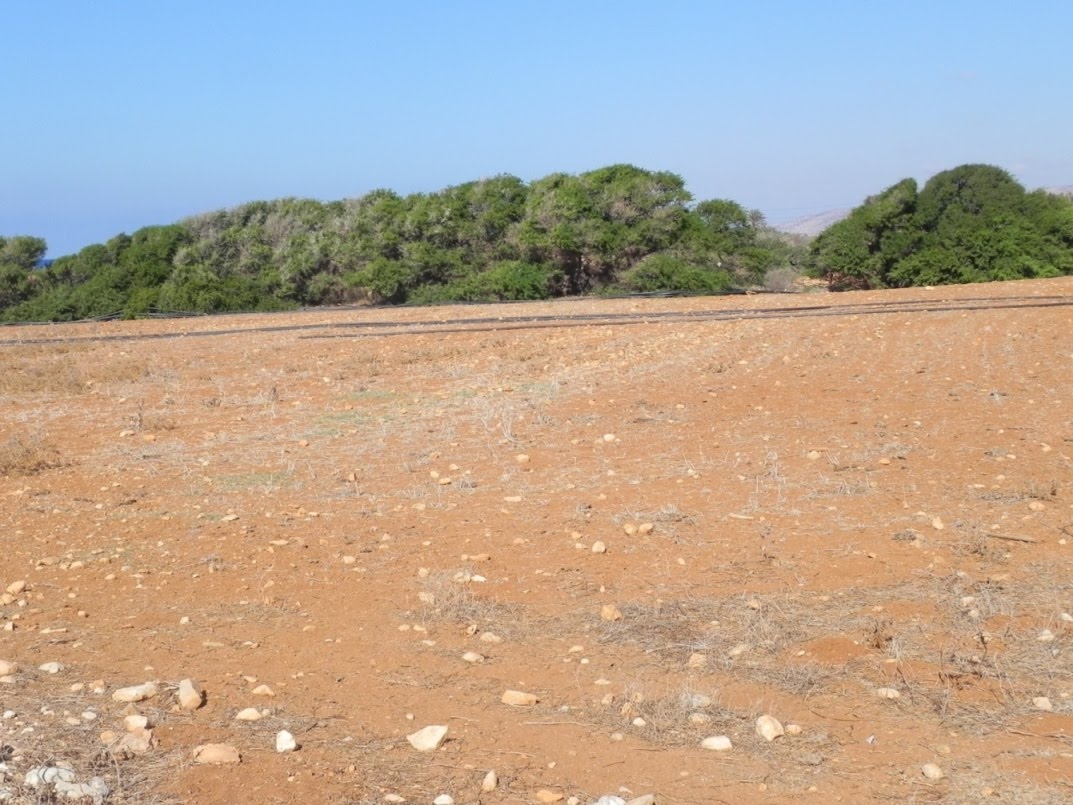
Fodder field just south of Janzour which attracted many migrants - mid April
I'm a bit behind with my blogs! This is an update on what was happening in Tripolitania around mid April. It covers two locations. I visited an area just south of Janzour on a couple of occasions which was farmed for fodder(see picture above). On Friday 16th I also went with Ibrahim and a fellow teacher, Penny for a day trip to the Al Urban area which was a new area for me - mid way between Tarhunah and Gharyan (some 60 kilometres south- south- eastof Tripoli).
Let's look at the farming area near Janzour first. The fodder was being cut down in stages. The area which was most recently cut attracted tens of
yellow wagtail. Only about 70% of them were
flava sub species. The second most common were
feldegg.


two male yellow wagtails (flava on the left, feldegg on the right)
Tripolitania was starting to be inudated with whinchat and this part of Janzour was no exception. The fields next to the fodder had large numbers. The picture below shows one on top of a water tap right in the middle of the folder field.

Whinchat just south of Janzour- mid April
In amongst the yellow wagtails were a small number of red throated pipit. Some of these birds are meant to over -winter in Libya but most come on passage. However, I didn't see any red throated pipits in the winter but have seen plenty during the passage. I suspect very few really do over-winter.

Red throated pipit - south of Janzour- mid April
In the adjacent fields there were a few remaining tree pipit and the odd tawny pipit too. In the tamarisk bushes I saw several willow warbler and wood warbler. For once the local spanish sparrow did not have these bushes to themselves. A few warblers were difficult to separate- wood or willow- for identification purposes! The one below I decided in the end was a willow warbler.

willow warbler- south of Janzour- mid April
Finally I saw woodchat shrike and desert grey shrike in the same field as the warblers. In the picture below you have to ask who is looking at whom.

Woodchat shrike- south of Janzour - Mid April
The visit to the Al Urban area midway between Tarhunah and Gharyan was very successful. We saw about 30 different species. Most of our time was spent along the great man made river (a cleared corridor above a hige water pipeline) but we also went further up into the hills. As soon as we turned off the main road along the pipeline (at Birr Trfas) we immediately saw barbary partridge, fulvous babbler, spanish sparrow and pigeon. As we travelled slowly along the track we added crested lark, thekla lark, barn swallow, laughing dove, turtle dove and desert grey shrike. The observation of turtle dove was interesting as it confirms that they are summer residents much further in land than the distribution maps say.
Passage birds were also very much in evidence. The area had a big concentration, everywhere you looked, of whinchat just like in Tripoli.
I was surprised to see a few northern wheatear too. Some of these birds was first seen in mid february. Clearly they have a prolonged migration period or stay in Libya for quite a while before moving on.

male northern wheatear at Bir Trfas (between Tarhunah and Gharyan)- Mid April
Northern wheatear were not the only type of wheatear seen in this area. One late isabelline wheatear was seen as well. But the biggest excitement was caused by seeing my first black eared wheatear. Actually we saw quite a few and they were of both sub- species ( hispanica and melanoleuca). We saw both pale throated and black throated males of meanoleuca and males of hispanica. Some were presumably on passage and some were part of the known summer breeding population. It was not until a trip two weeks later to a near-by area (see a later blog!) that I determined that the local breeders are the eastern race (melanoleuca). This sub species is in the records as breeding from southern Italy eastwards.

male black-eared wheatear - Bir Trfas -mid April
Further along the pipeline corridor two other passage birds were noticed- yellow wagtail in local fields and pied flycatcher in bushes. Woodchat shrike were also seen, some of which may breed there. House martin were flying over-head. I don't know yet whether this bird breeds in Tripolitania or was also on passage. A highlight of the trip was the sight of two adult stone curlew with a nestling. This bird is very common in Tripolitania and also breeds further inland than the distribution maps give it credit. Finally two other residint birds made an appearance- little owl and hoopoe.
After we left the corridor of the great man made river we rose further up into the hills near Al urban. Right on cue we saw our first black wheatear. In Libya this bird is an upland bird especially of the Jebel Nafusa. The area was a mixture of rocky hills and a slightly lower sandy plateau. In the rocky hills we saw trumpeter finch in its typical terrain and more crested lark. We had lunch at the pinnacle of one of these hills.
Down below we could hear and the see bee-eater. My suspicion is that they are local breeders. Certainly the sandy landscape was ideal for them.

Bee-eater - near Al urban- mid April
As we headed down through this sandy area there was a kestrel on a wire (see picture).

Kestrel near Al urban- mid April
Other sightings in this area were desert grey shrike, more northern wheatear and whinchat. Further down were pallid swift flying and a wryneck (on passage) in a solitary tree which unfortunately flew off just as my camera was poised. You win some, you lose some.