Showing posts with label isabelline wheatear. Show all posts

Friday, 29 December 2017

Back in Nouakchott

It has been notably cooler in Nouakchott this winter compared with last. This is following the weather pattern down western Europe from the UK southward through Spain and the Canary Islands to Mauritania. Here in Nouakchott, this has also included sand in the air straight off the Sahara for days on end.

My first birding back in Nouakchott after my holiday was in one such sandstorm taking place at the waste water site.

It was tough birding with poor visibility and difficult on the throat. After finishing the session, I went out and bought some surgical masks for future birding this winter.

One difficult bird was a first winter wheatear. I took it to birdforum as I suspected it was an Isabelline wheatear.

There was mixed opinion there but most of the expert opinion supported my view.

probable Isabelline wheatear 1

Here are links to pictures to a heavyweight supporter of Isabelline.

http://www.club300.de/gallery/photo.php?id=8
http://www.club300.de/gallery/photo.php?id=47961
http://www.club300.de/gallery/photo.php?id=47963
http://www.club300.de/gallery/photo....203&mode=0&i=2

Here is a comment from a bird illustrator who is one of the best identifiers in the game "The centres to the coverts and tertials seem to be a touch too brown for Northern and the primary tips can fall closer to the tail tip on Isabelline".

Mauritania falls within the wintering range of Isabelline wheatear but I suspect it is quite scarse as this is my first probable sighiting in two winters. I am surprised how often it is claimed in western Sahara though it is has much more birding.

The day after day of (sandy) winds from the east would make sightings more likely too.

probable Isabelline wheatear 2
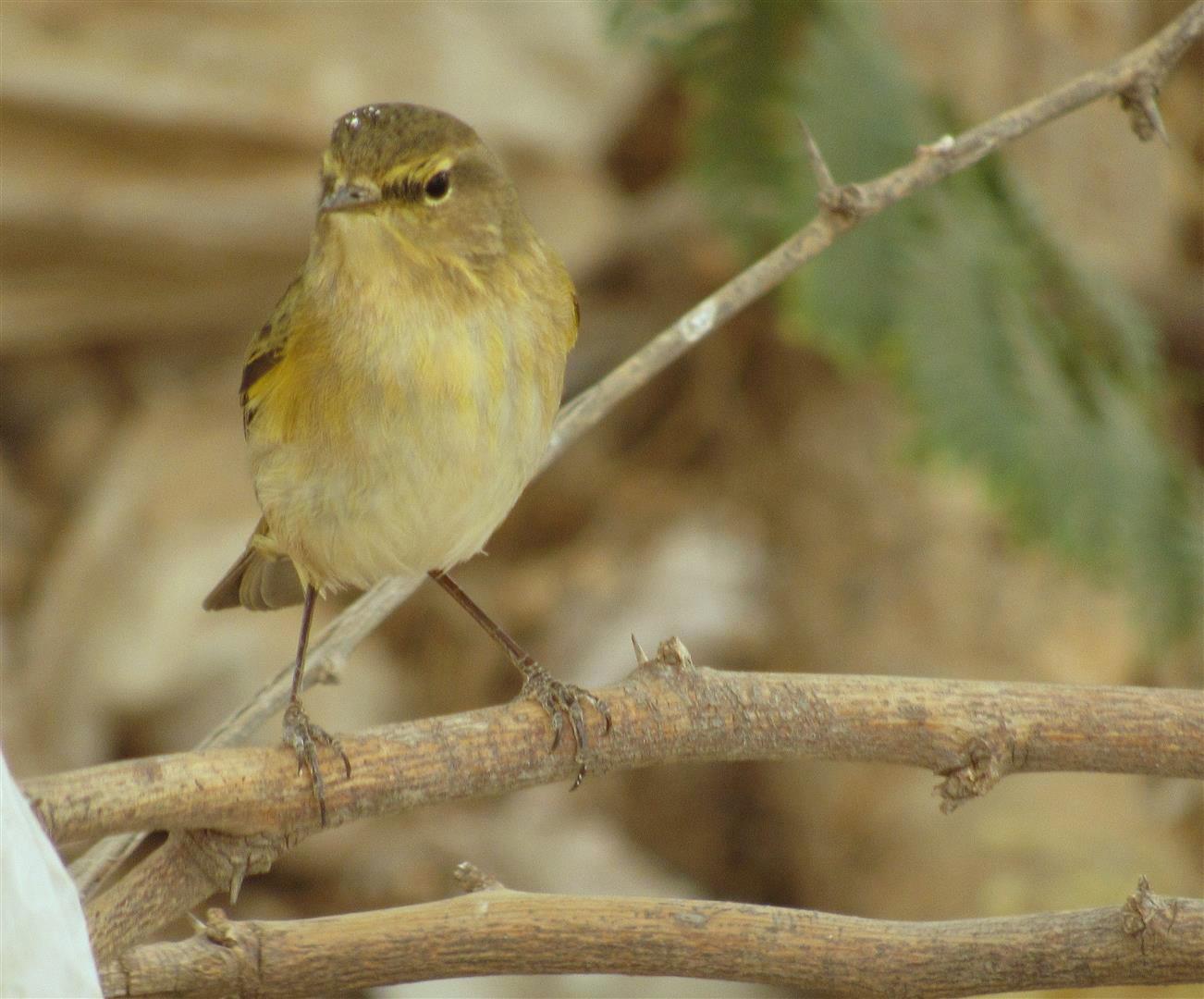
I am very confident now that the majority of chiffchaff wintering at the site are actually Iberian chiffchaff.

Iberian chiffchaff 1

Not all Iberian chiffchaff are as apparently obvious as the one shown. It has the beautiful lemon on the front end of its supercilium and a lemon sprinkling on the top half of its undersides.

Iberian chiffchaff 2

If it weren't for the sandstorm, the lemon would be clearer still.

southern grey shrike

Most of the time even the southern grey shrike stayed out of exposed positions.

spur-winged lapwing

Two guarenteed birds over the summer and autumn have been spur-winged lapwing and blue-cheeked bee-eater. The former were present but surprisingly quiet. The latter, as predicted, have left and I don't expect them back until July next year. 

As I have said before, blue-cheeked bee-eater is not resident in Mauritania contrary to the distribution map in Birds of Western Africa.

Kentish plover

A large flock of Kentish plover were present. For once they exceeded the numbers of common ringed plover.

Dunlin

Other waders on the main pool included ruff, wood sandpiper and dunlin.

Eurasian teal

Before I left for my break in early December, there were 16 Eurasian teal at the site. There were exactly the same number of the same species present nearly three weeks later.

Ruff

Some birds were difficult to identify than usual for another reason other than the visibility. Some were adopting unusual poses to reduce exposure to the wind.

The ruff were mostly in a hunched posture. The usually long neck was nowhere to be seen.

chiffchaff

The chiffchaff were in two clusters. In the second cluster I found them more difficult to separate. I suspect a mixed group.

little ringed plover

Little ringed plover is nowhere near as common as common ringed plover but two were observed.

At times they were being bullied by a lone common ringed plover. As it was not with the main group of common ringed plover and because its supercilium was weak I spent a lot of time trying to see if I could make it a semi-palmated plover.
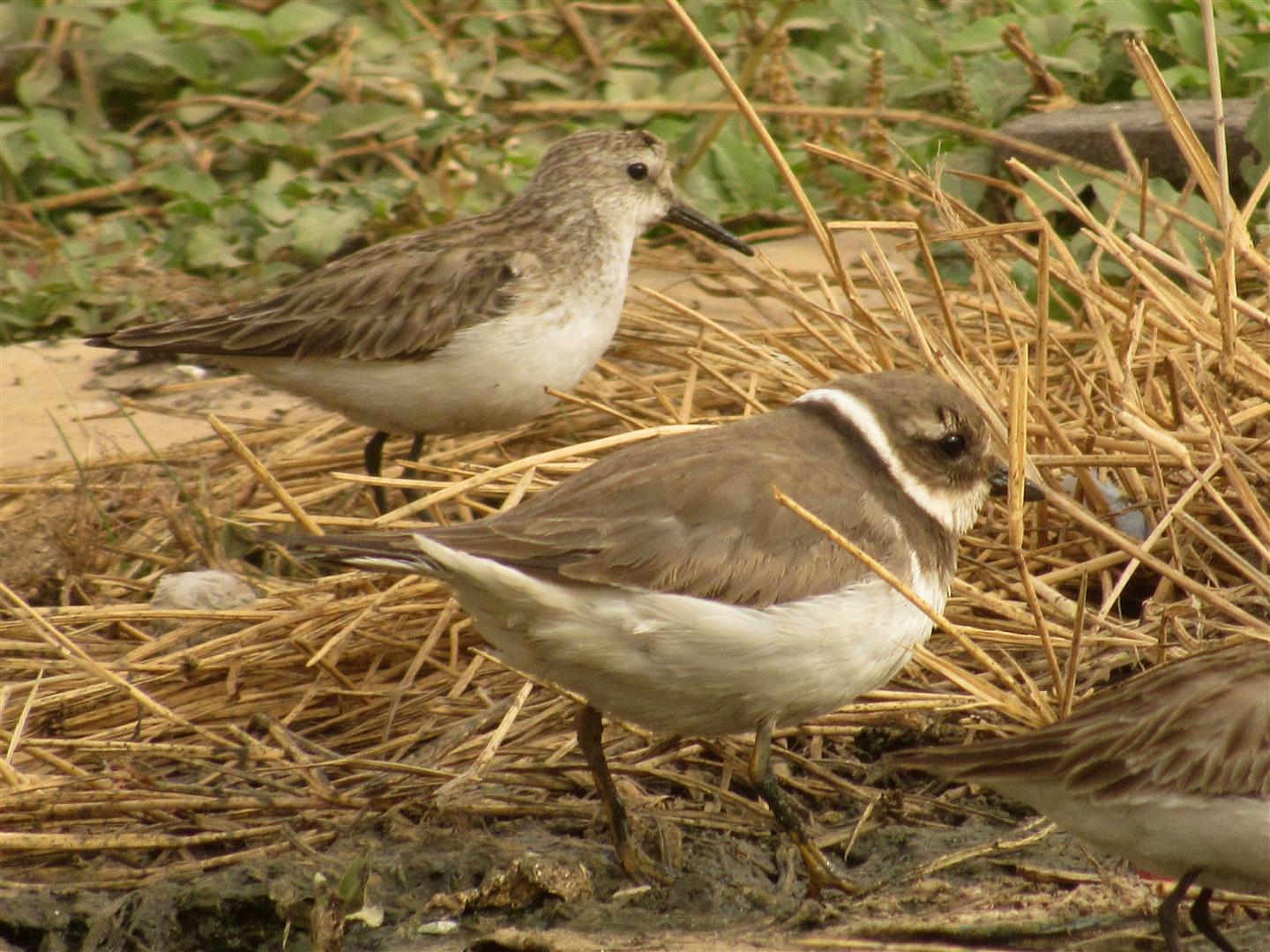
common ringed plover

It was not. There was no sign of a yellow eye-ring and the webbing on the feet did not match. I am not particularly fond of tracking waders but it can be rewarding.

wood sandpiper

It was not an easy day for the waders as this close group of wood sandpiper (and a dunlin) will testify. It was not easy for this birder either.

I am hoping for more comfortable birding this weekend Mohamed Vall and I go south.

Species seen at the waste water site on December 23rd
Eurasian Teal  
Common Moorhen  
Spur-winged Lapwing  
Kentish Plover  
Common Ringed Plover  
Little Ringed Plover  
Ruff  
Dunlin  
Little Stint  
Green Sandpiper  
Wood Sandpiper  
Laughing Dove 
Namaqua Dove 
Eurasian Hoopoe  
Common Kestrel
Southern Grey Shrike  
Crested Lark  
Barn Swallow  
Common Chiffchaff  
Iberian Chiffchaff  
Sardinian Warbler  
Fulvous Chatterer  
Northern Wheatear  
Isabelline Wheatear  
White Wagtail (alba)  
House Sparrow  
Sudan Golden Sparrow  

Thursday, 8 March 2012

The stonechats and wheatears at Al Baha

There are a bewildering array of possible stonechats at Baha at this time of year. There are three sub species of Siberian stonechat possible there - armenica, variegata and maura, and also European stonechat (rubicola) as in other parts of Saudi Arabia. However, for south west Saudi Arabia there is also a resident sub species of African stonechat called felix.

As I understand it, stonechat has not officially been divided into African, Siberian and European yet. I am happy with this! I see more variation in the sub species within a cluster (eg Siberian) than between them. 

  stonechat

The bird above is either a European stonechat or the resident felix sub species of  African stonechat. All I can tell you is that it is male. In felix the white collar is slightly larger than in European stonechat and the under belly is slightly whiter. The rump is always white but this is a known variation in European birds. 


Eastern stonechat

This second stonechat seen less than 20 metres away from the first one is clearly a Siberian stonechat. It has the predominance of white rather than orange on its breast typical of the three races of Siberian stonechat normally found in Saudi Arabia. 

By the way many European birders think all Siberian stonechat are like this but the Chinese sub species for example has just as much orange on its front as any European stonechat. Hence one of the reasons I think splitting stonechat into three or more species is just a game!

Siberian stonechat

A couple of the female birds buff front bordered on all white! Incidentally, I think I can see some white at the edge of one of the tail feathers in this bird making it a armenica or  variegata sub species which are the most westerly of the "Siberian" sub species and the most likely to be seen here anyway.

south Arabian wheatear

It was good to renew my acquaintance with the South Arabian wheatear. I have seen this Arabian endemic once before at Taif (250 kilometres further north).

pied wheatear

It was well outnumbered in the Baha valley by passage pied wheatear which look superficially similar. The south Arabian wheatear were found in the more natural areas whereas the pied wheatear was seen in the cultivated places.

The yellow vent of the south Arabian wheatear isn't always easy to see but I found the amount of black on the neck connecting the black face with the black  on the wing was just as good a way of separating them. The connection is much larger on the south Arabian wheatear.

probable first cycle pied wheatear

The pied wheatear above has hardly any connection at all but it isn't the closely related black eared wheatear (unfortunately as this would have added to my Saudi list).

Isabelline wheatear

The third wheatear I saw but the most limited in numbers was Isabelline wheatear. I couldn't make any of them into red-breasted wheatear (Botta's) which is known in south west Arabia. I understand it prefers a drier and wilder environment (as well as altitude).

second Isabelline wheatear

I find wheatear identification very difficult despite the large amount of practice I am getting in Saudi Arabia. The one above is Isabelline wheatear but it looks quite different to the first one. The single black alula on the wing is often a help in identifying Isabellines.

Tomorrow's blog looks at the pipits and wagtail in the valley. Pipit identification there was every bit as difficult as wheatear but I got an extra lifer out of it!.

Meanwhile I'm off birding my local patch south of Riyadh today. There should be plenty of passage birds to write about later.

Monday, 27 February 2012

The wheatears

Ten days ago I saw my first pied wheatear of the spring passage at Al Hayer. By last Thursday several more had arrived.


Apparently pied wheatear begins its passage early but is well-known to stop off for days and even weeks en route at suitable locations. It seems Al Hayer is one of those suitable locations.

pied wheatear

None of this week's pied wheatear were anything like as "burnt coloured" underneath as the single one last week. Indeed last week's was so yellow on the belly that I asked people on BirdForum if it could be a cyprus pied wheatear. The verdict was that it was within the natural variation of "normal" pied wheatear.

second view of pied wheatear

All the pied wheatear were in the same field which was a fairly recently sown and wet one.

It was popular with two other wheatears too.  Isabelline wheatear winters at Al Hayer in significant numbers but the numbers are swollen at the moment presumably with passage birds arriving from further south.

Isabelline wheatear

It's a similar situation with desert wheatear. They too were plentiful with additional numbers especially in the same field.


desert wheatear

There were only definitively three types of wheatear in the fields. Northern wheatear is well recorded as a passage bird but comes later. This is consistent with what I saw when birding in the past in Azerbaijan (directly north of here). The Isabelline wheatear always arrived in spring before northern wheatear.


unknown wheatear

There was one wheatear in the field which could conceivably have been a northern wheatear. It's picture is shown above. It's moult makes it difficult for me to hazard any sort of identification.

As for other wheatears, I have seen two different persian wheatear near-by,in more rocky areas, during the winter. There have been mourning wheatear close by but in drier places too. White crowned wheatear is a resident bird of drier areas such as Dirab which is only a few kilometres away. 

Three more wheatears I haven't seen which are recorded for central Arabia are black-eared wheatear, hooded wheatear and Finsch's wheatear. The first will almost certainly be seen on passage in the Al Hayer area in the next few weeks. Hooded wheatear is apparently a rare resident but I haven't found suitable habitat yet. Finsch's wheatear is a very rare wintering bird so I have probably missed my chance this winter.

Furthermore, Kurdish wheatear is feasible on passage though not recorded.

As you can see central Arabia has more than its fair share of wheatears. Its a great place to learn about them.


Friday, 12 November 2010

Wintering Isabelline wheatear

Last Saturday morning we set off on the "desert road" as the locals call it out of Ajdabiya. It goes all the way to Tobruk with only a couple of "proper" roads intersecting over its whole 400 kilometre distance. It's like a scene out of the wild west. A long straight road with the number of houses thinning out soon after leaving Ajdabiya. Its not a place where you want to break down.


Isabelline wheatear, 35 kilometres east of Ajdabiya

Once you travel about 15 kilometres inland the area the landscape is distinctly steppe for a further 30 kilometres.   It reminded me of my birding days in Azerbaijan. It clearly also reminds Isabelline wheatear (which are common summer breeders in Azerbaijan) of this too. We saw a small number,mostly standing up like soldiers in characteristic posture, near the side of the road which we stopped to investigate.

I am very confident these are wintering birds. The main passage took place in September. Also it is well-recorded that a number of Isabelline wheatear winter in similar steppe 200 kilometres directly east (towards the far end of this same desert road). There is no steppe (just desert and semi-desert) between these two places because the Jebel Akhdar hill range to the north creates a rain shadow area.

Incidentally while the easterly steppe area is on the Collins guide map for wintering Isabelline wheatear, the western area where we saw our birds is not.

black redstart, 35 kilometres east of Ajdabiya

The Isabelline wheatear do not have their wintering grounds to themselves. I saw a black redstart. Two Isabelline wheatear worked together to chase him off their turf. 

Sunday, 19 September 2010

Migrant wheatears and more


northern wheatear, Tulmaythah, September

Another place visited last Friday was Tulmaythah which is about 80 kilometres north east of Benghazi on the coast. This is where my friends relaxed on the beach while I bird-watched 100 metres away inland. This blog is about the birds I saw in the area with the exception of those seen around and in a near-by melon field!  The melon field merits a blog all of its own. It will follow this one. Why? well you'll have to wait and see.

The most noticeable birds in the area by sheer weight of numbers were wheatears. But what surprised me was the proportions of the different types. Over 70% were northern wheatear, 15% were black-eared wheatear and only a similar proportion were isabelline wheatear. All were migrants. The proportions were about the same as I found on spring passage near Tarhunah in Tripolitania, 950 kilometres to the west.


typical ground for wheatears, Tulmaythah, September

In fact there were so few isabelline wheatear that I failed to get a good photo. You will have to wait a couple of blogs for one of those. The presence of so many northern wheatear is once again contrary to the distribution maps in the main guide books. The maps show northern wheatear missing from this area.   Without spoiling future blogs I can reveal they are present in Benghazi and all along the coast between Tulmaythah and Benghazi too.


black-eared wheatear, Tulmaythah, September 

Black-eared wheatear proved easier to photograph than it's isabelline cousin. Here is a dark throated male. Both forms pale and dark throated were there.

There were other migrants too. I suddenly noticed (and so even did my beach loving friends) a flock of about 15 little egret flying down the beach from east to west. I had little time to react but just managed to record the event.


flock of passing little egret, Tulmaythah, September

The blurred photo of most of the flock is above and a clearer shot of three birds is below.


close up of little egrets on passage, Tulmaythah

My clumsy walking flushed two snipe in two different places. Some snipe stay the winter and some go further south. Who knows what these two will do but my guess is that these will move on when they gain strength. This area was not wet enough for them.

There were more migrants around but they were in the melon field so please wait for that blog. 

Meanwhile with all the migrant action, the residents were carrying out there normal business. House sparrow, great grey shrike and laughing dove were plentiful. Indeed every palm tree seemed to have at least one great grey shrike in it. I still checked carefully to see if any migrant sub species of this bird were among them. They weren't.

great grey shrike, Tulmaythah