This is one of the most unsavoury birding locations in the kingdom. It is also one of the best.
There is always a variety of both land birds and shore birds. It is major stopping off point for migrants too.

yellow browed warbler at Yanbu
The biggest discovery was another yellow browed warbler. Lou Regenmorter and I saw one east of Haql, 500 kilometres north of Yanbu the week before. Brian James and I saw one at the dump. We both got excellent views and photographs. This bird is not even mentioned as a vagrant in the kingdom in the main regional guide.
Like so many birds the reason for its lack of its presence on distribution maps is a lack of Saudi-based bird watchers particularly outside the three big cities. At least twenty species I know have much wider distribution than the guide's maps. On the other hand, a smaller number of others are said to breed which don't (anymore).

Yanbu dump
There was much more to the Yanbu dump site than this warbler although other warblers weren't particularly varied. Willow warbler was however abundant and presumably on passage.

willow warbler
The only other warbler here was graceful prinia.

common redstart
An excellent cross section of migrants was very much in evidence from small to large. Common redstart was in virtually every large bush and tree.

Daurian shrike
Red-backed shrike was common on top of bushes with at least one Daurian shrike also present.

spotted flycatcher
A small number of spotted flycatcher were also observed.

red-throated pipit
Like Tabuk the weekend before, there were no yellow wagtail still up there. However there were plenty of their frequent travelling partner: red-throated pipit. There were an equal number of tree pipit too. I suppose some red-throated pipit may winter there but it needs a mid-winter visit to be sure. White wagtail wintering numbers were higher than in Tabuk.

tree pipit
Whinchat were common as is usually the case in coastal areas on autumn passage. A single stonechat was also there.

whinchat
A nightjar was accidentally flushed but landed close-by. It was a European nightjar but not a sub species I have seen before. It was a unwini. This bird breeds in Iraq and Iran and is described as rare. It is much lighter than the nominate sub-species and on colour more closely resembles Nubian and Egyptian nightjars.
The long white moustache and pearls of white on the wing help define it as a European nightjar though.

European nightjar (unwini sub species)
When the bird flew initially there was no white flash underneath making it a female or an immature.

blue-cheeked bee-eater
Another interesting medium-sized migrant was blue-cheeked bee-eater. Four were seen on site.
There is evidence that the general passage in the Middle East is late this year and this was one sign.

female garganey
Unlike Libya where I used to bird, some garganey actually stay all winter. I am not sure they do so as far "north' as Yanbu. At least three were present along with a pintail and several mallard.

two female garganey and a female pintail
Both passage northern wheatear and probable wintering desert wheatear were around in the drier parts of the dump.

desert wheatear
I don't believe there are any fish in the lakes.

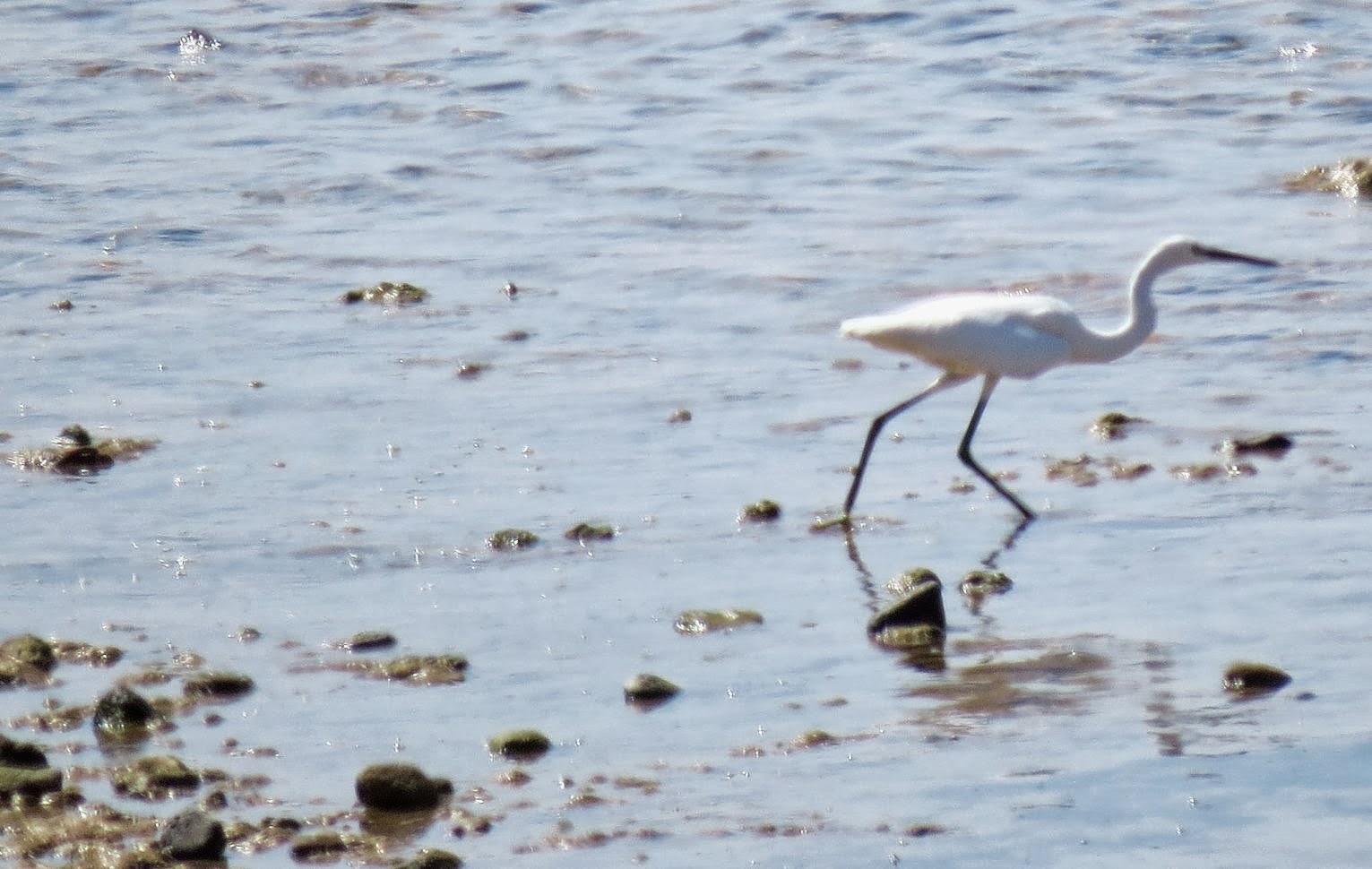
little egret

little egret with grey heron
Marsh harrier were trying to prey on small birds.

marsh harrier
A very pale headed bird of prey was also present that I couldn't identify. I now know it is a steppe buzzard thanks to BirdForum. It is certainly the palest headed one I have seen though I know they are very variable.

pale headed steppe buzzard
Miscellaneous other medium birds included hoopoe and moorhen.

hoopoe
Moorhen is extremely common. We spent twenty minutes or so near them looking for crakes without any success though some habitat looks ideal.

moorhen
In the wetter areas, there was a large variety of waders. Spur winged lapwing were the most obvious and vocal.

ruff
Ruff are also abundant and some were in breeding plumage though this doesn't necessarily mean local breeding.

common ringed plover and little stint
The most numerous smaller waders were little stint and common ringed plover. Dunlin were less numerous. One was still in summer plumage. A couple of lesser sand plover were also seen. Green sandpiper and a single wood sandpiper were observed though I don't recall any common sandpiper.

black winged stilt
Some of the many black winged stilt actually managed to stay clean.

Indian silverbill
One final observation which doesn't fit into the narrative anywhere else, the silverbill here are Indian silverbill despite it being on the west coast.
This was an excellent start to our weekend. We then moved on inland to do some speculative birding in areas where I hadn't found any previous reports. I'll blog on these next.