Tuesday, 14 November 2017

Back to the waste water site

Two weeks ago, I returned to the waste water site north of Nouakchott after a two week break. I went with Mohamed Vall.

Once again, there was considerable change on the previous visit.

One fixture was the five or six blue-cheeked bee-eater which have been around ever since I returned from my summer break.

blue-cheeked bee-eater

We didn't linger so long at the western side of the site as I normally do. We went more directly to the main body of water.

This paid dividends as Mohamed Vall saw his first ever red-throated pipit. It was made easier by the presence of two tree pipit to compare against.

red-throated pipit

It was darkly streaked on its back and the heavily patterned rump was easy to see.

red-throated pipit 2

The three parallel strong streaks at the side of both flanks were also obvious.

red-throated pipit 3

I had recently removed my previous record of red-throated pipit in Mauritania for lack of certainty so this one became a new addition as my total had gone back by one. 

It is painful to remove records but you can only be true to yourself.

Eurasian spoonbill 1

Still at the main body of water, we kept on inspecting the waders but nothing unusual appeared.

A Eurasian spoonbill caught our attention though.

Eurasian spoonbill 2

This is a young bird with a pink bill but there is no other resemblance to African spoonbill which is still not on my country list.

I have yet to visit either national park. A trip to Diawling in the south west corner of the country is the best bet to see this species.

This may be organised soon.

Eurasian spoonbill 3

We left the main water relatively quickly this time.

While walking down the sandy road eastward, Mohamed Vall pointed out a raptor just north of the site in a tree.

short-toed eagle 1

It turned out to be a short-toed eagle. This is not the first time this autumn that the site has attracted this species. However, they are not known to winter here. They do winter in large numbers though only 200 kilometres south along the Senegal River.

short-toed eagle 2

On returning back to the main site after our detour, we spent longer than usual in the eastern part where there are small pools with close cover.

A few of the delivery trucks dump their water here rather than at the main pool. It would be a shame if they ever stopped doing that as this creates a different habitat to the main pool which has more water but less tree cover.


northern wheatear

There is often a good mix of passerines in this area and they are not necessarily warblers. Ortolan bunting was seen here again. A deeply coloured northern wheatear was an interesting sight. I suspect it is Greenland or Iceland in origin.

Fulvous babbler

A young fulvous babbler was reluctant to move from under a tree as the temperatures started to rocket. It was a hot day.

Egyptian vulture

For a second time, Mohamed Vall called me over and for a second time it was for a bird of prey.

This time Mohamed Vall had picked up on a young Egyptian vulture.

This was the first time I had seen one in the Nouakchott area though I had read last year that a tagged one had spent all winter just outside the city. It had moved around quite a bit but by its tracking, it could easily have crossed this site.

blackcap (back)  with garden warbler (front)

After this excitement, I moved on to spend time and patience observing warblers in a damp and shaded area.

It was interesting to see the closely related garden warbler and blackcap side by side.

Blackcap though can winter in the Nouakchott area whereas all garden warbler are on passage to go further south.

European reed warbler

Once again the waste water site had plenty of Eurasian reed warbler. The beauty of this site is the ability to see this species in the open. It doesn't have long grass or reeds to hide in.

garden warbler

The warblers were so busy feeding, I found if I just stood still they would forget about me. You can see that I am looking down on this garden warbler because it came so close.

chiffchaff

Late October was the first time that chiffchaff arrived in big numbers. It was also the first time they outnumbered willow warbler.

a close European reed warbler

It wasn't just garden warbler that came up close. It was a privilege to see European reed warbler and blackcap do the same.

female blackcap

I have spent a lot of time this autumn trying (and in the end succeeding) in separating a small number of Iberian chiffchaff from willow warbler.

common chiffchaff with white belly

Some white bellied, lemon vented and lemen supercilium birds that Saturday may also have been Iberian chiffchaff. One certainly looked very good. However without calls it requires considerable photographic effort and I didn't priotise it this time round.

common chiffchaff with yellow belly 2

The bird above was not the one I considered closest. That one had the same features plus lighter legs and less grey tones around the head than the photographed bird.

Overall, it was another good day. I had to wait another week until I birded again. Mohamed Vall and I went to other sites around the city that time and I managed to add another bird to my Mauritanian list. I will blog about that next.


Species at the waste water site
Garganey  
Little Egret  
Eurasian Spoonbill  
Egyptian Vulture  
Short-toed Eagle  
Spur-winged Lapwing  
Kentish Plover  
Common Ringed Plover  
Ruff  
Little Stint  
Green Sandpiper  
Wood Sandpiper  
European Turtle Dove  
Laughing Dove  
Namaqua Dove  
European Scops Owl  
Little Swift  
Eurasian Hoopoe  
Blue-cheeked Bee-eater  
Common Kestrel  
Southern Grey Shrike  
Crested Lark  
Sand Martin 
Barn Swallow  
Willow Warbler  
Common Chiffchaff  
Iberian Chiffchaff   
Eurasian Reed Warbler      
Eurasian Blackcap  
Garden Warbler  
Spotted Flycatcher  
Bluethroat  
European Pied Flycatcher  
Common Redstart  
Northern Wheatear  
Western Yellow Wagtail  
White Wagtail (alba)  
Tree Pipit  
Red-throated Pipit  
Ortolan Bunting  
House Sparrow  
Sudan Golden Sparrow  

Monday, 13 November 2017

Coming back from Nouadhibou

Mohamed Vall and I started home early on Sunday morning three weeks ago. Our first stop was a wadi just east of the customs' post for Nouadhibou. It was the first area without halophilic vegetation and so likely to have a wider cross section of birds than the salty land we left behind.

Even with its few scattered bushes, the birding was good. 

desert sparrow

We met a calling desert sparrow. This was actually the first time I have ever seen one away from a mobile flock.

sub-alpine warbler 1

Tamarisk bushes are very good for passage warblers in October. The ones in this wadi were no exception. We took a long time to track a sub-alpine warbler down. It was very alert and refused close contact. When it eventually settled we saw it for what it was. However it was a deeper red than most that we have seen in country. This is presumably because it has retained more summer plumage. Nevertheless, we really wanted close views as the much rarer (for Mauritania) Tristram's warbler is possible in this area.


sub-alpine warbler 2

The red orbital ring alone was enough to prove its was "only" a western sub-alpine warbler.

Near-by a willow warbler was also causing a few identification problems. 

willow warbler 1

It had amber legs and a white belly. I had wanted to eliminate Iberian chiffchaff.

willow warbler 2

Mohamed Vall caught it dipping its tail which is also usually a feature of common chiffchaff and Iberian chiffchaff and not willow warbler.

willow warbler dipping tail by Mohamed Vall

However, I am assured this bird is a willow warbler. Among other things its legs are just too light apparently.

My camera battery exhausted soon after we left this wadi. The remaining two pictures are courtesy of Mohamed Vall.

white-crowned wheatear

We stopped twice at similar wadis close to the first one but never achieved anything more special. Mohamed Vall got a nice photo of a white-crowned wheatear though.

Our longest stop on the way back was at Bon Lanuar. This is a government supported project to grow small scale market gardens on marginal land next to the encroaching desert.

There is widescale use of non-native trees there to fix the dunes on the north sides of each parcel of land. These north sides are not attractive to native birds though the wind and sand proected cultivated areas are probably better. The different parcels require separate access and we only got permission to enter one. We saw just the usual October mix of spotted flycatcher, pied flycatcher, common redstart and willow warbler as well as large numbers of resident European collared dove.

Nevertheless I suspect this place may be very good in mid-winter.

The site had an unexpected bonus. Looking up we saw a long-legged buzzard flying over. This is a known species in this type of area just either side of the Sahara desert. Unfortunately with my camera out of action, I failed to have a picture.

It was, however, an another additon to my country list. It was the fourth and last one of the weekend away.

brown-necked raven by Mohamed Vall

One of our later stops was at the wadi just south of the turn off to the gold mine where we had seen Dunn's lark on the way up. Dunn's lark was still there and gave me pleasure to see this difficult bird once again.

The weekend after, it was a return to the waste water site just north of Nouakchott. At this time of year, the birding there changes each time. I will blog about this next.


Wadi east of the customs post
Willow Warbler  
Subalpine Warbler  
Spectacled Warbler  
European Pied Flycatcher  
Northern Wheatear  
Desert Sparrow

Bon Lanuar
Long-legged Buzzard  
Collared Dove  
Willow Warbler  
Spotted Flycatcher  
European Pied Flycatcher  
Common Redstart  
House Sparrow  

Sunday, 12 November 2017

Cansado bushes

On Saturday afternoon three weeks ago, Mohamed Vall and I were in the middle of our visit to Nouadhibou.

We tried to reach Cap Blanc by car for some seawatching. However the route was impassable without a 4x4.

osprey

Indeed we saw hardly any birds at all on the way and before we had to turn back. An osprey was the main exception.

As an alternative to Cap Blanc we went to a spot we knew from before. It is a large set of bushes and trees surrounding fresh ground water. This is just to the east of Cansado.

It was good last time and made excellent birding this time. There is no other fresh water source we know of in the peninsula and so it is an obvious migrant trap.

Things started very well. As we walked to the first visible ground water, we flushed a drinking pharaoh eagle owl

We traced it a second time and got excellent views.

pharaoh eagle owl 1

It finally flew into a near-by tree and fell asleep. I am very pleased we did not wake it up for all of the rest of the time we were on site. We wandered near-by for another 90 minutes without disturbing it. However it was nice to look up at it every now and again to realise it was still there.

This was my first pharaoh eagle owl in Mauritania.

It wasn't the only bird of prey on site. Two black kite drifted over from time to time though they spent more time at Cansado's small rubbish dump near-by. A marsh harrier was seen briefly.

pharaoh eagle owl 2

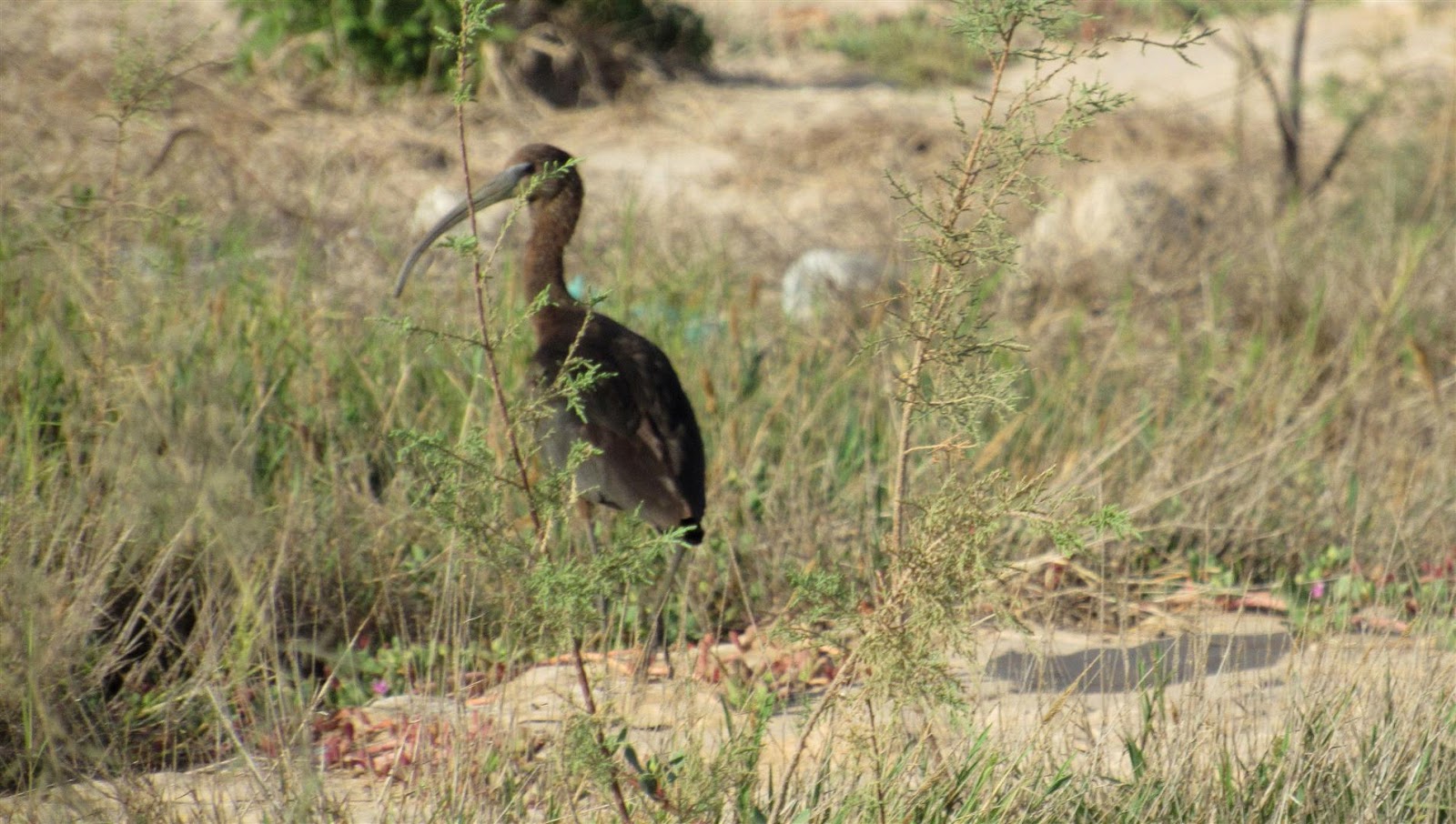
Being the only fresh water for a long way was probably the reason a glossy ibis was seen at such a small site.

glossy ibis

There were several white wagtail and the numbers got higher as we headed towards dusk.

white wagtail

In the bushes were different types of warbler. Two sedge warbler were observed as well as a reed warbler near the water. Bluethroat were in the same areas.  Common chiffchaff and willow warbler were also present but were more wide ranging as you might expect.

tree pipit

At one stage we saw a samll eclectic group of an ortolan bunting, tree pipit and yellow wagtail grazing in a shaded area. However, some people walked by and disturbed this odd group.

In one corner of the site, the fresh water gives way to a deeper salt water pool.

common redshank

Not unexpectedly, a small number of waders were seen there. There was a single common redshank.

common sandpiper

A common sandpiper showed and was bobbing its rear end endlessly as usual.

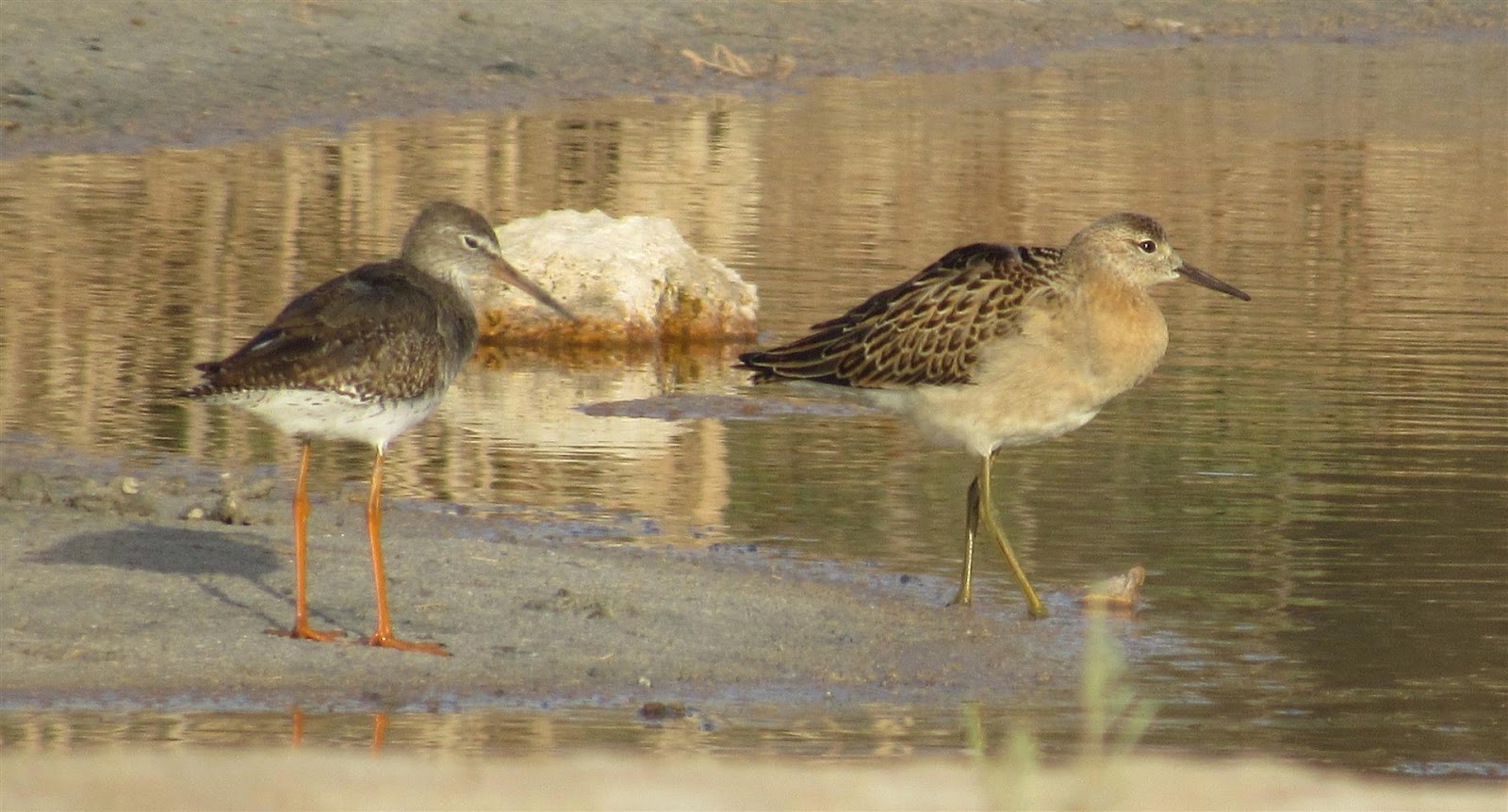
ruff (right)

Two ruff joined the common redshank at one stage. I couldn't make the female into anything more exotic like a vagrant buff-breasted sandpiper. Although I am always on the look-out. Mauritania sticks out well into the Atlantic and American vagrants are here to be had.

spotted flycatcher

One of the last birds seen was a spotted flycatcher helping to prove they get almost everywhere in Mauritania in October.

The next day, Mohamed Vall and I took all day to head home to Nouakchott allowing some birding on the way. I will blog about this next.

Birds seen at Cansado
Cattle Egret  
Glossy Ibis  
Western Marsh Harrier  
Black Kite  
Ruff  
Common Sandpiper  
Common Redshank  
European Turtle Dove  
Pharaoh Eagle Owl  
Willow Warbler  
Common Chiffchaff  
Sedge Warbler  
Eurasian Reed Warbler  
Spotted Flycatcher  
Bluethroat  
European Pied Flycatcher  
Common Redstart  
Western Yellow Wagtail  
White Wagtail (alba)  
Ortolan Bunting  
House Sparrow  

Saturday, 11 November 2017

Nouadhibou central inlet

Continuing our weekend in the Nouadhibou area three weeks ago, Mohamed Vall and I visited the central inlet just east of the airport either side of lunchtime on the Saturday.

After 15 months here, I always have target species in my mind before visiting a site in Mauritania. This time it was little gull, common gull, roseate tern or arctic tern among the hundreds of expected seabirds.

None of the targets were actually seen.

Instead things took a different twist almost on arrival. I thought I could see very distant birds of prey on some isolated sea cliffs a kilometre away. We made a detour towards them rather than head out to the start of the sea inlet as planned.

griffon vulture

They turned out to be six griffon vulture. The species is quite regular down the Mauritanian coast in winter as far south as Banc d'Arguin. However they were my first in the country.

griffon vulture flying

After a good look at the vultures, walking back up the beach towards the inlet but directly facing the sun, we managed to pick out a group of oystercatcher. There were great white pelican near-by too.

oystercatcher

The front end of the inlet was packed with birds.

greater flamingo

We didn't spend much time on the hundreds of lesser black backed gull, lesser numbers of black headed gull and tens of greater flamingo other than to look out for exceptions.

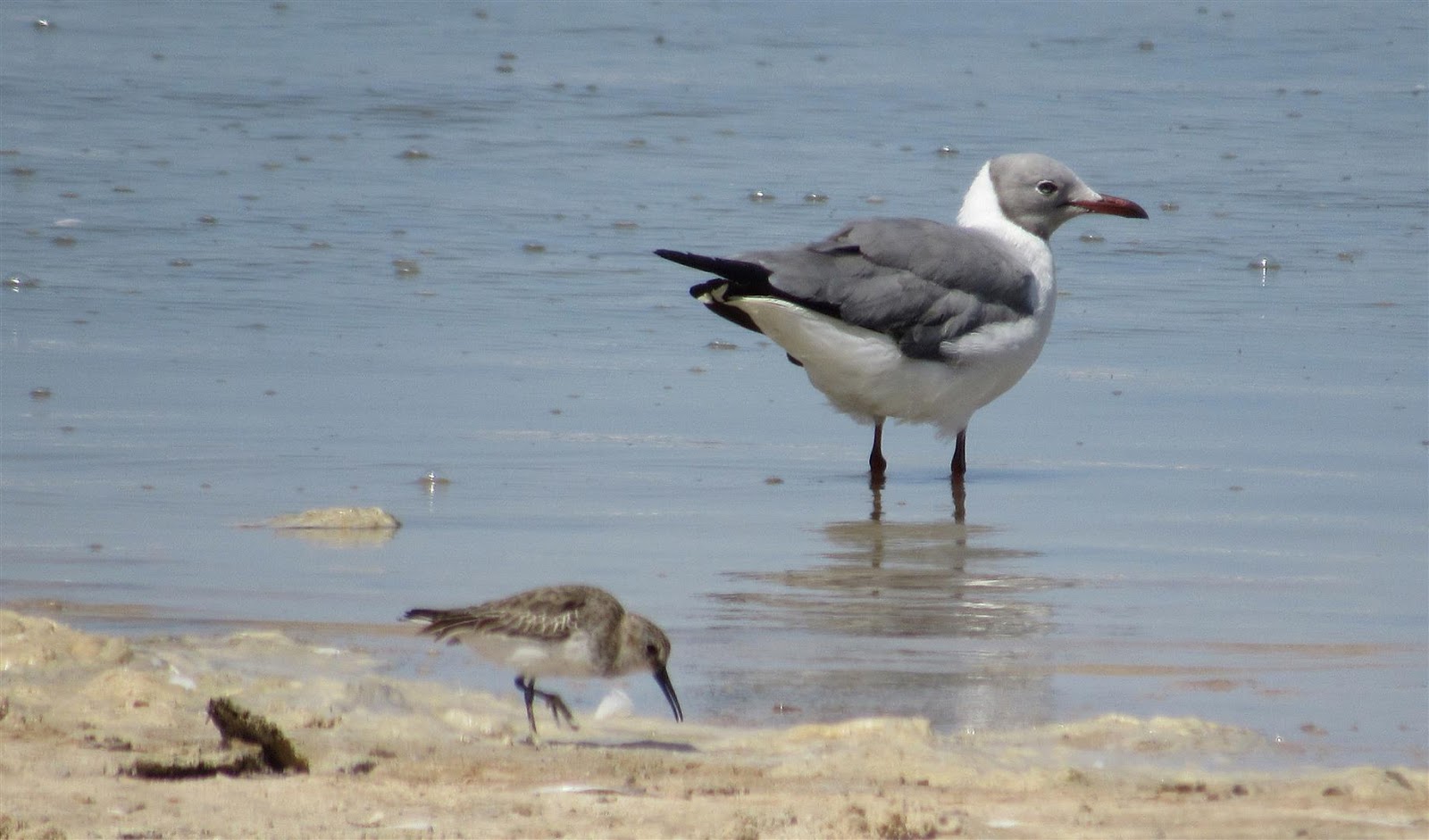
first grey-hooded gull

The exceptions we found were not the targets previously mentioned. Though there were two grey-hooded gull.

second grey-hooded gull

These are not western palearctic records as far as I understand it. I have seen several reports from Nouadhibou where European visitors are claiming records for the Western Palearctic. I have revisited Beaman et al's book which people use for the boundary. It says Mauritania north of the 21st parallel is in and maritime Banc d'Arguin is also in. Just because the peninsula containing Noudhibou is split down the middle with Western Sahara does not make Nouadhibou in. Nouadibou is only 20.5 degrees north. I'ts just tough luck that this inlet is less than 1 kilometre from Western Sahara.

I have seen some of the best birders in the wolrd claim Western Palearctic records from Cansado for example. It is a suburb of Nouadhibou and 500 metres from Western Sahara in places but it is out.

grey plover

I tried to photograph some of the less numerous birds in the bay. These included five grey plover and a single red knot.

red knot

There was also a single collared pratincole. As often is the case, this one was tame.

collared pratincole

The shear numbers of three types of tern were remarkable.

Caspian tern

Caspian tern were the largest and most imposing.

Sandwich tern was the second tern. 

all common tern

I spent a long time shifting through the common tern looking for an arctic tern or roseate tern but with no success. To make things quicker I looked hard for rings which virtually every western European roseate tern has been given.

Even in temperate Nouadhibou, early afternoon can be hot. We headed back to the car for a short break. 

great white pelican

The great white pelican were right in front of my return walk. Behind them were the cliffs holding the griffon vulture.

flying great white pelican

After our break and in late afternoon, we went to Cansado. The results were good. I will blog about this next.

Species seen in the central inlet, Nouadhibou


Greater Flamingo  
Great White Pelican  
Grey Heron (Grey)  
Great White Egret  
Western Reef-Heron  
Eurasian Spoonbill  
Egyptian Vulture  
Griffon Vulture  
Western Marsh Harrier  
Eurasian Oystercatcher  
Grey Plover  
Kentish Plover  
Common Ringed Plover  
Whimbrel  
Bar-tailed Godwit  
Ruddy Turnstone  
Red Knot  
Sanderling  
Dunlin  
Collared Pratincole  
Slender-billed Gull  
Grey-hooded Gull  
Black-headed Gull  
Yellow-legged Gull  
Lesser Black-backed Gull 
Caspian Tern  
Common Tern 
Sandwich Tern  
Common Redstart  
Western Yellow Wagtail  
White Wagtail
Tawny Pipit  
Tree Pipit  
Ortolan Bunting