Tuesday, 15 August 2017

Even heavier passage at the waste water site

I returned to the waste water site on Saturday 12th August. There was even more passage than the week before. Yet again e-bird would not accept that several species could be present this early. I had to add seven species which were not available on the drop down list.

At the same place as last week and next to where the car is parked up, a juvenile woodchat shrike was present.


woodchat shrike 1

It may well have been the same one as a week before. However, that is not guaranteed. There were four on site on Saturday and three were juveniles.

woodchat shrike 2

There were once again several western bonelli's warbler and melodious warbler around.

western bonelli's warbler

I had better views of the western bonelli's warbler than the week before. It is a pleasure to see so many so easily.

western bonelli's warbler

More willow warbler and chiffchaff were also coming through.


Very soon aferwards I spotted my first Eurasian pied flycatcher of the season. I met four of these too. One was a first year of either the iberian sub species or Atlas flycatcher. I didn't get the necessary pictures so the latter species is still not on my Mauritanian list.

The water body had more activity. Eight grey heron had arrived along with one glossy ibis which wasn't associating with them.

grey heron taking flight

Common redshank were still present. Both they and grey heron are skittish birds but I had more success than the week before at seeing the array of water birds without them flying off. It may be that I was more careful this time.

spur-winged lapwing

The spur-winged lapwing mobbed two brown-necked raven that turned up. It makes a change for ravens to be on the receiving end of a mobbing.

soiled dunlin

I am always on the look out for any single waders. This time there was a solitary juvenile dunlin. It looked like its head was a bit soiled.

common sandpiper

The least skittish of all the likely sandpipers is common sandpiper.

black-winged stilt

Black-winged stilt have not been a common visitor to this site.

wood sandpiper

By constrast wood sandpiper is one of the most common.

common redshank

One of the common redshank finally stayed still long enough for its photo to be taken.

the water body

After looking at the water for a while, I dived into some trees and stayed completely still to see what would come to me.

nightingale 1

I was rewarded with two nightingale and a rufous bush robin.

nightingale 2

I saw a small number of chiffchaff under the trees near the nightingaleAll the world's population of Iberian chiffchaff apparently migrate through Mauritania to their winter grounds just a little way south. And yet I still haven't positively identifed one. I will keep looking. 

chiffchaff

Even ones with strong supercilia and with a very pale belly like the one above, still have buff hues on the upperparts. I am beginning to wonder how many iberian chiffchaff have the steroetypical bright yellow supercilium, green upper parts and white belly? Are these colours all buffer in autumn?

western orphean warbler 1

On my way back to the car in an area where I had seen western bonelli's warbler, was an obviousy larger warbler. A western orphean warbler took a long time to come out into an exposed position but with patience it did.

western orphean warbler 2

This was fine end to a good birding session.

The next day I teamed up with Mohamed Vall. We went south to Amzela and the water plant in Riyadh district. I ended up with two additions to my country list. I will blog about this next.

Species seen at the waste water site on August 13th
Grey Heron  
Glossy Ibis  
Black-winged Stilt  
Spur-winged Lapwing  
Dunlin  
Little Stint  
Common Sandpiper  
Green Sandpiper  
Wood Sandpiper  
Common Redshank  
Laughing Dove  
Namaqua Dove  
Eurasian Hoopoe 
Blue-cheeked Bee-eater  
Common Kestrel  
Southern Grey Shrike  
Woodchat Shrike  
Brown-necked Raven  
Black-crowned Sparrow-Lark  
Crested Lark  
Barn Swallow      
Willow Warbler      
Common Chiffchaff      
Western Bonelli's Warbler    
Melodious Warbler      
Western Orphean Warbler  
Spectacled Warbler  
Rufous-tailed Scrub Robin      
Common Nightingale  
European Pied Flycatcher  

Monday, 14 August 2017

Lots of early warbler passage

While F-Nord lake is dying as a birding site due to drainage, the waste water site just north of the city is currently thriving. However, it needs to make sure that one large container of very contaminated waste doesn't poison the water as has happened before.

This site doesn't have the reeds of F-Nord Lake but it does have rows of non-endemic trees planted as sand breaks sometimes in the past and it does have water water itself. For many birds it is the first greenery having crossed the Sahara. In short it is a migrant trap.

It also attracts several local species too.

Even as early as August 6th, the autumn migration was strongly in evidence. Indeed I had to fight the e-bird database by adding no fewer than 6 species than the database felt shouldn't be here yet.

woodchat shrike

Barely out of the car, I spotted my first migrant and it was a juvenile woodchat shrike.
Namaqua dove

After nearly two months peace, the resident birds such as Namaqua dove are sharing the water and trees again.

western bonelli's warbler 1

I was surprised just how many warblers have already arrived. I counted eleven different western bonelli's warbler in different parts of the site.

western bonelli's warbler 2

There was cluster of four melodious warbler in one area. They were easy to see as they favoured a couple of leafless bushes.

first melodious warbler

All these birds were adults.

second melodious warbler

It was pleasure watching this species for five or ten minutes.

third melodious warbler

I first saw a spur-winged lapwing at the site in early Jume,. Their numbers have steadily grown. They appear to be colonising the site though I haven't seen any chicks.

spur-winged lapwing

I observed my first hoopoe of the autumn migration. It will not be the last.

hoopoe

Blue-cheeked bee-eater is a rainy season bird to southern Mauritania up to Nouakchott but not too far further north. This site is one of their furthest northern outposts south of the Sahara.

two blue-cheeked bee-eater

There is some evidence they may be experimenting with breeding at the site. A major breeding site for them south of the city was destroyed last winter by quarrying.

possible blue-cheeked bee-eater holes

There were more warblers as I moved round the site and not all were in or around the main avenues of trees.

The first willow warbler of the season were observed.

young melodious warbler 1

The only first winter melodious warbler I saw was out in the open and on a wire fence.

young melodious warbler

Birding the main water body was tricky. A flock of common redshank made it so. They were so flighty they went up with any movement. They managed to scare the other waders with them. The best was a single whimbrel.

wood sandpiper

True to form, wood sandpiper was the least easily scared of the common waders.

crested lark

I was at the lake in the morning when it was still relatively cool. I find that on morning vistis I often see very few larks. Crested lark is guaranteed though. On hotter days and in the afternoons, other larks are more prevalent as they come to drink.

laughing dove

I have on occasions seen up to twenty speckled pigeon on site. This time there were none. Instead larger numbers than usual of laughing dove were flocking.

reed warbler

It was good to see a reed warbler. Having no reeds to gravitate to it was easier to see than often is the case.

desert grey shrike

One of the last birds seen on site was a young desert grey shrike. It had a reddish hue to the tail which led me to give it more attention than usual but I couldn't make it into anything else.

The follwing Saturday, I went to the site again. This time the passage was very large and even more varied. I will blog about this next.


Species seen at the waste water site on August 6th
Common Ringed Plover  
Whimbrel  
Little Stint  
Common Sandpiper  
Green Sandpiper  
Wood Sandpiper  
Common Redshank 
Laughing Dove  
Namaqua Dove
Hoopoe  
Blue-cheeked Bee-eater  
Desert Grey Shrike  
Woodchat Shrike  
Crested Lark  
Barn Swallow 
Willow Warbler  
Western Bonelli's Warbler  
Western Olivaceous Warbler
Eurasain Reed wWrbler  
Melodious Warbler    

Friday, 11 August 2017

The demise of F-Nord lake

F-Nord lake is the best birding site in Nouakchott, Unfortunately it is being drained and I suspect it will be no more in two weeks.

This is a tragedy. There are saline pools all over the west of the city and I can understand why they are drained. They pose a threat to the housing in large areas. However there is a thin line running north to south in the middle of the city where freshwater appears on the surface in a few places. The two main places are F-Nord lake and Cinquieme Gardens.

F-Nord lake has grown and matured over ten years. It is fed by filtered sea water which is fresh by the time it reaches this far inland. It is almost certainly also fed by waste water from human activity. There is very little sewage collection in the city. However the water appears perfectly clean. It is cleaned by the soon-to-be-no-more reed beds as well as filtered by the earth. In this sense it is man-made.

I presume the drainage is part of a blanket policy to drain the city of lakes and pools or may be it is a private owner doing this.

There is very little I can do without local support. My friend Dr Mohamed Vall arranged for two of his students to do a study and report for their degrees but local awareness of the lake's value is very low. I wrote to Wetlands International three months ago but got no reply. 

I am very upset. This lake has had the only breeding Eurasian coot south of the Sahara in west Africa. It has been the most northern breeding of African swamphen. It has the only breeding moorhen for 200 kilometres. It has attracted water birds normally not seen further north than the Senegal river. I have seen dwarf bittern, little bittern (african sub species) and Allen's gallinule, once in each case.

Marbled duck and black-necked grebe wintered there.

Last Saturday it was immediately obvious the water levels were well down and the pumps were humming.

black-winged stilt

I have never seen more than two black-winged stilt at the site. This time there were ten. A sign that the levels temporaily suit them.

moorhen

The moorhen, coot and African swamphen were still there but I doubt for much longer if or when the reeds start to dry out.

white-faced whistling duck

I don't think white-faced whistling duck has ever been seen as far north as Nouakchott in West Africa but they were present last Saturday driven north by the rains further south at this time of year. I saw two of them standing on a small island that is newly in existence due to the lake level falling.

blue-cheeked bee-eater

Blue-cheeked bee-eater were back. I now know this is a July to December resident and not an all-year bird as erroneously declared in the maps of Birds of Western Africa. Indeed these were the first ones I and Mohamed Vall have seen in our travel throughout Mauritania since December and that includes the south. The only exception was a single migrant heading north in April.

five white-faced whistling duck

After a while I worked out there were five white-faced whistling duck present. 

wood sandpiper

I counted 30 wood sandpiper. This is my largest number at any site in Mauritania. I presume many are on autumn passage.

grey heron with little grebe

I had wondered what the grey heron do for food at this site. There are no fish. I witnessed a grey heron grab a little grebe. It took five minutes trying to both suffocate and drown the catch. The large little grebe population is over-exposed at the moment as diving into deeper water is no longer possible.

blue-cheeked bee-eater

I decided to walk partly round the lake to get a closer look at the grey heron. I passed more blue-cheeked bee-eater on the way.

little grebe now half swallowed

I was surprised the little grebe was not too large but it wasn't.

almost all swallowed

The grey heron succeeded in eating it all.

many wood sandpiper

I am not sure I will visit the lake again. It is too distressing. I am hoping for a thunderstorm to give it a temporary reprieve. However, thunderstorms are very irregular in Nouakchott which is right on the northern edge of the Sahel.

At least I have good records of what can be in Nouakchott.


Species seen at F-Nord lake on  5th August
White-faced Whistling-Duck  
Little Grebe  
Grey Heron  
Western Reef-Heron  
African Swamphen  
Common Moorhen  
Eurasian Coot  
Black-winged Stilt  
Spur-winged Lapwing  
Kittlitz's Plover  
Kentish Plover  
Common Sandpiper  
Marsh Sandpiper  
Wood Sandpiper      
Common Tern  
Speckled Pigeon  
Laughing Dove  
Little Swift  
Blue-cheeked Bee-eater  
Crested Lark  

Sunday, 23 July 2017

River valley, south of Botanic Gardens, Minsk

On my second day in Minsk, I chose to bird an area which has not history of birding in the e-bird database. This compared with the day before's Botanic Gardens which is listed as a hotspot.

My chosen area was the river valley just south of the Botanic Gardens.  It was risk but in the end I actually saw slightly more species than the day before.

Theret was gloomy start so the pictures at first were not good quality.

My first two extra species were jackdaw and starling. Both were seen on the way to the river valley as I walked past the wall of the Botanic gardens.

jackdaw

The river had attracted a black-headed gull and later I observed a common tern too.

black-headed gull

As I walked down a path on one side of the river, I met two common redstart in front of me.

common redstart

On a wire next to where I had to cross a main road was a resting barn swallow. In Bulgaria there has been a very large drop in barn swallow over the past two years with a concurrent rise in house martin numbers. Even in Minsk there were more house martin than barn swallow. I had seen one of the latter the day before.


barn swallow

With the exception of the house martin, all the species I have mentioned in the blog so far were not seen in the Botanic Gardens the day before.

great spotted woodpecker

The run of good luck continued as I came across four great spotted woodpecker. Two were out in the open and mostly feeding off the grass. They were remarkably tame.

fieldfare

Also feeding in the grass were several fieldfare.

hawfinch

Both hawfinch and goldfinch were foraging on the forest edge which got quite close to the river in places.

female great spotted woodpecker

I couldn't make any of the great spotted woodpecker into white-backed woodpecker which would have been a lifer.

However I met four treecreeper which was a lifer. I had seen short-toed treecreeper in Bulgaria and Albania but this was a first. It was my only lifer in Minsk.

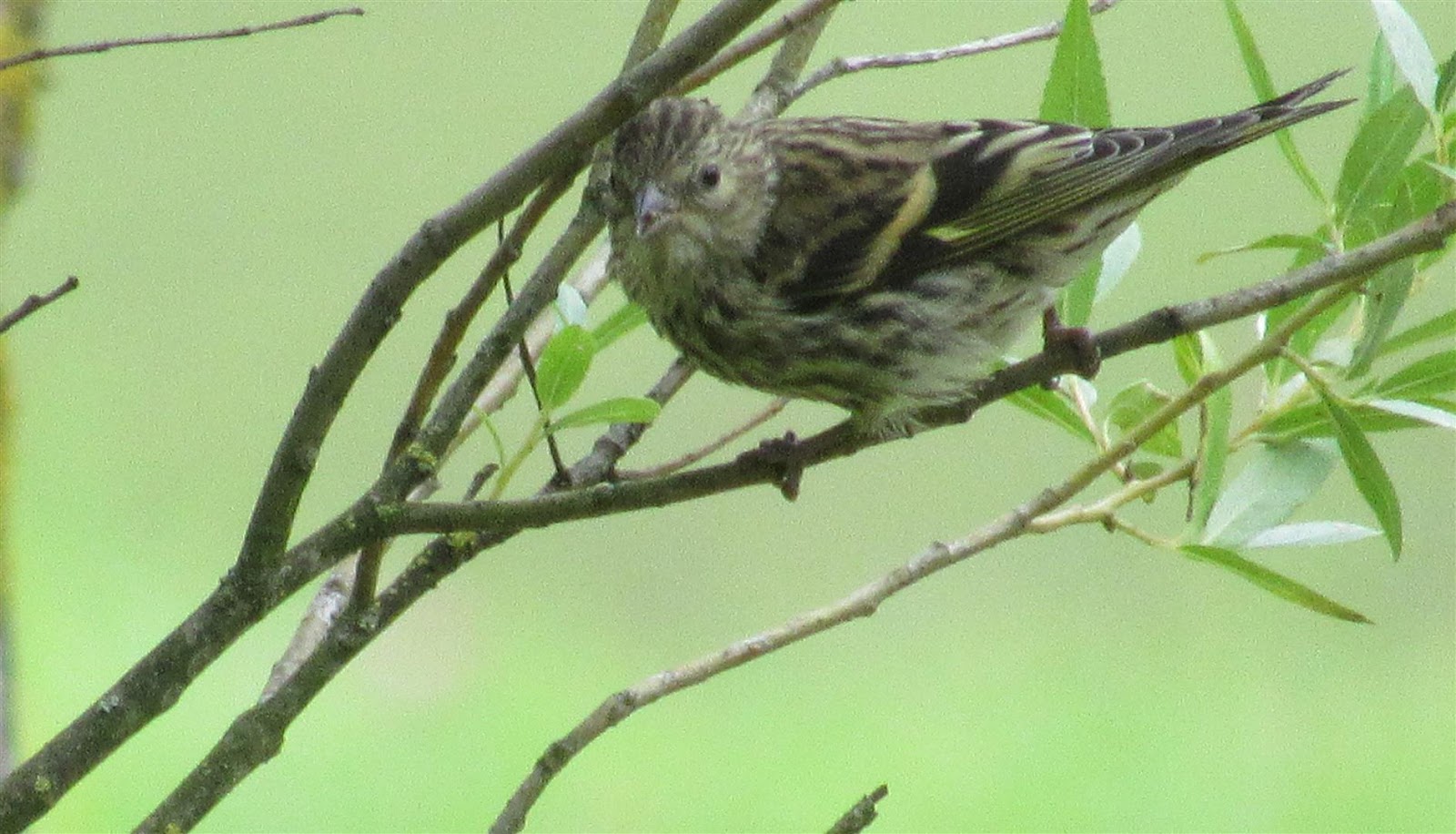
young siskin

Near-by the first two treecreeper, I spotted a single siskin just I had seen a single one the day before. It was very loosely associating with the more numerous goldfinch.

the river

Back in the forest area, I had a much better view of a local jay than the day before.

jay

There were also a pair of very large and well-fed hare.

local hare

My Belarussian list is a basic 37 now. If I ever return it is something to build on.

Species seen in the river valley, south of the Botanic Gardens, Minsk
Mallard  
Black-headed Gull  
Common Tern  
Feral Pigeon  
Common Swift  
Great Spotted Woodpecker  
Eurasian Jackdaw  
Hooded Crow 
Barn Swallow  
Great Tit  
Eurasian Treecreeper  
Willow Warbler  
Eurasian Blackcap  
Spotted Flycatcher  
European Robin  
Thrush Nightingale 
Common Redstart  
Eurasian Blackbird  
Fieldfare  
Mistle Thrush  
European Starling  
White Wagtail 
Common Chaffinch  
Eurasian Siskin  
European Goldfinch  
Hawfinch  
Eurasian Tree Sparrow