Showing posts with label African grey woodpecker. Show all posts

Tuesday, 18 April 2017

Thick woodland in Guidimakha

A week ago Sunday, having spent all morning and part of the afternoon in Gouraye, we headed back to our lodgings in Selibaby.

We knew we had time for another stop and we noticed that weather had clouded over. Presumably it does this every afternoon in the deepest south of Mauritania ahead of the rainy season.

The first bit of good news is that we sighted a Beaudouin's snake eagle on an electricity pylon, 10 kilometres out of Gouraye. It was instantly recognisable, like a short-toed snake eagle but with a dark brown wash on all parts.

A few kilometres later we arrived at a bridge over an apparently dry river bed. However the woodland next to it looked particularly thick.

This proved to be a very good choice of place to stop.

Gosling's bunting

Under the road bridge were several Gosling's bunting. It is highly probable that they nest there.

A much biggest nest was seen once we got into the woodland. It was a hamerkop's nest.

hamerkop's nest

We soon came across some hamerkop. However a bigger discovery was that there was water in places along the stream's bed. This made the woodland much more interesting.

four hamerkop

The small passerines: red-cheeked cordonbleu, red-billed firefinch, black-headed weaver, red-billed quelea were scattered around the wood but were most easily seen drinking.

red-cheeked cordonbleu and black-headed weaver drinking (courtesy of Mohamed Vall)

red-billed firefinch


Near the water were a small number of western plantain-eater. This was yet another addition to my country list. It is a bird usually assocaited with Savannah which gives you an indication as to how dense and wet this piece of woodland was.

western plantain eater

Yellow-crowned gonolek is another bird only found in the south of the country but not as selectively as the plantain-eaters. 

yellow-crowned gonolek

There was a second edition to my list here too. It was brown babbler. Unfortunately the group evaded my camera though Mohamed Vall got a record shot.

hoopoe

Resident African hoopoe were observed. This is ideal terrain for them.

African grey woodpecker (courtesy of Mohamed Vall)

A pair of African grey woodpecker were not easily scared by us. We had expected to see this species here when we surveyed the woodland before we went inside it. However, what we are beginning to question is why neither of us has seen any other type of woodpecker in the country.


Black-billed wood dove (courtesy of Mohamed Vall)

Another expected bird was black-billed wood dove. Indeed it looks better habitat (wettest and denser) than where we had seen them for the first time near Gouraye.

black bush robin

Of course more common birds of woodland were present such as black bush robin and namaqua dove.

We arrived back in Selibaby in the evening well satisfied.

Species seen at the woodland
Hamerkop  6
Grey Heron  1
African Collared Dove  3
Laughing Dove  11
Black-billed Wood-Dove  4
Namaqua Dove  8
Western Plantain-eater  6
Eurasian Hoopoe (African)  4
Western Red-billed Hornbill  5
Abyssinian Roller  3
African Grey Woodpecker  2
Common Kestrel  1
Ring-necked Parakeet  4
Yellow-crowned Gonolek  5
Common Bulbul  2
Willow Warbler  2
Brown Babbler  4
Long-tailed Glossy Starling  8
Gosling's Bunting  10
Northern Grey-headed Sparrow  6
Black-headed Weaver  4
Red-billed Quelea  75
Red-cheeked Cordonbleu  11
Red-billed Firefinch  8

Tuesday, 28 February 2017

Return to Mederdra

On Saturday, I returned to active birding in Mauritania following a break between semesters in the UK and Spain.

I went south to Mederdra with Mohamed Vall for a very full day trip from dawn until after dusk.

It was eventful and very rewarding. I added four species to my Mauritanian list.

However the trip didn't start well when I discovered my camera was broken. Luckily for me Mohamed Vall stepped in and all the pictures on this blog are courtesy of him.

The zoom is not as powerful so I have compensated as best I can by showing smaller than usual bird sizes. I am still very grateful for his help in being able to record what we saw.

I will try to replace or repair the camera in the near future.


Fulvous babbler

We visted three distinct areas around this southern inland but wooded town.

The first area was new to us both. It was directly west of the town in a valley containing the town's rubbish dump and a small tanning place for dead animals as well as open woodland.

The rubbish dump attracted plenty of Sudanese golden sparrow as well as a family of fulvous babbler.

The tanning unit and rubbish dump were twin attractions for both brown-necked raven and yellow-billed kite.

yellow-billed kite

Below I am seen walking towards a tree which held a maximum of ten resting yellow-billed kite at one stage.

Me walking towards a tree full of yellow-billed kite

Elsewhere in the valley were a few Namaqua dove and a group of several African collared dove which were all accidentally flushed from a single tree when we walked past.

Namaqua dove

Chestnut-bellied starling were every where but we came across one small group of greater blue-eared starling too.

greater blue-eared starling

Black bush robin were common too.

black-bush robin

While the birds were varied and numerous in this valley we failed to see anything new.

We had more luck with our second stop. This was north west of the town and two kilometres out.

striped kingfisher

Here we reacquainted ourselves with striped kingfisher. We had seen this species on our previous visit to Mederdra and close to where a pair were seen this time. Incidentally, so far it is the only place in Mauritania that I have seen this bird.

black-eared wheatear

It was now the heat of the day and we weren't hopfel to add to the list. We were picking up relatively few birds which included northern wheatear and black-eared wheatear. The one above was a tricky identifcation. The colours suggested desert wheatear which is just possible at the southernmost edge of its winter range. However I could see no hint of a join of the black face with the black on the wing.

Suddenly it all started to work out. We observed two woodpeckers some distance apart.

African grey woodpecker 1

One was a female African grey woodpecker while the other was a male.

African grey woodpecker 2

The female was more obliging. We got prolonged views and Mohamed Vall obtained photos. This was the first addition to the list.

African grey woodpecker 3

We paid particular attention to the small passerines in the woods. Western orphean warbler was common. We picked up at least two clear Western Bonelli's warbler as well.

Western bonelli's warbler

We interrupted our views of passerines for a pair of hoopoe which intervented.

hoopoe

When we returned to the passerines we kept seeing yellow-bellied eremomela.

yellow-bellied eremomela

It must have been hidden in plain sight during our visit in October. We saw eight this time. Surely we missed them last time by not looking closely enough at the small birds.

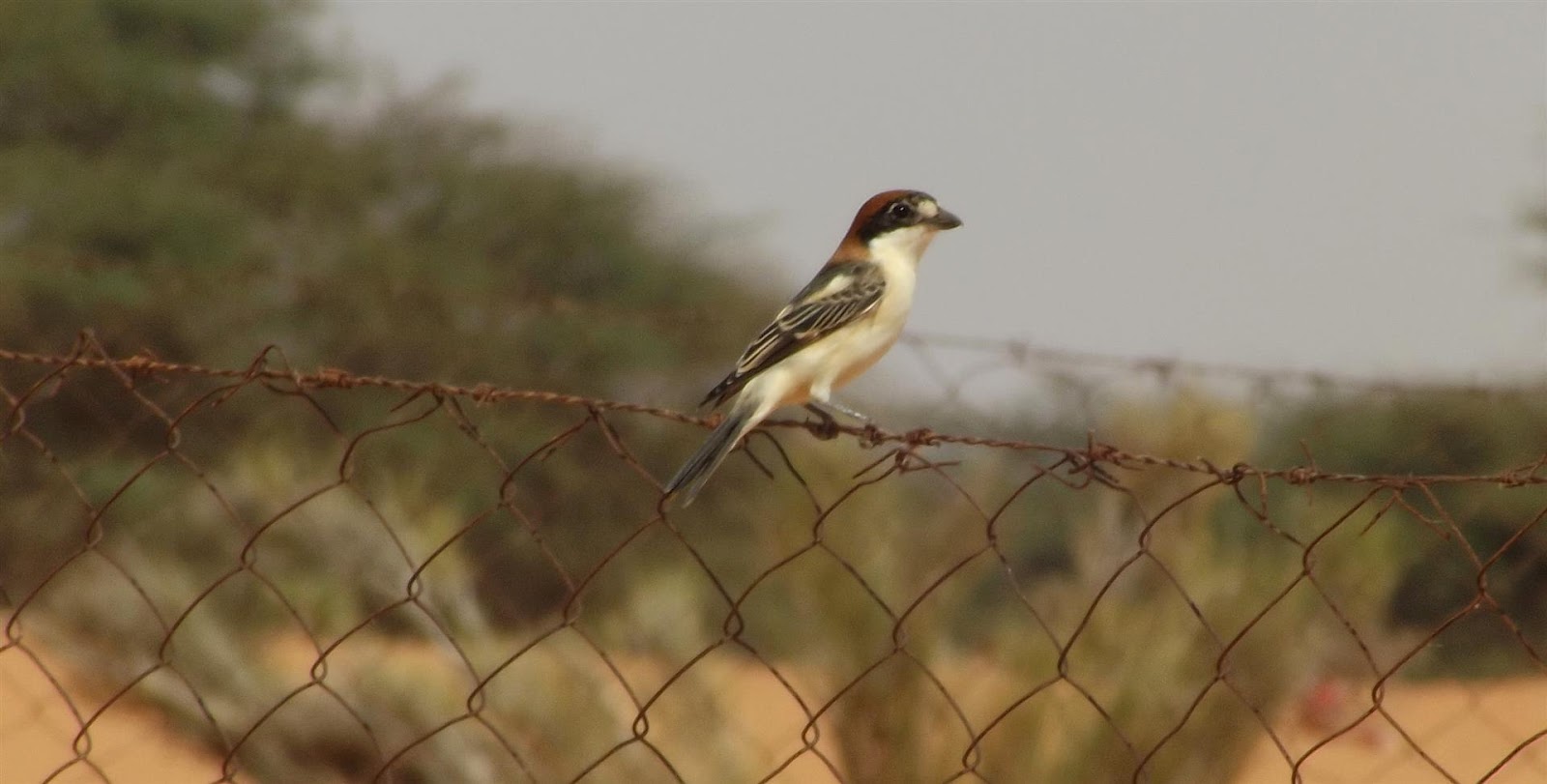
woodchat shrike

As well as the European warblers, other evidence of wintering palearctic birds came in the form of woodchat shrike.

striped kingfisher

After a break to eat, we resummed for our third and final session at the small farm, one kilometre north west of the previous site. We found two more of both striped kingfisher and African grey woodpecker.

The farmer had fenced off some grassland to prevent livestock other than his own from grazing. This meant natural long grassland. I had expected larks and we got them.

singing bush lark 1

Four singing bush lark were sighred over the fence in the middle of the field. Luckily for us they flew close to the edge and we got better views.

singing bush lark 2

I know from experience in Saudi Arabia and Oman that this species likes long grass on farms. It was true to form.


distant record shot of green wood hoopoe

We had given up birding for the day when we were walking through a small settlement near the parked car. We could not believe our eyes. Two juvenile green wood hoopoe were moving from tree to tree within the settlement. They were separated in identification from adult black wood hoopoe by their obviously larger size.

Unfortunately we couldn't get close. They were very timid. However it was an amzing end. The range map doesn't show them within 75 kilometres and to the south east.

Despite the difficulties, this was one of my best one day's birding in Mauritania. I am very grateful to Mohamed Vall for making it possible.

Birds seen at Mederdra

Black Kite (Yellow-billed)  14    
African Collared-Dove  10
Laughing Dove  6
Namaqua Dove  11
Blue-naped Mousebird  8
Eurasian Hoopoe  3
Green Woodhoopoe  2
Striped Kingfisher  4
Abyssinian Roller  1
African Grey Woodpecker  4
Common Kestrel  1
Black-crowned Tchagra  1
Southern Grey Shrike  2
Woodchat Shrike  5
Brown-necked Raven  20
Singing Bushlark  4
Barn Swallow  3
Northern Crombec  1
Willow Warbler  5
Western Bonelli's Warbler  2
Cricket Longtail  2
Yellow-bellied Eremomela  8
Western Orphean Warbler  6
Subalpine Warbler  1
Fulvous Chatterer  7
Black Scrub-Robin  8
Redstart  1
Wheatear  5
Black-eared Wheatear  3

Chestnut-bellied Starling 30
Greater Blue-eyed Starling 4
House Sparrow  6
Sudan Golden Sparrow  110    
Vitelline Masked-Weaver  3
African Silverbill  12