Showing posts with label European roller. Show all posts

Monday, 3 April 2017

European roller and bee-eater at waste water site

Saturday was insanely hot for the first day of April. Afternoon temperatures offically reached 44°C in the shade.

Birding was tough especially as there was a sandy wind blowing off the Sahara affecting visibility as well as temperatures.

Nevertheless Mohamed Vall and I went out in the morning. We chose the waste water site just north of the city. This is a place we stopped going to about 3 months ago as the water was so contaminated there were few birds around.

The water was still contaminated but relatively less so. The area of water had increased three fold too. There were plenty of dragonflies and flies to greet us when we parked up and I took that as a good omen.

Indeed the birding was excellent even if the weather wasn't.

The best news of all was the sighting of two additions to my country list. One was a European roller.
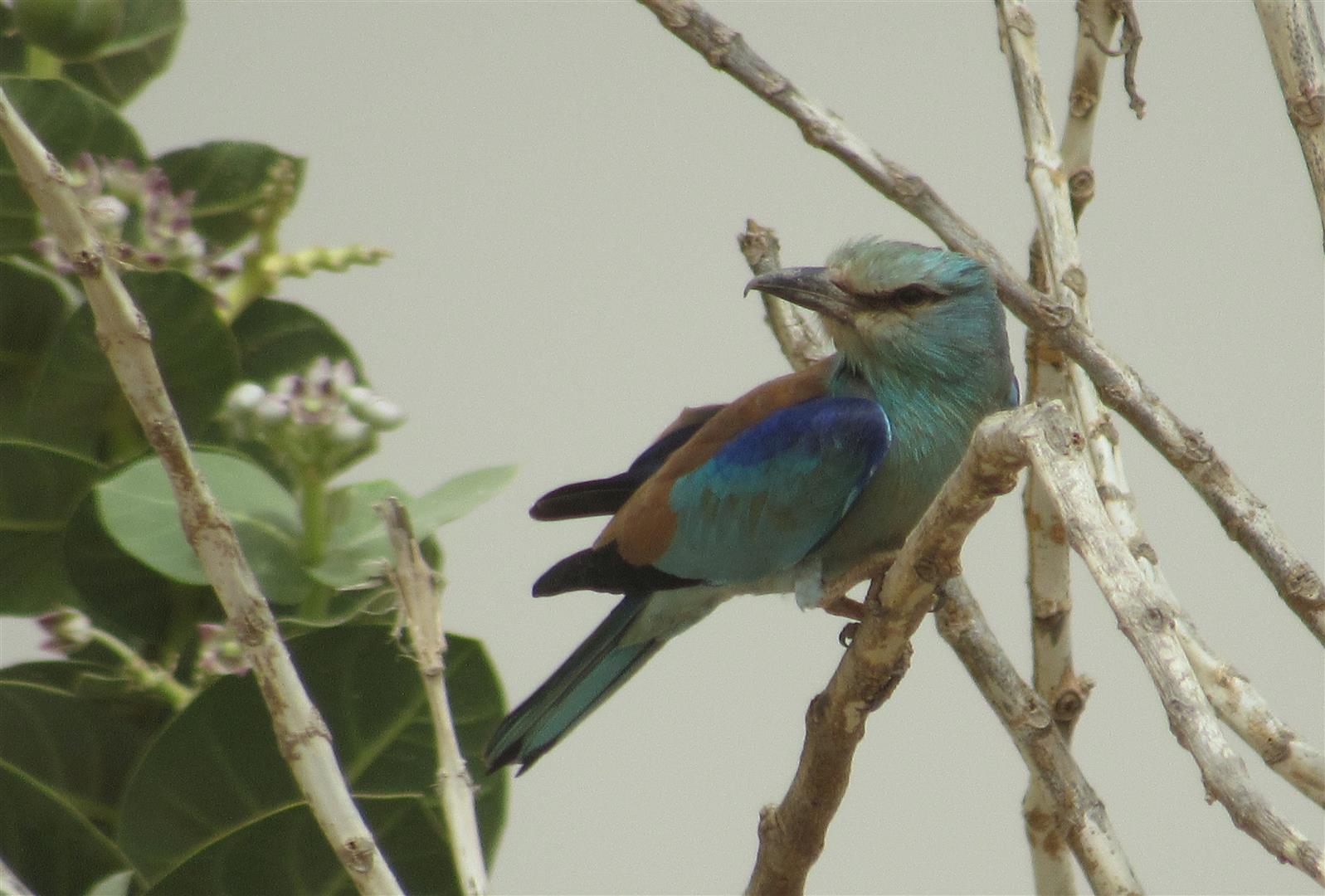
European roller 1

Like most birds there it allowed closer approach than usual since the weather was so hot.

European roller

Only a few minutes earlier a lone European bee-eater had been sighted.

European bee-eater

It was resting on top of a Sodom's apple in the middle of the largest pool. On seeing the dragonflies on arrival, I had hoped that this species would be present.

largest pool

While much of the pool is oiled, some sections are in better condition. These are easily found because that is where the waders congregate. Most were wood sandpiper and little stint.

wood sandpiper and little stint

Plenty of barn swallow were hawking over the water and at least one of the hirundines was a red-rumped swallow too. 

barn swallow resting

There was much more passage than just the swallows, roller and bee-eater.

woodchat shrike

Woodchat shrike was the most conspicous. We counted at least ten.

Namaqua dove drinking

We had to move away from the main pool to see mamy of the smaller passage birds. All the lesser pools looked oiled and yet a couple in one area were much less so. The birds seem to know. Namaqua dove and laughing dove would only drink from these.

It was at these two pools that we saw all the warblers. There had clearly been a windfall of mixed warblers and they had gravitated to the cover near these pools.

female blackcap (courtesy of Mohamed Vall)

A female blackcap was easily picked out as many of the bushes are leafless.

western olivaceous warbler (courtesy of Mohamed Vall)

At least three western olivaceous warbler, two western orphean warbler, a sardinian warbler, two chiffchaff and a willow warbler were in the group. This was also the place we saw the most redstart including a very smart male.

Making this spot even busier were regular visits from both house sparrow and Sudanese golden sparrow.

lone Fulvous babbler (courtesy of Mohamed Vall)

Elsewhere in the drier areas, a lone Arabian babbler was observed. This is the first time we had seen one within the official Nouakchott limits.

tawny pipit

Tawny pipit were seen in a dry area with yellow wagtail and white wagtail nearer water. Yet my targetted red-throated pipit was nowhere to be seen.

northern wheatear 1

There were also a few northern wheatear on site. One male allowed us very close. It really didn't want to vacate the shade and cool of a bush.

northern wheatear 2

We left the site at around 11.15 a.m. for a late breakfast. It had been very good but gruelling birding.

We elected to go on to south of fishing port at around midday. It was extremely hot but we inspected the rubbish dump there as always. We counted 16 yellow wagtail and 2 white wagtail. They were alternating between foraging for food and returning to the undersides of moored boats which provided shade. Once again red-throated pipit was looked for. We came closest with a single tawny pipit.

After this, we headed to the lagoons and the beach. The number of lesser black-backed gull was way down on previous weeks. I wondered whether the heat had triggered their northward migration.

Looking out to sea the best birds were storm petrels which I hadn't seen before. The sea was unusally choppy. However the birds were so far out that I didn't have a change to identify them. A cormorant also flew by. Otherwise it was all gulls and terns. Caspian tern, sandwich tern and common tern were  the bulk of the birds.

three first winter common tern

We carried out our standard look at all the resting seabirds in the lagoons. Slender-billed gull and black-headed gull were the new majority of gulls. Terns were either Caspian tern or common tern.

adult common tern

The waders included one red knot. We found where the cattle egret which normally frequent the rubbish dump had gone. They were all motionless in the lagoon, standing in water and trying to stay cool.

cattle egret at the lagoon

By 1.30 pm we decided we needed to cool off too. The birding day was finished though it had been a very successful one.

Species seen at the waste water site on 1st April
Black Kite  
Common Ringed Plover  
Little Stint  
Common Sandpiper  
Green Sandpiper  
Wood Sandpiper  
Laughing Dove  
Namaqua Dove  
Eurasian Hoopoe  
European Bee-eater  
European Roller  
Common Kestrel  
Woodchat Shrike  
Black-crowned Sparrow-Lark 
Greater Short-toed Lark  
Crested Lark  
Barn Swallow      
Red-rumped Swallow  
Willow Warbler  
Common Chiffchaff  
Western Olivaceous Warbler     
Eurasian Blackcap  
Western Orphean Warbler  
Sardinian Warbler  
Fulvous Chatterer  
Redstart  
Wheatear  
Western Yellow Wagtail  
White Wagtail 
Tawny Pipit 
House Sparrow  
Sudan Golden Sparrow 

Sunday, 24 April 2016

Early morning at Al Beed farm

Last Friday was my last desert trip this spring. I have engagements the next two weekends. Furthermore it is now getting very hot to bird all day. 

With a pre-dawn start I reached Al Beed farm and birded until 9 am. It was still relatively cool then.

Unfortunately the passage was not varied even though I searched hard.

European roller

There was a European roller and a dozen or so blue-cheeked bee-eater did pass through.

Eastern olivaceous warbler 1

Although the warbler fall wasn't very varied there was a big windfall of Eastern olivaceous warbler. I counted 13 in one small area.

Eastern olivaceous warbler 2

There were also three Upcher's warbler and four willow warbler mostly in the orchard.

rufous bush robin

Once again rufous bush robin were everywhere. There were nine seen. This must be one of the commonest migrants in the country. 

European turtle dove

Al Beed is excellent for doves though I yet to see an African collared dove there. This is despite the fact that it is found only 60 kilometres away in Mudhai.

European turtle dove is easily seen except in winter.

Namaqua dove

Namaqua dove is not common but can be seen with effort at the farm too.

rosy starling

Some of the wintering rosy starling were still there. Surely it's time for them to move on.

black-crowned sparrow lark

Very young black crowned sparrow lark were littering the fields. For that species, spring is already nearly over.

After Al Beed, my next stop was Dowkah farm. I will blog about that next.

Tuesday, 19 April 2016

Passage rolls through Jarziz

I went to Jarziz farm which is not an easy task at the moment despite being so close to home. A new youth centre is being built in front of it and roads are partially closed off. It was a case of park and walk. It was worth the exercise.

Salalah is off the main route for most non-wader passage in spring. However it is peak passage time in the Middle East so this is the time one is mostly likely to see some.

European  roller

Sure enough three European roller were scattered around the farm and the near-by Dhofar cattle company site which also has crops.

singing bush lark

Of course local birds are still making themselves heard. Indeed the farms are very noisy with the sound of large numbers of singing bush lark at the moment.

barn swallow

Another sign of passage though was the 40 barn swallow I counted hawking over the fields.

common myna

Meanwhile a few common myna are ever present. However Tristram's starling is a little less regular at the farm but not this time.

chestnut bellied sandgrouse in flight

Jarziz farm is the most guaranteed place I know in Oman to see chestnut-bellied sandgrouse.

chestnut-bellied sandgrouse

At the moment they spend a lot of time right in the centre of the largest field where for some reason it is kept fallow.

I am not sure they are under threat from the passing harriers. Certainly the singing bush lark are.

Montagu's harrier 1

There was quite a mix of harriers too. There were three pallid harrier, one marsh harrier and one Montagu's harrier which me identification problems. Part of the problem was the birds kept criss crossing each other but even with still photos ring-tailed harriers can be tricky.

Montagu's harrier 2

I walked over to the Dhofar cattle company site after finishing at Jarziz farm. The distance is not far but this site is often over-looked by visiting birders. For me it was a boon yesterday.

male pallid harrier

There was a male pallid harrier there which I took to be the same one I had seen earlier at Jarziz.

scaly-breasted munia

Among the crops, the singing bush lark were joined by large numbers of both African silverbill and scaly-breasted munia.

ortolan bunting facing

However a high point for me was the sighting of an ortolan bunting on a path in the fields. They are uncommon this far south. Their main passage route in Oman is further north through the desert farms and other desert stops. I fleetingly saw one on my last visit to Jarziz and was a little uncertain whether to add it to my day list. This time there was no doubt.


ortolan bunting 

In a further sure sign of passage, as I started the very long walk back to the car, the hedge on the edge of the company site held a blackcap and an eastern olivaceous warbler.

I now know for sure the importance of this Friday's forthcoming desert trip. Peak passage gives me by best chance for something new.

Friday, 1 May 2015

More migrants in late April

On Monday morning at work, a work colleague sought me out to tell me he had seen a bird hidden high in the canopy of a tree and seemingly asleep. He knew it was a nightjar too because of discussions we had had on birds I was looking out for.


European nightjar

Paul must have eagle eyes because it was hidden deep and high. Once he showed it me I realised no one had a camera other than on their phone. As I live locally, I immediately dashed home and back.

Luckily the European nightjar was still there.

European nightjar 2

It wasn't possible to photograph from many angles are the line of sight was limited. 

I am really grateful to Paul as I had not seen European nightjar in Oman before and it became species 273 on my country list.

The bird is paler than the nominate species and looks like unwini which breeds in Iraq and Iran. Dhofar is an understandable migration route for such birds.

I don't bird on Sundays and Mondays as work commitments take me late in the day so this was a real bonus.

On Tuesday though I found time in the late afternoon to visit Raysut settling pools. It is very hot now in Salalah during the day so I thought that being near water was my best hope of bird activity.

It turned out to be a correct assumption.

spotted flycatcher

The settling pools are all full and surplus water is being fed into the fields inside the plant perimeter. This is creating an excellent environment for birds as vegetation grows and the make shift marsh establishes. The water is flowing outside in places too. I visited the area outside first.

I immediatley came across a spotted flycatcher where I parked the car. It was the first of five.


marsh warbler

I could see warblers flitting about in considerable numbers. One was a common whitethroat. However the others were all marsh warbler. I counted five in the area outside the perimeter fence. One went deep into a bush and felt safe enough to sit still for three minutes and allow me excellent if partially obscured views.

outside the perimeter fence

One marsh warbler actually sat for a few moments on the fence itself.

marsh warbler on fence

After 20 minutes or so investigating this area, I headed back to the car to drive up to the main gate and go inside the plant.

However I stopped next to the car to observe the first grey-headed kingfisher of the summer. It has returned from Africa and is a breeding bird here.

grey headed kingfisher

It looked very thin but should soon recover once it starts eating the local lizards.

grey heron

This blog is solely about migrants and that includes not only passage birds and summer breeders but also wintering birds. There have been grey heron at Raysut settling pools most of the winter. I don't know whether this was one of them or is purely on passage. Either way it will go north soon along with other two seen on site.

little ringed plover

Likewise the little ringed plover and wood sandpiper present will migrate.

red-wattled lapwing

A red-wattled lapwing and the vagrant spur-winged lapwing are still associating. They wintered here but I have no idea what there next moves will be.

spur winged lapwing

Indeed they have been so close since the other red-wattled lapwing left, I had to check if they hybridise! Apparently the only known hybrids involving either of these species is spur-winged lapwing and blacksmith lapwing in parts of Africa.

flamingo

The fifteen or so flamingo are still present too.

As well as looking out for the larger birds inside the site, I could hardly miss the marsh warbler in the long grass and short bushes.


marsh warbler

I counted a further 18 making 23 in total for the afternoon.The two in the pictures above and below may be on the same bush but they are different birds. Both were on the same bush for a while.

another marsh warbler

Marsh warbler are known to travel through Arabia in large numbers especially in spring even though it may not be the most direct route. When I input the number 23 in e-bird I had expected the database to say the number was excpetional. It didn't.

European roller

Needless to say, there were also European roller passing though and a rufous bush robin was also seen.