Showing posts with label common kingfisher. Show all posts

Wednesday, 9 December 2015

The road to Masirah

Masirah was my destination for the four day holiday last week. It is nearly 800 kilometres drive from Salalah and requires a day-time ferry-journey as the last leg. So it was impossible to fulfil the whole journey starting early Tuesday afternoon after work broke up.

Instead I booked a room in a hotel in Duqm for Tuesday night leaving a 180 kilometre stretch and the ferry for Wednesday. 

I snatched small amounts of birding on both Tuesday afternoon and Wednesday morning en route. Furthermore I arrived on Masirah for 90 minutes birding on Wednesday evening. This blog covers the birding on these two days. 


Indian pond heron at Sadah

I elected to take the coast road out on Tuesday and as the distance was so great (over 600 kilometres), I stopped briefly just twice before dark. The first stop was at the small park at Sadah. Here I came across an Indian pond heron which was hiding in a tree.

Greater sand plover at Hasik

The next short stop close to dusk was at Hasik. This area looks like it has good potential for water birds but time was brief. The best sighting was a flock of greater sand plover.

Pacific golden plover

The most common birds were steppe gull. There was a lone pacific golden plover. The highlight though was a masked booby flying over the water.

After this was a long haul drive into the night before reaching the City Hotel Duqm for rest.

The next day only required a further 180 kilometres so it was slightly more leisurely.

A stop at a random wadi about halfway to the ferry port produced my first (and only) white eared bulbul. This was a sure sign that I was in the northern half of the country. It is not a bird of Dhofar.

white eared bulbul

I diverted off the main road to the ferry port to take in Filim on the coast which has a massive wetland often called Bar al Hikman.

On my way there was distracted further by seeing a sign to Mahoot waste treatment site. Perhaps I should have ignored it but like exploration.

Ruff at Mahoot waste site

This site was as rough as any I have seen in the Middle East yet birds were attracted to it. There were several ruff and even two great cormorant.

great cormorant

In these dirty sites, looking at the structure of a bird is often necessary as old stains are regularly picked up.

black-winged stilt

The ruff above have some odd colouration for example.

northern pintail

Perhaps the biggest surprise at the waste site was the number of ducks, many of which were northern pintail.
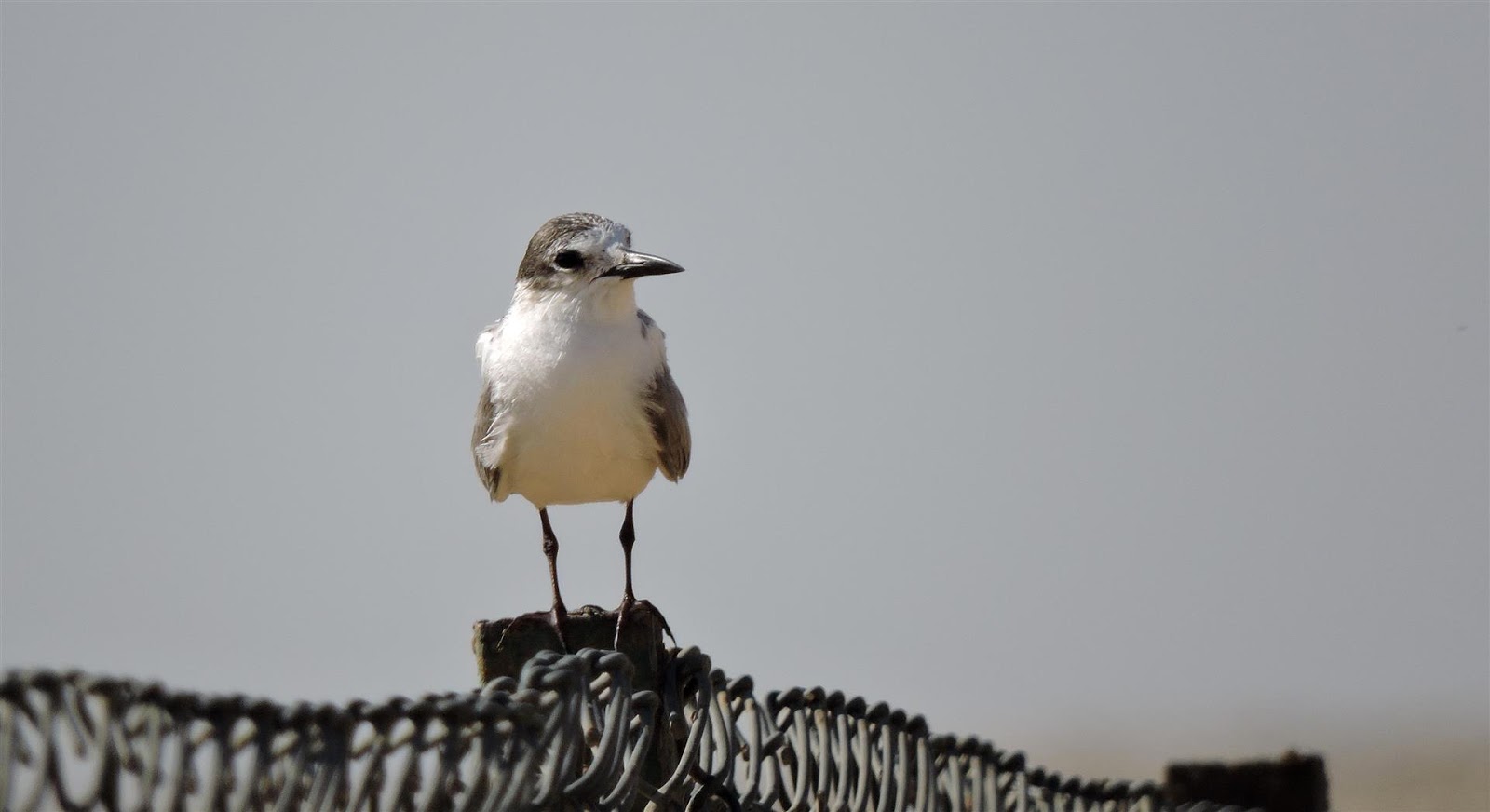
whiskered tern

I spotted three terns there. I believe they were all whiskered tern. The long legs and strong bill on this bird is typical.

redshank (left) and grey plover (right)

The main reason for my diversion was to look for great knot on the wetland at Filim. This was the only failure on the trip. The light was very difficult, the distances to scan were vast and time was hurried. It wasn't difficult to find bar-tailed godwit with which great knot is known to associate. I counted more than twenty but there were dispersed. There was no one place for them.

After Filim I was on the ferry to Masirah by mid-afternoon.

on the ferry to Masirah

I kept looking out to sea but the only birds were steppe gull and sooty gull both on the water and in the skies.

sooty gull

I had an hour before sunset to finally start birding Hilf sewage works which was to be my birding venue for the next two and a half days.

great cormorant on a tree at Hilf

I could tell immediately that the site was going to be prolific. For example 70 great cormorant had already come in to roost for the evening on probably the highest tree on the island.

red-wattled lapwing

A red wattled lapwing greeted me on one of the over-spill pools.

lesser black-headed gull

The main pools were full of ducks and gulls. The gulls were a mix of slender-billed gull and lesser black-headed gull.

hoopoe

A single hoopoe flew to the safety of a tree.

One reason for making the very long trip to Masirah was the report of the country's first ever white-throated kingfisher. It had first been reported in early November and again until late November. However there was no guarantee it would still be there.

common kingfisher

I did come across a common kingfisher near the main pools quite quickly.

common kingfisher 2

In the same tree was the only water pipit I saw all the time I was on the island.

water pipit

It's distant cousin, white wagtail was much more common.

white wagtail

As dusk was setting in, I headed back out of the works only to see a cattle egret roost forming up.

cattle egret

Very nearly the last bird I meet on my way out was the white-throated kingfisher. It was a fleeting look and was most unsatisfactory as it disappeared through the trees. There were however two full days to find it and it was an good omen as to what was to come.

Saturday, 28 March 2015

Uncommon birds at Mughsail

Having had an unsuccessful time birding for the spring passage in likely places, on Friday I chose to change my plan. Instead, I decided to do some general and less focussed birding in a location I hadn't been to for a while. I chose Mughsail.

It turned out to be a very good choice. I started out by visiting the main pool and sitting down in the hide.

On the way all the moorhen and other water birds scattered and a wigeon disappeared into the reeds not to be seen again.

One of the few birds left unperturbed was a great egret.

great egret

The next bird activity was a flock of rock pigeon which flew straight past the hide and landed on rocks a few metres way.

rock pigeon

Slowly the water birds returned as I remained forgotten in the hide. First back were two little grebe.

little grebe

One by one the moorhen returned.

moorhen

Then it suddenly got interesting. The lesser whistling duck swam into view. I last saw this vagrant in the second and smaller pool about 10 weeks ago.

lesser whistling duck

It didn't hide. Clearly it is now more confident in its surroundings.


lesser whistling duck standing upright

It remained in view for over ten minutes.

lesser whistling duck walking

The characteristic chestnut rump was easily seen.

lesser whistling duck walking off

While the lesser whistling duck was still in the open, a common kingfisher darted on to the scene on to some reeds barely 5 metres to the right of the duck.

common kingfisher 1

This was totally unexpected and a reward for speculative birding. Common kingfisher is very uncommon in southern Oman. It is right on the edge of its normal wintering range. I don't expect it to stay long.

common kingfisher 2

This bird is a female as told by the extensive red on its lower mandible.

It became bird number 262 on my Oman country list.

coot

Other returning birds included a solitary coot.

Tristram's starling

After this success I headed towards the second pool passing several Tristram's starling on the way to the car.

kestrel near the second pool

The second pool was quiet except for several moorhen and a greenshank. A common kestrel was also near-by. This pool has given me several successes in the past but it was not to be this time.

On the way out of the khawr, I came across black-crowned sparrow lark drinking. I don't think I have seen them at the site before.

black-crowned sparrow lark

My next stop was a wadi 9 kilometres further west of Mughsail. The birding was very interesting. I will blog about that next.

Tuesday, 22 April 2014

The river banks at Al Hayer

On Saturday morning, I made one of my irregular visits to the pivot field area south of Al Hayer. In my first two years in Riyadh I visited this area about twice each month.   In a sense it could be seen as my "local patch". However in the past year, the frequency has dropped to about twice every three months as I travel more.

Nevertheless it was a welcome return. There has been a lot of development recently and the Riyadh river seems to be continually changing course as reeds are burnt and earth moved.

I decided to concentrate on the edge of the water rather than spend too much time in the pivot fields themselves.

common kingfisher

A early surprise was the sight of a common kingfisher. One or two are known to winter near the fields every year but I wasn't expecting one to still be around on April 19th. 

purple heron

The birding had started well but before seeing it, a purple heron rose up at the very start as I walked along a new stretch of the river.

rufous-tailed bush robin

Near-by, on some scrub land between the river and the nearest field I witnessed my first rufous tailed bush robin of spring.

European collared dove

I only ventured into the near-by field trying to follow a streaked weaver. During my very short stay in  there I only saw crested lark and European collared dove.


new course of the river

As I returned to the river, I accidentally flushed three common snipe.  Further along near the river's edge were several red-throated pipit.

red-throated pipit

From the river I could see five cattle egret resting on the pivot bar in the middle of the field. While watching these, a black crowned night heron flew past me.


cattle egret

There was much more streaked weaver activity in the reeds at the far side of the river.  I saw 4 nests close together and i am sure there were plenty more out of sight.

male streaked weaver

Unfortunately this was a place where four fishermen were fishing. Sadly two hours later they had produced a barbeque which made the reeds catch fire and a very large area of reeds and tamarisk were burnt down almost certainly destroying all the nests. At least 50 black crowned night heron which I hadn't previously seen flew up into the air to avoid the smoke and fire.

I saw two similar fires last spring. This act made me angry and sad in equal measure. 

female streaked weaver

Further up stream I came across more weavers' nests so at least the whole population wasn't wiped out. The picture of the female above is from that different group.


squacco heron

In the same area were three squacco heron who like the ones in Jubail the day before were in complete summer plumage.

graceful prinia

There are lots of tamarisk and other bushes in this section but I failed to see many warblers who must be passing through at the moment. I can only think that the high temperatures are forcing them deep into cover during the day. Nevertheless the local graceful prinia were braving the heat and I also briefing saw my first barred warbler of the spring.

red avadavat

I have noted before that the exotic birds such as streaked weaver and red avadavat almost disappear from this area in winter only to reappear in spring. I believe they find more densely bushed areas up stream. Both are back in numbers. Red avadavat was easy to see. The males have started to gain some of their breeding plumage since my last sighting two weeks ago but they have a long way to go. However you can start to see why one alternative name is strawberry munia.


young moorhen

In contrast moorhen have been busy breeding since late January.

Turkestan shrike

As the heat steadily rose towards midday, fewer and few birds were disclosing themselves. Turkestan shrike perch out in all heat so one of these could be seen. A black bush robin was seen fleetingly.

grey heron

Something must have disturbed a grey heron which rose up unexpectedly. This was one of the last birds I saw before ending around 11.30 with temperatures still rising.

Strangely I didn't see a single bird of prey all the time at al Hayer. This must be a first.

kestrel at the Riyadh cricket club lake


The only one I saw was at the lake near Riyadh cricket club on the way out towards Al Hayer when I had travelled out with Bernard Bracken who spent the day there.