Showing posts with label dusky turtle dove. Show all posts

Wednesday, 19 March 2014

Further up the wadi, Muhayil

On Saturday, I decided to walk out of the hotel  and bird while in Muhayil in South West Saudi Arabia. However this time I chose to walk much further north and up the main town wadi. I walked more than 3 kilometres further north than on previous visits. 

For the most part, the birding was very enjoyable except when I nearly got ravaged by a pack of stray dogs which was very frightening and also when the temperatures got too hot after midday.

Dusky turtle dove with a Ruepell's weaver


Like in the more central parts of the wadi, there were hundreds of doves, mostly African collared dove and laughing dove as well as a few feral pigeons. The big surprise was the sighting of  three dusky turtle dove. This is normally found above 1000 metres but the main guide does say some move lower in winter. This location was at 650 metres.

African collared dove

The Nile Valley sunbird seen elsewhere in the wadi were supplemented by shining sunbird here.


chiffchaff

I decided to spend considerable time within the thickets looking for my main nemesis bird: black crowned tchagra.Once again I failed to see this elusive species. Instead I discovered that the more shaded thickets contained warblers I had failed to see any where else on the trip. 

There were a few chiffchaff.

Blackcap

However the most common warbler was lesser whitethroat. A single female blackcap was also seen with one small lesser whitethroat group.

Lesser whitethroat

Other western palearctic birds were present too. A female Siberian stonechat was found in an small arable field.

Siberian stonechat

Later on, three passage tawny pipit were observed on scrubby land.

Tawny pipit

No less than five masked shrike were seen along with one Daurian shrike.

Daurian shrike

Once again the wadi held both white wagtail and grey wagtail. The latter is more surprising as I didn't see any running water.


grey wagtail

As said  in a previous blog, little green bee-eater isn't very common.

little green bee-eater

In the air, the two birds of prey this time were long legged buzzard and yellow billed kite.

long legged buzzard

Also in the air were many little swift which are probably resident as well as a few passage red-rumped swallow and alpine swift (which are either summer visitors or resident).
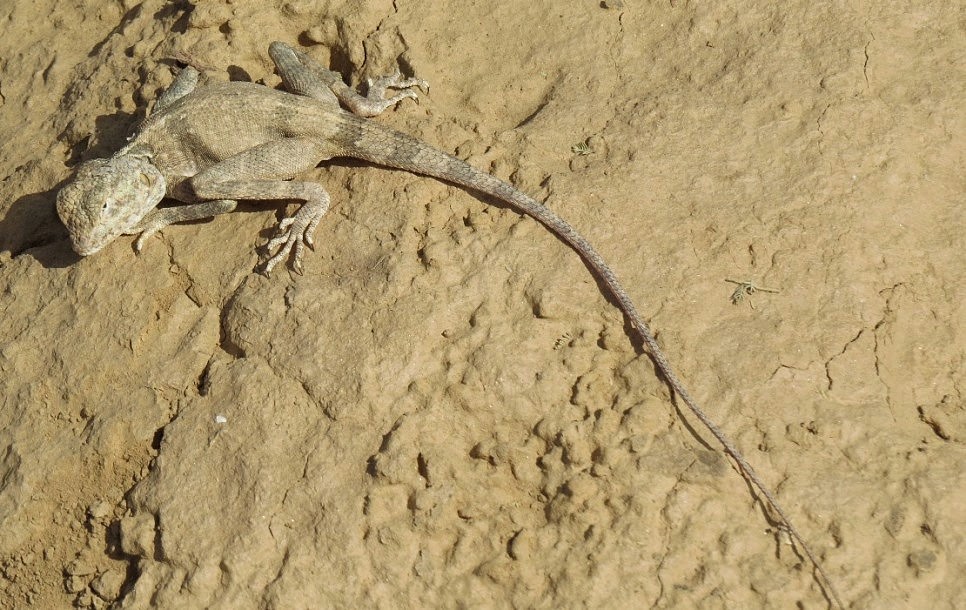
lizard in Wadi Muhayil

I feel I am only scratching the surface at finding good birding places in the Muhayil area. I will keep widening my search every time I visit.


Tuesday, 18 February 2014

Wadi Talea in the afternoon

In the afternoon in Wadi Talea, Bernard Bracken and I spent a lot of time looking unsuccessfully for Blanford's lark which we concluded must have moved to lower altitudes. We looked very intensively which is my preferred style. 

Dusky turtle dove

Other regional birds were  not so difficult. The wadi is clearly a stronghold of dusky turtle dove which was the most common dove of the day. No African collared dove were seen. Like the lark they move down in winter.

three dusky turtle dove

The only lark we saw was crested lark which can adapt more than any other.

crested lark

We had a little more luck with wheatears than larks. 

male Arabian wheatear

Arabian wheatear were common but we also picked up an Isabelline wheatear too. 

Isabelline wheatear

There were three other interesting chats in the area. Little rock thrush was quite conspicuous and not just on rocks.

little rock thrush

Both black redstart and common redstart winter here.

female common redstart

Among other smaller birds were also plenty of resident birds. Palestine sunbird was common. Abyssinian white-eye and African silverbill were seen less frequently.

male Palestine sunbird

Although Arabian babbler was seen in the morning, a young one was only seen in the afternoon and it was fearless.


young Arabian babbler

The similar sized Yemen thrush was also seen near-by.

Yemen thrush

Also in the bushes were graceful prinia and chiffchaff. The latter was the only wintering warbler seen but it was common and mostly found in small loose flocks.

chiffchaff

Towards the end of the afternoon, we came across a flock of Arabian partridge on two occasions. Their standard defence when noticing people is to fly directly down a hillside and away especially if it is steep. However this wasn't possible because we were at the bottom of the slope so we got prolonged views as their tried (badly) to hide. 

Arabian partridge

One of the last species we saw before leaving was brown-necked raven. 

One of the two ravens was carrying nesting material. Even this high up, spring is almost in the air.

brown-necked raven


On Saturday, Bernard and I spent the day walking down and up the Raydah escarpment. I'll blog about that next.


Birds seen at Wadi Talea based on a list kindly prepared by Bernard Bracken

Arabian Partridge
Steppe Eagle
Arabian Babbler
White Spectacled Bulbul
Little Green Bee Eater
Hoopoe
Dusky Turtle Dove
Laughing Dove
Rock Dove and Feral Pigeon
African Silverbill
Graceful Prinia
Chiffchaff
Scrub Warbler
Brown Woodland Warbler
Crested Lark
Isabelline Wheatear
Arabian Wheatear
Yemen Thrush
Little Rock Thrush
Common Redstart
Black Redstart
Black Scrub Robin
Brown-necked Raven
Tristrams Starling
Long Billed Pipit
Palestine Sunbird
Abyssinian White-eye
Yemen Linnet
House sparrow

Friday, 2 March 2012

Baha magic

Tonight, I have just returned from one of my best birding experiences! 


Once a month, I am visiting places in other parts of Saudi Arabia away from Riyadh. This weekend,I followed up my trip to Najran a month ago with one to Baha. Like Najran, Baha is in the south west but it is a more mountainous region.


The relatively few birders who have been to the south west usually go to Abha for land birds (250 kilometres further south). If they do go to the Baha area they often chose Mount Shada and Raghadan forest. I had intended to visit at least one of these but as it turned out this never happened. I'll explain why.


I arrived at my hotel which is the Golden Tulip on the edge of Baha on Thursday morning. The hotel is on one of the highest points in the city and there is a 300 metre drop directly behind it.  I noticed there was a wide wadi right next to the hotel which starts at 2,100 metres and descends into the city. It is lightly forested but I could see some cultivation further down.


I had a hunch that I didn't need to go far to have good birding. I decided to bird the wadi before setting off for the "normal" birding venues.


I never left the wadi all weekend.


I saw over 40 species, at least 10 of them were lifers (more depending on some identification issues) and there were 6 Arabian endemics there too. All were within walking distance of the hotel. I am sure the diversity of birds was because the wadi is an uncommonly diverse habitat itself.

dusky turtle dove

I will blog about the trip over the next few days. Since the trip turned out to be so eventful,I'll divide up the birds seen into groups.  

As a taster: dusky turtle dove is an almost random example of one of the lifers I saw. This one was eating seeds in a fallow field in the farming area of the wadi.

second angle on dusky turtle dove

I almost missed it as there were pigeons in the area and there is a superficial resemblance to them. 

To build on the sighting of dusky turtle dove, in the next blog, I'll take a look at doves and partridges in the wadi.