Showing posts with label hen harrier. Show all posts

Saturday, 6 April 2013

All the harriers and other birds of prey at Zulfi

As promised, here is a blog reporting some more of Mansur Al Fahad's four day trip to Zulfi. This blog is about the birds of prey he saw.

First and foremost he managed to see all four harrier species which are found in Saudi Arabia and they were in roughly the same area!

The hen harrier was found in fields 25 kilometres north of Zulfi on the penultimate day of his trip. It surprises some people to know that hen harrier can be seen in the northern most third of Saudi Arabia during the winter though places like Tabuk in the true north probably give you the best chance.

For Mansur it was a lifer.


hen harrier

Montagu's harrier is a passage bird which is rarer than pallid harrier. Indeed I still haven't seen one in Saudi Arabia. It is one of a small number of my "nemesis" birds.


Montagu's harrier

It was seen, on the last day, along with pallid harrier and marsh harrier over a barley field 30 kilometres south west of Zulfi. That field provided a bonanza!


pallid harrier

Pallid harrier is quite a common passage bird and can be seen almost anywhere in Saudi Arabia.


male marsh harrier

Likewise, male marsh harrier is mostly a passage bird. We see proportionately many more juveniles and females during the winter.

black kite

However the harriers weren't the only birds of prey observed. A steppe eagle and a black kite seen to the north of Zulfi.

steppe eagle

Finally we shouldn't forget that by far the most common bird of prey in the area is the humble kestrel.

common kestrel

There is more to come on Mansur's trip to Zulfi in future blogs. Thanks to him again for the information and pictures.


Monday, 11 March 2013

Raptors at Tabuk

One of the features of my weekend birding near Tabuk was the complete lack of sightings of eagles. However the other raptors more than made up for this as I will explain.


long legged buzzard in the fields

While Viv Wilson and I went into the desert on Thursday we visited the waste water wetlands on Friday which is a completely different habitat of course.

On the way there we spotted several black kite and one long legged buzzard and a single kestrel near the pivot fields.

black kite in the fields

There are several thousand black kite in the Tabuk area during late Autumn which thin out during the winter as many of the birds head further south. In spring the numbers swell but not up to autumn standards as returning birds pass quickly through.

The main excitement concerning birds of prey was not in the pivot fields but at the wetland.

The wetland was at least twice the size since the last time I visited in late November. The big and exceptional winter rain must be a major part of the cause.

There was a new area of low grassland and marsh beyond the pre-existing reed beds and pools.

hen harrier at the wetland

All these areas had a lots of small and medium sized birds and associated harrier activity.

My number two target bird (after Sinai rosefinch)  from my Tabuk visit was hen harrier.

Guides vary over what parts of Saudi Arabia can have hen harrier in winter. The Helms guide of birds of the Middle East says all the northern quarter. Others show a more restricted area but all include the north west corner. So I thought Tabuk was my best bet.

hen harrier hovering

Sure enough, there was a female hen harrier over the wetlands. It can be most easily differentiated from the other ringed tailed harriers by its broader wings. And the wings are so broad it is the only one that has five fingers rather than four.

This was one of the four additions to my Saudi list during the trip and my total is now 275 species (my next blog will talk about the fourth species).

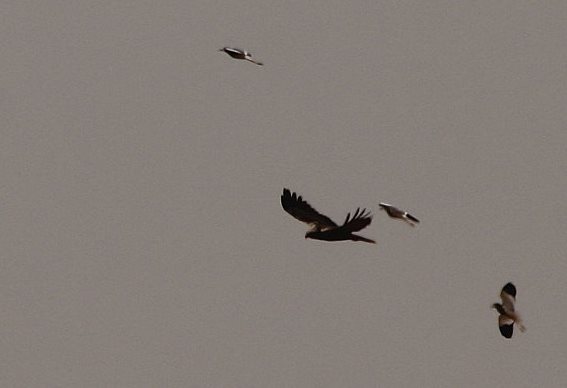
Marsh harrier mobbed by spur winged lapwing

As well as a hen harrier there was also at least one male pallid harrier and eight marsh harrier. One of the marsh harrier was an adult male.

One of the most interesting moments was when several spur winged lapwing mobbed one of the marsh harrier. I have seen crow family members do this but never lapwings.  I thought this was incredibly brave and can only assume they were defending breeding territories. 

There was a second type of lapwing at the wetlands too along with over 45 other species. My next blog will look at them in more depth.

Sincere thanks are due to Viv Wilson who took all the photographs some of which I have severely cropped.