Showing posts with label long-tailed nightjar. Show all posts

Sunday, 20 May 2018

Aleg and Mal

At the very beginning of April, I visited Kiffa in the east of the country for the first time. It was a long journey and it required a day off work to make a very long weekend out of it.

I went with Mohamed Vall and we set off from Nouakchott on Friday lunchtime.

We got as far as Aleg on Friday night. This meant we could bird Aleg early on the Saturday morning. Of course, our first choice then was to head out to Lake Aleg. However, here we got a big surprise. The lake was bone dry and for the first time in living memory.

Last year's rains had been very weak but this proved just how weak.

Instead of the lake we resorted to birding the edge of the town, not venturing into the woodland as we hadn't time. We didn't expect much.

Seeing two male Seebohm's wheatear was more interesting than expected. There are actually not uncommon in southern Mauritania in winter. I suspect they are over-looked/misidentified for black-eared wheatear as well. 

An alternative name for Seebohm's wheatear is black-throated wheatear. This is quite helpful in separating it from black-eared wheatear. Yes, the black does run further down the throat. The back on a male is more uniformly grey or grey-brown too.

Northern wheatear (Seebohm's)

Near-by were plenty of Sudanese golden sparrow and the odd yellow wagtail.

greater blue-eared glossy starling

Aleg is about as far north in west Africa that you can expect to see greater blue-eared glossy starling.

Perhaps this isn't the perfect place to put this but we also visited Aleg on the Monday morning on the way back from Kiffa. While everything else in this series of blogs is in chronological order, it seems appropriate to put our finds from Monday in Aleg here.

So, on the way back on the Monday,we chose a completely different habitat at Aleg to go to. This proved to be very interesting.

It started out with us seeing a kestrel kill a southern grey shrike.

kestrel killing a southern grey shrike

I know that kestrels prefer to kill birds larger than sparrow sized but this is the first time I have seen or heard of them taking out shrike.

kestrel and dead southern grey shrike

What was most surprising about the woodland was the variety of birds normally expected further south except in the rainy season. This was especially true as it had been such a poor rainy season last year.

black bush robin

Black bush robin was one of those birds. African grey hornbill was another.

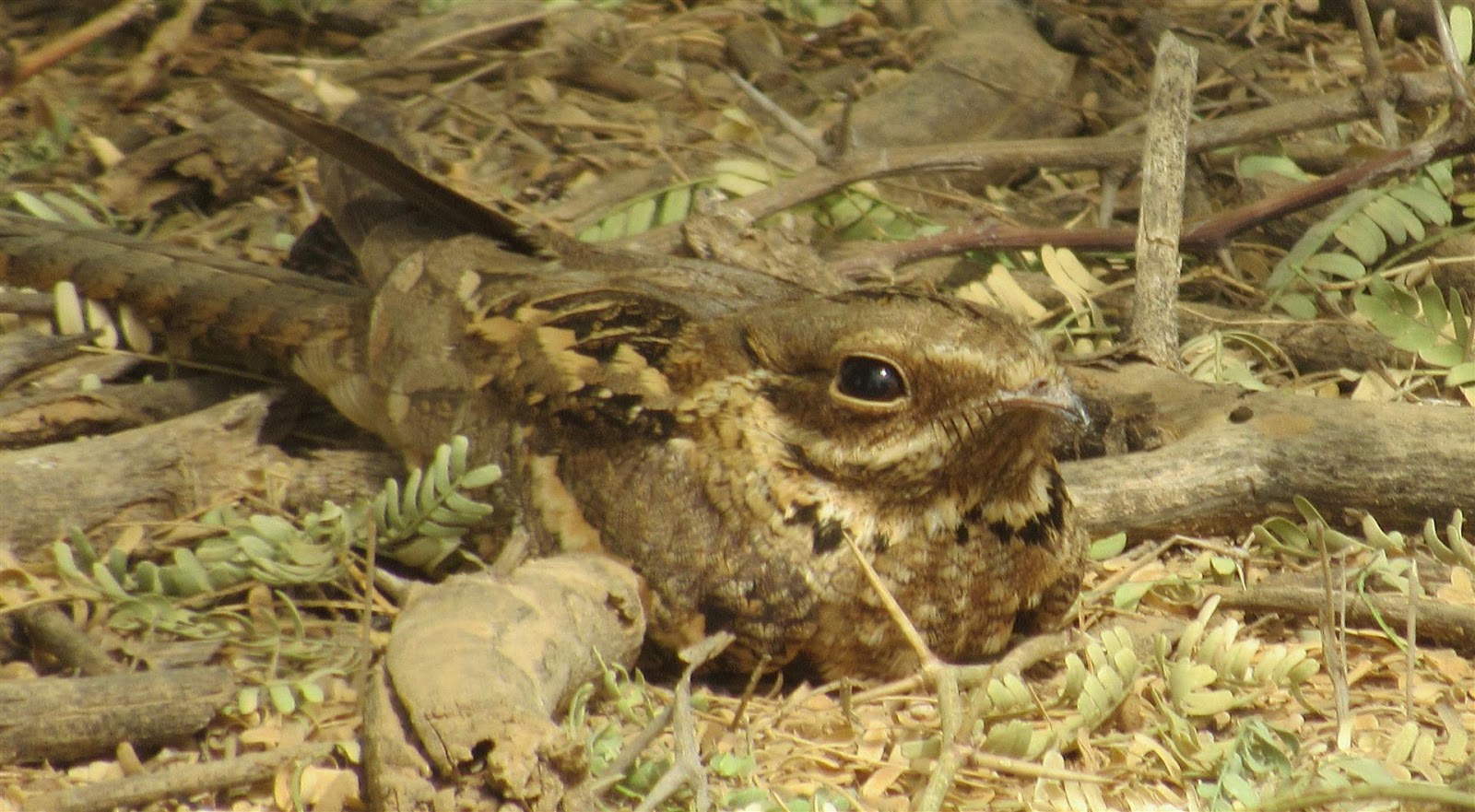
Long-tailed nightjar

Long-tailed nightjar was a real shock. It was well out of its recorded range.

red-cheeked cordonbleu 

Red-cheeked cordonbleu was yet another surprise.


rufous scrub-robin

There were passage birds as well. These included common redstart, northern wheatear and rufous bush-robin.

Only 80 kilometres from Aleg is Lake Mal. Until two years ago, it was a difficult cross-country journey there. However, a brand new road has been built east of Aleg going south to Mal. It was too big a target to miss on our way out to Kiffa. So we took the detour on the Saturday morning.

Lake Mal is typically five times bigger than Lake Aleg. Crucially, despite the poor rainy season in 2017, it was not empty. It pretty low though.

Nevertheless, it was worth the hiking off the road to seek out the remaining water.

part of Lake Mal

I counted at least 50 collared pratincole in the area I walked through. There must have been many more.

collared pratincole

A sign we were in the south of Mauritania was the presence of Abyssinian roller and blue-cheeked bee-eater. The latter bird is not seen in the centre of the country until July.

Abyssinian roller

Much of our effort was spent trying to see and identify the ducks which were mostly in the middle of the water. This was unfortunately separated from us by lots of treacherous mud. We couldn't approach close.

knob-billed duck

We did pick out Egyptian goose, spur-winged goose, knob-billed duck and garganey. Unfortunately, there were no ferruginous duck. This species is a known wintering bird at Lake Mal and would have been an addition to my country list. I suspect we just missed it by a week or two.

garganey and black-winged stilt

There were plenty of waders, yellow wagtail and various egret and heron but no storks.

spotted redshank

One of the waders was spotted redshank. This bird migrates in large numbers but is just as likely to be seen inland as on the coast in Mauritania.

The next blog is about going further east towards Kiffa. It was new ground for me.

Lake Mal on Saturday 31st Match
White-faced Whistling-Duck  
Knob-billed Duck  
Egyptian Goose  
Spur-winged Goose  
Garganey  
Grey Heron  
Great White Egret  
Little Egret  
Cattle Egret  
Glossy Ibis  
Black-winged Stilt  
Spur-winged Lapwing  
Common Ringed Plover  
Ruff
Little Stint  
Common Snipe  
Spotted Redshank  
Common Greenshank  
Wood Sandpiper  
Collared Pratincole 
Gull-billed Tern  
Sterna sp.  
Laughing Dove  
Namaqua Dove  
Eurasian Hoopoe  
Blue-cheeked Bee-eater  
Abyssinian Roller  
Common Kestrel  
Woodchat Shrike  
Brown-necked Raven  
Barn Swallow  
Common House Martin  
Northern Wheatear  
Western Yellow Wagtail  
Sudan Golden Sparrow


Woodlands west of Aleg on Monday 2nd April
Pallid Harrier  
Black Kite (Black)  
Laughing Dove  
Namaqua Dove  
Long-tailed Nightjar  
Blue-naped Mousebird  
Eurasian Hoopoe  
African Grey Hornbill  
Common Kestrel  
Lanner Falcon  
Southern Grey Shrike  
Woodchat Shrike  
Brown-necked Raven  
Black-crowned Sparrow-Lark  
Barn Swallow  
Willow Warbler  
Cricket Longtail  
Black Scrub-Robin  
Rufous-tailed Scrub Robin  
Common Redstart  
Northern Wheatear  
Desert Wheatear  
Chestnut-bellied Starling  
Greater Blue-eared Starling  
Sudan Golden Sparrow  
Red-cheeked Cordonbleu  

Thursday, 11 January 2018

Day three: from Diawling to Rosso

On New Year's Day, Mohamed Vall and I returned to Nouakchott the long way round. We detoured by following the Senegal River up to Rosso before heading north.

We took all day to return. We passed both fishing hamlets in Diawling on the way out of the National Park for one last time but not without stopping at both.

We were still looking for giant kingfisher which is known to like these locations. Again we failed to spot one.

pied kingfisher

Some sort of compensation was had by the sight of three pied kingfisher in one bush.

three pied kingfisher

We got our best views of African spoonbill at the first hamlet too. Though these were still distant.

African spoonbill

In contrast a group of great white pelican came up close to shore.

great white pelican

The big attraction for the birds at the hamlets is clearly fish. For the gulls it is dried fish.

grey-hooded gull

The fishermen didn't seem to bother as a grey-hooded gull walked over some drying catch.

juvenile black-crowned night heron

Two other birds were seen eating live fish. The first was a juvenile black-crowned night heron.


long-tailed cormorant

The second was a long-tailed cormorant which was fishing in shallow water.

many African swamphen

Between the two hamlets, we found an area with a high density of African swamphen.

At the second hamlet, this time there were far closer views of a yellow-billed stork than elsewhere on the trip.

yellow-billed stork (left)

There was also an opportunity to see several black crake for longer than before.

black crake

The best bird came from an unexpected quarter. It was an African reed warbler which was foraging around and in a tamarisk bush.

African reed warbler 1

African reed warbler is difficult to separate from Eurasian reed warbler which winter in Diawling. While the bird looks very short winged supporting African reed warbler, it is the yellow juvenile gape that is also critical information. A bird born in Europe in May should not show this much gape but a bird born in the African rainy season in September would do so.

African reed warbler 2

Whilst these factors are already enough to clinch its identification, the fact that it chose tamarisk to spend 15 minutes while next to extensive reed beds is also of some import. African reed warbler will take to drier terrain than Eurasian reed warbler. I saw several  African reed warbler (and some tawny-flanked prinia) in similar Tamarisk just the other side of the Senegal River in Saint Louis in early May 2017.

African reed warbler 3

Sadly, the African reed warbler had a bad skin infection around the neck.
.
African fish eagle

Also at the second hamlet, we spotted a sub-adult African fish eagle.

African mourning dove

We got one last good close look at African mourning dove which is the dominant dove of the wetter parts of the park.

There is one final open stretch of water before the terrain becomes marshland, then grassland then semi-desert over a few kilometres (along the north east road out of the park).

black stork

Here we had our best views of wintering black stork.

Eurasian spoonbill and pied avocet

There were very large numbers of both Eurasian spoonbill and pied avocet. The numbers were the highest I have ever seen in my life for both species.

garganey

Try as we might, we never found any Palearctic small or medium duck other than garganey. The larger ones were common shelduck, northern shoveller and also northern pintail but on day one only.

gull-billed tern

Still no marsh terns were seen either, although Caspian tern, gull-billed tern and a small number of sandwich tern were regularly seen.

Finally outside the national park, we elected to take the river road to Rosso rather than the more northerly route through Kaur Macene. 

Much of the route to Rosso consisted of semi-desert with tamarisk on the left and impenetrable reed beds on the right.

It was only when we reached within 25 kilometres of Rosso that irrigation channels and farming began to provide a landscape amenable to most birds. At the very beginning of this new habitat we found a row of tall trees next to the River's reed beds. We managed to accidentally flush over 100 sleeping black-crowned night heron. It was also the only one of two places over the weekend where we found red-billed firefinch.

Our only other stop in this area west of Rosso was at an abandoned palm plantation where land remediation is not really complete. 

Despite this, we flushed no few than six long-tailed nightjar having just got out of the car. 

long-tailed nightjar 1

That made a total of nine birds in two different places on the weekend trip. I don't know whether we were just lucky.

long-tailed nightjar

The pools and very close by to them were the best places for birds at the old palm plantation. Other areas are still too degraded. More red-billed firefinch were observed. In the water, little stint, greenshank, ruff and marsh sandpiper were found. Marsh sandpiper is a Russian bird and not many come through Nouakchott from this very eastern breeding area. Yet in the south west corner of Mauritania they proved not uncommon. 

marsh sandpiper

Our final stop for the weekend was made after a light lunch in Rosso. It was just 12 kilometres north of the town on the Nouakchott road. Here is the limit of continous woodland out of Rosso. Further north there are increasingly isolated patches of natural woodland.

short-toed snake eagle (photo:Mohamed Vall)

The area from Rosso and eastward along the Senegal River is a major wintering place for short-toed snake eagle. Though we were at the extreme western edge of this strip, we saw one.

At our stop, we came across a watering hole which was almost dry but which is fairly obviously quite large in the rainy season and had lasted over three months since it finshed.

African silverbill

African silverbill were frequent drinkers there. A small flock of white-billed buffalo weaver were hiding in the adjacent trees.

Elsewhere laughing dove and Namaqua dove were numerous and obvious.

Namaqua dove

Interesting birds included black-crowned tchagra.

black-crowned tchagra

We got close and prolonged views of a group of cricket longtail.

cricket longtail 1

This was effectively the last bird we sighted on an eventful long weekend south. I ended up with a Mauritanian list twelve higher at 292. The so called "line of shame" of 300 species (as invented in the UAE as the name of a target which proves one has extensively birded a Middle Eastern North African country) is within my grasp.

cricket longtail 2

I got even closer to the line of shame in Nouakchott last weekend. For the first time in months I added two birds to my country list in the city. I will blog about that next.