Showing posts with label palestine sunbird. Show all posts

Monday, 30 November 2015

Mazyunah in the morning

On Friday I made a very long day trip to Mazyunah. It's a large desert town right on the border with Yemen. It's 250 kilometres north west of Salalah and required a pre-dawn start.

This was my first visit and I will go again as there are several good birding sites.
My first stop was just 15 kilometres before the town in the last large wadi.

Palestine sunbird on Sodom's apple

The wadi's vegetation included both sodom's apple bushes and Tamerisk trees. Obviously this is a good combination for sunbirds. All three southern sunbirds were present: Palestine sunbird, shining sunbird and Nile Valley sunbird.

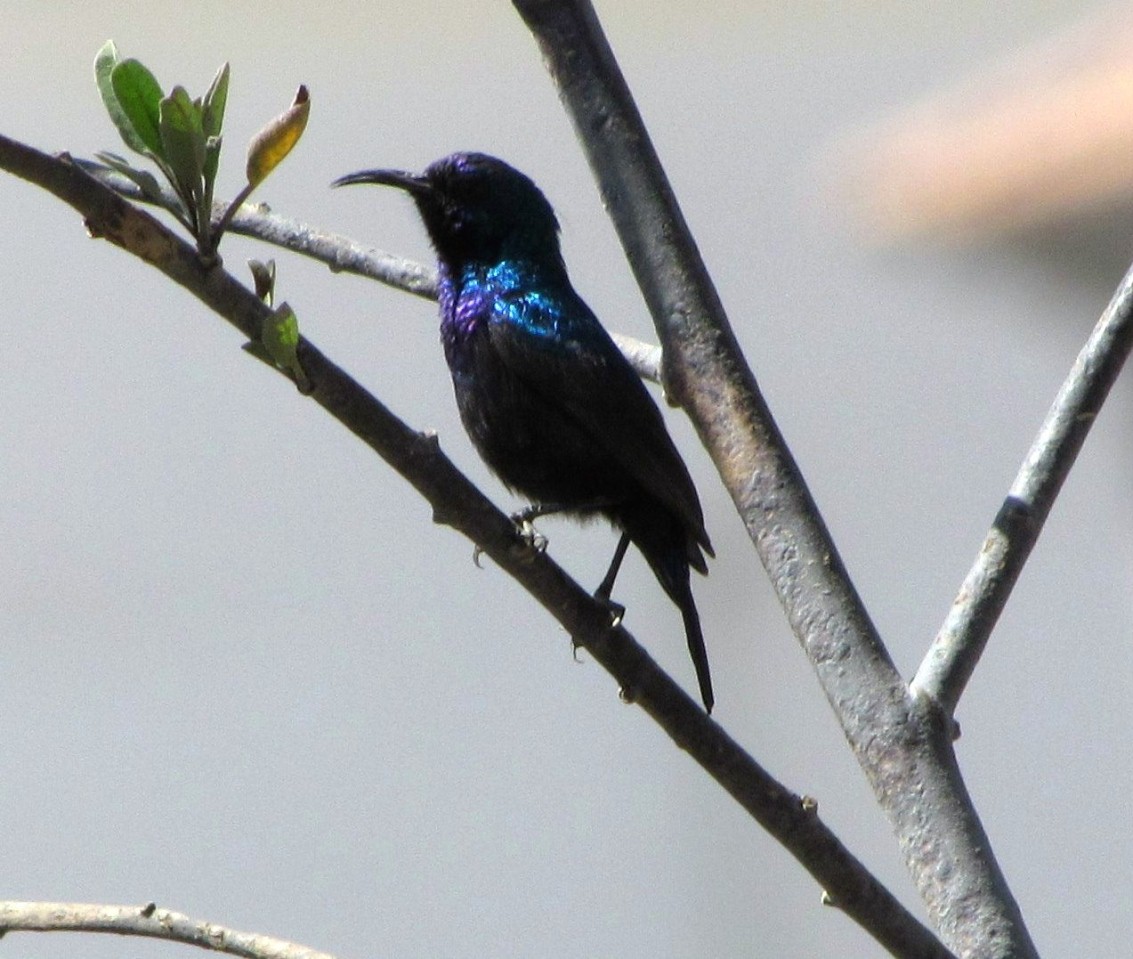
Palestine sunbird

This is the first place I have come to in Oman where Palestine sunbird is not in a highland.

Nile valley sunbird

The Nile valley sunbird have not fully grown their long tails yet ahead of the breeding season.

white spectacled bulbul

Elsewhere in the wadi I saw white spectacled bulbul, desert lark and a single European collared dove.

Eastern Imperial Eagle

As I travelled on and just before I arrived at the town, I came across an Eastern Imperial Eagle.


Part of the reason I went to Mazyunah was because a visiting birder had recently found a new spot. This is the dirty water settling pools where reeds, a marsh bed and a grassy stream have developed.

It is down a dirt track on the right hand side just before the last roundabout which leads to Yemen.

water pipit

On the reeds were two water pipit and two white wagtail.

Daurian shrike

On the fence was a Daurian shrike. It was still early and a spotted crake was out on the open water.

swimming spotted crake

It swam back to the reeds and I didn't see it again all morning.

bluethroat

Several bluethroat were around.

spotted sandgrouse with 2 crowned sandgrouse on the left

From 8.40 am onwards for about half an hour wave after wave of sandgrouse arrived to drink at the bottom end of the stream. The first birds were all Chestnut-bellied sandgrouse. I estimate there were about 90 of those.

Over 250 more sandgrouse arrived peaking at 9.10am. These were mostly spotted sandgrouse with a few crowned sandgrouse.

red-throated pipit

Along the stream were several citrine wagtail and yellow wagtail as well as at least red-throated pipit.

Back at the pool were several duck.

teal

Most were pintail and northern shoveller though there was one teal.

pintail

Waders there included ten or so greenshank.

four Eastern Imperial Eagles

As the morning progressed I turned my attention back to the stream. Where the sandgrouse had been up to six Eastern Imperial eagle came down to drink. One or eagles returned repeatedly all morning. Two Egyptian vulture were also seen briefly over head.

I stayed in the area all day and searched more widely. The afternoon turned out eventfully. I will blog about this next.


Sunday, 11 January 2015

A more showy grosbeck at Ayn Hamran

My friend Andrew Bailey from UAE came over for 3 days birding this weekend. We had some wonderful birding. Andrew saw 156 species in that time and had 14 lifers. I added 8 birds to my Oman list including some really rare birds. 

There will be a series of blogs reporting on where we went and what we saw.

It all started out at Ayn Hamran at around 7am on Thursday morning. We were keen to see Arabian golden-winged grosbeck. We went to the area I know gives the best chance. Sure enough at 7.36 am a grosbeck appeared in a tree next to us. This was precisely the time to the minute I had seen one in near-by tree a week before.

Arabian golden-winged grosbeck

We had been watching Abyssinian white-eye in the tree when the grosbeck arrived on top. It stayed about two minutes in a typical exposed position.

second view of Arabian golden-winged grosbeck

The first feature you notice when this bird arrives is the white cheek as opposed to the wing flash. There is no other bird with a white cheek in its range either so recognition is usually fast.

back view of Arabian golden-winged grosbeck

It took me a long time to work out the best time and place to see these birds but now I have fair chance every time I go to Ayn Hamran.

Before seeing the grosbeck, we observed fifteen or so Arabian partridge walking around the spring. The male masked shrike which has been there all winter was also easily seen and quite showy.

Palestine sunbird

Other birds seen while I was there included a male Palestine sunbird. This is an upland bird in Dhofar and not always easy.


second view of Palestine sunbird

An unusual bird for this site was a rufous-tailed rock thrush.

rufous-tailed rock thrush

A good non-birding sighting was a chameleon which I nearly walked on. It didn't bother to run away, it very slowly walked off.

chameleon at Ayn Hamran

I went to work for the morning while Andrew enjoyed the views of such birds as Arabian warbler, African paradise flycatcher and finally tracked down a black-crowned tchagra.

Indian pond heron at Khawr Taqah

When I returned we made a dash to Khawr Taqah as two African skimmer had been reported there the day before. We were out of luck. Good views of an Indian pond heron were poor compensation.

Next we went up into the mountains. It was here that my Oman list started to increase and there were plenty of other good observations.

Sunday, 9 November 2014

Palestine sunbird and more at Tawi Atair

It is still too hot in the afternoons to bird for any length of time unless you go up in the hills. That's what I did on Friday afternoon. I visited the Tawi Atair area.

Around the famous sinkhole, Yemen serin can be seen although I have failed to see them yet. The cooler months of December and January are the best for that when they spend more time out of their cold environment down the hole. An early morning visit might do it too.

Nevertheless I spend an hour around the top searching for them. Ironically it was here where I came across a male Palestine sunbird which was a target bird in the morning.

head of male Palestine sunbird

I got prolonged views of this bird too. When sunbirds are feeding they are easy to view. Otherwise they are near impossible.

Palestine sunbird

This was the last of the "easy" birds of the area to get on my country list. From now on list growth will be slow and I just enjoy the birding and see what happens.

Abyssinian white-eye

Around the sinkhole were many birds. Tristram's starling, cinnamon-breasted bunting, Abyssinian white-eye and Eurasian collared dove are all common. Plenty of pale crag martin were flying over the top too.

Pallid harrier

Each time I have visited, the occasional bird of prey has turned up. This time I observed two. One was a juvenile pallid harrier. The other was an adult Bonelli's eagle.

Bonelli's eagle

There is much more to the Tawi Atair area than the sinkhole. This is farming country with many cattle. The farmhouses in particular attract birds.

Barn swallow

I stopped near a small cattle farm which was buzzing with barn swallow. White wagtail aren't common in southern Oman but this site had a few.

white wagtail

There was a scattering of desert wheatear and Isabelline wheatear on wires throughout the area including near this farm.

Isabelline wheatear

The wires also had crested lark and a European roller.

crested lark

Tristram's starling is particularly attracted to small settlements. 

Tristram's starling

Finally, Tawi Atair is looking like one of the best places to see lappet-faced vulture. I have not seen them anywhere else in Oman but I saw one again in the area on Friday.

Lappet-faced vulture

On Saturday, I went to Raysut on the west side of the city. The next blog will report on that.

Wednesday, 7 March 2012

The Baha list

I have worked out one or two identifications since I came back from Baha and so I am close to a definitive list of birds seen there. As I am now about half way through reporting on the visit in the blog I thought it would be a good idea to show the list. 

Palestine sunbird at Baha

The one and only valley which I visited yielded six endemics, ten lifers and at least forty two identified species. There were also twelve additions to my Saudi list which has now reached over 150.  In addition there was one large bird of prey which will never be identified and possibly up to two more species which may be added later.

Bird species
Special notes
Kestrel

Philby’s partridge
Endemic, lifer, Saudi first
Arabian partridge
Endemic, lifer, Saudi first
Rock pigeon

Dusky turtle dove
Lifer, Saudi first
Laughing dove

Namaqua dove

Alpine swift

Hoopoe

Arabian woodpecker
Endemic, lifer, Saudi first
African rock martin

Barn swallow

Red rumped swallow

House martin

Long billed pipit
Lifer, Saudi first
Tawny pipit

White wagtail

Yellow vented bulbul

Black redstart

Stonechat

Isabelline wheatear

Pied wheatear

South Arabian wheatear
Endemic
Little rock thrush
Lifer, Saudi first
Yemen thrush
Endemic, lifer, Saudi first
Blue rock thrush

Song thrush
Saudi first
Graceful prinia

Scrub warbler
Saudi first
White breasted white-eye
Lifer, Saudi first
Brown woodland warbler
Lifer, Saudi first
Chiffchaff

Willow warbler

Palestine sunbird

Turkestan shrike

Brown-necked raven

Fan- tailed raven

Tristram’s grackle

House sparrow

Ruppell’s weaver

Yemen linnet
Endemic
Cretzschmar’s bunting
Lifer, Saudi first

Apart from the two partridges my greatest pleasure was a song thrush and a pair of Arabian woodpecker. This must be one of the most southerly places in the world where you can see song thrush (only in winter of course). The woodpeckers will appear in one of the later blogs.


Palestine sunbird launches itself

The next blog looks at the wheatears and stonechats in the valley.

Monday, 6 February 2012

Farms of Najran

I spent two sessions walking around some farms in Najran. It should have been easy as they can be reached by walking out of my hotel straight onto a country lane. However the second session, on Friday morning was complicated by  a very thick sand storm which cut visibility down.  It also made photography difficult. You can probably tell which shots were taken on Friday by the quality!


Nevertheless the birding was seriously good.


African silverbill next to the hotel

Straight out of the hotel and turning right, I had to walk barely 20 metres to come across a flock of African silverbill.

forts in the sand storm

The silverbills were there on Thursday when the weather was good, at dusk and on Friday when the dust storm brewed. I wondered if they ever move far.

Talking of the dusk storm, on Firday morning it was serious. Most people stayed in doors. Those who ventured out wore masks.  My birding was probably a bit foolish but I continued anyway!

laughing dove

In the farming areas, there are very large numbers of laughing dove almost everywhere. However, I said in the previous blog, I failed to see even one African collared dove!  

Namaqua dove

In the sandstorm, I managed to pick out a few Namaqua dove though.

a couple of common myna

Another bird which didn't seem frightened by the sand was common myna. They may officially be a pest but they have lots of character.

little green bee-eater

Just like in the Riyadh area, little green bee-eater is common in the greener places. 

Rose ringed parakeet

In Riyadh we also get rose ringed parakeet but only in the artificial parks and residential compounds. However in Najran it is widespread in natural and man-made habitats. I saw it everywhere almost I looked. 


Hoopoe

The only other medium and large sized birds I saw on the farms were pigeon, a couple of hoopoe and a small flock of cattle egret flying overhead. There was also one noisy kestrel.

Otherwise the farms belonged to the passerines. If you were attentive, especially required in a sand storm, there was plenty to see. 

Crested lark

The melancholic sound of crested lark was commonplace and once heard easy to see.
Graceful prinia

However the prizes for the most common birds went to house sparrow and graceful prinia. The latter bird was so common even I managed to get a good photograph of them on several occasions.

chiffchaff

Apart from graceful prinia the other warbler I saw was a wintering chiffchaff. He allowed me close access and seemed very reluctant to leave his tree. The sand must have been more daunting than me.

palestine sunbird

Two types of sunbird reminded me that I was in an exotic place.  Palestine sunbird was the more common but I did come across one male Nile Valley sunbird and it was in eclipse plumage.

Nile valley sunbird

I found this most interesting because my first edition of Helms guide to Birds of the Middle East says both are in summer plumage from December until July. Yet, in Najran at least, I can clearly see that one (Palestine sunbird) moves into summer plumage ahead of the other (Nile Valley sunbird).

female Ruppells weaver

The one or two tourist web pages I have found for Najran while researching this trip had all shown Ruppells weaver's nests. I suppose this gave me an impression there would be hundreds of them around such is the power of advertising. However they were certainly outnumbered by house sparrow, yellow vented bulbul and graceful prinia.

male Ruppells weaver

Some fields contained many white wagtail but it's a mystery to me why I didn't see any pipits or any yellow wagtail. If the farms at Kharj (south of Riyadh) have small numbers of yellow wagtail in winter I thought that Najran being much further south would certainly have them. I am sure they must have been around somewhere but not where I visited.

I did see a few members of the chat family. There were a small number of both male and female stonechat.  Both resident and wintering birds are known in South West Saudi Arabia. I didn't study them well enough to decide which I had seen.

stonechat

One winter chat which I did discover the sub species of was a beautiful male semi-rufus black redstart. Unfortunately it evaded my camera.

Isabelline wheatear

One of the last birds I met before heading off to the airport was a wheatear. I am confident it is an Isabelline wheatear but tried very hard to convince myself it was the similar looking red-breasted wheatear. Both stand bolt upright and have similar colouration. However red-breasted wheatear has adarker crown and a more distinct supercilium. Furthermore, according to books, it's not supposed to come down to 1200 metres (Najran's altitude).

Nevertheless the last bird I saw before I finished was a second Arabian serin of the trip. Its also not meant to come down this low but as yesterday's blog testifies with a picture, it does.