Showing posts with label pintail. Show all posts

Sunday, 23 December 2012

Four birds with one shot

Hunting is not as common in the Riyadh area as further north such as Hail. However on Friday a hunter was seen in the area of the blue lagoons, Al Hayer.

I went there with Mansur Al Fahad to show him this new venue.It was the place that on Thursday I added great snipe and short toed eagle to my Saudi list.

The hunter actually did us a great favour. We only heard two shots. The first one threw eight ducks and four snipe into the air.

Pintail(1), Gadwell (4) and Garganey (3)

With these few birds, Mansur added four lifers(including all the ducks)! and I added two more birds to my Saudi list. The great snipe from the day before was among the snipe that took to the air.

However we followed the ducks rather than the snipe to photograph. It turns out that it was a mixed flock of pintail (in the lead), gadwell (larger) and garganey (smaller). I sent the picture to BirdForum to confirm and there was agreement.


two common snipe

The second shot a few minutes later sent five snipe up. Unfortunately all were common snipe this time.


female Marsh harrier

The wagtails from the day before had moved on from the area. The green sandpiper were still plentiful. There was no short toed eagle to be seen. However the variety of birds of prey was a little larger. There were Marsh harrier, greater spotted eagle and steppe eagle.

Osprey
An osprey also gave good views.

Following the sighting of pintail and gadwell, my Saudi list total is now up to 249. However the big test will be this weekend when Mansur and I visit Jizan.


Sunday, 6 February 2011

Even more water species at Marj

I can't resist going to the water at Old Marj because the birding is so good.  Last Friday I walked round the north side of the lake for the first time where there is some tree cover to avoid scaring off the water birds. 

The trick worked even though it meant my boots were muddier than ever.

a few of the moorhen at Marj

I'll spare you more pictures of common snipe, northern lapwing, various sandpipers, redshank, whiskered tern  and dunlin. All were still there in large numbers.

However I saw two new species. Both were thanks to my cover which enabled me to see them without them bolting. One was also thanks to my new improved camera.

Old Marj "lake" from the north side.

About 200 metres from me at the far side (south side) of the lake were about 25 ducks.  My new camera was able to photograph them whereas my old camera wouldn't have been capable.


three adult male pintail duck

They were pintail duck with an even balance of the sexes. They were in breeding plumage unlike the pintail I had seen at Deryanah about 2 months ago.

some of the many little grebe

As I left my tree cover and continued eastward using a earthen ditch as cover I discovered yet another section of the lake hidden  from previous view by other, taller earth mounds.

There were coot and little grebe were present. I was astonished by the numbers of little grebe. There were 30 coot but over 75 little grebe. I think they must have been attracted to this very-difficult to reach place. I have no idea yet whether they are all wintering birds or whether they breed here. The picture above was taken from a great distance as the site is too muddy to reach and cover is non-existent. A digiscope would have been the best solution.

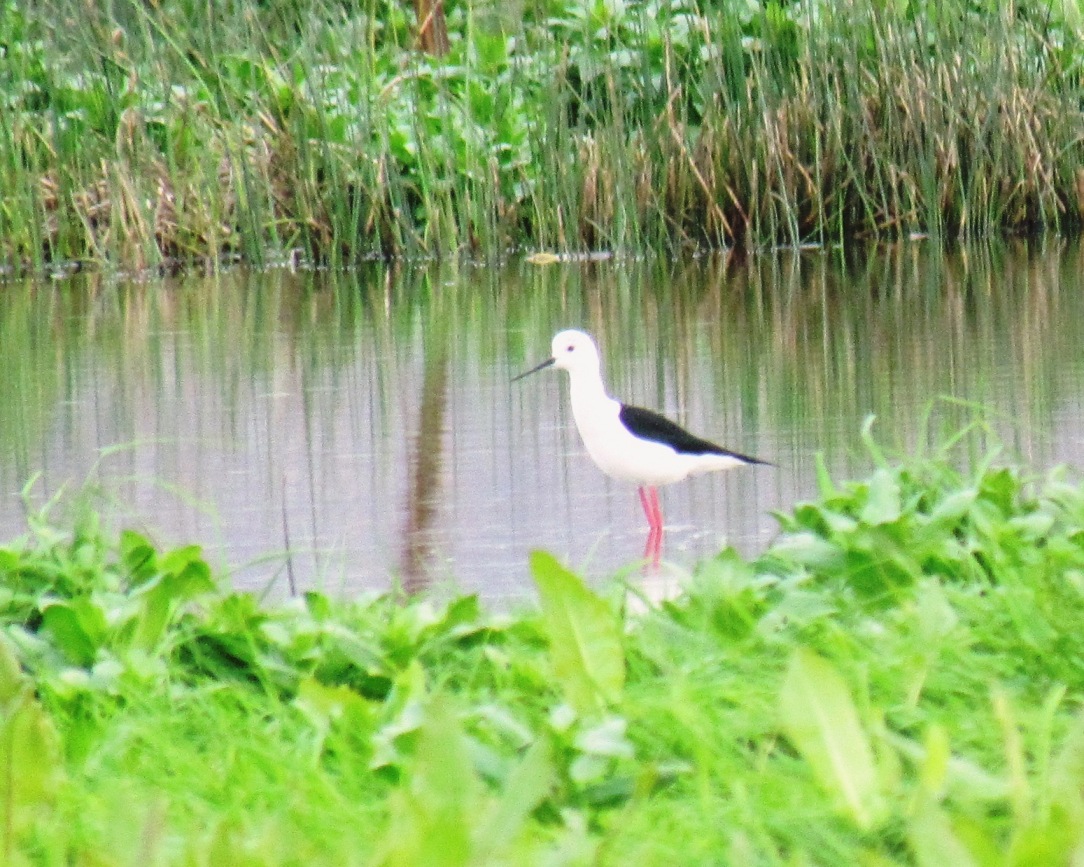
black winged stilt at Old Marj

Many of the local farmers know me now and are really keen to show their hospitality.  A 4X4 vehicle approached me out of nowhere to offer me tea but sadly it put pay to my ability to see more birds without being rude. Anyway it was probably time to move on.

I'll tell you what I saw next in the tomorrow's blog.

Monday, 4 October 2010

The ducks have arrived


Last Friday was a busy day. After the excitement of a visit to Ain Azziana to check up on the unidentified dark heron we moved on eastward to the wetlands just east of Deryanah. This was not as long a stop as I would have wished because my destination at the end of the day was the resort of Ras Al Hilal. 


Incidentally, Ras Al Hilal is the "Lands End" or "Finisterre" of Cyrenacia and is 120 kilometres further east of Deryanah. It is also holidaying place for the Libyan middle class.


Back to the birding - The wetlands east of Deryanah were home to tens of waders the previous week but by last Friday they had multiplied. However the biggest change was with ducks rather than waders. Last week I had seen only a handful of unidentified dabbling ducks. This week there were many more.  The biggest group were teal. There were at least 80 birds.


However there were a smaller number - perhaps 15 or so other dabbling ducks which were a little more difficult for me to identify.


dabbling ducks which were dabbling!

They were a little bit more difficult to identify because when I first saw them they were all up-ended and dabbling in the water. Had they just arrived and needed food?

flying pintail duck, Dernayah, early October

There were much easier to identify in flight. Their small heads, white trailing edges and black flash in front of them marked them out as pintail duck.

Cyrenaica has at least ten times more wintering ducks than Tripolitania according to the UN winter water bird count. Teal and pintail duck are among the known winterers in Cyrenica although they are not the most common so I was pleased with the sighting.

waders continue to multiply at Deryanah

I really didn't have time to look hard at the waders (see September's blog "next wave of waders and more" for details of what was seen here before). It was difficult enough as I didn't have my scope and getting close meant a muddy experience. I can say that the wetlands are getting very crowded.  It was no surprise that the area attracted the attention of two marsh harrier (see a later blog on birds of prey seen on that day)


greenshank, Deryanah

One new bird for this wetland which I did notice was a greenshank. It's legs looking red below the water line simply because the water had a red hue. I wonder why greenshank travel north in spring in groups but fly south in ones and twos like this one?