Showing posts with label red-breasted flycatcher. Show all posts

Saturday, 31 January 2015

After a picnic at Wadi Hanna

I visited Wadi Hanna on Wednesday afternoon. It is a wooded upland wadi for which I have high hopes of seeing new birds during the spring migration.

I din't see any hint of the migration yet although I had to make a double take of a female black redstart at one moment just to make sure it wasn't a (migrating) common redstart.

Otherwise it was a similar mix of resident and wintering birds as last time but with subtle changes.

One subtle change was the easy with which I saw red-breasted flycatcher. There were two in the relatively small area I surveyed. Both were first winter birds.

red-breasted flycatcher

One of them was much more confiding than usual. They are often tricky to monitor because they don't return to the same perch like so many other flycatchers.

second view

Very soon after observing this flycatcher I arrived at a very recently deserted picnic spot. Indeed I saw the picnickers leave. They didn't leave the place very clean and so the birds moved in in waves.


Abyssinian white-eye

First in was a flock of Abyssinian white-eye which are fairly omnivorous. They were joined by an African paradise flycatcher.

African paradise flycatcher

Things suddenly got very interesting when an Eastern Imperial Eagle swooped down low to see if any meat had been left behind.

Eastern Imperial Eagle

Almost out of nowhere around twenty fan-tailed raven appeared and started mobbing the eagle.

Fan-tailed raven

The mobbing moved off to another part of the valley and then presumably by co-incidence two more Eastern Imperial Eagle arrived near the original one. There was a lot of activity in the air between the eagles and the ravens.

Ruppell's weaver and Abyssinian white-eye

Meanwhile the Ruppell's weaver had discovered the remains of the picnic and joined the white-eyes.

I wonder if the Ruppell's weaver about to eat into a green pepper got a shock when it did so?

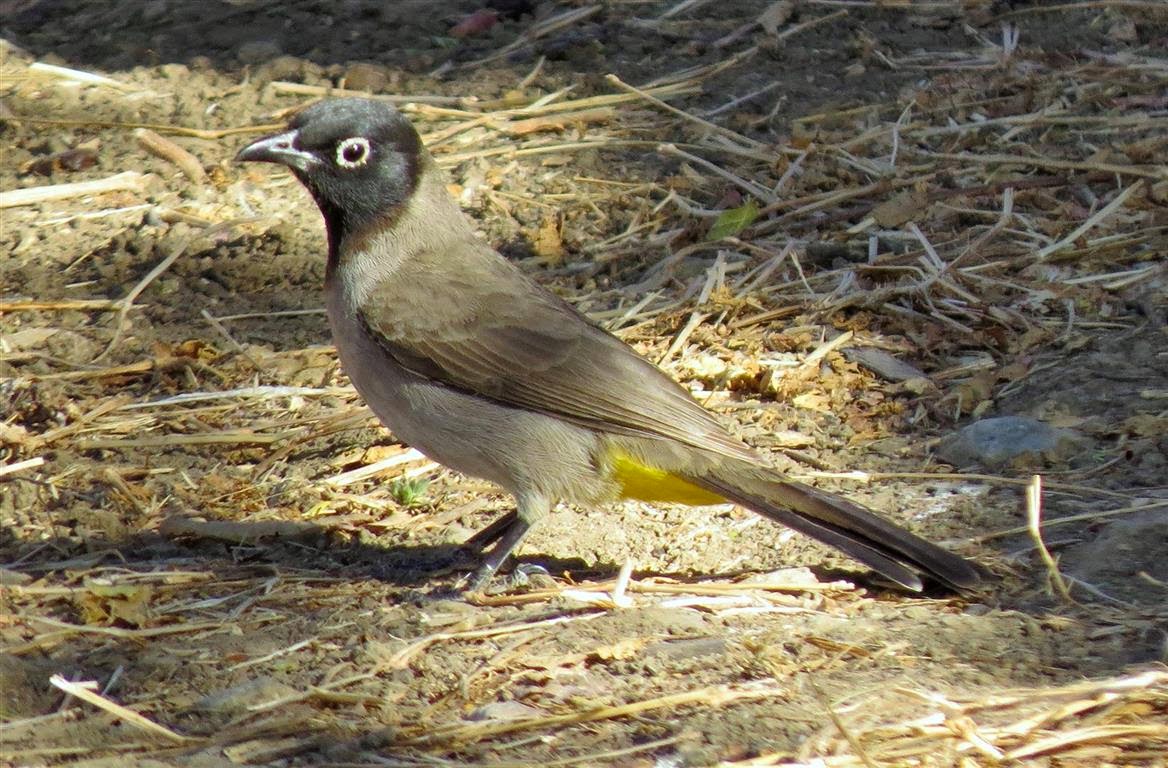
white spectacled bulbul

The last species I saw join the picnic before I moved on was white spectacled bulbul.

fan-tailed raven

It and the other birds were overlooked by a single fan-tailed raven which hadn't joined in the mobbing choosing instead to explore the picnic.

blackstart

Early the scene had been much more peaceful except for the constant sounds of cinnamon-breasted bunting and blackstart.

Ruppell's weaver

Ruppell's weaver were still flocking. There is not much sign of spring breeding up here. Most breeding of this bird is in the Khareef season but some on the coast appear to also breed in early spring.

steppe buzzard

I started the blog noticing a subtle change. I will end with one. The number of steppe buzzard in the area has gently risen from one to four in the past six weeks. All of them have the grey-brown plumage of nominate common buzzard. What are the odds of that?

Wednesday, 7 January 2015

Qatbeet excels again

Qatbeet was my second birding spot in the desert on Saturday. I arrived around 11 am. 

The motel gardens are famed for providing rarities and vagrants. The isolated location seems to be a magnet for migratory birds.

Saturday was no exception.  On arrival I discovered five other bird watchers in two groups were already there. They had come primarily to see a vagrant brown shrike sighted the day before by the Swedish group. Four more birders also arrived just a little after me but they like me had not heard about the brown shrike and had come coincidentally. Indeed it was a mostly coincidental meeting of 10 birders in total.


record shot of brown shrike 

Mattias Ullman and friends were kind enough to show me where the brown shrike was spending most of its time. It was a very shy bird, spending very little time in the open. Eventually it was pointed out to me (see the top photograph) but soon disappeared. 

The short wings that make it look long tailed are obvious.

I stayed on after all other birders had moved on to try to get more looks at the bird. It reappeared twice.

brown shrike obscured by branches

On one of these occasions it was in the open but obscured by branches of a dead bush. Nevertheless you can see the all buff undersides which many of these birds have.

brown shrike show big bill

In the next picture the large pinkish bill as well the buff underparts can be easily seen.

brown shrike looks ahead

In the last picture below both these features are clear. The uniformity of colour between the mantle and head is also noticeable though once again not all brown shrike are this distinctive. 

brown shrike with all buff undersides

A rarity report is needed by the finders but I have no personal doubts.

The Swedish group also found a yellow-browed warbler and Hume's warbler.

I also saw the Hume's warbler but missed out on the yellow-browed warbler. The Hume's warbler was high in the canopy and photographed by two other birders from which a definitive identification could be made.

There are around 50 records of Hume's warbler now in Oman and it is no longer the major rarity it was believed to be even 5 years ago.


 chiffchaff

As is often the case, birds seem to be more difficult to photograph first time around but once I have them listed it seems much easier. For example one chiffchaff was extremely showy.

second shot of chiffchaff

There were two red-breasted flycatcher at the location. Both were female and quite confiding.

red-breasted flycatcher

While some of the other birders saw a yellow-browed warbler, I don't know but I may have been the only one to spot a blackcap.  This was hidden deep in a thicket and was very shy. It also failed to give me a clean photographic view but it is readily identified.


blackcap through the thicket

For some reason its crest was raised throughout the time I was observing it.

second shot of blackcap

Qatbeet was exceptional birding. I intend to continue doing the 550 kilometre round trip by visiting it once a month.

Thursday, 1 January 2015

My search for Arabian golden-winged grosbeck

I have been visiting Ayn Hamran about three times a week and Wadi Hanna about once a week for the past month. I have typically visited Ayn Hamran early in the morning before work.

The reason has been my search for the elusive Arabian golden-winged grosbeck which is reported in those two places more than anywhere else. it was one of my Nemesis birds.

On New Year's Eve morning I finally saw one at Ayn Hamran for a fleeting moment. I returned after work and saw another but again only for a few moments.

So I returned this morning. This time I observed two and one stayed long enough for a few photos. All photographs are from below because the bird chose to stop in the tree I was standing under.

first view of Arabian golden-winged grosbeck

To help other birders, I can tell you I saw one yesterday at about 7.30 am. The two today were seen at about 7.15am and at exactly 7.36am. I know the exact time of the last bird since it is recorded on the photographic file. 

second view of Arabian golden-winged grosbeck

All three sightings were within 30 metres of each other. This area is immediately left if facing up hill (west and west north west) of the top pool with large tree. 

Each bird arrived from the north west from up the mountain and flew south east towards the stream. This area is the same place as two other recent sightings by other birders who I have spoken to. 

The single bird I saw in afternoon was in a different place. Like most birds at this time of day it was in a shaded place. It was with Abyssinian white eye in the canopy of a large tree on the edge of the thick woodland at the northern end (upper) of the Ayn. 

Masked shrike

As I was single-mindedly looking for grosbeck this morning, I didn't bother with observing and photographing other birds. However the masked shrike was seen in an exposed perch just as I was leaving so it was no effort.

Masked shrike rarely winters in southern Oman but this male has been present all winter.

Arabian partridge

The morning before, on New Year's Eve I did bother with other species. Arabian partridge are always around the Ayn, nearly always heard and occasionally seen. 

black-crowned tchagra

Black-crowned tchagra did its best to distract me from the grosbeck search and like the grosbeck it is best seen at Ayn Hamran and Wadi Hanna.

Arabian warbler

Arabian warbler are very noisy at the moment and easily seen in the trees and bushes in the more open areas.

Arabian warbler scrambling

On New Year's Eve two wryneck were also seen. One was observed in the morning and one in the afternoon in two different places.

Eurasian wryneck

There are so easily over-looked due to their camouflaged plumage especially from the back.

Eurasian wryneck from the back

The Ayn seems to have gained more wintering hoopoe over the past two or three weeks.

hoopoe

Two other birds are of note that have been seen at Ayn Hamran recently. One is Shining sunbird. The males are in full breeding plumage at the moment. 

male Shining sunbird

The second bird was a male Turkestan shrike.

Turkestan shrike

I understand these shrike undergo a winter moult. This might explain the lack of a white wing patch.

male Turkestan shrike


Without this patch, this particular bird looks even closer to a brown shrike than most Turkestan shrike males.  Even some brown shrike have this patch but I thought Turkestan shrike always do.

Turkestan shrike turns

I am currently double checking this birds identity with experts.

It has not just been Ayn Hamran I have visited for the grosbeck. Wadi Hanna is further away but is a larger site with just as many sightings.

red-breasted flycatcher

During my times there I have come across a wintering song thrush and a red-breasted flycatcher among the less usual birds.

first winter red-breasted flycatcher

The buff wing bar in the greater coverts apparently is found on first winter birds but not females.

another view of red-breasted flycatcher

Either way, the difference in colour between female type red-breasted flycatcher and the taiga flycatcher (subject to rarity committee decision) I saw at Qatbit is great. The latter bird is all greys, black and white. This bird is all buffs and browns.

male cinnamon-breasted bunting

Wadi Hanna is an excellent place to see wintering birds of prey. However the three most common birds which even the non-birder will notice are cinnamon-breasted bunting, Abyssinian white eye and fan-tailed raven.

Abyssinian white eye

Somewhere among them are Arabian golden-winged grosbeck as well.

Finally at this time of year, I issue an annual list of the cumulative readership of the blog over the years with the change in position from last year. It is below.

I would like to wish my readership a Happy New Year and good birding in it. Thanks are particularly due to my new readers from Poland and China.

Cumulative readership of the blog since it began
1. United States (NC)
2. Saudi Arabia  (NC)
3. United Kingdom  (NC)
4. Libya (NC)
5. Russia (NC)
6. Germany  (NC)
7. United Arab Emirates  (+1)
8. China  (+4)
9. Bulgaria  (-2)
10. Poland  (+25)


Saturday, 16 October 2010

Where do red breasted flycatchers go?

Red breasted flycatcher is not unheard of in Libya but has been rarely reported and even rarely photographed!  Yesterday I got lucky. I saw and photographed one at a well irrigated smallholding near Sultan. Sultan is 120 kilometres south west of Benghazi.


I love the way this small bird can make itself look bigger in a show of bravado by cocking its tail. This action reminds me of the similarly small scrub warbler.

red-breasted flycatcher, near Sultan, mid October

The bird breeds in central Europe eastwards and is very common in European Russia. Most research has been on Russian birds which winter in the Indian sub-continent. However, it has been breeding increasingly westward over the past 30 years and some are known to winter as far west as Sinai. 

frontal view of red-breasted flycatcher, near Sultan, mid October

I wonder how many now winter in north east Africa or perhaps it even winters in small numbers in Libya itself after all Sinai is climatically similar!

female red-breasted flycatcher hitches a lift near Kufra 

I searched the internet today and came across another picture of a red-breasted flycatcher in Libya. The circumstances are quite interesting. This picture is taken from a book "Incident at Jebel Sherif". It's author Kuno Gross (who like me often works in Libya) is interested in second world war action and is an expert on the Libyan desert war. While touring the Libyan desert for his book and other studies, a red-breasted flycatcher hitched a lift for 60 kilometres.


This is a little more evidence that my bird was not a vagrant but could be part of something bigger. Is Libya on a minor migration route for central European red-breasted flycatchers?


Yet another bird to watch over the coming months. My observations keep raising more questions than they solve!


PS: If you are interested in Kuno Gross's book -visit his website