Showing posts with label singing bush lark. Show all posts

Friday, 27 March 2015

Drinking and singing

On Tuesday and Wednesday I went out birding in the late afternoon to Ayn Hamran and on Wednesday I also finished off at Sawnout farm which is on the way home. I still had intentions then to look out particularly for any March passerine passage.

Well I can tell you what I had suspected for some while, there is hardly any such thing. In the autumn I saw at least 60 rufous bush robin and they lingered too. So far I have seen 3 in spring and that's my best passerine (equal with common redstart) in the Salalah area excluding yellow wagtail. Of course further north in the desert farms I got two wheatears but things have been thin even there too so far. 

In Salalah, there has not been a single bee-eater yet of either blue-cheeked or European variety.

In the autumn birds meander and Salalah is green and worth the diversion. However in spring they move directly and Salalah is not on a direct route for many.

Odd birds such as Amur falcon and pied cuckoo come this way but they aren't heading to the western palearctic or even Iran.

So at Ayn Hamran, having looked so hard again in bushes and trees, I resorted to watching a watering place to see good birds.

One good bird was striolated bunting which likes rocky slopes. However it does come down to drink.

striolated bunting

I find it is best separated from cinnamon-breasted bunting by the colour of its wings which are deep rufous.

striolated bunting facing me

Cinnamon-breasted bunting were also drinking to ease the comparison.

cinnamon-breasted bunting

Indeed the spot I chose saw many species visiting to drink. Any stray warbler could be picked up.

Abyssinian white-eye (with cinnamon-breasted bunting)

I had to make do with Abyssinian white eye.

Namaqua dove

The rarest of the four locally breeding doves is Namaqua dove. Three visited the stream while I was watching.

White spectacled bulbul

The much more common white spectacled bulbul and laughing dove also made appearances.

laughing dove

Ruepell's weaver are busily making or visiting nests depending on gender. It must be thirsty work.

Ruepell's weaver (left)

Still without moving from the same spot, a common sandpiper joined in.

common sandpiper

Other birds seen near-by were common greenshank and two common snipe.

common greenshank

On Wednesday, I also stopped off at Sawnout farm. I need to check there regularly so as not to miss any Amur falcon passing through. This is a well-known place for them. There is also a small chance of passage ortolan bunting which from my experience in Saudi Arabia likes farms. It's still early for either.

I did get lucky with one bird. A very confiding singing busk lark was on the perimeter fence on the west side. It allowed excellent views.


singing busk lark 1

Singing bush lark were numerous at both Sawnout farm and Jarziz farm over the winter. They still are. 

singing bush lark

Though they are very noisy they can be difficult to see except when they launch into their aerial display.

singing bush lark 3

Seeing one so close and on a fence was a real treat.

singing bush lark

Other notable observations at the farm were that the wintering birds of prey are thinning out. I saw just one marsh harrier and a lingering greater spotted eagle.

marsh harrier at Sawnout farm

I will continue to monitor the passage. Who knows? It may be strong in April. In the meantime I went to the Mughsail area today without the focus any focus on passage. I don't know weather it was the more relaxed approach but I did add to my Oman list and the birding was very satisfying indeed. My next two blogs will cover this.

Tuesday, 17 March 2015

City birding

I stayed very local on Saturday. In the morning I visited Jarziz farm and then on to The City Park. I was in search of any passerine passage. 

At Jarziz farm, I once again came across both chestnut-bellied sandgrouse and common quail. I flushed three of the latter. Two of them were flushed without me seeing them from less than two metres away. 


chestnut-bellied sandgrouse

Also in the fields was the now familiar mix of crested lark and singing bush lark. Early in the morning the singing bush lark make a considerable amount of noise.

singing bush lark

Another bird I see on every visit is Asian grey shrike (aucheri).

aucheri Asian grey shrike

One of the three birds seen had a pigmentation issue. Some of its wing feathers were brown and not black.

Pallid harrier

There seem always to be birds of prey at the site. There are always kestrel and usually other species. This time there was an Eastern Imperial Eagle and a pallid harrier. This is one place I really must watch out for passage Amur falcon in the coming weeks.


female pallid harrier

However there was still no sign of a major passerine passage in the massive pivot field or in the cluster of trees and bushes. Even the tawny pipit could be wintering birds.

tawny pipit

After the farm I moved on to the city park. It is actually closed on Saturday morning for the gardeners to work. However I find I am allowed it if alone and go about my birding quietly.

Salalah city park

I looked really hard in the trees, bushes and on the lawns. One of the few signs of passerine passage were four lesser whitethroat chasing each other in a set of trees. However once again a small number of these birds winter in the Salalah area and I may have just overlooked them in the park before.

shining sunbird

Several resident species are breeding or heading towards it. The park was alive with their activity. I believe the shining sunbird above is moulting into breeding plumage rather than moulting out.

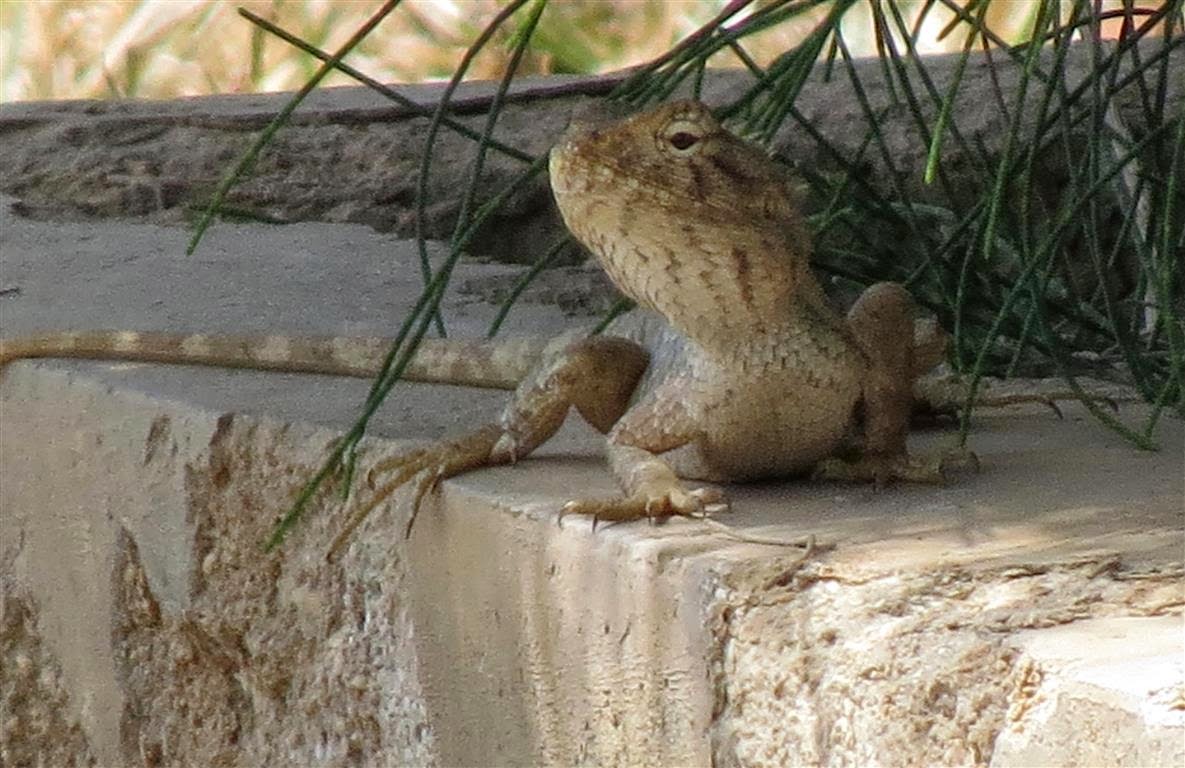
lizard in the park

With the park closed to visitors, the wildlife is more relaxed including several lizards seen. 

common sandpiper

Once again there were several common sandpiper walking around the lawns.

tree pipit

In the more shaded parts of the lawns were several yellow wagtail and tree pipit. Nearly all the white wagtail have gone.

common myna

Unfortunately there were far too many common myna on the grass too and Indian house crow in the trees for that matter. These two invasive species are far too common in parks.

second lizard in the park

I haven't mentioned possibly the most common bird of all in the park: Abyssinian white-eye. It is actually a distraction when looking for warblers but attractive in its own right.

Abyssinian white-eye

I finished in the park at about noon. After a three hour break in the heat of the day, I resumed some more local birding. This time I went off to Raysut. I can't fault the sheer numbers of species I saw there. I will blog about that next.

Sunday, 14 December 2014

Singing bush lark at the farm

I took it relatively easy on Saturday morning after the long trip the day before.

I visited Sawnaut farm which is very close to where I live. As I have said before it is out of bounds to the general public but birders peer over the fence.

I visit it with three sets of target birds in mind. First, sociable lapwing are known to come in large numbers but none have been seen this winter. Second, oriental turtle dove have been spotted there this winter in very small numbers against the hundreds of other doves.  Third I am interested in any falcon other than lesser kestrel, kestrel and hobby which I have already seen in Oman. 

Unfortunately I succeeded with none of these targets this time. Odds of success are higher when one of the pivot bars is spraying close to one of the perimeters. This was not the case on Saturday. 

singing bush lark

There were some highlights however. A very confiding singing bush lark sat up on the fence within two metres of me.

second view of singing bush lark

I am told it is a young bird. The streaking is pronounced and comes together in a black patch at the side of the throat.

marsh harrier carrying a lizard

Otherwise I was particularly noticing the amount of harassment birds were giving each other. This marsh harrier was being harassed in the sky by an eastern imperial eagle presumably to drop its food.

eastern imperial eagle

In turn later I saw a resting eastern imperial eagle being mobbed by group of Indian house crow.

Indian house crow

I only occasionally see little green bee-eater in the city but there were two next to the farm on Saturday morning.

little green bee-eater

On the fence at the western side were the normal array of house sparrow and ruppell's weaver but this time there was an unusually large group of 50 African silverbill. This is the largest single flock I have ever seen.

Daurian shrike

I invariably see a shrike or two on the same fence. At this stage of the winter there are now more Daurian shrike than Turkestan shrike in stark contrast to two months ago.

On Saturday afternoon, I moved over to the other side of the city to Raysut. Here I added another species to my Oman list in an interesting afternoon.


Tuesday, 9 September 2014

Wadi Darbat

On Friday, three work colleagues and I made the short trip up to Wadi Darbat. This wadi is overwhelmingly green at this time of year. Along with a string of hills just inland, it benefits most from the edge of the south Asian monsoon which effects the Salalah area from mid June to mid September.

I expected the birding to be good and I wasn't disappointed.

Before we had even reached the top of the hill, two Arabian partridge were seen at the side of the road. Furthermore on top of the sign at the junction of Wadi Darbat and the hill road stood a a waiting Arabian wheatear.

My colleagues dropped me off, before we reached the river, for a couple of hours while they ventured on.

Singing bush lark

I strode straight into some lightly wooded pastureland. Almost immediately I glimpsed a dark and white bird flash in front of my eyes without being able to positively identify it though I had my suspicions.

The area was thronging with laughing dove though I quickly noticed one Bruce's green pigeon in the distance. Two passerines were also very common. These were Ruepell's weaver and Singing bush lark.

The lark is described in most guides as liking dry scrub. Yet it seemed very at home here. I am told that by mid November much of the greenery browns and that the landscape may then be more usual for this lark.


some of Wadi Darbat's pasture land

After 15 minutes or so I caught up with the bird that had originally flashed in front of my eyes as I left the car. It was a Dideric cuckoo.

Dideric cuckoo

At no time did it stay still for long. Indeed I saw it or another one or two in three different places in the area. It was quite easy to spot as it seems to like exposed perches.

Another (?) Dideric cuckoo

It parasitises passerines and especially weavers. This is a bird which eluded me in Saudi Arabia.

Tristram's starling

Other birds in the area were Tristram's starling and grey headed kingfisher.

Grey headed kingfisher

Another common bird was blackstart. Like singing bush lark this is normally a bird of much drier habitat and shows how dry the wadi must get later in the year.

Blackstart

All the time. up high above in the clouds Forbes-Watson swift were hawking for insects. All the time below there was a continual light drizzle.

Both the swift and the cuckoo were "lifers".

Laughing dove

After wandering back to the road and with a little time on my hands before my colleagues were due to pick me up, I decided to bird the road and other near-by tracks. The idea was that this slightly more open habitat might have different birds.  Laughing dove proved to be here too.

African silverbill

However there were indeed some different birds. African silverbill were common in gardens of small holdings.

Cinnamon breasted bunting

Cinnamon  breasted bunting was a bird of walls. In hedgerow I found a rufous bush robin. I'm not sure whether any winter here or whether all are passage.

Wadi Darbat river

After I was picked up we had a very pleasant barbeque near the river. From here I wandered away from the group from time to time to bird the waterway.

Common sandpiper

Once again, I found common sandpiper which is common in so many habitats in the Salalah area at least at this time of year.

Purple heron

A single young purple heron and several grey heron were seen next to and in the water.

Bruce's green pigeon

As the others left, my friend Michael Immel joined me for some last birding on the near the banks as the skies grew darker. We were rewarded with two birds in one tree. The first was a Bruce's green pigeon which was much better behaved than the one seen at the start of the visit.

Spotted flycatcher

The second was a spotted flycatcher. It left me wondering if, like the rufous bush robin, any of these stay the winter.

The next day, on Saturday I returned to East Khawr. Here I added another 13 species to my Oman list which I hadn't seen on the previous visit only 5 days before.  I also saw the most species in any session since I arrived.

List of birds seen at Wadi Darbat    O= new on my Oman list. L= lifer

Arabian partridge   O
Grey heron
Purple heron
Common sandpiper
Laughing dove
Bruce's green pigeon  O
Dideric Cuckoo  O, L
Forbes-watson's swift  O, L
Hoopoe
Grey headed kingfisher
White spectacled bulbul
Singing bush lark  O
Pale crag martin
Tristram's starling
Rufous bush robin  O
Arabian wheatear  O
Spotted flycatcher  O
Ruepells weaver
Striolated bunting  O
Cinnamon breasted bunting  O