Showing posts with label whinchat. Show all posts

Thursday, 15 September 2016

West Nouakchott

The western side of Nouakchott has a high water table in many places. I made my first visit to these part of the city on Tuesday afternoon which was the end of our Eid break from work.

In several places there are shallow brackish lakes and the larger ones attract waders.

I spent some time birding a small cluster of these larger lakes.

Ringed plover were common but associating with them were a smaller number of Kittlitz's plover.

Kittlitz's plover (left) with ringed plover (right)

Kittlitz's plover is at furthest north of its normal range. It was also a lifer.

young kentish plover

This is ideal terrain for Kentish plover and given the young age of several of the birds seen, they are breeding here.

spur-winged lapwing

The other "plover" present was spur-winged lapwing sometimes called spur-winged plover.

wood sandpiper

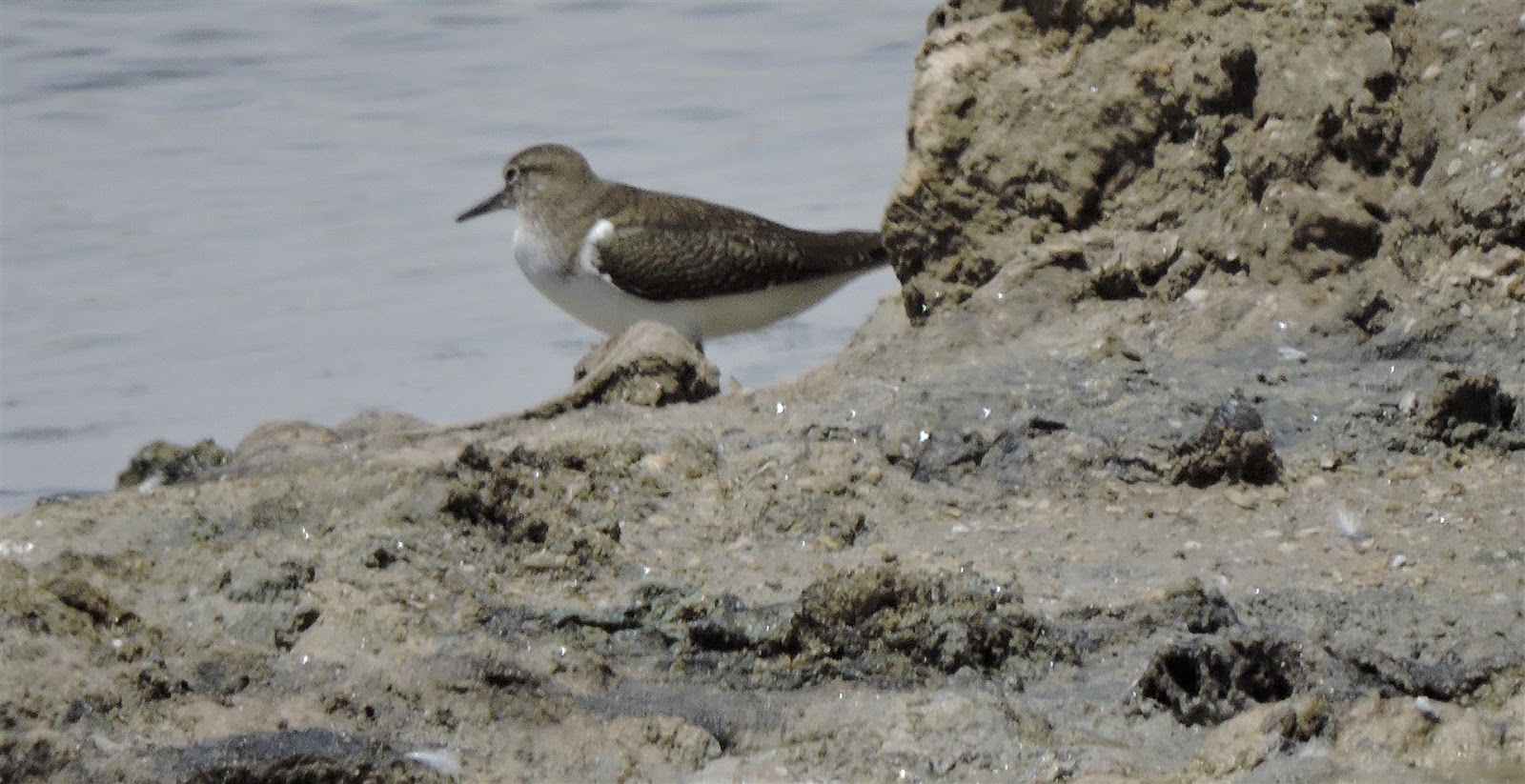
Only two types of sandpiper were observed. These were wood sandpiper and common sandpiper.

common sandpiper

I should expect easily to add green sandpiper and curlew sandpiper to my country list fairly soon. Other sandpipers are much rarer.

little stint

The most abundant wader of all on Tuesday afternoon was little stint.

sanderling

There were a few sanderling too. I am not use to them actually wading rather than running around on sand near the water's edge.

dunlin

Four dunlin were also sighted.

common redshank

As well as the spur-winged lapwing already mentioned, there were other larger waders present encouraged by the fact that the "lakes" were up to 30-40 cms deep in a few places.

Common redshank were easy to pick up. However a single greenshank was nearly missed as it was resting in the middle of the complex of pools and partially hidden.

black-winged stilt

The final larger wader was black-winged stilt.

At the edge of the lakes was a medium sized rubbish dump. I gave this a close look. Although most of the birds there were house sparrow, I was rewarded for my efforts by two migrants.

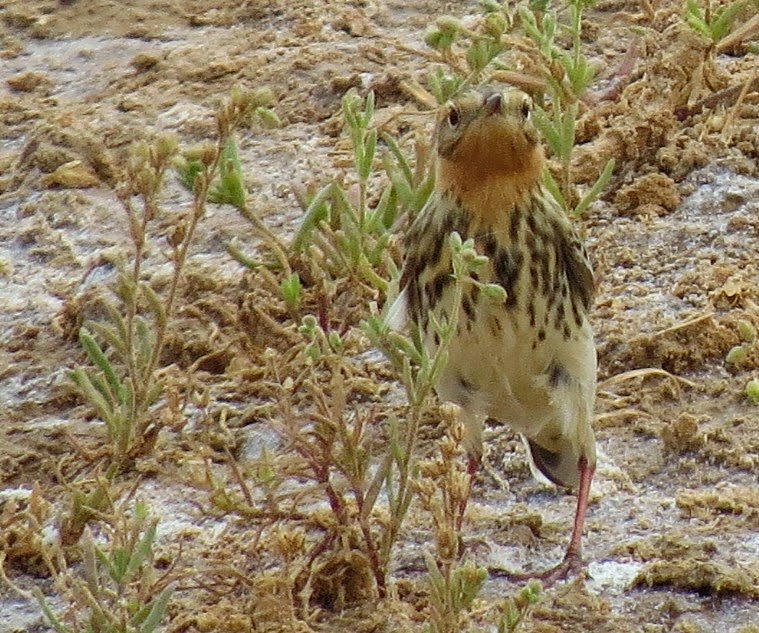
whinchat

One was a spotted flycatcher but the other pleased me more. It was a whinchat.

This was an encouraging sighting as the passage season is still young.

Thursday, 18 February 2016

Mazyunah in late winter

A week ago Friday I made the long day trip to Mazyunah on the border with Yemen with visiting birder Markus Craig. 

It is sufficiently different from Salalah to give me prospects of new additions to my Oman list. Notably I had Dunn's lark, golden eagle and little crake (at the small wetland there) on my mind. All three are tricky birds. Indeed any bird not already on my country list is tricky. The list is too long now to have any "easy" left.


To get to Mazyunah you have to travel to Thumrait and then via Mudhai. The stretch of road between Thumrait and Mudhai is about the only place in recent years where the elusive Dunn's lark has verifiability been seen (though there have been more doubtful reports from Al Beed farm). 

We studied every lark we came across there causing us to "lose"all the early morning. Every one was a desert lark. Dunn's lark is tough.


Desert lark by Markus Craig

As we finally pressed on towards Mazyunah we stopped briefly at a hamlet called Qafa on a dirt side road marked towards Shisr. I had seen European turtle dove and a crowned sandgrouse there on a previous stop.

Black redstart

This time the best bird was a black redstart assumed to on passage as the habitat there is very open. The small water tank is a big attraction.

As we neared Mazyunah we noticed the town's rubbish dump on the left hand side about 5 kilometres out. 

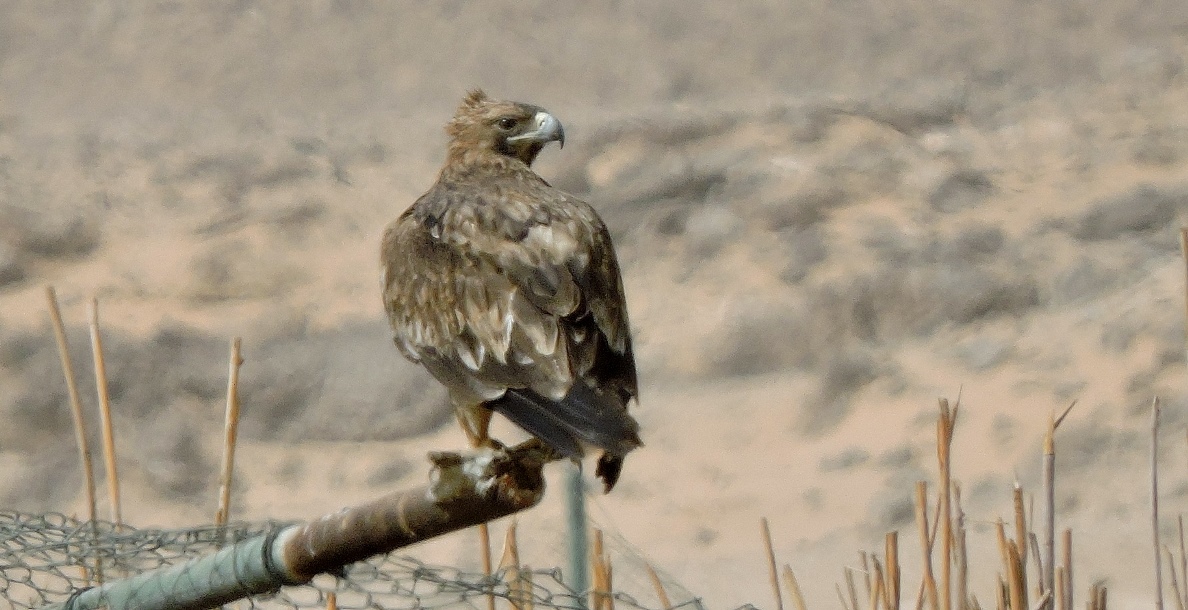
Scattered on the hill tops around it were several large birds of prey which all turned out to steppe eagle with one griffon vulture which soon departed.

steppe eagle perched

The steppe eagle were all adult or near adult.

steppe eagle 1

They approached closely on occasion.

steppe eagle 2

We stayed some while as it was always possible that a golden eagle might be around. It proved not to be the case.

Egyptian vulture

Nevertheless by staying we noticed the arrival of six Egyptian vulture.


Spotted sandgrouse

Twenty spotted sandgrouse also flew over.

Close to Mazyunah we divided our time during the day between the old sewage pond just to the north of the city and the smaller new sewage works to the south off the Tosinat (dirt) road.

The latter had few birds except on our first arrival where three birds of prey were drinking. These were two Eastern Imperial Eagle and one steppe eagle.

Eastern Imperial eagle at new sewage works by Markus Craig

The old sewage pond with its reeds and overflow creating a long stream is the best birding location though.

Eastern Imperial eagle at old sewage pond

Here several Eastern Imperial eagle came and went to drink all day long. Ducks and waders included pintail, teal, garganey, mallard, ruff, Temminck's stint, wood sandpiper and more. All these were in a desert location.

Desert wheatear were scattered around but there was also one red-tailed wheatear. It is right at the south westerly edge of its known wintering range.

red-tailed wheatear

From four pm onward birding came frenetic. Bird activity rose substantially. It began as we spotted a wintering whinchat. This follows on from one seen at Muntasar oasis a few weeks ago.

whinchat by Markus Craig

Four water pipit hadn't been seen during the day either.

water pipit by Markus Craig

Both Eurasian collared dove and African collared dove started to gather around the reeds where we assume they roost at night. The numbers that can be seen here are the highest in Oman.

African collared dove (l) and Eurasian collared dove (r)

To finish the day we looked for crakes and found two very quickly. One was a spotted crake which was seen first and was more open.

spotted crake

The second was more problematic. We had trouble with quaity of our photographs and separating the possibilities of adult Baillon's crake from adult male little crake.

We saw the bird had clean deep blue underparts with little barring on the flanks and the shape including primary projection supported little crake. However we struggled to see any red on the bill. This left us in some doubt.

Luckily Hanne and Jens Eriksen visited four days later and cleared the mystery up. From their observations and pictures it can be seen the the red at the base of the bill is very small. This was a lifer for me and instructive in what features can and can't be used in the field to separate the adult male birds.


little crake at Mazyunah by Hanne and Jens Eriksen

Little crake and particularly adult birds are uncommon in Oman. Mazyunah is about as close to their main migration route (a little north and west of Oman) as there is in the country. 

close up of little crake at Mazyunah by Hanne and Jens Eriksen

I am grateful for Markus Craig's company on this trip and permission to reproduce some of his photographs. I am equally grateful to Hanne and Jens Eriksen for permission to reproduce their photographs of little crake. Ownership of all these photos remains with them.

Monday, 11 January 2016

Desert stops around Ghaftain

On Friday I was based at Ghaftayn in the desert and visited Muntasar oasis, Qatbeet motel gardens to the west. Then on return I overshot Ghaftayn to the east (to collect some supplies) for a short stop at Haima which is the only town for 150 kilometres in any direction.

Ghaftayn is my preferred hotel over Qatbeet motel as the rooms are better and less expensive and, there is good food available. The staff are really friendly too.

Muntasar Oasis is often visited by birders for the sandgrouse that often come to drink in the early to mid morning. However I find Dowkah farm more reliable. I arrived at Muntasar a little too late for this potential spectacle.

Nevertheless I was more than compensated by finding a wintering whinchat. 

whinchat at Muntasar

Whinchat is an uncommon bird in Oman and seeing one in winter is ever more uncommon though not unheard of.

whinchat

Whinchat became species 321 on my Oman list.

Muntasar Oasis

Muntasar Oasis appears to be a better habitat once again. It is heavily grazed and there is water pumped away but it looks like the water table is higher than it has been. I suspect there have been winter rains. Also the camels have arguably helped in some ways by chomping back some of the thickest reeds.


mallard drake

A mallard seems to find the habitat satisfactory.

Asian desert warbler from the rear

There were at least three desert wheatear around the site. As is fairly typical at this time of year, one of them had an Asian desert warbler associating with it.

Asian desert warbler on the move

I failed to get good pictures as this one was so flighty.

flock of house sparrow

Earlier I had birded the grounds of Ghaftayn guesthouse where I was staying. It can be excellent in the passage seasons but can be thin in winter. I resorted to inspecting every house sparrow and collared dove on site for rarities.

desert wheatear

There was very little diversity. Only desert wheatear and brown-necked raven added to the mix.

After Muntasar I headed further west to Qatbeet.

male crowned sandgrouse

As I was speeding down the road, I passed a pair of sandgrouse and the roadside. A quick stop and turn and I discovered they were crowned sandgrouse. 

Although you can't see the characteristic black stripe at the front of the face from this angle, the brown crown surrounded by a blue-grey edge is obvious.

female crowned sandgrouse

A female crowned sandgrouse is actually more spotted than a spotted sandgrouse and some of the spots merge into blotches.

This is the species of desert sandgrouse that many visiting birders struggle to find. 

black redstart

Qatbeet was nearly very good. I came across an eastern leaf warbler. It had at least one yellow wing bar, was low-lying and not making a sound. I suspect it wasn't a Hume's warbler because of the latter two aspects. It is the one leaf warbler which I have seen at Qatbeet before. 

Unfortunately it moved away into another part of the heavily shaded area and just at the same time, a large group of men decided to have a picnic near-by. The disturbance made my chances too low to continue. This was one bird that got away.

Otherwise Qatbeet was not very fruitful this time though a black redstart had some interest.

After Qatbeet I retraced my route eastward back to Ghaftayn but had to overshoot to Haima to get some provisions. 

I took the opportunity to bird the small public garden and saw nothing but laughing dove and house sparrow.

hobby at Haima

As I moved on towards the shops, I looked up at a wire and a hobby was sitting undisturbed. 

facing hobby 

The desert stops can be very hit or miss in mid-winter. Haima was typical of how this can sometimes turn on a single bird.

Monday, 5 May 2014

Water rail and much more at East Salbukh

I returned once again to East Salbukh wetland on Saturday. There was one major difference from the visit eight days before - the temperature. Not only was the daily high 34C against 40C but I also went out three hours earlier from 6 am to noon. As a result the birding was much cooler than the previous session. I was rewarded with many more birds. 

water rail

Arguably the highlight was seeing two water rail and in different places but more about that later.

In the meantime I'll recount the birding session in chronological order. 

male red-backed shrike

On arrival, I decided to do a clockwise circuit round the wetland as usual. This means starting in an area which has plenty of tamarisk bushes. 

Straight away it was obvious that there was a major wave of red-backed shrike on their way through. I counted five shrikes in these bushes.

Spanish sparrow

This part of the circuit is one of two areas with large numbers of house sparrow. However on Saturday I noticed quite a few Spanish sparrow there too.

barred warbler

Instead of the willow warbler and chiffchaff of recent times, I counted three barred warbler. The other warbler here was the resident graceful prinia.  

little stint

As you go round, there is an area where water spills out from the reeds and grass giving the appearance in places of a stream.  Small groups of little stint were seen here. 

female red backed shrike

In the bushes and reeds were still more red backed shrike of both gender. In the reeds Eurasian reed warbler made fleeting appearances.

After an hours walk, at seven in the morning, I arrived close to a place one week before where I had flushed a bird back into the under-growth. At the time I instinctively felt wasn't a moorhen but I didn't get more than a fraction of a second's look.

This time, I approached slowly and from within cover I scanned the place I had seen it. I couldn't believe my luck. A water rail was standing there. Indeed it walked around for two or three minutes without noticing me.

Within Saudi Arabia, I have only seen them in Tabuk before.


water rail

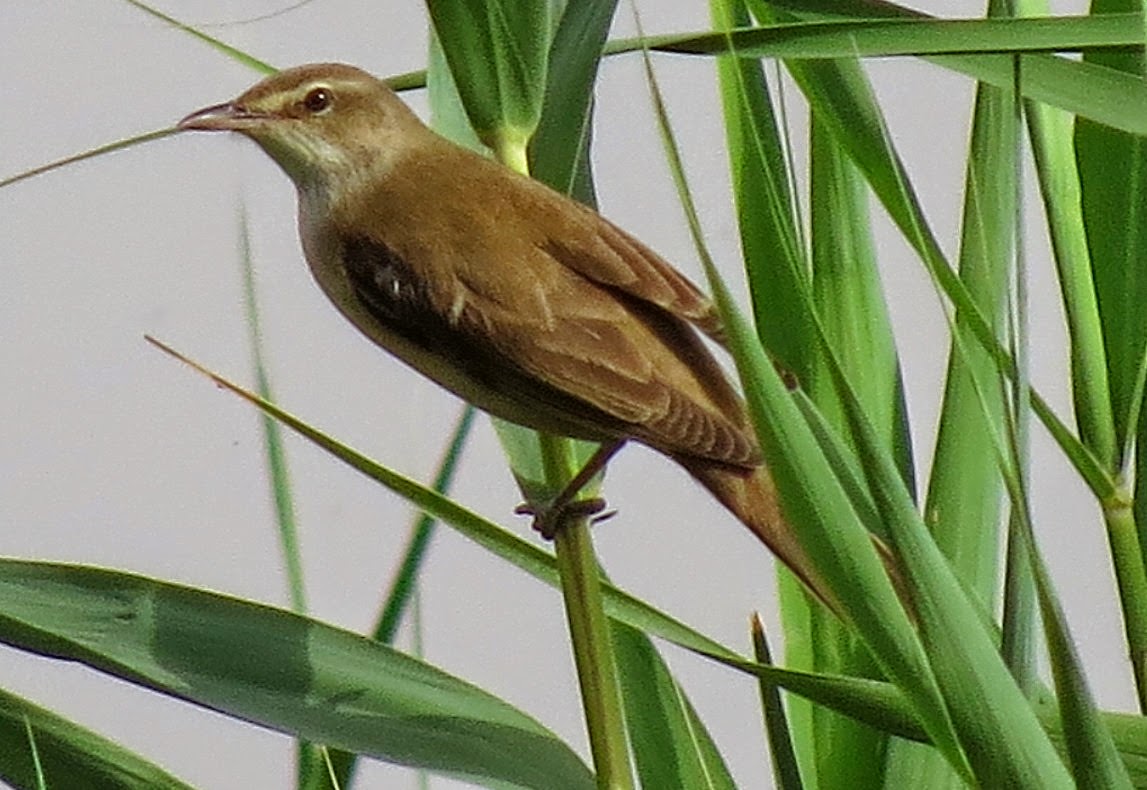
Eventually it went into cover and I moved on. Less than 50 metres further round but closer to the impenetrable centre of the wetland there was some interesting activity in the reeds.  Two great reed warbler showed themselves and a sedge warbler popped up.


great reed warbler

I think the sedge warbler may have been pursued by the great reed warblers.  

second great reed warbler

After that flurry of excitement I continued walking round but very slowly. I noticed crested lark and Kentish plover to my left and away from the wetland.

crested lark

There was persistent squealing noise like a puppy begging. Indeed I thought it was just that. It wouldn't have been the first time for me in Saudi Arabia to come across wild puppies.

I scanned the edge of the reeds. It turned out to be a second water rail calling in an area at least 200 metres from the first.

a second water rail

This one never fully came out of the reeds but was in view for at least two minutes.

curlew sandpiper with little stint

The next area on the way round has lots of open but shallow water. Every time I have visited it has had some waders. This time there were curlew sandpiper and twice that number of little stint.  There was a single common snipe with them too.

purple heron

I have to move away from the main wetland in this area and walk behind some earth works to be able to get close to the waders without scaring them off. Next to the earth works are some pools with reeds. As I walked past one I accidentally flushed a resting purple heron.

two willow warbler

Once I passed the open water area, I moved back in towards the reed beds. There are several low bushes in this stretch. I saw several willow warbler and another barred warbler.


whinchat

Slightly further round, the main birds of note, also out near the bushes rather than by the reeds, were a whinchat and a spotted flycatcher.

spotted flycatcher

The wetland slopes very gently down from south to north. In the northern section there is some deeper water. It rained last week so the water levels were higher so other parts of the northern section have flooded.  These parts were teeming with yellow wagtail from five different sub species on Saturday.

lutea yellow wagtail

In the deeper water areas I once again saw moorhen, little grebe and little bittern.

male little grebe

Black winged stilt were common in many parts of this northern section.

black winged stilt

The overflow in the north creates a short stream which was longer than usual because of the rain.  Where it breaks out of the wetland is very green and has proven good for birds on every visit.  

squacco heron

This time as well as more yellow wagtail, there were two squacco heron, twenty or so red-throated pipit and several wood sandpiper.

red throated pipit

I usually find the part of the circuit where I head back south towards the start is not such good birding. It certainly has a higher percentage of blanket reed beds than elsewhere. However I suspect an important reason is that I am always there at hotter times of day when bird activity has reduced.

Daurian shrike

Two observations of note here included a Daurian shrike which was the only one of the day.

wood sandpiper

I also managed to finally get a good view and photo of one of the wood sandpiper around.

Overall I was very satisfied with this birding session. I rank it within the top ten sessions I have had in the Riyadh area.

The wetland has some advantages over Al Hayer. There is less human disturbance and cars can't get near because they would simply get bogged down. Of course this means all birding has to be done on foot but this is my favoured approach anyway.


The full list of species seen at East Salbukh: 

Little grebe
Turkestan shrike
Little bittern
Red backed shrike
Squacco heron
Crested lark
Purple heron
Barn swallow
Water rail
Graceful prinia
Moorhen
Great reed warbler
Little ringed plover
Eurasian reed warbler
Kentish plover
Sedge warbler
Common snipe
Willow warbler
Green sandpiper
Barred warbler
Wood sandpiper
Black bush robin
Little stint
Whinchat
Curlew sandpiper
Spotted flycatcher
Collared dove
House sparrow
Laughing dove
Spanish sparrow
Common swift
Yellow wagtail
Daurian shrike
Red throated pipit