Showing posts with label white cheeked tern. Show all posts

Tuesday, 10 June 2014

Outer Farasan islands boat trip

On Saturday morning, Bernard Bracken and I took a four hour boat trip out of the small harbour next to our hotel. Indeed it was organised through the hotel and cost 250 riyals per hour (125 riyals per person per hour). However in my view it was worth every penny.

The boatman not only spoke English well and piloted the boat well but knew where to take us for many of our requested birds. These included close ups (but not too close to force evacuation) for example of brown noddy which we had only glimpsed through the ferry window the day before.  

brown noddy

The first place of interest the boatman took us was a platform some way off an island. Here we had good views of greater crested tern which Bernard photographed well.

greater crested tern (swift tern) by Bernard Bracken


The first island which the boatman took us close to had mini cliffs two or three metres tall. On ledges all along the north facing mini-cliffs were brown booby.

brown booby

We soon realised there were a couple of sooty falcon menacing the area.

sooty falcon

One perched for a moment but the swell on the boat made photography almost impossible. However I finally got a distant shot when we landed on a very small beach.

After this, we asked to go to a low-lying island with potential for terns, knowing, by the way, that surveys show that breeding doesn't start quite yet but that extreme care was needed.

However as we headed to a likely island where we could see terns on the beach, the boatman deviated toward a very small rocky outcrop of an island. As we got closer we realised the outcrop was covered in birds. 


white eyed gull courtesy of Bernard Bracken

Most were brown noddy. There were over 45. However there were also a few white eyed gull and brown booby

plenty of brown noddy

We were conscious of the need not to force them off and asked that the boat be pulled away. 

We had similar issues, trying to minimise disturbance, when we finally headed to the large low-lying sandy island. 

white cheeked tern

We landed on a beach with little activity except 3 or 4 white cheeked tern preening.

bridled tern landing

On another beach further round the island there was much more activity and we decided not to approach it. From a distance we could see many of the birds were bridled tern. However, one came in from the sea and obliged by posing on a bush inland.

Bridled tern was not only a lifer but also proved to last addition to my Saudi list on the trip.

bridled tern

We headed back to the boat after about 10 minutes. We started the homeward journey. However we had plenty of time to visit one last island.

greater flamingo and crab plover

We stopped off at an island with a sand bar in front of a shallow lagoon. This beautiful setting had four crab plover hard at work seeking out food.

At the back of the lagoon were two shy over-summering whimbrel.

greater flamingo in flight

A single young greater flamingo was also present. On the mounds near-by were yet more osprey.

dolphins

Before making the stretch of the journey which would take us back to the main island, Farasan Kabir, we sailed further round the island with the lagoon.

We came across a pod of dolphins. 


common tern (left)

On some rocks near-by we saw another type of tern: common tern.  It was then time to sail directly to Farasan Kabir.

Black crowned night heron

We hit Farasan Kabir about two kilometres west of the harbour and so had a chance to look out for birds as we moved along the shoreline. It was here that we added one final species to the trip list as two black crowned night heron were seen resting on some rocks. 


List of 33 species seen on the Farasan islands.

L = lifer. S = addition to Saudi list

Brown booby
Sooty gull
Greater flamingo
Baltic gull
Black crowned night heron
Lesser crested tern
Striated heron
Swift tern
Goliath heron  L,S
Bridled tern  L,S
Western reef heron
White-cheeked tern
Pink backed pelican
Common tern
Osprey
Brown noddy   S
Egyptian vulture
Laughing dove
Sooty falcon  L,S
African collared dove
Crab plover
House crow
Grey plover
White spectacled bulbul
Kentish plover
Black crowned sparrow lark
Whimbrel
Hoopoe lark
Common redshank
Crested lark
Ruddy turnstone
Mangrove reed warbler
White eyed gull


In addition, three species were seen at Jizan ferry terminal which weren't seen on the Farasans. These were feral pigeon, house sparrow and African palm swift.

Some notes on the logistics of the trip

Ferries

The ferry has a very large capacity for passengers and I imagine rarely gets full. However car space looks more limited.

Jizan to Farasan ferry: Ferry terminal gate opens at 5.30 am. Boarding starts at 6.30 am. Ferry officially departs at 7.00 am and arrives at 8.00 am

Farasan to Jizan ferry: Ferry terminal gate officially opens at 3 pm but was open when we arrived at 2.45pm. Boarding starts at 4.00 pm. Ferry departs at 4.30 pm and arrives in Jizan at 5.30 pm.

Tickets are free and can be bought at an office next to the ferry terminal gate in Jizan from 6.00 am onward. I didn't see where the booking office was on the Farasan side.

However we bought our passenger only tickets on-line via https://www.mot.gov.sa/ar/Pages/home.aspx  Be warned the site is in Arabic. Furthermore, to buy a ticket you need to register and the only people who can register are Saudis. Once you have a Saudi willing to register for you, he can reserve and print your tickets but only if you give him your passport number (an iqama number is not sufficient).

I understand that car tickets can also be bought this way but need more advance booking as spaces are limited. 

Travel around Farasan Kabir

There are no taxis on Farasan however many locals use their cars as private taxis. It is quite easy to see a local at the ferry terminal who will give you a ride to your hotel. Our hotel had a list of several drivers they could approach to give us lifts to wherever we wanted during our stay. Prices are reasonable. If the journey is short a hotel staff member will take you to your venue free.

Farasan Coral Hotel

We each paid 450 riyals per night for double rooms with single occupancy but it was worth it. The staff were friendly and efficient. The restaurant was better than average. Indeed most Saudi hotels don't have a restaurant! It is also the only hotel on Farasan that you can book on-line through booking.com

Tuesday, 11 June 2013

North of Khobar

Having spotted my one target bird for last weekend, Socotra cormorant, so early on, I spent the second day (Friday) speculatively birding an area a little further north of Thursday's. 

This meant I birded the central and northern corniche of Khobar and then on to the Dammam port area.

white cheeked tern

To be honest the central and northern corniche at Khobar were a bit of a disappointment. Although neatly landscaped with lawns, palm trees and water features, it is not as natural a setting as the southern end.  The coastline itself is mostly artificial boulders too.

Nevertheless there were a few highlights. I managed to see another tern species, white cheeked tern, to add to the three species seen the day before. 

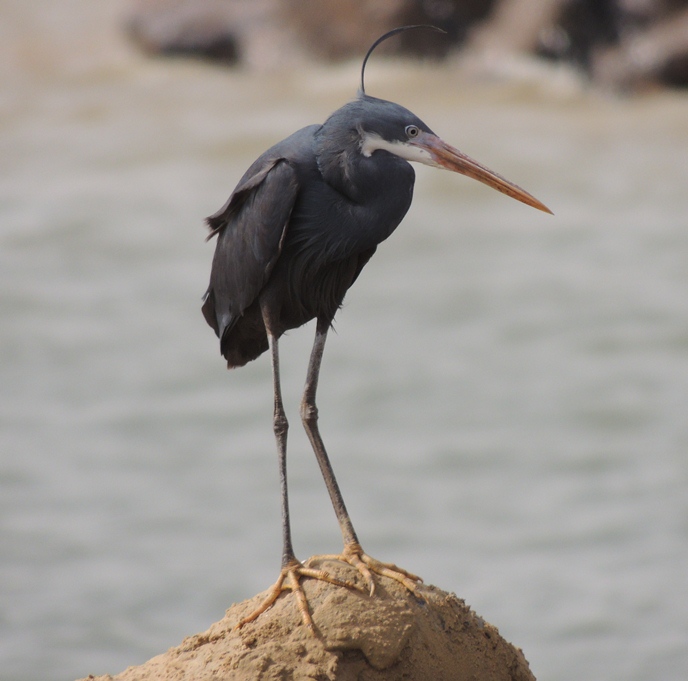
western reef heron

The lack of vegetative cover at the water features didn't stop the odd western reef heron making an appearance.

house crow

I hadn't seen house crow on Thursday but it was easily seen in the parkland alongside more common myna, house sparrow, white eared bulbul and crested lark.  


common myna

Collared dove again was very numerous.

collared dove

Birding became more interesting again as I left Khobar and headed towards Dammam port stopping briefly at the so called high roost on the border of the two cities.

black winged stilt

Here were the first black winged stilt seen on the trip and a few more western reef heron.

flamingo

In the port itself are several bunded water filled areas whose purpose I am not sure of but which make some for some of the best birding in the area.


the full group of flamingo

One such bunded area held five sub adult flamingo.

greenshank

Indeed one of the features of the weekend was seeing sub adult and therefore non-breeding birds which belong to species which don't regularly breed in the area but do so relatively close by. Slender billed gull for example don't breed here but do so in Kuwait as I understand it.  

One possible interpretation is that these sub adults come for the winter and over summer because there is no biological imperative for them to move on.  Who knows whether this explains the odd greenshank and dunlin also seen but which I can't age unlike the gulls and flamingo.

second cycle slender billed gull

The mangroves at the port have taken a battering since the last time I visited with an ill considered (and apparently abandoned) road  having cut off the tide to part of it. What a shame.

curlew

In the diminished area were more waders than any where else over the weekend. These included curlew, common redshank and greater sand plover.

greater sand plover (left), dunlin (centre) and kentish plover

Its always a pleasure to see sand plovers and usually a headache in identification terms too. Its easier in summer when the vast majority are greater sand plover which breeds locally.

This was a rewarding end to a gentle weekend's birding in the fierce heat of a Saudi summer.

Monday, 9 April 2012

Jizan bay

I visited the shoreline in the centre of Jizan twice over last weekend. The first visit was to an area of mud flats. The second was a walk along a rocky piece of coast next to the flats. It was very productive. They were large numbers of waders and I added three "lifers".

western reef heron

Herons weren't the most common birds but they were among the most photogenic. I saw one western reef heron and one striated heron. The former was very tame allowing me to within 3 metres with prolonged viewing. 

striated heron

There were much larger numbers of waders. As is often the case, dunlin was the most abundant. Common sandpiper was also common.

There were several curlew sandpiper which I misidentified as dunlin at first. Through correspondence on BirdForum, I have learned the best way to tell these birds in winter plumage apart is that curlew sandpiper have longer necks and longer legs. Actually the length and shape of the bill is not the best guide. 

curlew sandpiper

On the mud flats, there were a range of plovers and two were "lifers".  

crab plover

A single crab plover was caught eating a small crab. This wasn't my lifer though. I had seen this bird previously in Jeddah.

grey plover

Neither was grey plover a lifer either. 

pacific golden plover

One "lifer" was a pacific golden plover which was resting on the rocky shoreline with other waders. It was the only one I saw during the weekend.

ringed plover

There were three types of small plover on the mud flats. Two were kentish plover and ringed plover.

lesser sand plover

The third was lesser sand plover. This was my second "lifer" plover of the weekend. I knew greater sand plover from Azerbaijan where it breeds and one wintering bird in eastern Libya but had never seen a lesser sand plover before.

greater flamingo

There were significant numbers of larger water birds on the mud flats. A lay person would probably have noticed the six greater flamingo first. All of them were first cycle birds.

bar-tailed godwit

There were also three bar-tailed godwit in different stages of plumage. The one above was part way to its summer plumage.

whimbrel

There were several whimbrel seen as well though never in groups of more than three. 

three whimbrel on the beach

On a sandbank in the middle distance was a solitary oystercatcher.

oystercatcher

I only saw two different members of the tern and gull family here. Nevertheless, the good news is that the tern was another "lifer".

white-cheeked tern

Thanks to my posting pictures on the BirdForum website, without their help I would never have been able to to identify the tern above (as a white-cheeked tern). Apparently they breed on most of the west side of the Red sea coast but surprisingly few places on the western side. Is this a case of under-reporting?

white eyed gull

The final bird for this blog was white eyed gull. There were several at the seaward end of the mud flats and on rocks. I knew this bird from a visit to Jeddah last Eid.  

There were 5 more types of tern and gull at a different location which I'll blog about in the coming days.