Saturday, 15 April 2017

Foum Gleita and onwards

There is a truly massive dammed lake near Mbout in Mauritania. It's called Foum Gleita and is being developed to regulate the flow of water in the region so agriculture can be better developed.

It was also just a minor detour off our route from Aleg to Selibaby last weekend. Mohamed Vall and I spent about 90 minutes there around noon last Saturday.

We parked the car close to the barrage and starting walking towards it up the river which flows down from the barrage. There is an agricultural water channel lined with reeds running parallel too.

Even on this short walk towards the barrage birding was good. A Senegal coucal was seen in the reeds. This is the first time I have seen one outside away from the Senegal River.


Black-headed lapwing

A pair of black-headed lapwing were resting under a tree. In the tree were plenty of Sudanese golden sparrow as well as red-billed quelea.

pied kingfisher (courtesy of Mohamed Vall)

Pied kingfisher are immediately in evidence near the barrage itself.

Right next to the barrage is a cave. I was really pleased to see a barn owl fly straight into it in broad daylight. It got better still. The barn owl rested inside the cave but still in public view.

barn owl

On reaching the barrage and looking over into the lake, I realised just how massive it was.

Foum Gleita

The lake would take two or three days to walk all around though the trees on the far banks looked enticing. The expanse of water itself looked surprisingly barren.

Birds were coming down to drink all the time and if we had had time we would have waited to see just how much bird diversity there was.

However we didn't have time. Even so a Gosling's bunting appeared and it was both an addition to my country list and a lifer.


gosling's bunting

Other drinking birds that we did have time to see were common sandpiper, Sudanese golden sparrow and yellow wagtail. A very interesting and plain looking pipit flew off before I could identify it. Some times the birds get away.

western red-billed hornbill

I still check all red-billed hornbill because northern red-billed hornbill is possible in Mauritania. Yet everyone I have seen so far has been western red-billed hornbill. My understanding is the easiest way to tell them apart is the orbital eye ring which is dark in the western bird but pale yellow or pink in the northern bird. Northern red-billed hornbill is mostly a bird of East Africa and as far as I can see has "normal" range which only just sneeks into the south east corner of the country. Nevertheless range maps aren't brilliantly accurate for some species in Mauritania so any visit towards the east could yield this other hornbill. 

another pied kingfisher

After visiting the barrage we investigated downstream more thoroughly though the temperature and time were major constraints.

great white egret

Several little egret were in the river or in near-by trees. I checked all the larger egrets too but found only great white egret. Once again intermediate egret was nowhere to be seen.

greater blue-eared starling

The greater blue-eared starling above caused a few identifaction headaches. The eye colour of this bird is usually pale yellow. However, having consulted with an expert from The Gambia, I am told they can occasionally be this dark and that the most fitting alternative bronze-tailed starling would have a noticeably shorter tail.

Viellot's barbet

Other notable birds included a Viellot's barbet.

woodchat shrike (courtesy of Mohamed Vall)

Almost everywhere in Mauritania at the moment the wave of migrant woodchat shrike continues.

Despite our two stops at Lake Jintu and at Foum Gleita, we made such good time last Saturday on our journey to Selibaby that we had time for two short stops in woodland just north of the town.

The first stop was not as good as we had hoped. We think it was because with chose a place with only one main type of tree.

chestnut-backed sparrow-lark

Nevertheless it was still good to met up with chestnut-backed sparrow-lark which is only present in the far south of the country.

northern grey-headed sparrow

The same can be said about northern grey-headed sparrow though it has a wider variety of habitats.

speckle-fronted weaver

Our first and only speckle-fronted weaver of the trip were seen in one of the woods.

Sudanese golden sparrow

They formed mixed flocks with Sudanese golden sparrow in places. However the best birds were a mobile small group of tawny-flanked prinia. This was yet another addition to my country list and the last of the day.

western red-billed hornbill

It became increasingly obvious that western red-billed hornbill is a very common bird in Guidimakha province.

After Saturday's long jounrney from Aleg we were all set up for the jewel of the trip which was to be a full day on Sunday  in the Gouraye area. This proved to be excellent birding. We saw 64 species within walking distance of the town alone. The next two blogs recount what we saw.

Species seen at Foum Gleita
Grey Heron  4
Great White Egret  4
Little Egret  8
Squacco Heron  1
Black-crowned Night-Heron  2
Common Sandpiper  2
Gull-billed Tern  2
Caspian Tern  1
White-winged Black Tern  2
Whiskered Tern  1
Laughing Dove  8
Namaqua Dove  9
Senegal Coucal  3
Barn Owl  1
Blue-naped Mousebird  8
African Grey Hornbill  3
Western Red-billed Hornbill  8
Pied Kingfisher  9
Green Bee-eater  4
Vieillot's Barbet  1
Black-crowned Sparrow-Lark  12
Barn Swallow  10   
Northern Crombec  1
Willow Warbler  2
Black Scrub-Robin  4
Rufous-tailed Scrub Robin  1
White-crowned Wheatear  1
Western Yellow Wagtail  13
Gosling's Bunting  1
Northern Grey-headed Sparrow  4
Sudan Golden Sparrow  40
Red-billed Quelea  60
Red-cheeked Cordonbleu  14

Return to Jintu

Mohamed Vall and I arrived at Lake Jintu in perfect light just before 8am last Saturday morning.

It didn't take us long to find some very good birds. Up in one of the large trees were two black-crowned night heron and many doves. However sharing the tree with them was a young gabar goshawk.

gabar goshawk turns head to face us

While preening, the distinctive white rump could be seen from time to time.

gabar goshawk showing white rump

The bird was not fazed by us at all.

gabar goshawk resting

The last time I saw this bird was in south west Saudi Arabia where it is locally common around another lake.

This bird was sighted in the far south west corner of the lake. We walked round the lake anti-clockwise starting there. However, this little corner proved an excellent start. 

While looking round from the place we could see the gabar goshawk, Mohamed Vall noticed three three black birds on a wire. They proved to be piapiac.

two piapiac

The bird with the red bill is the juvenile.

juvenile piapiac

This member of the crow family will come into urban areas and Lake Jintu is within one.

Turning back round again towards the lake and hardly needing to take a foot forward, we spotted a Seebohm's wheatear. Not much is known about the wintering quarters of this sub-species of northern wheatear. I suspect many winter here. This is my second sighting in country. The other was in the Nouakchott area.

Seebohm's wheatear 1

This bird was quite tame for a wheatear and gave good views.

Seebohm's wheatear 2

We finally moved on from the south west corner and started to realise the lake was about half the size it was on our visit in December. Nevertheless it still held substantail water and will obviously not dry up before the next rainy season starts.

Last time we saw hundreds of white-faced whistling duck. Though reduced in number this time there were still dozens around. Their numbers varied by the minute as there was a constant flow in and out, presumably moving to and from the near-by Senegal River.

white-faced whistling duck

There were a scattering of waders as we moved round including black-winged godwit as well as common ringed plover and Kittlitz's plover.

little egret

The little egret look fine in their breeding plumage.

We took the fortuitious decision to walk along a strip of land in the middle of the lake which is almost an island. It's small bushes surrounded by water looked a little bit different in terms of habitat.

white-rumped seed-eater

In the first row of bushes and on near-by ground were plenty of white-rumped seed-eater and Sudanese golden sparrow.

Vinaceous dove

Further in, we came across a Vinaceous dove. This dove has a strong affinity to water and is essentially a savannah bird. Very little of Mauritania appears as savannah so we took this as good omen. 

We soon spotted another savannah bird. This time, it was a lifer.

Brubru 1

It was a brubru. It is a bird which I read likes the canopy of savannah woodland. Well, there is no canopy on this set of medium sized but thick bushes. In other words not only did we see this bird for the first time, we also saw it with better views than is usual simply because it had nowhere higher to go.

Brubru 2

This was the third addition to my country list at Jintu and my second lifer.

After the finishing the spit of land, we doubled back and continued round the lake anti-clockwise. The north west corner had some interest just before we finished the circuit.

lesser black backed gull

Lesser black-backed gull rarely comes this far inland but we had two. I suppose there could be on passage.These two are heading to Britain or near-by as they are graellsii sub-species.

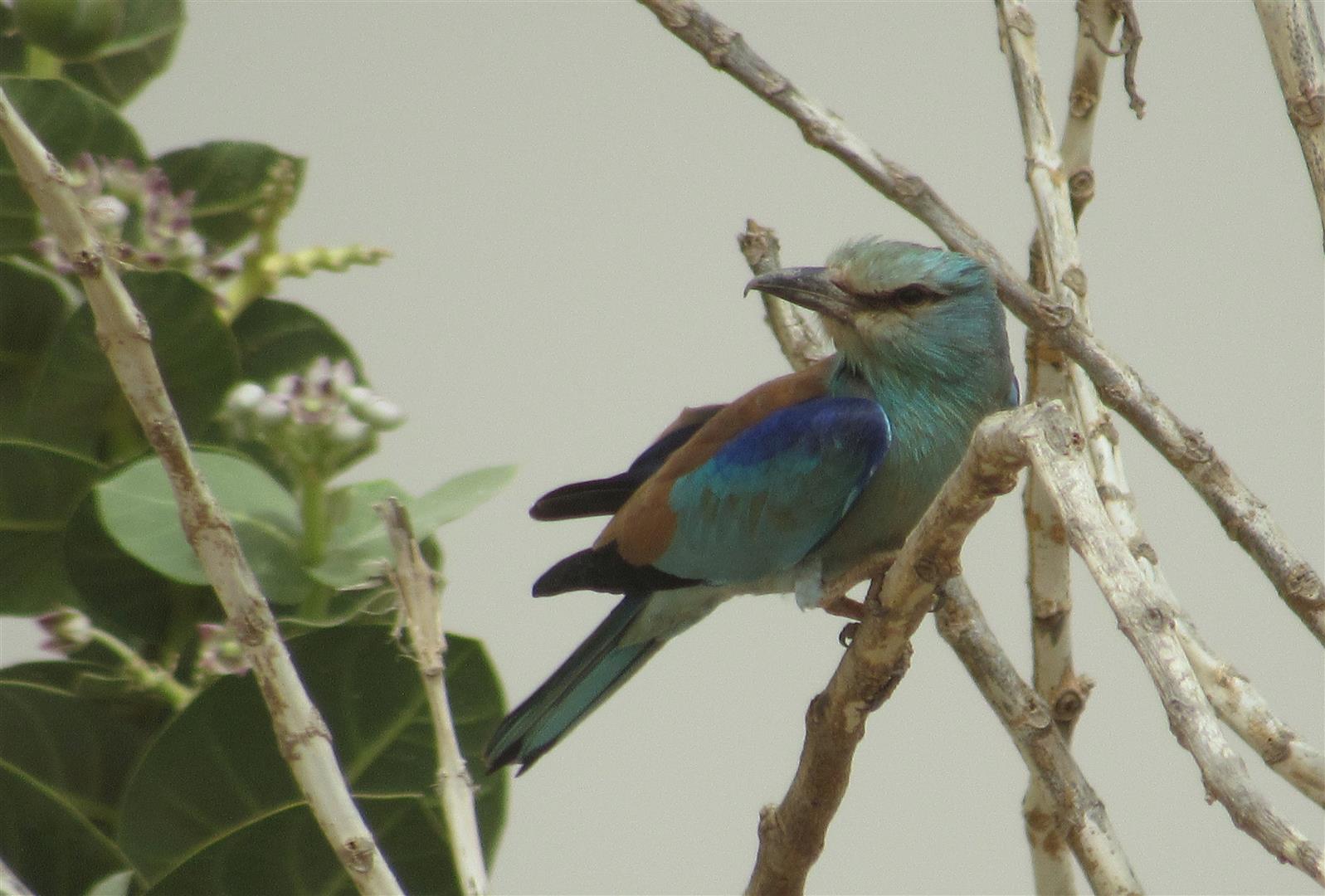
Abyssinian roller

We had one last look at the south east coner again where we had parked the car. A neat Abyssinian roller was posing for us.

We would like to have stayed longer but Selibaby was still 350 kilometres way and we had to reach there by nightfall. It had been excellent start to the day and there was more to come.

Species seen at Jintu
White-faced Whistling-Duck  60
Hamerkop  1
Grey Heron  4
Little Egret  3
Squacco Heron  2
Black-crowned Night-Heron  3
Gabar Goshawk  1
Black-winged Stilt  7
Kittlitz's Plover  4
Kentish Plover  2
Common Ringed Plover  12
Little Ringed Plover  1
Black-tailed Godwit  5
Ruff  4
Dunlin  3
Little Stint  12
Common Greenshank  5
Lesser Black-backed Gull (graellsii)  2
Speckled Pigeon  2
African Mourning Dove  4
Vinaceous Dove  1
Laughing Dove  8
Namaqua Dove  5
Little Bee-eater  4
Abyssinian Roller  2
Brubru  1
Southern Grey Shrike  1
Woodchat Shrike  4
Piapiac  3
Crested Lark  2
Barn Swallow  8   
Willow Warbler  2
Common Chiffchaff  1
Black Scrub-Robin  2
Rufous-tailed Scrub Robin  1
Northern Wheatear  1
Chestnut-bellied Starling  9
Greater Blue-eared Starling  5
Western Yellow Wagtail  22
White-rumped Seedeater  14
House Sparrow  15
Sudan Golden Sparrow  30
Red-billed Quelea  40

Friday, 14 April 2017

Aleg at dusk

Mohamed Vall and I had a long weekend's birding trip down to Guidimakha province. This the southermost part of the country and borders both Senegal and Mali. It has more rainfall and longer rainy season than anywhere else. Consquently it birds include species not found eslewhere in the country.

We started out at noon last Friday. Needless to say it is impossible to travel there in half a day. We elected to stay the night in Aleg. Indeed we arrived ahead of dusk and managed some birding at the lake before it got too dark.


Sunsetting over Lake Aleg (courtesy of Mohamed Vall)

A late arrival coupled with extra time needed to walk to the edge of the lake through muddy landscape meant we missed out on identifying so many birds. However we stumbled over many collared pratincole, yellow wagtail and spur-winged lapwing in the fields on our walk towards the water's edge.

Some of the birds going up

Indeed there were many hundreds of birds huddled round the remains of the lake which was only one twentieth the size of our last visit. It will only swell again with the next rainy season, probably from late July onwards.

glossy ibis

Of the larger birds there were probably between 100 and 200 each of cattle egret and glossy ibis.  There were certainly hundreds of assorted waders but most went unidentied.

sacred ibis with cattle egret

There was some good news though. Even though the gloom we could pick out a group of sacred ibis among the cattle egret. This was the first addition to my Mauritanian list of the weekend. Unfortunately we couldn't make out which type of spoonbill was present. This could have added another if they had been African.

We were reliant of identification of birds which chose to come close to our corner of the lake. These included several terns. Many were white-winged black tern and a few were gull-billed tern


whiskered tern (courtesy of Mohamed Vall)

More good news was that we could make out a few whiskered tern which were in breeding plumage.

This was a second welcome addition to the list.

collared pratincole

The next morning we left Aleg early and stopped first at Lake Jintu on the Senegal River near Boghe. The light and the birding were excellent. We could indentify all we saw and good pictures were taken. Three more additions were made to the list too. I will blog about that next.


Species identified at the Lake and near-by woodland
Northern Pintail  12
Little Egret  3
Cattle Egret  110    
Glossy Ibis  140
Sacred Ibis  14
Western Marsh Harrier  1
Black Kite (Yellow-billed)  1
Common Ringed Plover  35    
Little Stint  40
Wood Sandpiper  24
Collared Pratincole  40
Gull-billed Tern  12
White-winged Black Tern  55
Whiskered Tern  6
Laughing Dove  12
Namaqua Dove  8
Southern Grey Shrike  2
Woodchat Shrike  4
Brown-necked Raven  2
Black-crowned Sparrow-Lark  14
Sand Martin  5
Barn Swallow  40    
Red-rumped Swallow  1
Western Orphean Warbler  2
Black Scrub-Robin  4
Northern Wheatear  2
Long-tailed Glossy Starling  3
Western Yellow Wagtail  45
Red-billed Quelea  300

Monday, 3 April 2017

European roller and bee-eater at waste water site

Saturday was insanely hot for the first day of April. Afternoon temperatures offically reached 44°C in the shade.

Birding was tough especially as there was a sandy wind blowing off the Sahara affecting visibility as well as temperatures.

Nevertheless Mohamed Vall and I went out in the morning. We chose the waste water site just north of the city. This is a place we stopped going to about 3 months ago as the water was so contaminated there were few birds around.

The water was still contaminated but relatively less so. The area of water had increased three fold too. There were plenty of dragonflies and flies to greet us when we parked up and I took that as a good omen.

Indeed the birding was excellent even if the weather wasn't.

The best news of all was the sighting of two additions to my country list. One was a European roller.

European roller 1

Like most birds there it allowed closer approach than usual since the weather was so hot.

European roller

Only a few minutes earlier a lone European bee-eater had been sighted.

European bee-eater

It was resting on top of a Sodom's apple in the middle of the largest pool. On seeing the dragonflies on arrival, I had hoped that this species would be present.

largest pool

While much of the pool is oiled, some sections are in better condition. These are easily found because that is where the waders congregate. Most were wood sandpiper and little stint.

wood sandpiper and little stint

Plenty of barn swallow were hawking over the water and at least one of the hirundines was a red-rumped swallow too. 

barn swallow resting

There was much more passage than just the swallows, roller and bee-eater.

woodchat shrike

Woodchat shrike was the most conspicous. We counted at least ten.

Namaqua dove drinking

We had to move away from the main pool to see mamy of the smaller passage birds. All the lesser pools looked oiled and yet a couple in one area were much less so. The birds seem to know. Namaqua dove and laughing dove would only drink from these.

It was at these two pools that we saw all the warblers. There had clearly been a windfall of mixed warblers and they had gravitated to the cover near these pools.

female blackcap (courtesy of Mohamed Vall)

A female blackcap was easily picked out as many of the bushes are leafless.

western olivaceous warbler (courtesy of Mohamed Vall)

At least three western olivaceous warbler, two western orphean warbler, a sardinian warbler, two chiffchaff and a willow warbler were in the group. This was also the place we saw the most redstart including a very smart male.

Making this spot even busier were regular visits from both house sparrow and Sudanese golden sparrow.

lone Fulvous babbler (courtesy of Mohamed Vall)

Elsewhere in the drier areas, a lone Arabian babbler was observed. This is the first time we had seen one within the official Nouakchott limits.

tawny pipit

Tawny pipit were seen in a dry area with yellow wagtail and white wagtail nearer water. Yet my targetted red-throated pipit was nowhere to be seen.

northern wheatear 1

There were also a few northern wheatear on site. One male allowed us very close. It really didn't want to vacate the shade and cool of a bush.

northern wheatear 2

We left the site at around 11.15 a.m. for a late breakfast. It had been very good but gruelling birding.

We elected to go on to south of fishing port at around midday. It was extremely hot but we inspected the rubbish dump there as always. We counted 16 yellow wagtail and 2 white wagtail. They were alternating between foraging for food and returning to the undersides of moored boats which provided shade. Once again red-throated pipit was looked for. We came closest with a single tawny pipit.

After this, we headed to the lagoons and the beach. The number of lesser black-backed gull was way down on previous weeks. I wondered whether the heat had triggered their northward migration.

Looking out to sea the best birds were storm petrels which I hadn't seen before. The sea was unusally choppy. However the birds were so far out that I didn't have a change to identify them. A cormorant also flew by. Otherwise it was all gulls and terns. Caspian tern, sandwich tern and common tern were  the bulk of the birds.

three first winter common tern

We carried out our standard look at all the resting seabirds in the lagoons. Slender-billed gull and black-headed gull were the new majority of gulls. Terns were either Caspian tern or common tern.

adult common tern

The waders included one red knot. We found where the cattle egret which normally frequent the rubbish dump had gone. They were all motionless in the lagoon, standing in water and trying to stay cool.

cattle egret at the lagoon

By 1.30 pm we decided we needed to cool off too. The birding day was finished though it had been a very successful one.

Species seen at the waste water site on 1st April
Black Kite  
Common Ringed Plover  
Little Stint  
Common Sandpiper  
Green Sandpiper  
Wood Sandpiper  
Laughing Dove  
Namaqua Dove  
Eurasian Hoopoe  
European Bee-eater  
European Roller  
Common Kestrel  
Woodchat Shrike  
Black-crowned Sparrow-Lark 
Greater Short-toed Lark  
Crested Lark  
Barn Swallow      
Red-rumped Swallow  
Willow Warbler  
Common Chiffchaff  
Western Olivaceous Warbler     
Eurasian Blackcap  
Western Orphean Warbler  
Sardinian Warbler  
Fulvous Chatterer  
Redstart  
Wheatear  
Western Yellow Wagtail  
White Wagtail 
Tawny Pipit 
House Sparrow  
Sudan Golden Sparrow