Showing posts with label African paradise flycatcher. Show all posts

Monday, 19 January 2015

Shikra at Ayn Hamran

Having thought it was going to be very difficult to add to my Oman list before the spring passage, I added a new bird today.

It was a juvenile shikra at Ayn Hamran.

shikra in a bush

It was one of the first birds seen there today. I noticed a bird on the ground in one of the few deep thickets. I got too close but instead of flushing, the bird moved round the bush. It was then I realised it was an accipiter. It was clearly stalking for food. The only other birds in the thicket were two Arabian warbler, a laughing dove and the wintering masked shrike. One of them might well have become a victim without my appearance.

shikra moves to a tree

Luckily for me when the accipiter did move, it only flew up into a near-by tree. Here I had better looks. The streaked breast ruled out European sparrowhawk whose juvenile birds have barred breasts.

shikra in a tree

Consulting birdforum, I was reminded that the pale iris rules out levant sparrowhawk. It is nowhere near bulky enough for a goshawk so that leaves shikra.  I had seen one in Saudi Arabia from a distance but this was my first ever close encounter with this species.

Ayn Hamran is quite small and when you go there the first time you wonder why it has such a wonderful reputation for good birds. After half an hours walk you know why.

Bruce's green pigeon

This time I had really good views of Bruce's green pigeon which is usual present but often not seen. The fruiting trees will have them.

African paradise flycatcher

The African paradise flycatcher are in full breeding plumage at the moment.

Arabian partridge

Most visits allow you to see Arabian partridge if the spring is not heavily disturbed by people.

common greenshank

There is permanent water there and this has attracted one common greenshank all winter. I also counted three common sandpiper, two common snipe, a grey wagtail and a citrine wagtail who all need water-based habitat.

Abyssinian white eye

In the shaded middle area there were plenty of Ruepell's weaver and Abyssinian white-eye as usual.

song thrush

The single song thrush has also decided to stay all winter.

white spectacled bulbul

In the same area were about a dozen white-spectacled bulbul attracted not only by the fruiting trees but spillage from a picnic.

hoopoe

Two other notable birds in the bottom end of the spring were hoopoe and black-crowned tchagra.

Ayn Hamran still has the ability to enthral even after four months of at least weekly visits.

Saturday, 22 November 2014

Black crowned tchagra and more at Ayn Hamran

I returned to Ayn Hamran on Tuesday afternoon. The highlight was undoubtedly the sight of a family of black-crowned tchagra. 

I used to have difficulty finding these birds but once you know their calls and follow them they are quite easily seen. Ayn Hamran is the best place I know for them.

Juvenile black-crowned tchagra

Having followed the sounds I saw two adult tchagra disappearing into a bush. However it appears they left two juveniles behind them. These two were very noisy and one of them even stood on top of a bush in the open screaming. The other was more careful but separated by a few bushes.

black-crowned tchagra

Given that the juveniles didn't seem to know how to reach the adults, So the adults came looking for the juveniles.


two black-crowned tchagra

After about five minutes on of the adults suddenly popped up on the same bush as the more brazen juvenile. Moments later I noticed that the bush had three birds including the second adult. At this point the juvenile went quiet.

black-crowned tchagra

The adults appeared to be on look out for the remaining juvenile which I presumed was expected to make its way to the rest of the group. I left at this point but I suspect I may have been in the way.
.
male African paradise flycatcher

Near-by but in the woodland, I came across a male African paradise flycatcher in full breeding plumage complete with full grown tail. I don't know much about the breeding seasons of the birds here. Some breed in the monsoon period (summer) while others breed in very early spring (February). Ruepell's weaver breeds in summer (convenient for Dideric cuckoo) but it looks like the flycatcher breeds in spring. Judging by the sight of a family group of tchagra, black crowned tchagra appear to breed in the khareej (monsoon) season.

second view of African paradise flycatcher

A week before I had seen a male with a half grown tail at the same place. I wonder if it was the same bird. It was also the white tailed morph.

rear of African paradise Flycatcher

Abyssinian white-eye are very much a flocking bird so I was surprised to see two together totally independent of a flock. I don't know whether this is mating behaviour or a juvenile with an adult but I suspect the former.


two Abyssinian white-eye

The two birds were literally inseparable.

Abyssinian white-eye

Another interesting sight at the Ayn was a passing short toed eagle.

Short toed eagle

I am seeing them with increasing frequency at the moment. It looks like several of them may winter in the Dhofar mountains.

shot toed eagle flying off

The only other bird of prey at Ayn Hamran was a common kestrel. It was very clean underneath so I can't rule out lesser kestrel which also winters in the mountains.

kestrel

The more common birds were of course still at Ayn Hamran such as Ruepell's weaver, blackstart and little green bee-eater.

little green bee-eater

As well as Ayn Hamran, I also called into Khawr Soly which is very close. However birding this time was disturbed by a large grazing herd of camels.

juvenile European spoonbill

There was no time to see any thing out of the ordinary though a juvenile European spoonbill was a good sight.

European spoonbill walking away

I returned there two days later and birding was excellent. I will report on that in one of the future blogs.

Monday, 7 July 2014

Azizah after nine

Bernard Bracken and I continued downstream of the valley in Azizah until just past 9 a.m on Friday. It suddenly became lusher. We presumed that was because there is water extracted in the area around the village but not further downstream.

We rested for a while in this lusher area and watched. We were rewarded by the sighting some distance away of an African paradise flycatcher.

African paradise flycatcher

After resting, we decided the descent downstream was too difficult and elected to walk back upstream with the idea to go past our original dropping off point and to investigate the higher reaches of the valley.

Yemen thrush

On the way back we saw many of the same birds as on the way out. We got better looks at Yemen thrush which incidentally is not a timid bird.

Yemen linnet

I obtained this photo of a male Yemen linnet when we passed through the "linnet zone".

Hoopoe

Hoopoe is a very common bird in all the wadis near Abha that I have visited. Azizah is no exception.

Tristram's starling

As we went through the village area, Tristram's starling was its usual noisy self.

Crested lark

We saw very few larks all day and they were all crested lark. I had hoped to see Blandford's lark but this bird again escaped me. It is now on my nemesis bird list. That is to say I have spent so much time looking for it, I should have got it by now.

Abyssinian white eye

I finally managed a picture of an Abyssinian white eye which never keeps still.

As we headed upstream from the village past our drop off point, there were signs that the valley was becoming wetter. We had gone past the area where the villagers extract water. Soon we saw the start of a permanent stream.

The weather was also becoming over-cast as it does every day in the Abha area during the summer months. The cloudy sky resulted in the red-rumped swallow, little swift and pale crag martin that had been hawking the skies coming much lower.   

Red rumped swallow

As we headed further upstream, the water became more significant. We saw our first green sandpiper and hamerkop of the day. Both birds need wetland, pools or streams.

Hamerkop

We would have liked to have investigated this area more fully but the rain came down and wouldn't stop. Indeed it turned to hail at one point! We got so soaked we were shivering. This was in July in Saudi Arabia and when it was 46 C in Riyadh at the same moment.

We essentially had to abandon our birding an hour early.

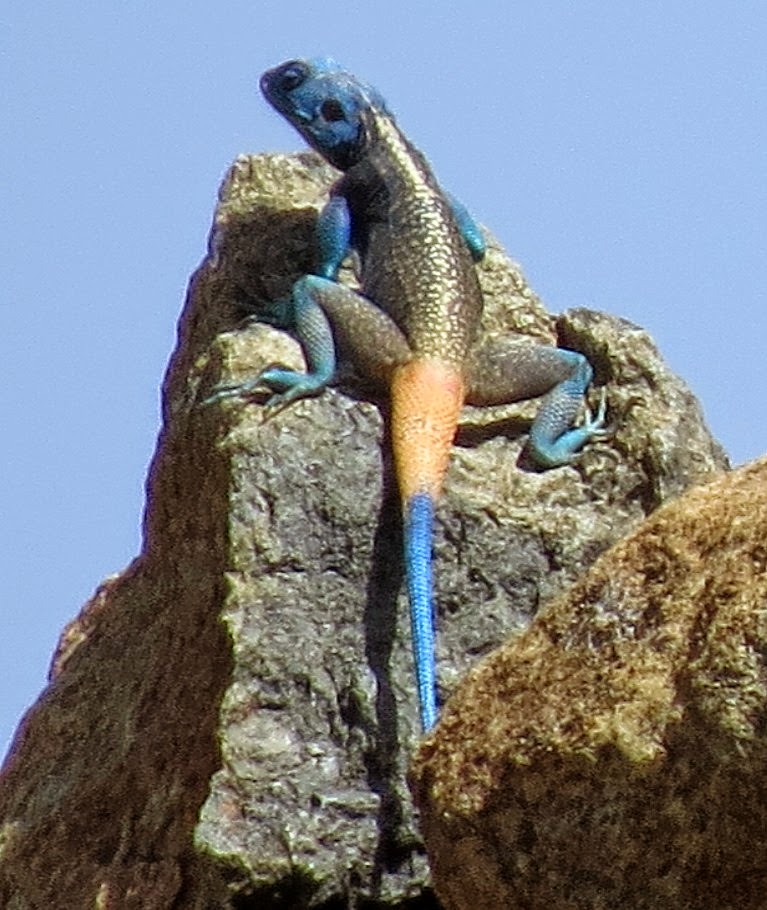
yellow spotted agama

As is often the case, we spotted other interesting wildlife on this birding trip. Arguably the most interesting was this male yellow spotted agama.


The 35 species seen at Azizah

Hamerkop
Arabian babbler
Green sandpiper
Gambaga flycatcher
Feral pigeon
Little rock thrush
Dusky turtle dove
African stonechat
Laughing dove
Arabian wheatear
Bruce’s green pigeon
Red breasted wheatear
Little swift
Yemen thrush
Eurasian hoopoe
Violet backed starling
Eurasian kestrel
Tristram’s starling
African paradise flycatcher
Palestine sunbird
Crested lark
Long billed pipit
Pale crag martin
Cinnamon breasted bunting
Red rumped swallow
Striolated bunting
White spectacled bulbul
Yemen linnet
Brown woodland warbler
House sparrow
Graceful prinia
Rueppell’s weaver
Arabian warbler
African silverbill
Abyssinian white eye


Tuesday, 13 May 2014

Far end of Wadi Talea

I blogged yesterday about what Bernard Bracken and I saw near Al Shat village in the highland Wadi Talea near Abha. 

We also walked up the wadi away from the village. 

When you do this, the base of the wadi turns sharp left at one stage but instead of following the base we crossed some terraced fields in a direct line to make a short cut.

This blog is about the crossing of the fields and the lush base of the wadi at the far end of our walk before we doubled back.


The area at the far end is truly lush with many fig and other fruiting trees.

female African paradise flycatcher

It was here that we spotted a female African paradise flycatcher.

another view of African paradise flycatcher

Having lost sight of it twice, it finally gave us good and prolonged views. This was only the second time I had seen this bird in Saudi Arabia. My last view of one anywhere in the world was seen climbing up my hotel wall in Adama, Ethiopia!

Bruce's green pigeon

The fruit and fig trees were a magnet for Bruce's green pigeon. 


four Bruce's green pigeon

In near-by bushes brown woodland warbler was common.

Brown woodland warbler

The main regional guide says that Arabian warbler is found up to 1500 metres. However we saw a pair here at over 2500 metres. Indeed the comments on altitude for several species in the guide underestimate how high they are found including the African paradise flycatcher.

Arabian warbler

The Arabian warbler up at this altitude is almost certainly summer-only undergoing seasonal movements up and down the Asir mountains.


second view of Arabian warbler

Palestine sunbird is unusual in that we found more of them at this high altitude in winter. We presume it is because they follow flowering plants and one particular plant was flowering in large numbers up there in February. It's certainly a hardy bird.

Palestine sunbird

In contrast plenty more Rueppell's weaver were present this time.

Ruepells weaver

The other main habitat visited in this part of the walk was stony open terraced fields with a few bushes. I had hoped to find Blanford's lark here to add to my Saudi list but didn't get a positive identification. As you can see from the picture of the crested lark, larks are well camouflaged in this type of terrain.

crested lark

The wires and sporadic bushes gave more dividends. On one wire, I saw a red-breasted wheatear for the one and only time I have seen this species in Wadi Talea.


Red breasted wheatear

Cinnamon breasted bunting was very common even though none were observed on our winter visit.

Cinnamon breasted bunting

Both red-backed shrike and lesser grey shrike were spotted here. Both are passage birds.

Lesser grey shrike

Only one species of bird of prey was seen all day. This was kestrel. In winter there are eagles.

Kestrel

On Saturday, Bernard and I visited the Raydah escarpment where some difficult birds were observed and I added a new bird to my Saudi list. The next blog will report on this.


43 species seen in Wadi Talea

Arabian partridge
Abyssinian white eye
Kestrel
Violet backed starling
Feral pigeon
Tristram’s starling
Bruce’s green pigeon
Yemen thrush
Dusky turtle dove
White throated robin
Laughing dove
Whinchat
Hoopoe
Red breasted wheatear
Red backed shrike
Arabian wheatear
Lesser grey shrike
Little rock thrush
African paradise flycatcher
Spotted flycatcher
Arabian babbler
Gambaga flycatcher
Fan tailed raven
Palestine sunbird
White spectacled bulbul
House sparrow
Crested lark
Rueppells weaver
Pale crag martin
African silverbill
Red rumped swallow
Yellow wagtail
Graceful prinia
Long billed pipit
Brown woodland warbler
Tree pipit
Willow warbler
Yemen linnet
Blackcap
Cinnamon breasted bunting
Arabian warbler
Striolated bunting
Common whitethroat