Showing posts with label hamerkop. Show all posts

Wednesday, 19 April 2017

Dar El Barka revisited

A week ago Monday, Mohamed Vall travelled the 800 kilometres back to Nouakchott in one day. It was obviously a long day. Nevertheless we made time for one main stop and we chose Dar el Barka in Brakna and next to the Senegal River.

Before that we were lucky enough to see five chestnut-bellied sandgrouse flying over a farming area at Lexeiba, Gorgol. The sandgrouse truned out to be the last addition to my country list during the trip though Dar El Barka had interest.

There is a semi-circle of wide water at Dar El Barka will doesn't quite link up directly with the Senegal River itself. 

We concentrated our time around this rather than other good looking habitat in the area (i.e the river itself, a dense forest and a waterlogged smaller woodland).

Many birds were seeking cover as it was hot day and we were there at the hottest time of day too.

flying hamerkop (courtesy of Mohamed Vall)

Hamerkop were plentiful. I suspect they came from the dense forest which we didn't have chance to explore. Most of the time they sought cover.

The near-by dense forest may well be the reason that Vinaceous dove was the most common dove in the area. That in itself is very unusual.

two hamerkop under cover

With so much water and with wet grassland at the edges, it was no surprise to see a good scattering of both yellow wagtail and collared pratincole.

water bodies at Dar El Barka

No fewr than three types of bee-eater were present. These were little bee-eater, little green bee-eater and red-throated bee-eater. Like elsewhere in Mauritania no blue-cheeked bee-eater were seen. There is more and more evidence that it is not resident in Mauritania unlike the distribution map's claim in Birds of Western Africa. 

While blue-cheeked bee-eater may return in late spring, as a general point there are many more birds that are described in the maps as resident but look now as if they are only present in the rainy season and also just before and after it.

red-throated bee-eater

Red-throated bee-eater stubbornly refused to leave the shade so I have yet to obtain good photos of this bird.


spur-winged goose

The water was attractive to all four of  most common largest water fowl in South Mauritania: spur-winged goose, Egyptian goose, white-faced whistling duck and knob-billed duck.

Egyptian goose with knob-billed duck

We didn't have time to do the small birds justice. However of note were chestnut-bellied sparrow lark in the fields and a pair of pygmy sunbird on a beach seeking to drink.

pygmy sunbird (courtesy of Mohamed Vall)

In the long grass just before we left the water, a greater painted snipe was spotted.

greater painted snipe

Dar El Barka is a fascinating place. It is also just about possible to include it in a normal  weekend's birding based out of Rosso.

Species seen at Dar El Barka, Brakna
White-faced Whistling-Duck  80
Knob-billed Duck  18
Egyptian Goose  14
Spur-winged Goose  40
Long-tailed Cormorant  1
Hamerkop  9
Grey Heron  3
Little Egret  2
Cattle Egret  14
Squacco Heron  1
Striated Heron  1
Black-winged Stilt  7
Kittlitz's Plover  4
Common Ringed Plover  2
Greater Painted-Snipe  1
Common Snipe  1
Common Sandpiper  3
Common Greenshank  14
Collared Pratincole  9
Gull-billed Tern  1
White-winged Black Tern  1
Whiskered Tern  1
African Collared Dove  2
Vinaceous Dove  12
Laughing Dove  16
Namaqua Dove  5
African Palm-Swift  4
Eurasian Hoopoe  2
Pied Kingfisher  1
Red-throated Bee-eater  9
Little Bee-eater  3
Green Bee-eater  5
Woodchat Shrike  1
Chestnut-backed Sparrow-Lark  10
Black-crowned Sparrow-Lark  15
Barn Swallow  11   
Willow Warbler  2
Grey-backed Camaroptera  1
Common Redstart  2
Northern Wheatear  1
Pygmy Sunbird  4
Western Yellow Wagtail  10
Sudan Golden Sparrow  14
Black-headed Weaver  6
Red-billed Quelea  140

Monday, 7 July 2014

Azizah after nine

Bernard Bracken and I continued downstream of the valley in Azizah until just past 9 a.m on Friday. It suddenly became lusher. We presumed that was because there is water extracted in the area around the village but not further downstream.

We rested for a while in this lusher area and watched. We were rewarded by the sighting some distance away of an African paradise flycatcher.

African paradise flycatcher

After resting, we decided the descent downstream was too difficult and elected to walk back upstream with the idea to go past our original dropping off point and to investigate the higher reaches of the valley.

Yemen thrush

On the way back we saw many of the same birds as on the way out. We got better looks at Yemen thrush which incidentally is not a timid bird.

Yemen linnet

I obtained this photo of a male Yemen linnet when we passed through the "linnet zone".

Hoopoe

Hoopoe is a very common bird in all the wadis near Abha that I have visited. Azizah is no exception.

Tristram's starling

As we went through the village area, Tristram's starling was its usual noisy self.

Crested lark

We saw very few larks all day and they were all crested lark. I had hoped to see Blandford's lark but this bird again escaped me. It is now on my nemesis bird list. That is to say I have spent so much time looking for it, I should have got it by now.

Abyssinian white eye

I finally managed a picture of an Abyssinian white eye which never keeps still.

As we headed upstream from the village past our drop off point, there were signs that the valley was becoming wetter. We had gone past the area where the villagers extract water. Soon we saw the start of a permanent stream.

The weather was also becoming over-cast as it does every day in the Abha area during the summer months. The cloudy sky resulted in the red-rumped swallow, little swift and pale crag martin that had been hawking the skies coming much lower.   

Red rumped swallow

As we headed further upstream, the water became more significant. We saw our first green sandpiper and hamerkop of the day. Both birds need wetland, pools or streams.

Hamerkop

We would have liked to have investigated this area more fully but the rain came down and wouldn't stop. Indeed it turned to hail at one point! We got so soaked we were shivering. This was in July in Saudi Arabia and when it was 46 C in Riyadh at the same moment.

We essentially had to abandon our birding an hour early.

yellow spotted agama

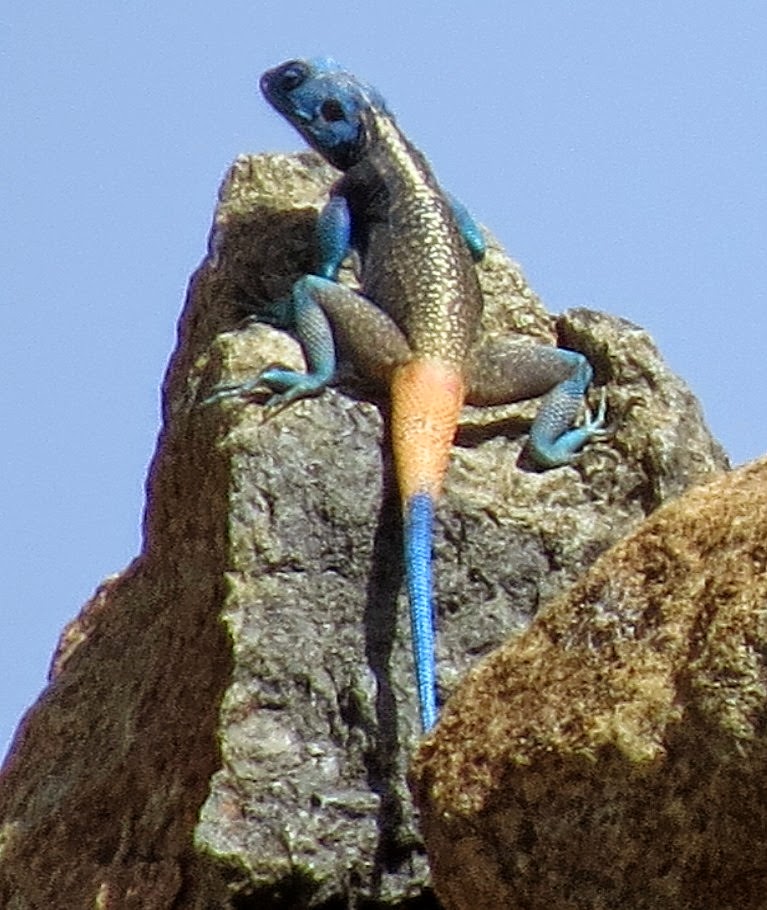
As is often the case, we spotted other interesting wildlife on this birding trip. Arguably the most interesting was this male yellow spotted agama.


The 35 species seen at Azizah

Hamerkop
Arabian babbler
Green sandpiper
Gambaga flycatcher
Feral pigeon
Little rock thrush
Dusky turtle dove
African stonechat
Laughing dove
Arabian wheatear
Bruce’s green pigeon
Red breasted wheatear
Little swift
Yemen thrush
Eurasian hoopoe
Violet backed starling
Eurasian kestrel
Tristram’s starling
African paradise flycatcher
Palestine sunbird
Crested lark
Long billed pipit
Pale crag martin
Cinnamon breasted bunting
Red rumped swallow
Striolated bunting
White spectacled bulbul
Yemen linnet
Brown woodland warbler
House sparrow
Graceful prinia
Rueppell’s weaver
Arabian warbler
African silverbill
Abyssinian white eye


Monday, 19 May 2014

Wadi Haly revisited

Over last weekend, I was in Muhayil, south west Saudi Arabia again to visit my friend Shane Ngahere.


On Friday a group of four of us went to Wadi Haly to walk and to in my case to bird watch too.

We were in the wadi from 7.30 am until 2 pm. It was even hotter than we expected. One colleague left for home at 9.30 am and all three of the rest of us suffered some degree of heat stroke before a car came at the appointed time to collect us.

I had not expected these extreme conditions. Nevertheless the birding was good but mostly until about 10 am. After that the heat affected bird activity too.

Hamerkop

Wadi Haly was the first place I saw hamerkop in Saudi Arabia and there were several seen again on Friday with ease.

Squacco heron

Squacco heron were also seen again. I noticed that none of them were in breeding plumage unlike the passage and resident birds seen in the Riyadh area and east coast recently.

white throated bee-eater

Some of the summer breeders from Africa have now arrived in the south west.

One of these is white throated bee-eater.

little green bee-eater taking off

They have joined the resident little green bee-eater at Wadi Haly.

little green bee-eater perched

In a shaded dip running parallel with the main wadi I came across another African migrant, a grey headed kingfisher. 

grey headed kingfisher

The wadi had less water than during my last visit in February. It was dry in places but mostly held water and in some places this was still quite wide.

Wadi Haly water course

No waders were seen this time. The water was still deep enough in one place to attract a lone little grebe, a bird which requires metre deep water.

local baboons

The availability  of water in this heat made the wadi attractive to baboons. I believe there were at least 150 present in several troops. This made birding a little more hazardous.


sand partridge

In one area, sand partridge were abundant but very difficult to photograph as usual.

laughing dove

I don't recall seeing any African collared dove but there were plenty of laughing dove around.

desert lark

The only lark observed this time was desert lark but they were very common. 

No buntings were seen.  In February both cinnamon breasted bunting and striolated bunting were observed. 

This is the opposite of my observations on my visits to Abha (at high altitude) where no buntings were seen in winter there but they were common in May.

It is fairly clear the these two buntings descent in winter and move up for summer.  

black crowned night heron

One of the last birds I saw before the end of the trip was black crowned night heron. Four landed near the water course. However my slow reactions due to exhaustion meant I only photographed them leaving.

The rest of the birding over the weekend was carried out towards dusk and early morning. I'll blog about them next.

Tuesday, 14 January 2014

Wadi Haly, Muhayil

A few kilometres west of Muhayil and north of the main road is Wadi Haly. This is a wadi with running fresh water and an excellent birding venue.   

There were many wadis in the south west like this in the past but the call on water for the growing population and farming needs has made them quite rare. They are especially rare at this low altitude.

Thanks are due to Shane Naghere's friend Mark who pointed me to it. Without the local knowledge of these people I would never have found it.

Shane joined me to bird the area. It may have been his first ever birding experience and it was a good one! We started at the upper end of the wadi where the water is very shallow and moved slowly downstream as the stream became stronger and stronger.

first hamerkop

One of the first birds we saw was a Hamerkop. 

Hamerkop was my number one nemesis bird in Saudi Arabia. I have spent so much time looking for it at water bodies in the south west with no success. Yet here it was standing out in the open.

Hamerkop is the 318th bird on my Saudi list.

another hamerkop

In fact this was the first of eight hamerkop seen along the stream. There are probably more but the stream was so long we never managed to see how and where it ends. This will make a very exciting birding trip for the future. I shall certainly return.


the upper end of the valley

One of the main features of the birding was the variety of water liking birds.

cattle egret and cattle

A large flock of cattle egret were spending time with a herd of cattle.

little egret

Three little egret were in the same general area though they were detached most of the time from the cattle egret flock.


squacco heron

There was a single squacco heron and at least two grey heron.


grey heron

There were plenty of waders present. At the upper end of the stream nearly all were green sandpiper.

common sandpiper

However as we moved down stream there was more variety. First we started seeing common sandpiper as well as green sandpiper. Then  there were also two wood sandpiper.

wood sandpiper

In the more rocky areas there were a small number of little ringed plover and a Temminck's stint.

little ringed plover and Temminck's stint

Any water in Saudi Arabia in winter attracts white wagtail.

white wagtail

However citrine wagtail are much less commonly seen. There were two at Wadi Haly. 

citrine wagtail

The wadi lacked bushes next to the stream probably because of grazing. However the area above the low valley was sandy with scattered bushes. This meant that non-water birds were present too.

a rocky stage of the stream

African collared dove descended to drink.

African collared dove

Namaqua dove was equally as common here.

Namaqua dove

Daurian shrike made use of any bushes that did exist.

Daurian shrike

Some birds don't need vegetative cover.

desert lark

Desert lark was the only lark seen.


Striolated bunting was heard among the rocky sides to the valley a long time before it was seen. A single cinnamon breasted bunting was observed at the top of a side slope too.

I would like to return to this wadi in other seasons and also to go further down stream to see what the end looks like be it lake or marshland.

In the next blog, I will write about some birding on the edge of Muhayil.