Showing posts with label Black-headed bunting. Show all posts

Monday, 28 March 2016

Dull weather at Beed farm

Last weekend a long weekend in the desert which I try to do once a month. The journey started on Thursday afternoon. 

On the way out there was time before dark for just one stop and that was at Al Beed farm. The weather was very dull with even a few spots of rain. However a downpour never came.

There were a few more signs of passage than my last visit to Al Beed six days before. Rufous bush robin is one of the most common passage birds in both spring and autumn throughout Dhofar.

rufous bush robin 1

There was one under a tree at Al Beed. It was very shy and didn't venture out from the undergrowth at the base of the tree.


rufous bush robin

In the same tree were a couple of lesser whitethroat.

European turtle dove

Last week I came across my first European turtle dove in the desert this spring. This time there was one at Al Beed. It seems their numbers are small but widespread.

greater hoopoe lark

I have no doubt that there are more greater hoopoe lark at the desert farms in spring than at any other time of year. I suspect they gravitate there to breed near-by. The increased food needs are a plausible reason.

black-headed bunting

The black-headed bunting seen the week before was still present and still associating with the house sparrow. This species doesn't normally arrive in its breeding grounds until May so it may be in no hurry to leave.

Namaqua dove

There were other unusual single birds. One was a male namaqua dove.

red wattled lapwing

The other was a red wattled lapwing. Though common in the north, few are seen in Dhofar.

I toured round the farm more than usual since I had no other chance of birding anywhere before dark. I was a little surprised to count six Arabian grey shrike. They were widely scattered.

Arabian grey shrike

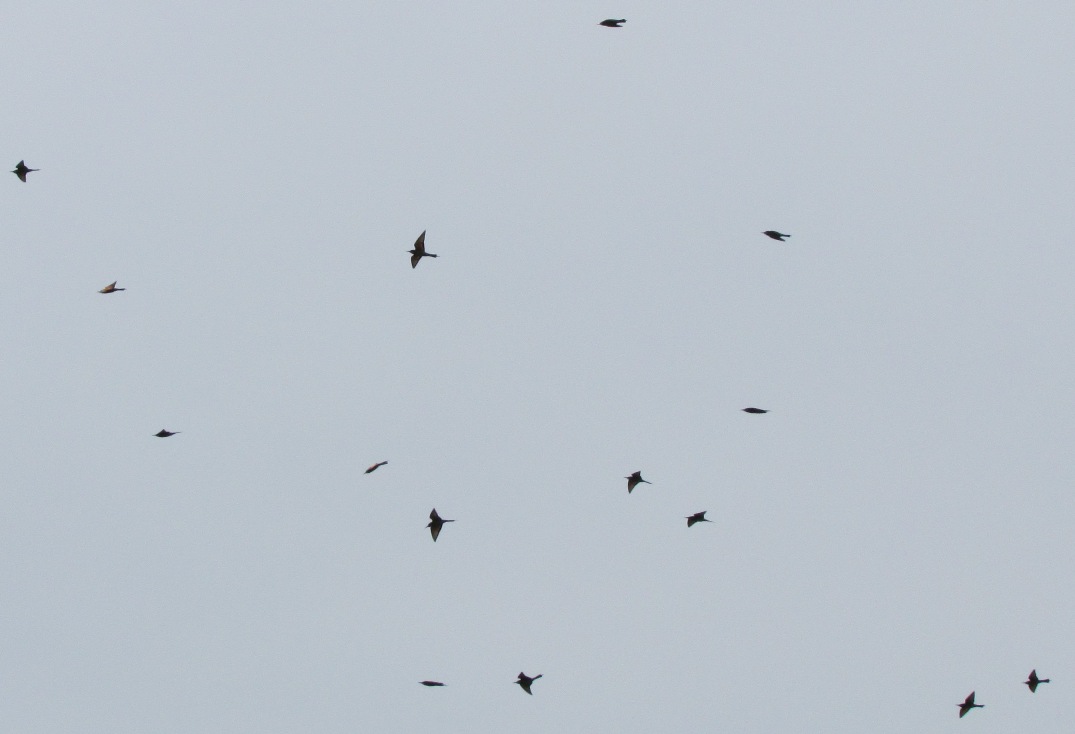
Two species flew through the farm without stopping. They were a red-rumped swallow and two European bee-eater. The later species was only the second time I had seen it in Oman. It was another sign of passage. I will report more on this trip in the next blog.

Sunday, 20 March 2016

Mid March at Al Beed

Last Friday was a very long birding day for me. I left Salalah well before dawn and arrived back well after dusk. In the meantime I birded four desert stops: Al Beed farm, Dowkah farm, Qatbeet Motel gardens and Muntasar Oasis.

I was very pleased with the results as hopefully be revealed in my next 3 blogs.


Al Beed was the first stop being only (sic) 90 minutes drive north of the city. Birding there was relatively pleasant as the temperatures are manageable early in the morning.

This was a story of pivot bars and wires. All my best birds came from them and not off the ground or in the sky.
As always there in early morning the first impression is the large number of European collared dove, black-crowned sparrow lark, house sparrow and sandgrouse. This time there were plenty of spotted sandgrouse and chestnut-bellied sandgrouse.

I knew things were going well when I spotted a male black-headed bunting on a pivot bar loosely associating with the house sparrow.

black-headed bunting 1

This bird is still in winter plumage and is very early on passage. It is only my second sighting in Oman.

black-headed bunting 2

It was not the only uncommon bird present. Near the main outbuildings a hypocolius suddenly flew out and landed on a wire near me though not in perfect light.

hypocolius 1

A small number winter at Mudhai about 80 kilometres to the south west to al Beed farm. Otherwise the bird is rare in Oman. It is plausible that this is one of the Mudhai birds on back migration.

hypocolius 2

Also near the main outbuildings was a flock of rosy starling which I have seen there on and off all winter.

A Tristram's starling in among the rosy starling

However one of the starlings was not rosy, It was a Tristram's starling. It belongs further south in the khareef zone (monsoon zone) near Salalah. Although this is only 90 kilometres directly south, Tristram's starling is described as a vagrant outside it.

rosy starling (l) and Tristram's starling (r)

The rare birds did not stop there. On a pivot bar was a strange looking pipit.

probable olive-backed pipit 1

With a strong but split supercilium as well as the rather plain and olive tinged back it is probably an olive-backed pipit. Furthermore, it also has a rusty tinge in front of the eye. 

There have only been 38 previous records and eight of these were at one place at one time (Hilf).


probable olive-backed pipit 2

I will have more discussion on olive-backed pipit in a forthcoming blog combining this observation with what was seen later the same day. 

wood sandpiper

As I have said so many of my observations at Beed were on wires and bars. Even wood sandpiper got in on the act.

Arabian grey shrike

At least the Arabian grey shrike (aucheri) was photographed on a bush.

Friday's desert trip started well. However there was more to come.


Sunday, 20 September 2015

Full blown passage at Dowkah

I left home in Salalah at 4.30 am on Friday once again for a desert trip centred on Dowkah farm. Each time I have been this autumn the birds have been changing as a different wave of migrants comes and goes.

There is no doubt the shear volume of birds was the highest so far and I finally added a migrant to my Oman list here which is a main part of why I have been going.


As usual I started with a tour of the eastern pivot fields. A good passage bird was seen here. Five pied wheatear were there. It's not as common in Oman as in Saudi Arabia as Oman is a little south of its main passage route but Dowkah farm is as good a place as any to see it.

pied wheatear

Another notable bird observed at first light out in the fields was a steppe grey shrike. This is a migrant and reasonably easy to separate from the resident aucheri sub species sometimes called Arabian grey shrike or in the past southern grey shrike. 

Steppe grey shrike has a buff front not grey and a much larger amount of white in the wing which can be seen when flying. There are several other differences too.

E-bird and Clements count conservatively and one allow me one species for these two.

Steppe grey shrike

The third pivot field I walk past was absolutely soaked in water in places just like it was last week.

Also just like last week, it had attracted Montagu's harrier. I positively identified two and the third ring-tailed harrier photographed below is probably a third.


ring-tailed harrier

As expected in a wet field at this time of year, there were yellow wagtail and waders such as ruff were present too.

More surprisingly I saw a flock of 20 garganey flying that way just after I left it.

There were a few spotted flycatcher scattered around the fields but they became more numerous as I reached the bushes and trees in the centre of the farm. 

This is the place where many of the rarities have been found in the past.

spotted flycatcher

There were several Daurian shrike and Turkestan shrike.

Turkestan shrike

Rufous bush robin keep coming. Each time I have visited this autumn there have been plenty.

Rufous bush robin

The shaded area is perfect for sleeping European nightjar on passage. I counted seven.

European nightjar

Strangely there were no whitethroat this week but four eastern olivaceous warbler were seen. European roller and golden oriole flitted around the trees.

garganey

Two of the farm's visiting garganey dropped in briefly.

Right next to the shaded area is a pivot field which is being heavily watered.

This was good for birds last time and excellent this time.

The pivot bar and path running by it were especially good.

European roller

I counted ten European roller on the bar at one time.

female rock thrush

I saw three rock thrush there.

Male rock thrush
One was male.


common cuckoo

A female common cuckoo gave a perfect pose.

golden oriole

The maximum count of golden oriole on the bar at any one time was seven. This one looks like its stretching wing has nearly hit a perched rufous bush robin behind.

black-headed bunting with house sparrow

Over fifty house sparrow were around too. Its always good practice to search a large flock of any bird for the rarer exception and in among the house sparrow, I found a female type bunting which I originally thought might be an ortolan bunting. It looked an ill fit. Thanks to Andrew Bailey from UAE for suggesting black-headed bunting. 

It didn'
t stay long as two Montagu's harrier chose that moment to move to that field. The sparrows and the one bunting scattered.

However a few minutes later, I caught up with a bunting on the bar. It is probably the same bird. 

female type black-headed bunting

This was one of this autumn's target species and part of the reason I have been coming out into the desert. It is not common in Oman and less common still in autumn compared with spring. Apparently their main migration is in October so this was lucky.

Ortolan bunting became species 292 on my Oman list.

dunlin (foreground)

The path alongside the bar throws up good birds. There can't be many pictures showing both a dunlin and golden oriole.

common sandpiper (left)

I have seen common sandpiper and spotted flycatcher combinations before.

barn swallow

There are three inner fields. Two of them are on the ways back to the car and have been good for sandgrouse and hirundines lately. Both chestnut-bellied sandgrouse and spotted sandgrouse were seen.

house martin (left)

Most of the hirundines were barn swallow so I concentrated on the exceptions. There were a small number of sand martin and a single house martin.

willow warbler 1

In the middle of one field, there was some tall grass in the middle of the pivot. This was surprising place to see both a willow warbler and Upcher's warbler.

willow warbler 2

I started the day seeing pied wheatear. I ended it with virtually the last bird being a desert wheatear. The latter bird will be in southern Oman in very large numbers all winter.


desert wheatear

After Dowkah, I decided to head further away from Salalah and make it to Qatbeet. This turned out to be a good decision.

Thursday, 19 May 2011

Black-headed bunting

In my last blog I asked whether black headed bunting was even here yet because I had failed to see it. Well today all that changed. I saw plenty and one within 30 metres of my house.


male black headed bunting near my house


Granted I birded a different area today. I went to the side of the village which has the most arable cultivation whereas the last twice I have visited more natural areas. It appears the bird likes cultivated terrain but it didn't stop me seeing one on a wire very close to my house too.


My best analysis is that it has only just arrived.  

male black-headed bunting in a field of rape

If you think a black headed bunting is easy to see then I challenge you to pick one up in a field of rapeseed!

Actually the easiest birds to see were the ones on the wires. I seem to be doing some of my best birding when I look at telephone wires.  Dont forget the rollers I saw on them last week for example.

sparrow nesting on top of a telegraph pole.

The wires always have birds. Some are quite exotic and some are mundane. Every (and I mean every) telegraph pole in the village has a house sparrow nest on its top. I can only assume that they are hollow at the top.

northern wheatear

Managed to take a better picture of one of the local northern wheatear today which is above. I am reaching the conclusion it is the only one of the four wheatear species known on the Black sea coastal area which breeds near my village. I'll have to look at the drier, more steppe like areas further up the coast to find the others I think.


yet another flock of bee-eater

Although the local bee-eater are back, I am still seeing wave after wave of bee-eater flying north. Today I saw three waves in an hour and a half.

Some of them must be like the black-headed bunting here - only in the breeding place for less than three months then they go back again!