Showing posts with label rufous bush robin. Show all posts

Monday, 28 March 2016

Dull weather at Beed farm

Last weekend a long weekend in the desert which I try to do once a month. The journey started on Thursday afternoon. 

On the way out there was time before dark for just one stop and that was at Al Beed farm. The weather was very dull with even a few spots of rain. However a downpour never came.

There were a few more signs of passage than my last visit to Al Beed six days before. Rufous bush robin is one of the most common passage birds in both spring and autumn throughout Dhofar.

rufous bush robin 1

There was one under a tree at Al Beed. It was very shy and didn't venture out from the undergrowth at the base of the tree.


rufous bush robin

In the same tree were a couple of lesser whitethroat.

European turtle dove

Last week I came across my first European turtle dove in the desert this spring. This time there was one at Al Beed. It seems their numbers are small but widespread.

greater hoopoe lark

I have no doubt that there are more greater hoopoe lark at the desert farms in spring than at any other time of year. I suspect they gravitate there to breed near-by. The increased food needs are a plausible reason.

black-headed bunting

The black-headed bunting seen the week before was still present and still associating with the house sparrow. This species doesn't normally arrive in its breeding grounds until May so it may be in no hurry to leave.

Namaqua dove

There were other unusual single birds. One was a male namaqua dove.

red wattled lapwing

The other was a red wattled lapwing. Though common in the north, few are seen in Dhofar.

I toured round the farm more than usual since I had no other chance of birding anywhere before dark. I was a little surprised to count six Arabian grey shrike. They were widely scattered.

Arabian grey shrike

Two species flew through the farm without stopping. They were a red-rumped swallow and two European bee-eater. The later species was only the second time I had seen it in Oman. It was another sign of passage. I will report more on this trip in the next blog.

Monday, 7 September 2015

Much more at Dowkah farm

There was much more to Dowkah farm than the sandgrouse written about in the last blog.

It was a good start on arrival when in the gloom of dawn, the first birds I saw were 15 European turtle dove resting on a sand bank. It was too dark to get photographs and they moved off quickly. However I caught up with two again at the very end of the session.

The doves were the only birds not showing signs of the heat at that time of day.

The rosy starling and house sparrow near-by were all panting.

European turtle dove (centre)

Also very early a Montagu's harrier flew over a field. It rested for a few minutes on the ground too. Then it was mobbed by a couple of brown-necked raven and flew off south west out of the farm. 

I managed a distant shot but you can see it is a male.

distant Montagu's harrier

The brown-necked raven still didn't have that field to themselves.

brown-necked raven

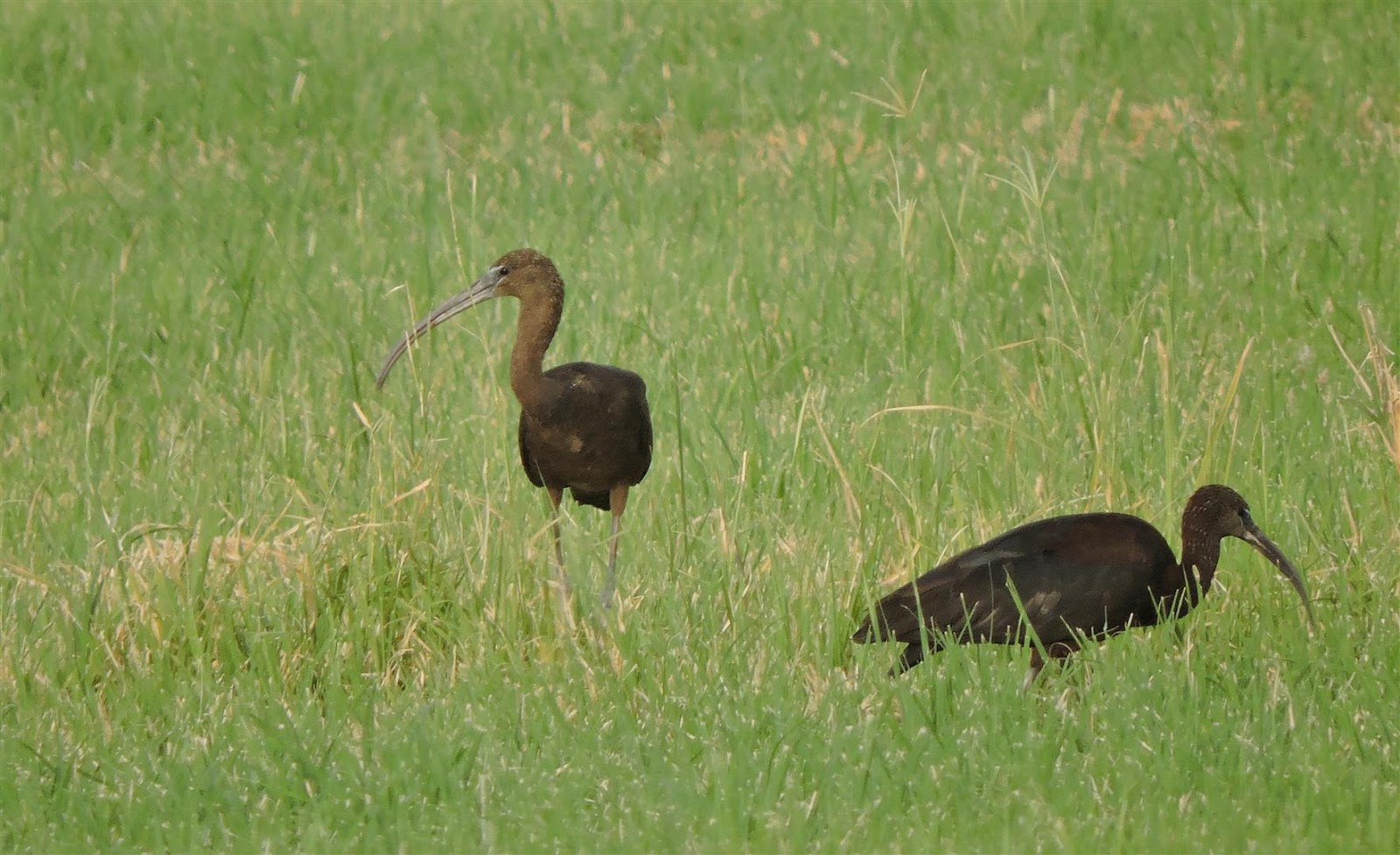
Scattered around the field were 14 glossy ibis.

glossy ibis

When they left, I caught up with them later in the same area that the sandgrouse came to drink.

all the glossy ibis

Near the glossy ibis was an intermediate egret. It was very flighty and did not allow me anywhere near close.

distant intermediate egret

In another field, black-crowned sparrow lark were on the ground but several hirundines were in the air.


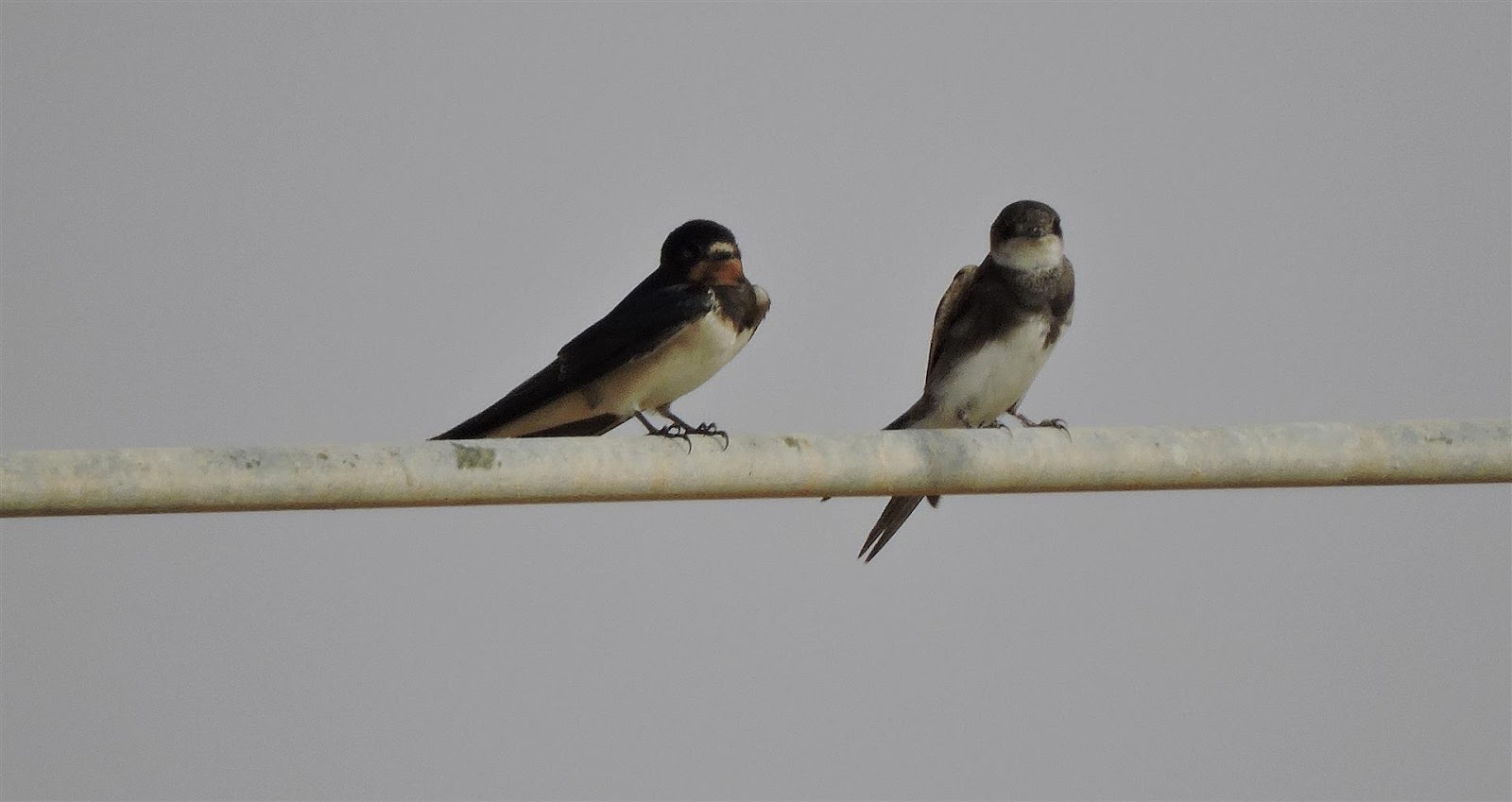
barn swallow and sand martin (right)

Many of the hirundines were barn swallow but there were notable exceptions including three sand martin.


barn swallow

There were also three pale crag martin, a house martin and an red-rumped swallow.

red-rumped swallow

Red-rumped swallow are rare migrants in Oman and I struggled to photograph it. Despite the pale rump this is definitely the red-rumped swallow and not the house martin.

whimbrel

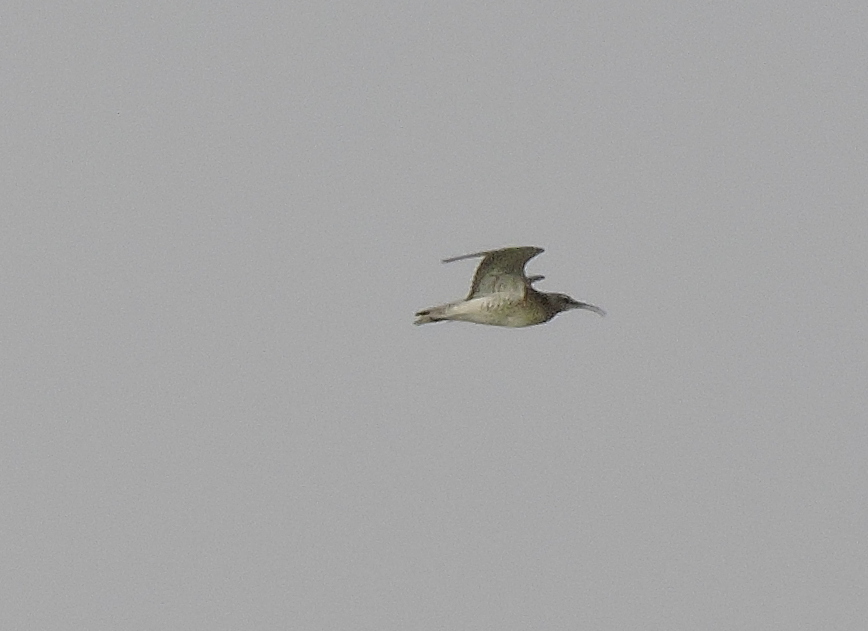
Not at all rare in Oman but it little surprising in a desert location was a whimbrel in the same field. 

whimbrel in flight

Having inspected several of the fields I moved over to the area of palms and bushes. This can be exceptional good for migrant passerines. Indeed the week before there had been over 30 warblers in this small area. This time I saw only two eastern olivaceous warbler. Incidentally one whitethroat was seen in a field.

Nevertheless it was still moderately good for passerines. 

aucheri Asian grey shrike

Two aucheri Asian grey shrike was on the edge of the area. At least 8 spotted flycatcher were in the bushes and palms.

spotted flycatcher

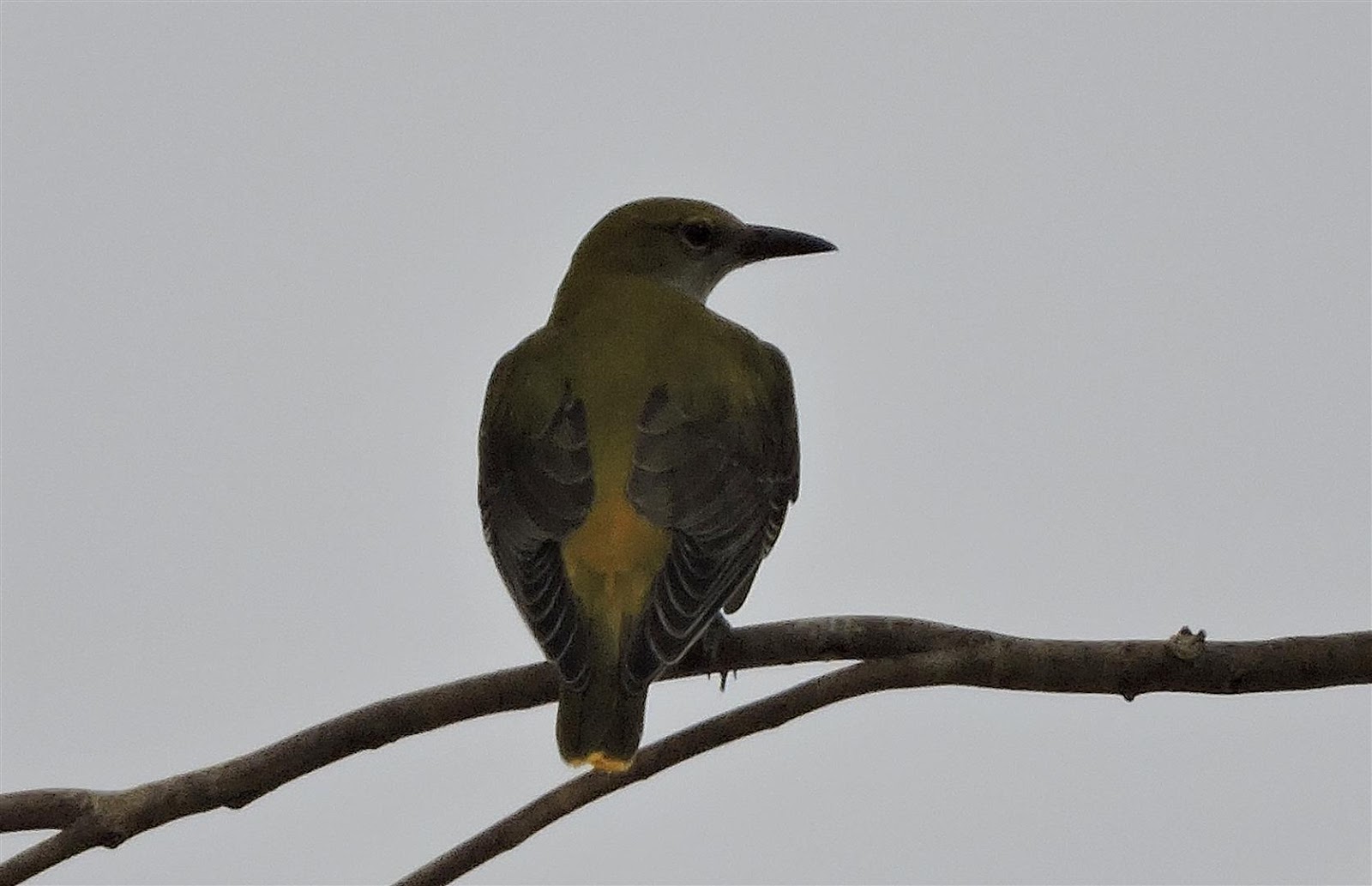
Last week's one golden oriole had multiplied into three.

golden oriole

This week the rosy starling numbers had gone and all appeared to be juveniles.

rosy starling

There were three red-tailed shrike both weeks. Last week there were three Turkestan shrike. This week there were two Turkestan shrike and a Daurian shrike.

Turkestan shrike

On the far side of the bushes was one last field and it was still being watered when I arrived. Watering tends to stop before the main heat of the day and can be resumed in late afternoon when things cool down.

hoopoe

The watered field was attractive to hoopoe. 

yellow wagtail

This was also the place I saw my first yellow wagtail since spring.

ringed plover

A lone ringed plover found this the best place for a wader.

rufous bush robin

A small number of rufous bush robin had ventured out from the shade of the bushes to be in this field. More surprisingly a common nightingale was also there darting out from under the shade of the engineering gear in the centre of the field from time to time.

Although I didn't add to my country list at Dowkah, I can't argue with the diversity and interest of the species there.

As it was still only 10am when I left the farm I had plenty of time for two more desert stops on Friday. I will blog about them next.

Monday, 23 March 2015

Mid March at Ayn Hamran

I birded dawn to dusk on both Friday and Saturday but before that on late Wednesday afternoon, I made a short trip to Ayn Hamran.

The birding was a little quiet possibly because it was so warm.

Several of the birds were coming to the water's edge to drink.

These included a namaqua dove. This species is not at all common in southern Oman. 

namaqua dove

I have only seen it at two places. These are in or near Sawnout Farm and at Ayn Hamran.

rufous bush robin

The passerine spring migration continued to be weak. Indeed the only obvious spring migrant was a single rufous bush robin.

common sandpiper

Several of the wintering birds were still present such as common sandpiper.

grey wagtail

Grey wagtail has been there all winter too.

cinnamon-breasted bunting

Standing still and watching birds coming to the water is a good strategy now for many of the passerines. It may well work in the coming days with any migrants that pass through. I will certainly try it.

African paradise flycatcher

For other birds you still have to go into the woods or at very least into a cluster of trees. African paradise flycatcher are nearly always seen.

In the next blog I will write about Friday's full day in the desert.

Saturday, 13 September 2014

Ain Razat

Ayn Razat is one of two closest places to me in the hills north of Salalah. I went there for the first time yesterday.

It is partly turned into a leisure area for families but hasn't lost its essential character.

I started out by birding the area around the leisure area which luckily for me was not busy. This is because Omanis tend to stay at home on Friday mornings. My only human company to begin with were four Indians swimming in the water. This by the way is a dangerous thing to do as the water has the snails which host bilharzia.  There are plenty of signs in Arabic and English warning people not to go in the water. I'll come back to the snails later.

The birding started very well. I quickly came across another dideric cuckoo. This was one of two seen during the day.

Dideric cuckoo

However it wasn't long until I realised the habitat was very similar to Wadi Darbat the weekend before and the bird life reflects that. However I persisted in the area and decided to walk up the wadi.

Arabian warbler (a.k.a) Red sea warbler)

Just as I had decided this was a bad idea, I came across an Arabian warbler. Again this was one of two seen during the day. It was also the only addition to my Oman list near the Ayn.

second view of the Arabian warbler

Birds in the area were otherwise mostly laughing dove, white spectacled bulbul, Ruepells weaver, blackstart and cinnamon breasted bunting. Though the occasional rufous bush robin was also seen.


the landscaped part of the Ayn

I returned to the landscaped area after about two hours.

fish in the Ayn

Common sandpiper were indeed common and judging by my photograph doing their bit to keep the snail population down.

common sand piper

The same could not be said for the cinnamon breasted bunting.

cinnamon breasted bunting

Ruepell's weaver nests can be almost anywhere with tall enough bushes but their density is always higher close to water.

male Ruepell's weaver

Contrary to my first opinion, I now know categorically that they are still breeding. There breeding season in Dhofar (Salalah region) seems to coincide with the Khareef.

Grey headed kingfisher

There is an ornamental garden next to the landscaped part of the Ayn. Certain birds were only found in it or next to it. These were shining sunbird, Bruce's green pigeon and Eurasian collared dove. Grey headed kingfisher was seen elsewhere but was easiest to see there.

Blackstart

The most common bird in the garden was cinnamon breasted bunting. However it looked a bit strange to see blackstart on the paths and common sandpiper on the lawns.

Laughing dove

Laughing dove was everywhere.

Rufous bush robin

I have a little more to say about snails before I finish the blog! I doubt the snails I was seeing on the bushes are the same as in the water. Nevertheless the climate clearly encourages their growth. One strange thing I noticed while watching rufous bush robin in the Ayan Razat area was that they seemed to land on bushes with these snails on.

Rufous bush robin having moved

Finally a reminder that there are always other species seen on my trips.

two mating butterflies

After finishing at the Ayn (spring), I walked down into some drier scrubby area with less bushes and trees.  This turned out to be a good decision because I saw three birds for the first time in Oman including a lifer. I will blog about this next.


Saturday, 9 August 2014

Gouizha

Ealry morning on July 29th before I left Kurdistan, I ventured up the heights near Gouizha, Sulaimani. 

The altitude was only about 1150 metres but the habitat was sufficiently different from Sulaimani itself to see some difference in the species. 


Rufous bush robin

One species that I had seen down in the town was rufous bush robin. However their density up at Gouizha was higher and they were more approachable.

another pose of rufous bush robin

This was the only place I saw Upcher's warbler on the trip and it appeared quite common.

Upcher's warbler

It was also the only place I saw a shrike. In this case it was a young woodchat shrike. 


Juvenile woodchat shrike

I found the separation between it and masked shrike quite difficult. The rusty nape on the second picture was a big clue. It also has a white rump and large bill fitting woodchat shrike better. My thanks to contributors to birdforum identification forum for drawing my attention to these last two features.

second view of woodchat shrike

My identification issues didn't finish with the woodchat shrike. A wheatear was very common in the area but I struggled to decide whether they were black-eared wheatear, pied wheatear or their hybrids. The default species in Kurdistan in summer is (eastern) black-eared wheatear.

eastern black-eared wheatear - first view

Once again I turned to birdforum for help. Omar from Baghdad pointed out that the face and neck colours fit black-eared wheatear. The nape is partially obscured but the chin colouration is clearer and it is not dark as would be expected with pied wheatear.

eastern black-eared wheatear -second view


There is a useful picture I often refer to (see below) when making comparisons with male Cyprus, black-eared (both dark throated and pale throated) and pied wheatears. This comes from a paper on the cyprus wheatear by Christoph Randler, Marc I. Forschler, Javier Gonzalez, Mansour Aliabadian, Franz Bairlein and Michael Wink. The degree of dark colouration on the nape and chin for each species is shown.


Male dark-throated eastern black-eared wheatear were not the only type of eastern black-eared wheatear seen. 


pale-throated black-eared wheatear 

There was a male pale throated variant near-by.

female type black-eared wheatear

Yet more eastern black eared wheatear were about including female types and young birds.

young black-eared wheatear

I regretted the fact that I had to catch a plane to leave Kurdistan soon after lunch time because I would have liked to have explored this area more fully. I had birded only along the trail at the bottom of the tree line. The woods above looked very interesting as did the higher slopes.


looking up the heights at Gouizha

I did manage to see two wood pigeon as an appetiser as to what may have been there. 

In the end I was satisified with seeing 44 species on the trip in a region with great potential but with some current difficulties being so close to a war zone. 


Summary of all 44 species seen in Kurdistan including the ones at Gouizha


Azadi Park, Sulaimani
Tanjaro river, Sulaimani
Dukan
Tanjaro river (2), Sulaimani
Gouizha
See-see partridge


x

White stork

x

x

Short-toed eagle


x


Moorhen


x

Black-winged stilt


x

Red-wattled lapwing

x

x

Little ringed plover


x

Green sandpiper

x

x

Common sandpiper

x

x

Wood sandpiper


x

Armenian gull


x


Feral pigeon
x
x
x
x

Woodpigeon


x
Collared dove
x
x
x
x

Laughing dove
x
x
x
x
x
Hoopoe
x


White throated kingfisher


x


Pied kingfisher


x


Blue-cheeked bee-eater


x


European bee-eater


x


Woodchat   shrike


x
Golden oriole


x


Magpie

x
x
x
x
Jackdaw


x


Northern raven

x
x


White eared bulbul


x


Great tit


x


Crested lark

x
x
x
x
Red rumped swallow


x


Barn swallow
x

x
x

Graceful prinia


x


European reed warbler


x


Eastern olivaceous warbler
x


x

Menetries’s warbler
x


Upcher’s warbler


x
Blackbird


x


Rufous bush robin


x
x
Isabelline wheatear


x
Black eared wheatear


x
House sparrow
x
x
x
x
x
Yellow  wagtail


x

White wagtail
x


x

Greenfinch
x


Goldfinch


x