Showing posts with label Crested honey buzzard. Show all posts

Friday, 8 May 2015

Two more Amur falcon at Jarziz farm

I visited Jarziz farm early on Tuesday morning. The highlight was the presence of two more Amur falcon and they were different birds from those days before making four I have seen there.

Last time there were an adult male and an adult female. This time there was an immature male and what I believe was an immature female too.


resting immature male Amur falcon

I would have loved to have stayed longer but I had work to go to so the photos are what I managed in a short time. Better ones would have come with time.

The male is immature as it still has streaking on the underparts and on the underwing. 

immature male Amur falcon in flight

I didn't get such good views of the female but I got a flight picture which eluded me when last week's female flew through. 

female Amur falcon

Just as I saw two Amur falcon as I had four days before, there was also a oriental honey buzzard as also seen on both days. I don't know whether this was the same bird or not. However I did get better views.

oriental honey buzzard 1

The six fingers and lack of a dark carpal spot rules out European honey buzzard which I still haven't seen in Oman. While some oriental honey buzzard winter here, the European bird is only seen on passage.

oriental honey buzzard 2

Indeed I had been seeing ones and two oriental honey buzzard all winter in Salalah from time to time.


oriental honey buzzard 3

A new sighting for me at Jarziz farm was a flock of Pacific golden plover although I have seen this bird at Sawnout farm before.

flock of pacific golden plover

Most are heading towards breeding plumage.
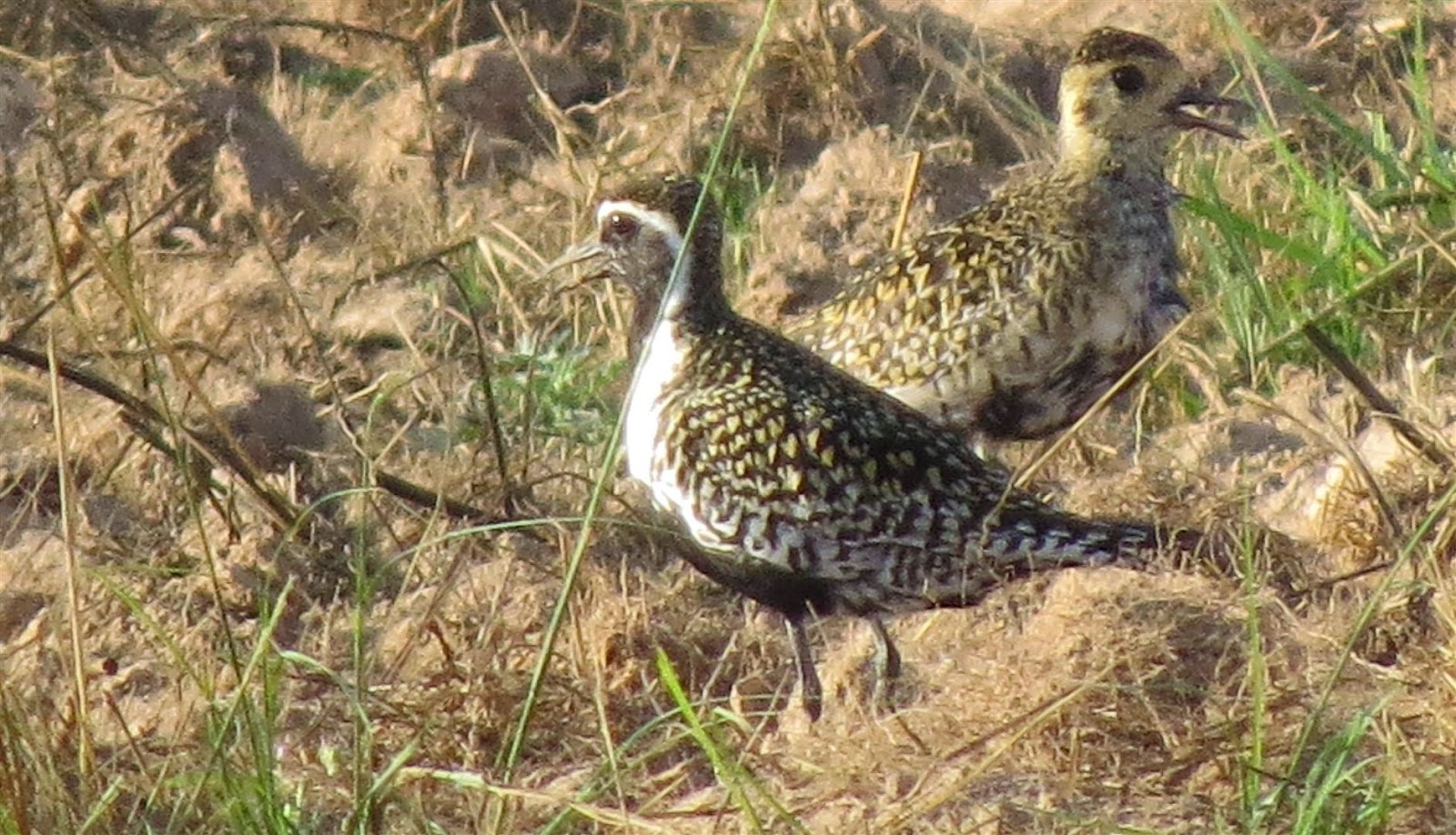
two pacific golden plover

All over the big pivot field, the singing bush lark were making their usual loud singing.

singing bushlark

The number of common swift passing through has started to tail off. I counted only 10 this time over the fields.

chestnut-bellied sandgrouse

In the scrub next to the field I believe the chestnut-bellied sandgrouse are breeding. The male here walked away as I started out towards ti but there is a female well hidden to his right who stayed put. I dared not go closer as I didn't want to disturb the possible nesting site.

African silverbill

The African silverbill love the long grass in the field.

Graceful prinia

Whereas graceful prinia is much more versatile. Its expansion in the middle east in the past 25 years has been phenomenal. 

I managed some birding on Tuesday afternoon too. I will blog about that next.

Thursday, 20 November 2014

A walk near East Khawr

On Saturday I stayed close to home with a walk in the area around East Khawr. I started in the bush north of the Khawr, walked passed the khawr and into Dahariz Park.


I got off to a good start seeing a family group of spotted thick-knee under a tree.

I have seen spotted thick-knee regularly in Salalah but never in the car.

one adult spotted thick-knee

The two adults were either side of the juvenile which was further under the tree.

the other adult spotted thick-knee

There are no spots, only streaks on juveniles birds.

juvenile spotted thick-knee

I turned away for a moment and when I turned back the juvenile must have walked into deeper cover. All I could see was the two adults looking like they were standing guard.

spotted thick-knees

Apart from the thick-knees the bush held remarkably few birds although I did spot a Namaqua dove along with the normal array of collared dove and laughing dove.

blue-cheeked bee-eater

A small flock of blue-cheeked bee-eater dropped down for a short while too.

marsh harrier

The khawr was not the primary object of my viewing on Saturday. As I walked passed I saw two greater spotted eagle and four marsh harrier. At the seaward end were a typical group of a few hundred waders of which ruff and Kentish plover were the most common. Obviously I made a quick scan for any thing extraordinary.

flamingo squabbling

There are still increasing numbers of flamingo in the lagoon which now include several adults. There seem to be squabbles going on between them with lots of posturing.


two flamingo give ground

The three greater white fronted goose were still there and are quite tame.

greater white fronted goose

Three hundred metres west of East Khawr (Khawr Dahariz according to the locals) is Dahariz Park. I have visited there before chiefly to look for passerines.

Dahariz Park

Indeed that is what I was looking for on Saturday.

yellow wagtail

There were plenty of yellow wagtail, white wagtail and Ruepell's weaver as expected. There was also lots of noise from the resident Indian house crow.

Suddenly they flushed the target they were mobbing. It was a dark morph male Crested honey buzzard. The tail pattern is quite characteristic.

male crested honey buzzard

As I moved round the park, I came across a second crested honey buzzard which was an adult female. This time the gorget is quite diagnostic as the tail pattern is similar to a male European honey buzzard.

female honey buzzard

The photo above shows the tail pattern whereas the photo below is a more classic pose.

second view of female crested honey buzzard

There is a strong possibility these were the same two birds I saw in flight over my home five days before.

Ruepell's weaver

The buzzards were eventually chased out of the park by the crows and I returned to looking at smaller birds. This young male Ruepell's weaver made me wonder if they breed twice a year. certainly they breed in the khareef season (monsoon) in summer but will they breed again in early spring which is February here. 

Hoopoe

Parks are among the best places to see wintering hoopoe.

Bluethroat

Finally, having seen my first bluethroat in Oman the day before, one popped up in the park. It was much more approachable too.

During the week, I have been taking a closer look at Sawnowt farm, I 'll report on that in the next blog.

Wednesday, 12 November 2014

Two Oriental honey buzzards at home

On Monday afternoon after work, I had planned to go birding at Ayn Hmaran popping into East Khawr on the way to see if anything new had occurred.

However, as I was getting into the car to start out I heard a screeching noise from over the road from the car park and above the plantation.

It turned out to be one of those lucky moments in birding.

adult male oriental honey buzzard

Two dark morph adult oriental honey buzzard were passing through and I had my camera.

adult female oriental honey buzzard

They were under heavy moult which is typical of oriental honey buzzard on early migration.

The regional guide describes this bird as a vagrant to Oman and to Saudi Arabia. However several observations in these countries in recent times have cast doubt on this classification. 

I doubled checked the identification in BirdForum where there was unanimous agreement on their identity.

After finally leaving the car park, ten minutes later than expected, I headed to East Khawr.

Western reef heron and African sacred ibis

There was still no change there with hundreds of birds but nothing obviously new.

 The African sacred ibis has been there on and off for over two months now.

male northern pintail

I am taking particular notice of the ducks. Mallard may be a simple species but I haven't seen it in Oman yet and records show some arrive this way in mid to late November. The latest wave are more pintail.

After a short while at east Khawr, I moved on to Ayn Hamran where I stayed until close to dusk.  There are always good sightings there including being one of the best places to see Arabian warbler.


Arabian warbler

This time were two good highlights there. The first was a black-crowned tchagra which gave me prolonged if obscured views.

black-crowned tchagra

The bird was in a large very bush which was being eaten by camels at the time so it was being pushed into a certain direction. Even then it was stealthy.

second view of black-crowned tchagra

It was seen at the bottom end of the Ayn. I had to walk back to the car at the top end. it was here that I saw the last bird of the evening and it was a good one. There was a pale morph male African paradise flycatcher. 

male African paradise flycatcher

The pale morph is supposed rare in Arabia so this was an excellent find. It was a very good end to rewarding late afternoon session.

Wednesday, 12 December 2012

Crested honey buzzard at Najran

Last winter I visited Najran in the south west of Saudi Arabia. Among other birds, I saw a type of honey buzzard. The question was whether it was an oriental honey buzzard or European honey buzzard.

I posted it on BirdForum for identification. It was impossible to definitively identify the bird which was juvenile though the balance of opinion was in favour of oriental honey buzzard.

Oriental honey buzzard, Najran

My friend and birding colleague, Lou Regensmorter was in Najran 10 days ago and saw another honey buzzard in almost the same place as I had seen one 10 months before.

second view of oriental honey buzzard

Once again I asked birders on BirdForum for their views. There was no mistaking this time. Lou's bird is an oriental honey buzzard. In particular you can see the all dark eyes found on an adult male bird.

Looking again at the map in the Helms guide to birds of the Middle East and you see it isn't supposed to winter within 1200 kilometres (in UAE and northern Oman). This is another incidence of under-reporting from KSA. There is a lot more here than the maps say.