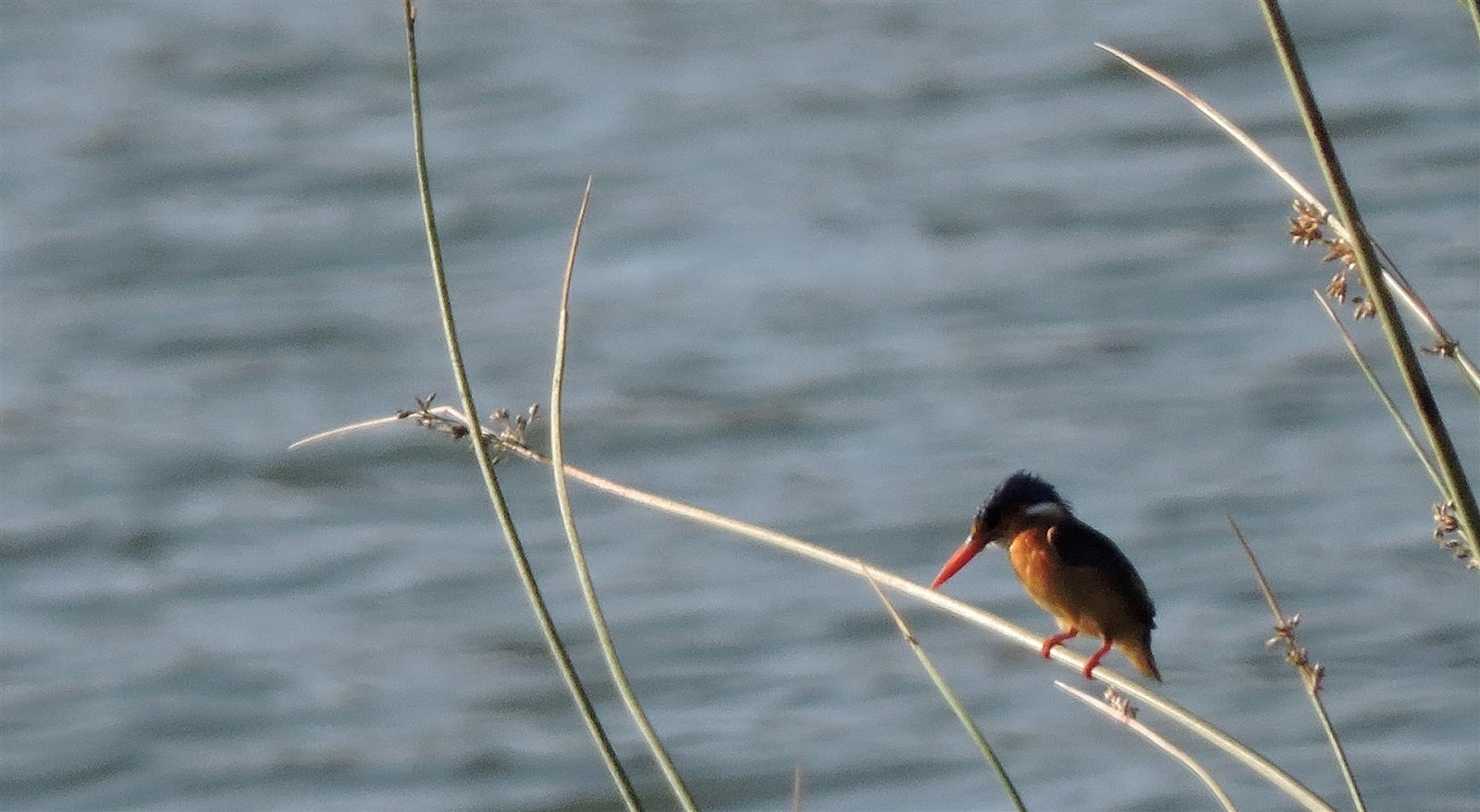
Showing posts with label baillon's crake. Show all posts

Friday, 20 January 2017

Baillon's crake at North Nouakchott Lake

I may not have too many significant birding sites in the city of Noaukchott but the few I do still produce very interesting results. My local patch, because it is within easy walking distance, is North Nouakchott Lake. It is fresh water created by the growing city under-ground aquifer finding an exit. It has grown from nothing in the last ten years apparently. I just wish it were turned into a nature reserve and not a dump for fly tippers.

Through all the rubbish, it is real gem. It has small clumps of dense reed beds and vast amounts of water. Some of which is contaminated, some looks nearly pristine.

I visited the lake again on Wednesday afternoon after work. I checked the gulls for rarities. Once again with no success. I scanned the water for any new water birds. I spent a lot of time inspecting the reeds for passerines but only came up with (lots of) chiffchaff this time.

I deliberately stayed late to look for crakes. I selected two spots which had the most potential. I could not believe my eyes when I turned up at the second spot to see a Baillon's crake walk on to the scene.


a Baillon's crake arrives

The water in this spot has a covering of vegetation but only a small clump of reeds. I presummed the thin covering would hold a crake's weight and I was right.

Baillon's crake in the reeds

Given the small size of the reedbed, the crake spent much of its time in the open on the top surface of the water.

crake back on the water

Identifcation was a little tricky since it was showing a large number of primary tips. This is usually associated with a little crake. However the plumage including the lack of a red base to the bill and streaked top of the breast as well as number of spots on the mantle fitted Baillon's crake. The reason for the large number of primary tips was because the tertials had become folded. The identification was tested and confirmed on BirdForum.

Baillon's crake from the rear

Baillon's crake is much rarer in western Europe than eastern Europe and Asia so the number of wintering birds is less. It's not yet on the e-bird list for the country.

Baillon's crake as dusk approaches

BirdLife International, The Birds of Western Africa and the Mauritanian Bird Atlas show it wintering in the Senegal River delta. Indeed that area appears to be the primary wintering place for birds throughout western Europe. The Mauritanian Bird Atlas suggests that there is strong breeding evidence there too. Elsewhere it is unexpected and certainly not in Noaukchott in mid winter.

African swamphen at dusk

As I headed for home, I glimpsed an African swamphen in the last embers of light. 

I have made a note to investigate the site for nightjars at night though I need to get equipment and security sorted.

northern wheatear 1

Earlier, as I have said, I concentrated a lot on passerines. As well as chiffchaff in the reeds, Sudanese golden sparrow were present again and a second northern wheatear was seen for the first time.
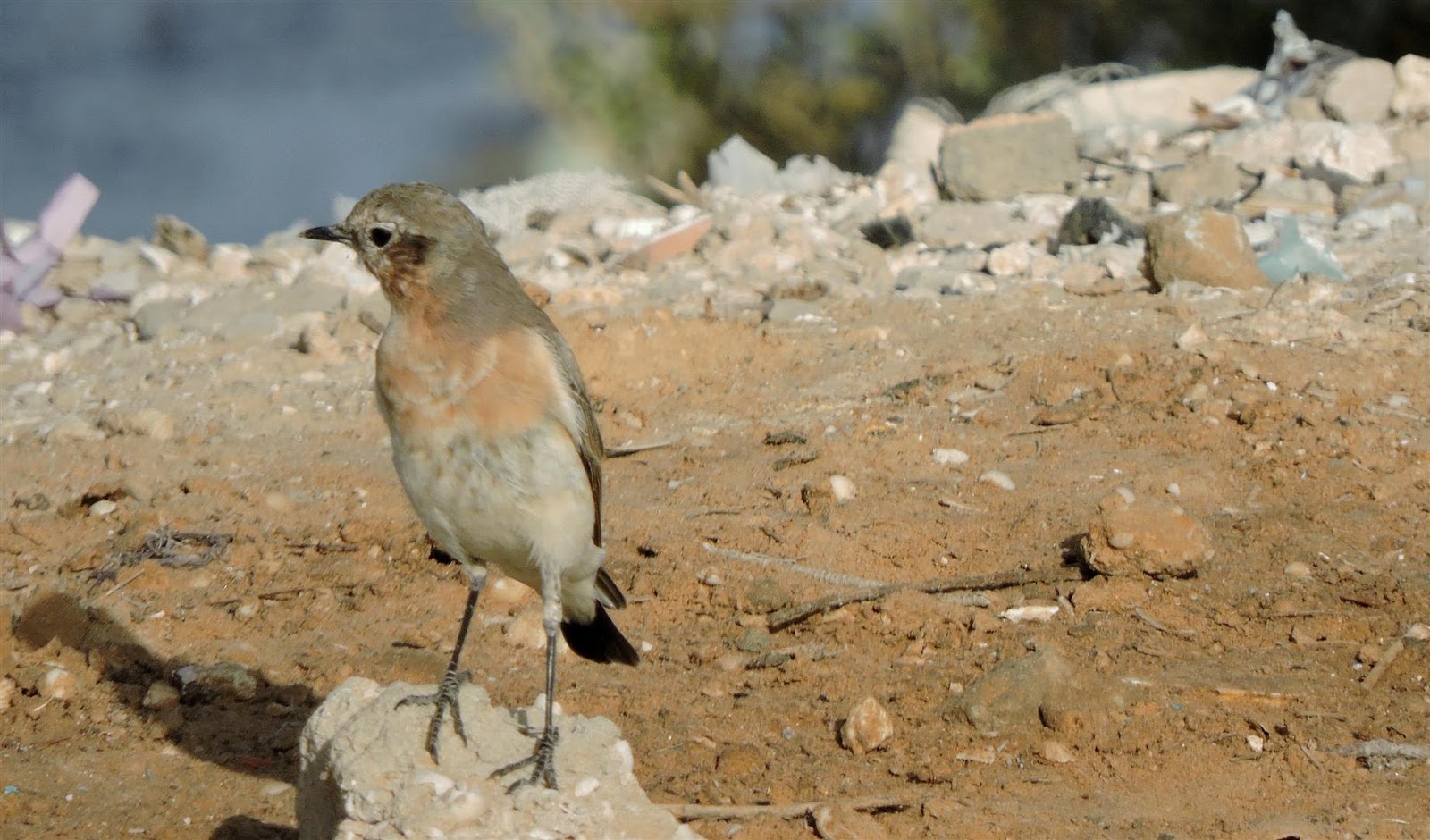
northern wheatear 2

There is still time this winter for the cold weather further north to push new passerines down or even ducks for that matter. Then spring may bring both returning Euoprean and intra-African migrants. The lake still holds prospects.

Saturday, 30 January 2016

West side stories

I went out birding twice during the week on returning from Spain. Both times I headed west from the city.

One visit was to Mughsail. A vagrant Brahminy kite had been spotted at Wadi Darbet two months ago by one group but not seen again until a report last week of it at Mughsail which is over 60 kilometres away.

It was sufficient reason to go there.

I searched hard but it was not to be found.

Instead I resorted to looking for crakes as the sun started to go down.

five Arabian partridge

When you stand still long enough, things can happen. In this case as I was waiting for crakes at the water's edge of Khawr Mughsail, a flock of Arabian partridge walked across the close hillside right in front of me.

eight Arabian partridge

I am quite adept at finding crakes but still not the one I want. There is no secret to crake watching except to keep still and be patient. I find I don't even really need cover. Stillness is the key.


Baillon's crake 1

I saw both a spotted crake and a Baillon's crake. The latter for a prolonged period.

 2
Baillon's crake

The very short wing projection told me it was Baillon's crake once again and not a little crake. Little crake is still alluding me in Oman even though Mughsail has had more reports than any where else in recent months.

Baillon's crake 3

Another good bird seen here was a yellow bittern. Of course I kept an eye out for birds of prey as a Brahminy kite had been the first objective. 

short-toed snake eagle

My total haul was one greater spotted eagle, one short-toed snake eagle and two kestrel.

My other trip out west was to Raysut. Raysut may be an industrial zone but it has four or five of the best birding sites in the country. The two I visited this time were the settling pools and the lagoons.

The settling pools were teeming with birds and yet nothing was new. Finding new species while birding in Dhofar is getting harder and harder. 

However I have other interesting than just obtaining a longer list.

The settling pools aren't really a sewage works. It's not the water than is recovered but the biomass. This is usually dumped at the corner of the works to dry out completely before being bagged as fertiliser. The drying mass is covered in wagtails and pipits at this time of year. Sometimes other birds join in.

I am always looking for something different. This time it was a wagtail with no colour.

wagtail 1

There isn't enough white on the wing panels for a young citrine wagtail.


wagtail 2

Likewise a young white wagtail has more white than this and at least some trace of a dark necklace.

wagtail 3

Most but not all yellow wagtails have some yellow on the vent. The exception is the beema sub species and that's what I think this bird is. Nevertheless it is still underdeveloped for this time of year.

wagtail 4

I believe I can see a hint of green appearing on the back.

wood sandpiper and common redshank

Elsewhere as I have already said, the site was teeming with birds. There were very large numbers of waders near all the pockets of water.

steppe eagle

Although the near-by city rubbish dump attracts hundreds of steppe eagle, the settling pools are a magnet for a smaller number of greater spotted eagle. The Eastern Imperial eagle show less preference though sometimes can be seen there. Steppe eagle do however fly over the pools but don't often land at the works.

Intermediate egret

There are always several grey heron and western reef heron at the pools at least in winter. Other heron family members are common but not certain. Intermediate egret is not uncommon but  is prized by visiting birders to Dhofar. This one has a dark tip to the bill showing it comes from India rather than Africa.

teal

Many of the ducks are now in breeding plumage including this teal.

black-headed gull and cattle egret

Not so many black-headed gull make it south to Dhofar in winter but the settling pools are the best place to see them especially towards the end of winter.

After the settling pools I made a quick scan of the lagoons before the sun set.

ruddy shelduck and slender-billed gull

The ruddy shelduck were still present. Here slender-billed gull replace black-headed gull as the main type.

glossy ibis

The number of glossy ibis there continues to rise.

There wasn't much time to view the lagoons properly.

However yesterday, it became the site of a very important sighting which was not only a an addition to my country list but a lifer too. I will write about this next.

Saturday, 21 November 2015

Crakes and kingfisher at Khawr Rori

On Wednesday afternoon, I went to Khawr Rori again in my quest to find a little crake which is still missing from my Oman list. I was with my work colleague and friend Michael Immel. As we arrived early we visited the main water section as well as the reedy offshoot of the water body where crakes can be found.

I will write about the main water body but first I will give news on my crake hunt.

The good news is that we saw both Baillon's crake and spotted crake.

Baillon's crake

We actually saw two of each.

close up of primary projection of Baillon's crake

The two easiest characteristics to separate the above bird from a little crake is the lack of any red on the base of the bill and the short primary projection (i.e short wings). So this bird is a Baillon's crake.

spotted crake

I only managed a picture of a spotted crake at dusk itself.

In correspondence with Jens Eriksen, it is confirmed that little crake is much the rarest of the three crakes in Dhofar but it is possible apparently so I won't give up.

Before looking for crakes, the main lake was interesting.

two cotton pygmy goose

The number of cotton pygmy goose has doubled in a week: from one to two.

shoveller with cotton pygmy goose

Flamingo and black-tailed godwit are two of the more obvious species at the khawr.

flamingo with a black-tailed godwit

I managed a picture of the intermediate egret which has now been present for a week or two.

Intermediate egret

Two of the resident red-knobbed coot were spending time in the deep water well inland but they flew closer by briefly.

distant shot of red-knobbed coot flying

However the most interesting sighting of the session was probably the re-emergence of a malachite kingfisher.

Malachite kingfisher

As far as I know all previous sightings have been in the inland spur of the lagoon which is approached from the main road. Sightings from there stopped over a week ago. This sighting was at least 500 metres away in the main lagoon.

greater spotted eagle

While a lot more steppe eagle than greater spotted eagle winter near Salalah, the odds chance near water. The fewer greater spotted eagle gravitate there. This is probably the same bird I saw at the khawr a week before.

On Friday I acted out my role as a birdingpal with two visitors. We went west of the city. I will blog about that next.

Tuesday, 13 January 2015

West of Salalah in early January

On Friday morning, Andrew Bailey and I went west to Mughsail and then worked our way back towards Salalah over the course of the day.

As is becoming usual the best birding was at the second and smaller inland pool.

It is a favourite especially with ducks though the wintering vagrant lesser whistling duck couldn't be seen. 

The ducks went frantic when a Bonelli's eagle flew over but it was more interested in chasing the one adult flamingo at pool. After a prolonged chase, the flamingo escaped.

Bonelli's eagle

The eagle then settled on a ledge above us waiting for the ducks and moorhen to slowly reappear from hiding.

wigeon and pintail

The duck at this pool included wigeon, pintail, ferruginous duck and garganey.

ferrugineous duck

Garganey is a strictly migratory bird which forsakes any places north of the Sahara and Arabian deserts in winter. However they are common here at this time of year.

garganey

As we walked round, Andrew spotted a Baillon's crake which remained visible for about two minutes.

Baillon's crake

This is my third Baillon's crake in Oman and in three different places. It appears to be much commoner than little crake at this time of year at least in Dhofar.

second view of Baillon's crake

It even came fully in the open for a few seconds.

Baillon's crake more in the open

While most of our attention was on this back pool, the main inland lake was actually the place that I added a bird to my Oman list. A European reed warbler was seen flitting around the front of the reeds. Two cotton teal were also among the ducks, moorhen and coot there.

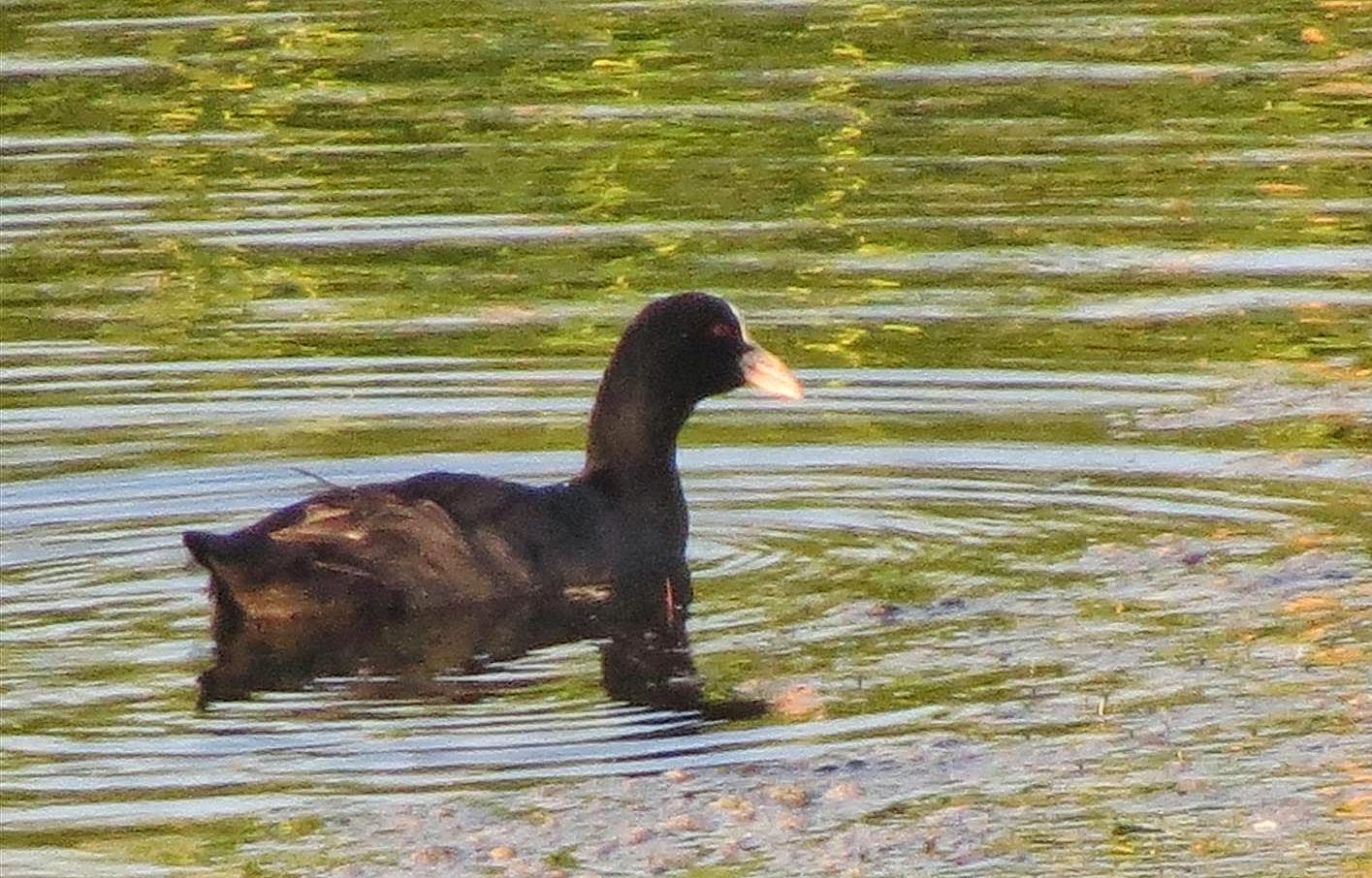
common coot

Even though it is only January, there are signs that some birds (but  no waders seen yet) are starting to attain spring plumage. 

citrine wagtail

The citrine wagtail above was a good example.

After leaving Mughsail, we headed back westward towards Salalah. Before noon we managed to bird it to Raysut settling pools, Raysut treated water lake and Raysut lagoons.

At the settling pools, the vagrant black tern was still on view as was the vagrant spur-winged lapwing. This time it was associating with no fewer than ten red-wattled lapwing.

The best bird for me though was a jack snipe which was an addition to my Oman list.

Abdim's stork

Andrew was hoping to see an Abdim's stork on his visit. He got 200 or 300 times that.

After the settling pools we made a brief stop at the treated water lake. In stark contrast to the smells at the settling pools, this lake is crystal clear. More ducks and flamingo. The black-necked grebe was still there associating with the resident little grebe.

red-throated pipit

A red-throated pipit was starting to show its red throat in readiness for spring.

common redshank

Other notable birds included at least eight common snipe and some common redshank.

Our final stop at the morning was at Raysut (Salalah) lagoons. Sadly these lagoons are being rapidly trashed by people dumping construction waste, presumably illegally. Nevertheless the eastern side of the wadi is not yet overwhelmed.

The lagoons are there and so still was the demoiselle crane.

demoiselle crane

It main company was a flock of flamingo and a single white stork. Also, several steppe eagle were settled on some of the cliffs.

demoiselle crane with flamingo

This was a good end to an excellent morning. I think the afternoon was even better. I'll write about that next.

Monday, 24 November 2014

Baillon's crake and White tailed lapwing at Khawr Soly

On Thursday I went to Khawr Soly again. I like this Khawr because it is less busy than the others near by and because it has given me so many good birds so far.

Baillon's crake

From about 4.30 pm I was privileged to have prolonged views of a Baillon's crake there. I wasn't really equipped for it in the sense of still wearing my work shirt and having no hide other than part of a bush to break up my shape. However by keeping still I went undetected or at least seen as no threat.

Baillon's crake

I was helped by the height of the grass too which was relatively low. I have learned that this juvenile is quite easily separately from juvenile little crake by the brown head and buff belly. A similar aged little crake has pale, almost white cheeks and a paler belly too. 

rear of Baillon's crake showing primary projection

The primary projection of Baillon's crake is very short compared with little crake as well.

White tailed lapwing

Not long earlier  I had come across my first white-tailed lapwing in Oman.

White tailed lapwing

This bird also allowed very good views though was rather inactive.

There are three quite distinct sections to this khawr. The Baillon's crake was seen in the part closest to the sea while the lapwing was in the most inland section.

This was only the second time I had visited the inland section and I regret not looking at it closer before.

Marsh sandpiper

There was a large array of different waders including common sandpiper, wood sandpiper, marsh sandpiper (one), green sandpiper, dunlin, Temminck's stint and little stint.

Wood sandpiper (right)

Both common redshank and common greenshank were also present.

common redshank

Some larger water birds were there. There was one immature flamingo, one little egret, one intermediate egret, two reef heron and five grey heron.

flamingo

The two European spoonbill seen last time there were still around.

two European spoonbill

A common sight of all khawrs over the last three weeks have been blue-cheeked bee-eater.

blue-cheeked bee-eater

There was a variety of birds of prey too. The largest was an Eastern Imperial eagle.

Upper side of Eastern Imperial eagle

It is a little unusual to see one at a khawr.

Under side of Eastern Imperial eagle

An osprey rested there for some while.

Osprey

Much more active were a marsh harrier and a Montagu's harrier.

Montagu's harrier

I deserted the coast at the weekend for more inland locations where the birding was equally good but quite different. The next three blogs will look at these trips.