Showing posts with label black tern. Show all posts

Friday, 31 August 2018

A walk near the fish market

Last Saturday, I went for a walk with a new work colleague near the coastal fish market. This was not a full blown birding session. My colleague is not a birder and birding was not the main objective.

However, there were some sightings:


  • A European cuckoo was seen for the second week running in the Nouakchott area
  • Many black tern are obviously migrating south. Unlike the other marsh terns, they primarily migrate along the coast
  • a nice flock of little egret were earnestly flying south over the sea
  • In contrast a larger flock of great white pelican were flying north. There is much movement all year of resident great white pelican moving back and forth between Banc d'Arguin and the Senegal River Delta
  • Very few gulls near the lagoon.


blue-cheeked bee-eater

black tern

sanderling

dunlin

migrating little egret

black tern. Immature left

great white pelican

Laughing Dove  
Namaqua Dove  
Common Cuckoo  
Whimbrel  
Sanderling  
Dunlin 
Common Sandpiper  
Common Redshank  
Audouin's Gull  
Lesser Black-backed Gull  
Black Tern  
Royal Tern  
Great Cormorant (White-breasted)  
Great White Pelican  
Little Egret  
Blue-cheeked Bee-eater  
Crested Lark  
Barn Swallow  
Sudan Golden Sparrow  

Thursday, 27 April 2017

Westside walk

Last Friday afternoon, I walked all the way from my home in Tavragh Zeina in central Nouakchott to the fishing port.

Fortified by the previous weekend's finding of a pectoral sandpiper, I took a route which guarenteed me views of the maximum number of waders.

First I passed by the central lake. This man-made and surrounds the future Senegalese embassy. Discretion is needed here as the authorities are very sensitive to cameras in this area.

waders at the central lake

This is the only water body in the city where black-winged stilt breed and can be guarenteed to be seen all year round.It is also favoured by ducks in winter even more so than North Nouakchott lake.

However on this visit, no special birds were seen. Black-winged stilt were plentiful and the typical winter birds of sanderling, little stint and common ringed plover were added to by a few dunlin and curlew sandpiper on passage. I gave the waders some considerable scrutiny but rarities were not found each time.

Next, I moved on to west Nouakchott pools. These are saline whereas the Central Lake is only slightly brackish.

There seems to be an attempt to pump much of the water out of the pools at the moment though how successful this will be when there is some summer rain is in doubt.

ruddy turnstone

Nevertheless this had the effect of reducing waders numbers. Birds not seen at the central lake but were at the pools included ruddy turnstone and a single ruff.

ruff (right)

Common greenshank appears to be loyal to this site even though water levels are down.

greenshank (left) with curlew sandpiper (right)

Kentish plover were well in evidence. One chick confirmed that this is a breeding site for this species.

Kentish plover

There are always a small number of spur-winged lapwing present including one which is very tame. Every time I visit it allows me very close.

spur-winged lapwing

The walk from central Nouakchott to the fishing port is over 4 kilometres. The central lake and west Nouakchott pools are conveniently about one third and two thirds along the journey, so the walk rarely feels onerous except in the mid-afternoon heat.

The area south of the fish port had much less gull activity than in the winter. The large majority of wintering gulls have gone.

mostly sanderling and black tern

It is always hit or miss whether there is anything really interesting at the lagoons south of the fish market.

This time the main interest was the very large number of sanderling present and about twenty black tern on passage.

common tern

It is always worth looking hard at the mix of terns. Both Caspian tern and common tern were also seen in low numbers.

black tern in various plumages

From my observations around the country and over three seasons now, it appears that black tern migrate along the coast whereas the other two marsh terns: whiskered tern and white-winged black tern migrate mostly inland.

For example at inland Lac Aleg three weeks previously there were only whiskered tern and white-winged black tern. Whereas south of the fish market (on the coast) last Friday there was only one white-winged black tern but many black tern. This appears to be a typical pattern.

This birding last Friday, while enjoyable, threw up nothing special. In stark contrast the birding over Saturday and Sunday was very interesting indeed. I will blog about these next.

Tuesday, 20 September 2016

South of the fish market

On Sunday I made a visit to the fish market on the coast west of Nouakchott.

Hundreds of longboat-shaped fishing boats were moored up and there were plenty of fish on sale, some of which were extremely large.

Yet strangely, there was hardly a bird in this immediate area apart from a few house sparrow.

Moving south 150 metres down the coast, it was a different story with several locations producing a different array of birds.

The first location was a smelly rubbish dump based on partially on fish parts and broken shells but with pools surrounding it.


bar-tailed godwit

Bar-tailed godwit were patrolling the pools and some of the wet earth.

sanderling

Sanderling were there in numbers.

ruddy turnstone

Ruddy turnstone were also present.

Welsh common ringed plover 1

Common ringed plover are proving to be abundant all over west Nouakchott including near the fish market at the coast.

One of them was ringed and flagged. If I have understood the rings correctly this is a Welsh bird. I have written to the contact sending pictures and await verification.

Welsh common ringed plover 2

A young Kittlitz's plover is good evidence that this species breeds here.

juvenile Kittlitz's plover

While walking a little further down the coast to a cleaner area, a large flock of Eurasian spoonbill flew past and laso travelling south. 

Eurasian spoonbill

In this place, there are three sand-banked small lagoons managed by the environment ministry which are designed to attract birds.

black tern

Black tern were certainly attracted to it.

whimbrel

Whimbrel were there.

sanderling

On a small island in one lagoon, a large number of sanderling were huddled together. 

little tern

A much smaller tern was easily picked out there. Little tern is the only option.

pied avocet

Another single bird was a pied avocet which was swimming rather than wading.

I was surprised that gulls and sea-faring terns were not seen at the ocean's edge.

Counter-initutively, by scanning all around,  I found a large number 500 metres inland from the lagoons. I had been looking in the wrong direction.

greater flamingo

As I walked towards the cluster of gulls and terns, three adult greater flamingo passed over.

I used a wall as a backcloth to approach the gulls so as not to spook them.

lesser black backed gull

The larger gulls were all lesser black-backed gull.  One medium sized gull was a black-headed gull.

Audouin's gull

The big surprise was the presence of 14 Audouin's gull. Such a large number may be explained by a probably affinity to the fish port and market. This gull is unusally dependent on fish for its diet.

Sandwich tern and Royal tern

I am on the look out for lesser crested tern which are known to winter on the Mauritanian coast and in particular Libyan birds, a few of which are ringed.

They are known to associate with closely related sandwich tern. Well, I found several sandwich tern. However the orange-billed tern seen with them near the fish market were both the larger Royal tern.

Walikng back towards the fish market through the coast scrub turned up a small number of warblers, crest lark and an unexpected hoopoe lark.

hopooe lark

Two desert grey shrike were observed on bushes and they were of the expected elegans sub-species in contrast to the unexpected algeriensis seen the day before at Zaatar allotments.

desert grey shrike

At a small pool, my first curlew sandpiper in country was seen.

curlew sandpiper

The last new bird of the session was a shy northern wheatear.

northern wheatear

No fewer than 16 species were added to my country list so I was well satisfied.
List of birds seen. New additions to my Mauritiania list are in bold.

Greater Flamingo  
Grey Heron  
Eurasian Spoonbill  
Pied Avocet  
Kittlitz's Plover  
Common Ringed Plover  
Whimbrel  
Bar-tailed Godwit  
Ruddy Turnstone  
Curlew Sandpiper 
Sanderling  
Dunlin  
Little Stint  
Common Greenshank  
Common Redshank  
Black-headed Gull  
Audouin's Gull 
Lesser Black-backed Gull  
Little Tern  
Caspian Tern  
Black Tern  
Royal Tern  
Sandwich Tern  
Laughing Dove  
Southern Grey Shrike  
Greater Hoopoe-Lark  
Crested Lark  
Willow Warbler  
Western Bonelli's Warbler  
Spotted Flycatcher  
Pied Flycatcher  
Redstart  
Wheatear  
House Sparrow  

Tuesday, 13 January 2015

West of Salalah in early January

On Friday morning, Andrew Bailey and I went west to Mughsail and then worked our way back towards Salalah over the course of the day.

As is becoming usual the best birding was at the second and smaller inland pool.

It is a favourite especially with ducks though the wintering vagrant lesser whistling duck couldn't be seen. 

The ducks went frantic when a Bonelli's eagle flew over but it was more interested in chasing the one adult flamingo at pool. After a prolonged chase, the flamingo escaped.

Bonelli's eagle

The eagle then settled on a ledge above us waiting for the ducks and moorhen to slowly reappear from hiding.

wigeon and pintail

The duck at this pool included wigeon, pintail, ferruginous duck and garganey.

ferrugineous duck

Garganey is a strictly migratory bird which forsakes any places north of the Sahara and Arabian deserts in winter. However they are common here at this time of year.

garganey

As we walked round, Andrew spotted a Baillon's crake which remained visible for about two minutes.

Baillon's crake

This is my third Baillon's crake in Oman and in three different places. It appears to be much commoner than little crake at this time of year at least in Dhofar.

second view of Baillon's crake

It even came fully in the open for a few seconds.

Baillon's crake more in the open

While most of our attention was on this back pool, the main inland lake was actually the place that I added a bird to my Oman list. A European reed warbler was seen flitting around the front of the reeds. Two cotton teal were also among the ducks, moorhen and coot there.

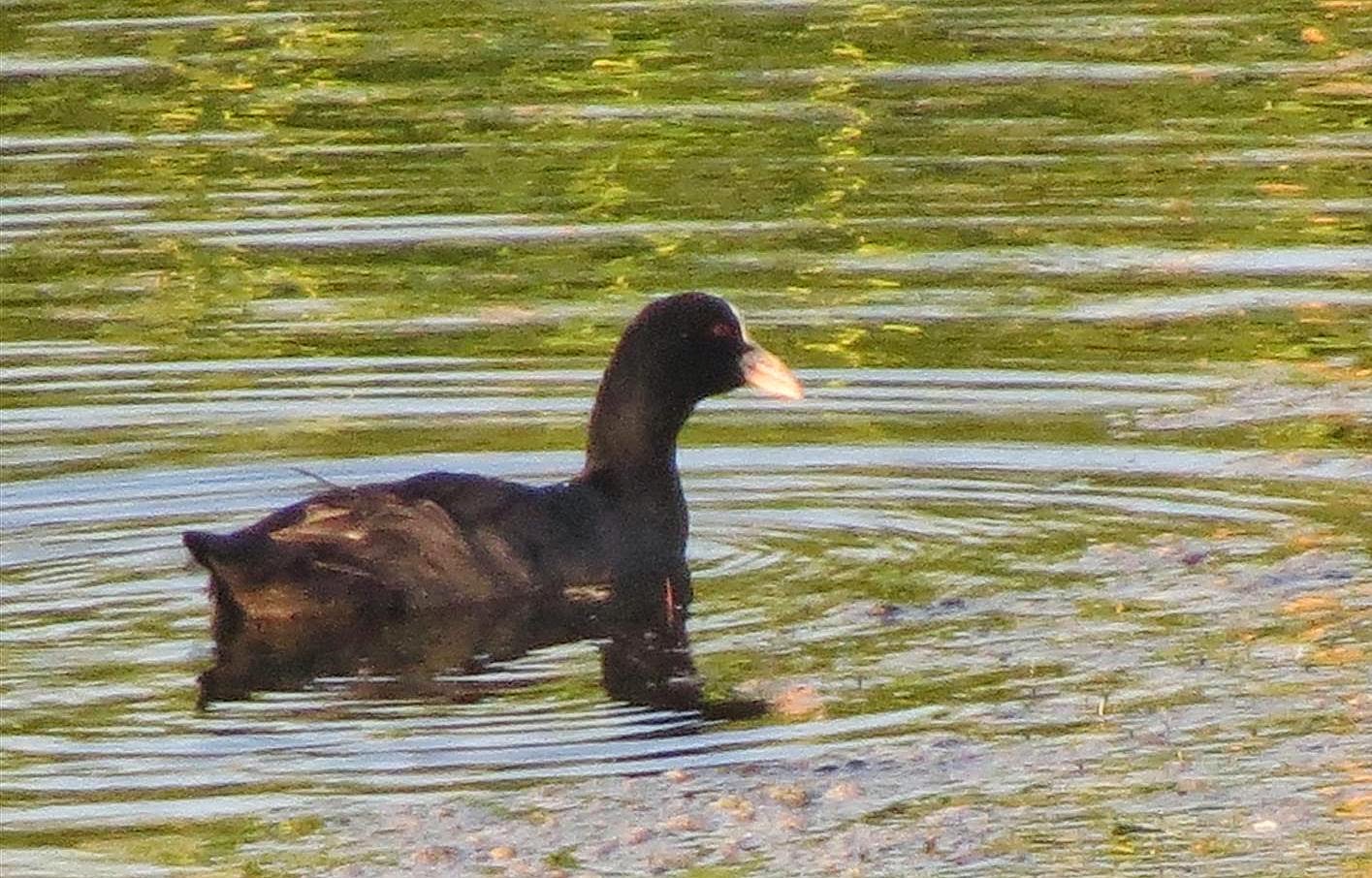
common coot

Even though it is only January, there are signs that some birds (but  no waders seen yet) are starting to attain spring plumage. 

citrine wagtail

The citrine wagtail above was a good example.

After leaving Mughsail, we headed back westward towards Salalah. Before noon we managed to bird it to Raysut settling pools, Raysut treated water lake and Raysut lagoons.

At the settling pools, the vagrant black tern was still on view as was the vagrant spur-winged lapwing. This time it was associating with no fewer than ten red-wattled lapwing.

The best bird for me though was a jack snipe which was an addition to my Oman list.

Abdim's stork

Andrew was hoping to see an Abdim's stork on his visit. He got 200 or 300 times that.

After the settling pools we made a brief stop at the treated water lake. In stark contrast to the smells at the settling pools, this lake is crystal clear. More ducks and flamingo. The black-necked grebe was still there associating with the resident little grebe.

red-throated pipit

A red-throated pipit was starting to show its red throat in readiness for spring.

common redshank

Other notable birds included at least eight common snipe and some common redshank.

Our final stop at the morning was at Raysut (Salalah) lagoons. Sadly these lagoons are being rapidly trashed by people dumping construction waste, presumably illegally. Nevertheless the eastern side of the wadi is not yet overwhelmed.

The lagoons are there and so still was the demoiselle crane.

demoiselle crane

It main company was a flock of flamingo and a single white stork. Also, several steppe eagle were settled on some of the cliffs.

demoiselle crane with flamingo

This was a good end to an excellent morning. I think the afternoon was even better. I'll write about that next.