Showing posts with label black kite. Show all posts

Friday, 27 October 2017

Road to Akjoujt

On Sunday 8th October,Mohamed Vall and I took the Atar road out of Nouakchott. Our main target destination was a woodland about 30 kilometres south west of Akjoujt.

There, in April, we had seen a vagrant skylark.

On the way to it the main interest turned out to be birds of prey. The first one seen was a very young black kite resting next to the road.

young black kite

It allowed close approach until a heavy lorry travelling in the opposite direction to us disturbed it.

Further on down the road, we came across a lanner falcon. This is probably the most common falcon in the drier areas of Mauritania. One wonders how common they would be in the Gulf countries if falconers and traders stopped taking them out of circulation.

lanner falcon

A few kilometres on, a lesser kestrel was observed resting on a low bush.

lesser kestrel

When we finally arrived at the woodland in the blistering heat, it wasn't as good for birding as we hoped. Strangely there were hardly any migrant warblers. I know from experience that they can be very patchy on migration. You can get a windfall one day and very few or none on another. We had clearly chosen the wrong day for this site.

greater short-toed lark

Greater short-toed lark were present and seemingly desperate to keep out of the sun. The best place to see them was under bushes.

red-necked nightjar through the haze

We accidently flushed a red-necked nightjar. Unfortunately, it was very timid in the same way as those seen the week before at the waste water site. We simply couldn't get close to it.

European pied flycatcher

One European pied flycatcher was exhausted. I doubted it would survive to fly on. The Sahara to the north can be punishing at this time of year for migrants. Choosing a lucky day to cross is so important to them.

bar-tailed lark

We saw bar-tailed lark again at the site as we had in April. It may be one of very few residents.

African collared dove

Another candidate resident is African collared dove.

common redstart

Common redstart is a broad front migrant so it was no surprise to see it in the woodland.

Bouet's agama

Once again, it was not just birds we saw. A Bouet's agama (a.k.a Mali agama) gave very good views.

greater short-toed lark

On the way back we found a smaller woodland. It actually held more warblers. A windfall of willow warbler had taken place. There was also one sub-alpine warbler. However the biggest interest there was a flock of around 40 greater short-toed lark. They were really suffering in the heat. So were we. We were happy to finish our birding early. There is a physical limit to what one can do.


Woodland 30 kms south west of Akjoujt
African Collared Dove  
Namaqua Dove  
Red-necked Nightjar  
Greater Hoopoe-Lark  
Bar-tailed Lark  
Greater Short-toed Lark  
Spotted Flycatcher  
European Pied Flycatcher  
Common Redstart  
Northern Wheatear  

Tuesday, 5 January 2016

Raysut at New Year

From mid-morning onwards on New Year's Day I was in Raysut. I went to the settling pools first. My main idea there was to observe the hirundines for rarities of which there have been two different species recently.

I was not exclusive to this task however.

flamingo at Raysut settling pools

Before reaching the pool which is best for viewing hirundines, I had already noticed a larger number of greater spotted eagle on site than usual.

A group of greater flamingo waded through one of the pools.

tawny pipit

In the corner of the site a dark looking pipit was standing. Initially I thought it was too dark for a tawny pipit. However it cannot be a Richard's pipit despite it overall colour and stance.

The lores were dark not pale and a close view of the hind claw showed it was not long.

claws of the tawny pipit

I concluded that it must be a tawny pipit afterall.

barn swallow

On arrival at the pool which hirundines prefer, there were about 30 barn swallow.

They are most easily identified when they periodically come to rest on some part submerged dead bushes that are at the pool. I could tell that the vagrant wire-tailed swallow and streak-throated swallow seen before Christmas were no longer present.

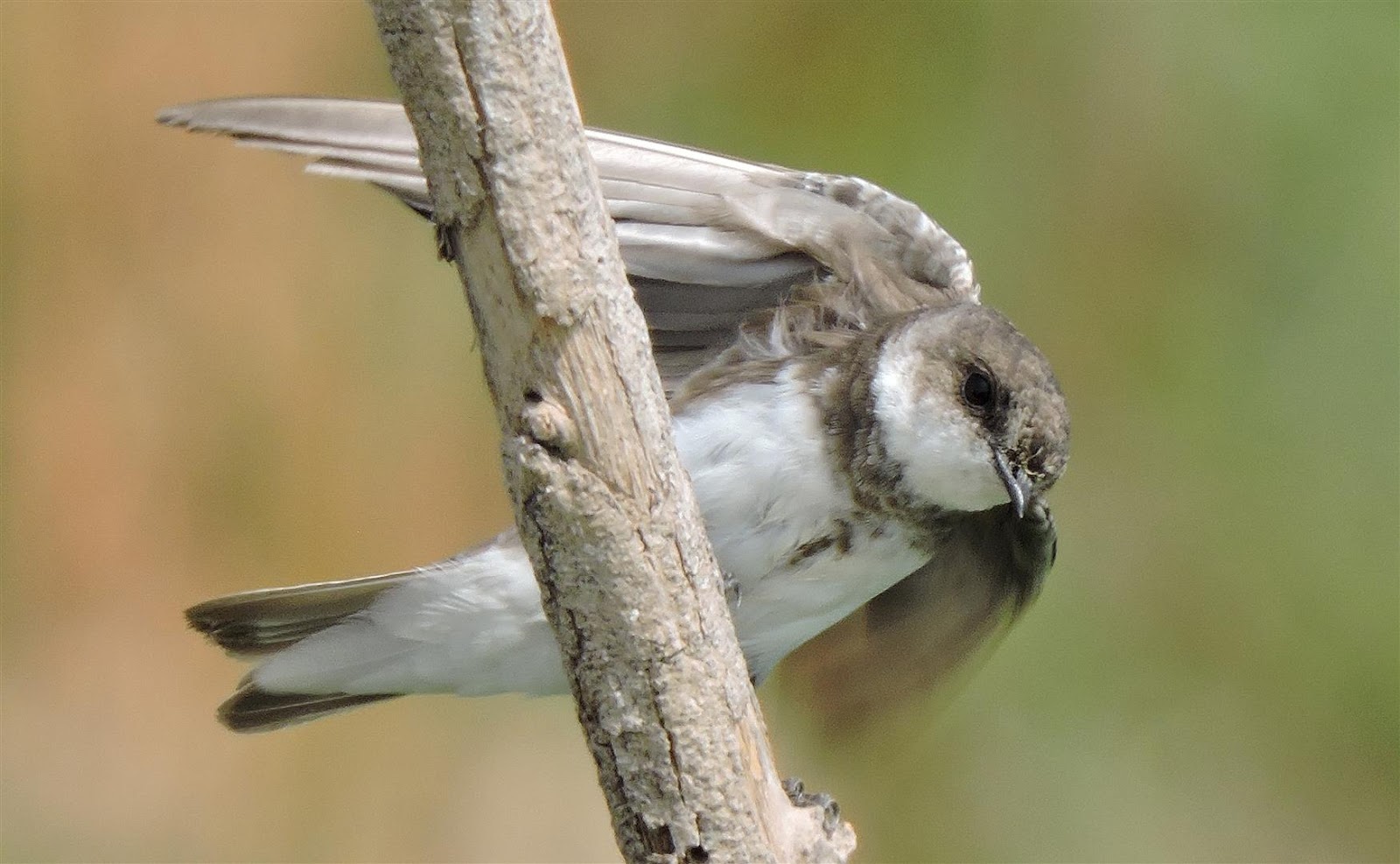
So I concentrated on the four sand martin also flying around. Pale martin is always a possibility in winter. I believe it is over-looked.

sand martin

Two of the birds were most probably sand martin. Their upper parts were darkish and the throat band was heavily marked. One of those birds is pictured above.

There is apparently considerable overlap in the strength of the throat markings between the two species. Pale martin's marking can be almost as strong as sand martin. However if the markings are very weak this points strongly towards pale martin.

sand martin - bird 3

The third sand martin was a candidate for pale martin. It was the palest and had a weak throat band.  

sand martin - bird 3

However I did not get a good enough views of its tail to be sure. Apparently the surest way to differentiate between the two birds is the degree of fork in the tail. A sand martin is more highly forked and a pale martin is just a notch.

sand martin - bird 4

The fourth bird has the lightest throat markings of all yet it had dark wings. Its tail was noticeably forked too.

sand martin - bird 4

The tail was probably too forked too.

In short, I find the separation of these two species really difficult and I cannot convince myself that any of the four birds were definitely pale martin.

Elsewhere on the site, the vagrant spur-winged lapwing which was first seen 15 months ago was still present. It now has four red-wattled lapwing to associate with.

spur-winged lapwing

There are large numbers of wagtails and pipits around the grassy areas of the site.

Many of the wagtails are starting to change into breeding plumage.

male black-headed wagtail

The red-throated pipit are generally less advanced. The head of the one below is going red but the throat shows no sign yet.

red-throated pipit

The Abdim's stork are also beginning to look more attractive as they head towards their breeding season.

Abdim's stork

This species is one of the earliest winterers to leave, in mid February.

Pallas's gull

After I left the settling pools I headed to Raysut lagoons. There was not much visible change to the birds since last time. The star birds are arguably the ruddy shelduck and they were still present.

One chance was the presence of a Pallas's gull. Just as Abdim's stork is one of the first leavers in winter, Pallas's gull is one of the last regular arrivals.

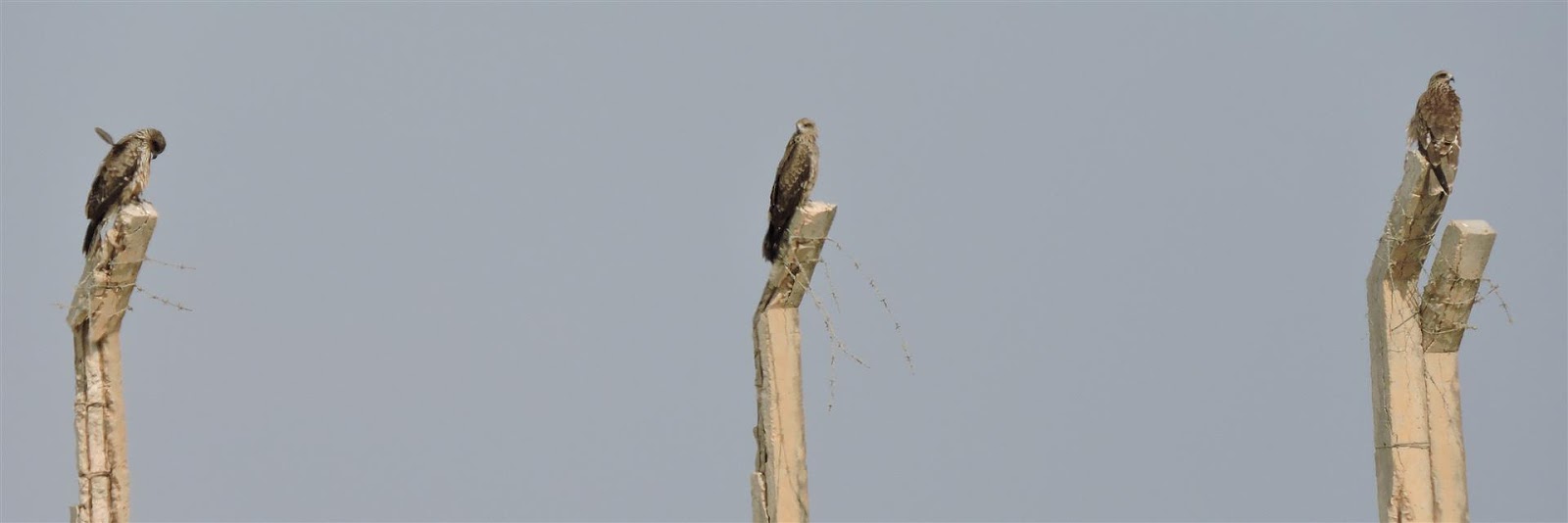
three black kite

To round off my trip to Raysut, I visited the beach area. Just like last mid-winter this is the place to see black kite (as opposed to yellow billed kite) in Dhofar. I have no real idea why they roost here and spend much of the day here too.

closer view of black kite

It was other birds of prey that were more active though. An Eastern Imperial eagle was eating a large black headed gull in a tree with two steppe eagle watching on in other branches. On the ground near-by a greater spotted eagle was also eating another gull. It had been a bad day for gulls there.

Wednesday, 15 January 2014

Muhayil south side

On Friday afternoon, having returned from wadi Haly, I found time to bird the south side of Wadi Muhayil within Muhayil town.

It has a much more open aspect than the north side and a more rural feel.

The birding was quite different in part because of this. 

male Eurasian sparrowhawk

The first and most obvious difference from my birding on the north side was the presence of more birds of prey. While I saw two kestrel on the north side, there were three types of raptor on the south side. All were arguably more interesting than kestrel.

One of main target birds from the south west is dark chanting goshawk. For a short moment I thought I had seen one in this area. However as I got closer I saw it was a male Eurasian sparrowhawk. This was the best and longest stationary view of a Eurasian sparrowhawk I had had in Saudi Arabia. 

second view of Eurasian sparrowhawk

This part of the wadi is attractive too with fine views of old buildings and the surrounding hills.

old buildings, Muhayil

On a post was a wintering black kite as opposed to a yellow billed kite which is resident in parts of the south west.

Black kite

On the hills over-looking the wadi was a long legged buzzard.

long legged buzzard

Of course not everything was different from the north side of the wadi. For example African collared dove proliferated. Rueppells weaver were once again also present in numbers.


African collared dove

A small pool of waste water housed a green sandpiper and two white wagtail.

Green sandpiper

A green sandpiper was the only wader I saw with the town envelope. 

white wagtail

In contrast an area close-by was so dry it supported wheatears and larks.

Isabelline wheatear

An easily identifiable Isabelline wheatear was seen.

second Isabelline wheatear

A second wheatear proven more difficult to identify. Despite its greyer crown, I believe it also an  Isabelline wheatear. Note the white supercilium is much stronger in front of the eye.

black crowned sparrowlark

The lark observed was black crowned sparrowlark. This is much more common in the south west than anywhere else in the country.

house sparrow

No house sparrow were seen on the north side of the wadi earlier in the day but they were plentiful on this south side later.

female shining sunbird

Shining sunbird were seen on both sides.

First winter Daurian shrike


One final bird gave me identification problems. A first winter shrike with so much scaling on the undersides would normally be a red-backed shrike. Very few Daurian shrike keep them except at the sides this late. However after consulting BirdForum, the view is that it is indeed a Daurian shrike. There is no scaling on the head and the nape should be grey even with a rufous morph red-backed shrike. 

The next blog will look at birding on Saturday which started in Muhayil and continued on my journey towards Abha airport. 

Friday, 4 January 2013

Some birds of prey from Jizan

Mansur al Fahad and I saw 7 or 8 species of birds of prey while we were down near Jizan. It was 7 or 8 depending on whether you think yellow billed kite is a separate species from black kite.

I have a personal dislike of modern splitting unless its supported by sound DNA measurement. My scientific back ground has brought me up to think that way. Look at the fog the grey shrike complex was in before the DNA scientists got to grips with it. 

So you may have guessed I think it is premature to support yellow billed kite as separate species because its bill is a different colour and they don't live permanently in the same district.  

Incidentally, we have got two versions of Arabian babbler down here with the same bill colour differences (black and yellow). No one (yet) is saying they are not the same species!


black kite

Anyway, we saw both types in and around Jizan. If anything the winter visiting black kite were more numerous than the resident yellow billed kite.

yellow billed kite

Talking (or writing) about resident birds brings me onto the next bird of prey - short toed eagle. The Helms guide to the Birds of the Middle East says that the Arabian birds may be resident although the map cautiously shows them as summer breeders in all places.


You may remember that I blogged seeing my first one in KSA a couple of weeks ago and that was at Al Hayer, central Arabia. This is pretty close to where they breed (a little bit of dispersal). I said at the time that this some evidence along with a Pers Bertilsson observation of one in winter in the same region that they (or at least some) don't migrant.

short toed (snake) eagle

Sure enough, Mansur and I saw another one this time near Sabya, Jizan province and also close to another place on the map where they are down as summer breeders. Its getting close to a pattern now. 

steppe buzzard

The final photograph is tentatively of a steppe buzzard (foxy morph) which only really became separable from long legged buzzard when it flew off. It has a dark head which I understand is a useful feature in separating when they are perched.

The other birds of prey seen were kestrel, steppe eagle and marsh harrier.

Another vote of thanks are due to Mansur Al Fahad who provided all the pictures except the buzzard. I have once again taken the liberty of cropping his originals.


Wednesday, 14 March 2012

What type of black kite?

Over the pasture where I was birding on Friday around midday, there were several birds of prey but the most numerous were black kite. There were five that I counted.

black kite "bird A"


My experience with black kite is quite limited and I was confused by these at first. All of them were obviously kites if you saw them fly not least because they had the characteristic forked tail.
Black kite bird A (left) with bird B (right)

Even though I viewed all of them into the sun, I could see that they had pale heads with a black mask running through the eye.
black kite bird B takes off


I wondered whether this might make them black-eared kite. This sub species is from Siberia to the far east. However northern inland birds are known to migrate to the Persian Gulf which is not so far way.   

black kite bird C

It now looks though that all five birds are first cycle black kite from the nominate species. The first cycle too have a dark mask. They also have a streaked belly which these birds have and lack the bright white carpal patch of black eared kite.  

What I am surprised about is why they were all first cycle birds. As it happens I visited the known winter roost of black kite about 20 kilometres away in Dirab later in the day and found out more. I'll blog about this as part of my next article!

Saturday, 17 December 2011

The road to Dirab

Yesterday, Clive Temple and I visited the farming community of Dirab which is a recommended birding venue on fatbirder.com


We took the back road from Al Hayer to Dirab but instead of birding the farms, we birded a couple of refuse sites!


I will explain why this happened.


It all started out according to plan. As we drove along the back road, we stopped to observe a flock of brown necked raven which had gathered at a  picnicking site with left over refuse. This proved to be a harbinger for the day.

black kite near Dirab

Our next stop, a few kilometres along the road was when Clive spotted several black kite at a large farm. 

As we headed further west, near Dirab, I spotted a white crowned wheatear at a quite small refuse site.  This was my first sighting of this bird in Saudi Arabia. 

young white crowned wheatear

When we stopped to look we found at least one adult and one young white crowned wheatear. However the site had much more than this.

desert lark

The refuse site was by the side of the road with an escarpment behind it. It is clearly ideal territory for desert lark. The one above was very confiding. 

blackstart

There was also a pair of blackstart at the site.


one of the hoopoe

The most abundant bird at the refuse site however was hoopoe. There were at least 8 present. This is a wintering group because resident birds hold a territory.  They were more flighty than the other birds. When they felt threatened they flew part way up the escarpment, returning when calmed. 

white wagtail

At least one white wagtail and two blue rock thrush were also present. 

blue rock thrush

The blue rock thrush above is not one of those seen at the first refuse site. Actually we saw yet another on a wall by the side of the road on the return journey towards Al Hayer. This proved easier to photograph.

To finish the roll call of birds at the site, there were several little green bee-eater and one desert wheatear. 

Travelling west from the refuse site, we found that the farms in Dirab were generally not accessible to the public unlike those south of Al Hayer which I normally visit. So we headed back east on the same back road that we had come out on.

We found that about 6 kilometres east of the first refuse site that there was another which we had missed on the way out. This was speculatively birded since the first site had been so successful.

Like the previous refuse site, it too had a couple of white crowned wheatear and blackstart. This time there was also a mobile flock of house sparrow and another flock of white cheeked bulbul darting around near-by trees and bushes. 

mourning wheatear

More excitedly, this second  refuse site was home to a mourning wheatear. Apparently this is only a winter visitor to central Arabia probably through dispersal from north west Saudi Arabia.

desert lesser whitethroat

The second site also differed from the first site by desert lesser whitethroat encouraged to be there by the more abundant natural vegetation (even though my picture shows one in a man made situation!)

Before finishing my comments on the refuse sites, I must return to the black kite seen at the beginning of the day. Near the second site, extremely high in the air was one of the black kite soaring with a young imperial eagle which completely dwarfed it.

Heading further east near the town of Al hayer, we crossed the Riyadh river at a stretch of the river that I haven't birded before. This was brief stop but long enough to see a wintering wryneck in a bare tree. 

grey heron at the bridge crossing the Riyadh river


The wryneck was an unexpected bird to see ending a day where we birded unexpected places.