Showing posts with label Eurasian sparrowhawk. Show all posts

Wednesday, 12 August 2015

Inside Bishkek

I had tine for two short sessions in isde the city of Bishkek last week. One was a walk round the area (Lebedinovka) where my hotel was situated. The other was a trip to the Gareev Botanical Gardens in the city cenre.

Birding conditions weren't ideal as it was 37C at the height of the day. Nevertheless I birded around my hotel early evening and in the Botanical Gardens until mid monring to give myself a chance. 

I like Botanical Gardens for many reasaons including a sentimental one concerning Oxford where I was a student.

However the gardens in Bishkek are in a sad condition despite evidence of foreign partnerships aiming to maintain the area.

Some of the taller trees had died and the undergrowth looked untended.

On one of the dead trees ironically I was given very good views of an adult male sparrowhawk.

sparrowhawk 1

Not all adult males acquire eyes as deeply coloured as this one. Some maintain yellow eyes like females and juveniles.

sparrowhawk 2

The gardens are still a pleasant enough walk and there are shaded areas.

path in Gareev Botanical Gardens

There were wood pigeon in the denser areas.

wood pigeon

While feral pigeon were in the more open spaces.

feral pigeon

Common magpie was everywhere.

common magpie


The two most common birds in the trees were great tit. 

great tit

Though spotted flycatcher was more easily seen as they adopted more exposed positions.

spotted flycatcher


On one bush in clearing was a Turkestan shrike. This is a bird I see in large numbers in Arabia on migration and in winter.

Turkestan shrike

The botanical gardens are also home to several red squirrel.

red squirrel

Turkestan shrike was also one of the birds observed when I walked around the hotel one evening.


Turkestan shrike in Lebedinovka

In a sense I was disappointed to see laughing dove. This bird is still spreading north out of Africa and has reached Bishkek and even southern Kazakhstan to its north. It would never survive in winter without human settlements providing scraps of food.

laughing dove

Another and even more invasive species is common myna which is indeed common in the city.

common myna

More interestingly I came across goldfinch in gardens. These are of an eastern race which doesn't have a black head.

goldfinch

I would have loved to have had more time in Kyrgyzstan. I have checked whether it can be visited en route to anywhere else I am likely to visit in my quest to see every country in the world. There are a couple of options. Who knows I may return some day.

Monday, 24 November 2014

The road to Wadi Hanna

Last Friday was a day for inland birding. I started out with a quick visit to the western perimeter of Sawnout farm.

There was no watering in this part of the farm and a pivot bar on which so many birds were perched last time had been moved. Nevertheless it still had some interesting birds in this section.

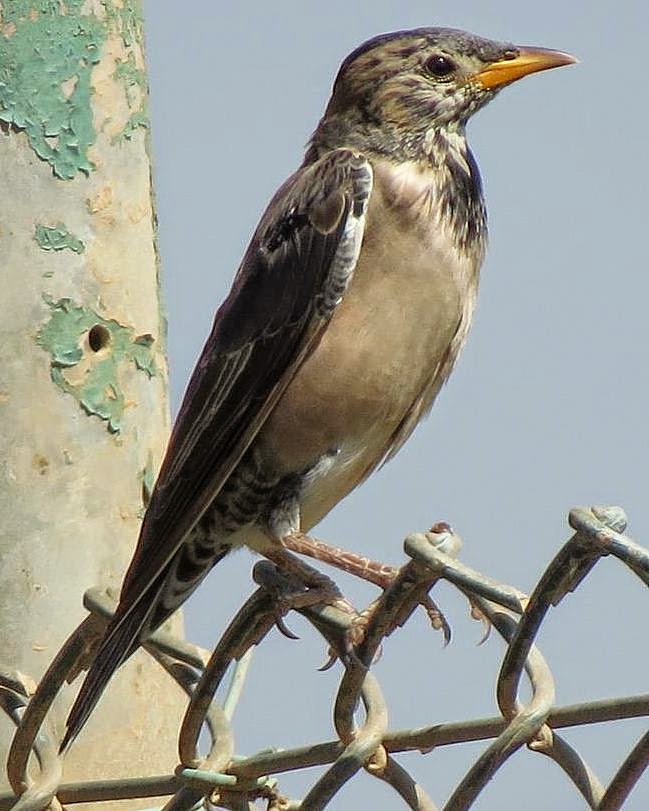
The common myna had mostly moved on but I saw two more rosy starling, one of which wasn't one of those like seen last time.

two rosy starling

I suspect rosy starling will prove not to be very rare at the farm in winter.

first rosy starling

I believe I have chance of seeing common starling here during the winter though it is right on the edge of their range. It seems strange to get excited by such a bird given how common they are in Europe.
.
second rosy starling

Namaqua dove are quite widespread now in southern Oman but not common. 

Namaqua dove

I have only seen them close to the farm and the adjacent Wadi Sawnout and at Ayn Hamran, nowhere else.

female house sparrow

The house sparrow is even rarer in the city area. They appear to be only by this farm and the remains of Jarziz farm (as it closes down). They shun houses just like Spanish sparrow and desert sparrow.

Eastern Imperial eagle

I got closer views of the Eastern Imperial eagle but there was no sign of the yellow billed kite from last visit. I also couldn't see any of the expected sociable lapwing which have been wintering on Salalah's two (now one) farms. I am now quite happy for someone else to spot them first. I have all winter to see them.

underside of eastern Imperial eagle


After leaving the farm, the plan was to go searching for the elusive golden-winged grosbeck up at Wadi Hanna which is past Tawi Atair. the plan didn't work out exactly which  I will explain as I go along.

I headed up the hills until I arrived at the plateau just before the small town of Tawi Atair. I was tempted to deviate off the main road to the left to look at a green-looking wadi off- the-beaten-track.

Arabian partridge

Very early on, I accidentally flushed an Arabian partridge which I caught up with later.

very young cinnamon breasted bunting

The place was thronging with cinnamon-breasted bunting. One confiding one was very young. This is the first time I had seen one of this age still with a yellow gape.

second view of juvenile cinnamon-breasted bunting

They are attractive at this age with more cinnamon suffusions than in adult birds.

African paradise flycatcher

The wadi even had some standing water and was very shady in parts.  I was not surprised to see an African paradise flycatcher.

Long-billed pipit

As I left the wadi and walking back towards the car, I came across a tame long-billed pipit.

underside of short toed eagle

After this wadi, I drove straight through Tawi Atair and up into Wadi Hanna which is beautiful wooded highland area. I stopped quickly just as I arrived at the start of the wadi as I heard fan-tailed raven screaming. This is often a sign that they are mobbing a bird of prey. Sure enough two of them were mobbing a short toed eagle.

upperside of short toed eagle

However my primary purpose in visiting Wadi Hanna was to search for golden-winged grosbeck, the elusive Arabian endemic.

euphorbia in Wadi Hanna

It is known to be particularly attracted to euphorbia. Furthermore many of its sightings have been at Ayn Hamaran and at Wadi Hanna. 

A friend in Saudi Arabia (Lou Regenmorter) has circulated a picture of a euphorbia found near a recent sighting of them south of Taif, Saudi Arabia. I found large tracts of the same euphorbia to the east of the main woodland at the top of Ayn Hamran and in two places in the large wadi Hanna.

However the euphorbia at Ayn Hmaran had died back but may come back in another season. While the euphorbia at the more elevated Wadi Hanna looked like it was two months short of coming into fruit (and then berry).

Further correspondence has suggested they feed on other plants too such as prickly pear but  I haven't any prickly pear in the mountains near Salalah. 

I have since read an excellent article on euphorbia in Dhofar and discovered there are at least 8 types, fruiting at different times and looking quite different from each other. I suspect the grosbeck rotate around those in fruit and berries.

Meanwhile, when I was in the euphorbia grove and having just seen a pair of Arabian warbler, I again heard the fan-tailed raven screaming. I rushed out into an open space to see my first Eurasian sparrowhawk since being in Oman.

Eurasian sparrowhawk

This continued to be the pattern of my birding: in the woodland until I heard fan tailed raven then out into the clearings to see what they were up to.

Eurasian sparrowhawk flying off

On another occasion, it was a steppe eagle that got mobbed.

Fan-tailed raven mobbing a steppe eagle

Finally as it came towards dusk, four eagles appeared around the same time. This time the fan-tailed raven did not respond. Perhaps the numbers were too great for them or they were more interested in roosting.

steppe eagle

The two steppe eagle and two Eastern Imperial eagle flew around unhindered.

Eastern Imperial eagle

It was a strange day. I went out looking for golden-winged grosbeck but ended up with plenty of sightings of birds of prey.

On Saturday I went out north into the desert. I'll blog about that next.

Wednesday, 15 January 2014

Muhayil south side

On Friday afternoon, having returned from wadi Haly, I found time to bird the south side of Wadi Muhayil within Muhayil town.

It has a much more open aspect than the north side and a more rural feel.

The birding was quite different in part because of this. 

male Eurasian sparrowhawk

The first and most obvious difference from my birding on the north side was the presence of more birds of prey. While I saw two kestrel on the north side, there were three types of raptor on the south side. All were arguably more interesting than kestrel.

One of main target birds from the south west is dark chanting goshawk. For a short moment I thought I had seen one in this area. However as I got closer I saw it was a male Eurasian sparrowhawk. This was the best and longest stationary view of a Eurasian sparrowhawk I had had in Saudi Arabia. 

second view of Eurasian sparrowhawk

This part of the wadi is attractive too with fine views of old buildings and the surrounding hills.

old buildings, Muhayil

On a post was a wintering black kite as opposed to a yellow billed kite which is resident in parts of the south west.

Black kite

On the hills over-looking the wadi was a long legged buzzard.

long legged buzzard

Of course not everything was different from the north side of the wadi. For example African collared dove proliferated. Rueppells weaver were once again also present in numbers.


African collared dove

A small pool of waste water housed a green sandpiper and two white wagtail.

Green sandpiper

A green sandpiper was the only wader I saw with the town envelope. 

white wagtail

In contrast an area close-by was so dry it supported wheatears and larks.

Isabelline wheatear

An easily identifiable Isabelline wheatear was seen.

second Isabelline wheatear

A second wheatear proven more difficult to identify. Despite its greyer crown, I believe it also an  Isabelline wheatear. Note the white supercilium is much stronger in front of the eye.

black crowned sparrowlark

The lark observed was black crowned sparrowlark. This is much more common in the south west than anywhere else in the country.

house sparrow

No house sparrow were seen on the north side of the wadi earlier in the day but they were plentiful on this south side later.

female shining sunbird

Shining sunbird were seen on both sides.

First winter Daurian shrike


One final bird gave me identification problems. A first winter shrike with so much scaling on the undersides would normally be a red-backed shrike. Very few Daurian shrike keep them except at the sides this late. However after consulting BirdForum, the view is that it is indeed a Daurian shrike. There is no scaling on the head and the nape should be grey even with a rufous morph red-backed shrike. 

The next blog will look at birding on Saturday which started in Muhayil and continued on my journey towards Abha airport.