Showing posts with label cinereous bunting. Show all posts

Thursday, 5 September 2013

Cinereous bunting and other migrants at the farm

The walk from work was arguably every bit as exciting today as yesterday. Admittedly there was no sign of the Egyptian nightjar seen yesterday afternoon but there were other new migrants. 

The best was certainly a (eastern) cinereous bunting seen in the farm's gardens. Friend and fellow birder Mansur Al Fahad, who joined me for the late afternoon, was with me to see it.

It was a lifer for him and it was only the third time I had seen this near threatened bird. The first time was in the same place in April!

cinereous bunting

Mansur has a much better camera than me but I am using my pictures so that it can be blogged the same day.

cinereous bunting facing me

An Isabelline wheatear was observed although probably a different one from yesterday. However today was the first time this autumn that I have seen a desert wheatear.  They winter in large numbers around here but in summer they breed in the north of the country. There was also a male northern wheatear around which is purely a passage bird.

desert wheatear

In among the increased number of yellow wagtail, which have probably been attracted by the near-by pool, was a single red throated pipit. This was another first for this autumn.


red throated pipit

Incidentally most of the yellow wagtail present were the beema sub species also known as Sykes wagtail. These breed in the extreme east of European Russia and western Siberia.

yellow wagtail (beema)

Another first today was an adult woodchat shrike. All the shrikes until now which have passed through have been immature. 

adult male woodchat shrike

One immature woodchat shrike has remained here for nearly two weeks now while the others are long gone.

second view of adult male woodchat shrike

Of the other migrants the thrush nightingale which had been here 6 days was present this morning but nowhere to be seen in the afternoon.
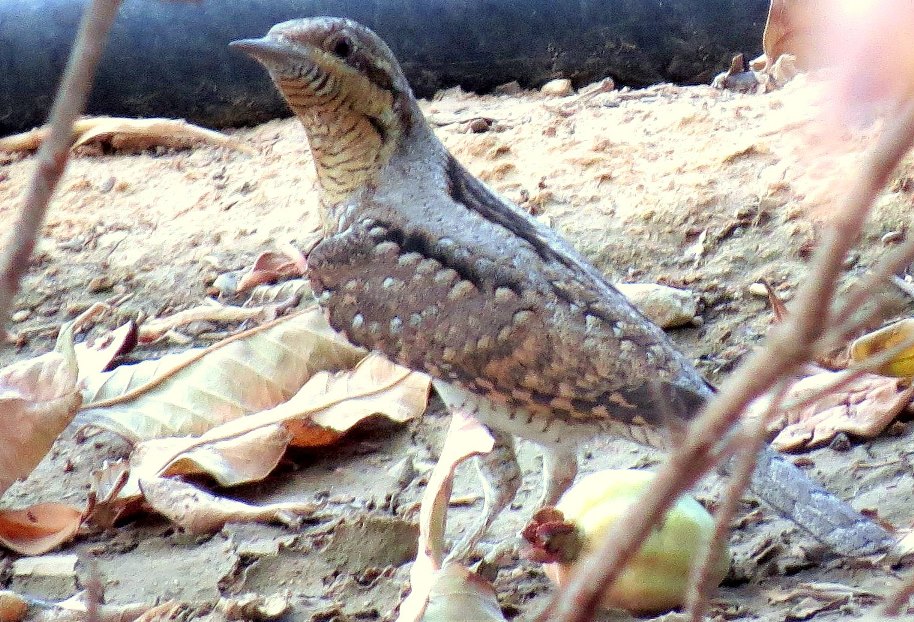
wryneck

Two wryneck were on view at the same time.

spotted flycatcher and laughing dove

Three spotted flycatcher were present and one was an immature. Several common whitethroat were also around but still no other warblers have been through the farm. This is even though other types have been observed at Al Hayer. 

And it's Al Hayer I am visiting again tomorrow.

Saturday, 27 April 2013

Fields at Mithnab, Buraidah

The second part of my exploratory visit to Buraidah was to farmland.  I chose the Mithnab (variant spelling of Muznib) simply because it is the closest farming district in the Buraidah area to Riyadh (albeit 325 kilometres away!)

The corridor from Buraidah to Hail has the highest concentration of farms in the country and must be good birding because of that. And yet it is rarely visited.

I chose a farm almost at random near Mithnab and started birding. It had several fodder and wheat fields.

collared pratincole

I had a very successful and enjoyable time near and in two wheat fields, one of which had recently been harvested. I could see at a glance that it had attracted lots of birds but I was shocked to find out that 55 pratincoles were either on the field or next to it.

several pratincoles

I didn't have too much time as this was day trip but I soon realised that this was a mixed flock of pratincoles with both collared pratincole and black winged pratincole. Indeed I had not seen collared pratincole on such dry terrain on passage before. Maybe the black winged pratincole had some influence on selection.

the field with the most pratincoles

At least 5 of the birds were black winged pratincole. They had no white trailing edge, smaller tails and fully black under-wings. Though it has to be said that the dark red in the under-wings of some collared pratincole weren't always discernible to my naked eye from a distance (the camera did better on this).

black winged pratincole

Black winged pratincole is the 281st bird on my Saudi list.

ortolan bunting

These wheat fields held more surprises. Though there were many tens of ortolan bunting gorging on the seed spillage, I had'nt expected to see another cinereous bunting again so soon.

cinereous bunting

It was alone as most reported cinerous bunting on passage have been. Only one report I know of this year in the Saudi Arabia has involved two birds. I only saw my first one two weeks ago at the small farm on the way to work. 

European bee-eater, ortolan bunting and red backed shrike

Near the cinereous bunting were many birds of different species resting on a pivot cross bar. Indeed another theme of this farm was the number of resting birds more usually seen on the wing.

resting blue-cheeked bee-eater

As well as resting European bee-eater the dirt areas around the fields were littered with resting blue-cheeked bee-eater and barn swallow.

resting barn swallow

Once again I saw a whinchat, now viewed as a common migrant in my opinion.

whinchat

However, its nowhere near as common as both red throated pipit and yellow wagtail which are often found together and were present in numbers in the harvested wheat field.

red throated pipit

As I said in the last blog, woodchat shrike are still commonly seen in central Arabia despite being among an early migrants. Lingering in central and northern Saudi Arabia seems to be the only logically conclusion as to what is going on.

woodchat shrike

The most common shrike in Buraidah over the whole day was actually red backed shrike. I can't remember seeing a single Daurian shrike or Turkestan shrike. This is in stark contrast to the Riyadh area and to Jubail (on the east coast) last weekend.

red-backed shrike

On top of two types of pratincole and a near threatened bunting, the birds of prey were a little bit more interesting than average too. Along with a marsh harrier and pallid harrier, a group of three lesser kestrel were hawking over the fields.

My conclusion about birding Buraidah is very positive. Why haven't I been there before?

Friday, 12 April 2013

Cinereous bunting - a lifer in the city

On Wednesday my walk to work not only gave me an addition to my Saudi list but it was a lifer too.  I spotted a yellowish green bird in the tomato patch of the university's experimental farm. I recognised it immediately as a male Eastern cinereous bunting.

cinereous bunting - number 279 on my Saudi list

To add to my joy, it moved out of the tomato patch and onto the path in front of me affording very good views.

a second view of cinereous bunting

All those early morning starts and afternoons lingering on the way home have paid off.

Eastern cinereous bunting breeds in south eastern Turkey and south west Iran. It apparently winters mostly in Eritrea and Yemen so Riyadh is an obvious candidate place to see it on passage though I have failed in previous seasons.   

Interestingly this near-threatened bird has been seen by Jem Babbington and Phil Roberts on the eastern coast and by Lou Regenmorter and Brian James in south west Saudi Arabia in late March this year. I know that for at least three of them this was the first time seen in Saudi Arabia. I thought I was going to be left out despite being on a more direct passage route. This seems to be the year to see it. Three sightings were singles and one was of a pair.

the first whinchat in the tomato patch

I don't often visit the tomato patch area but I was following two whinchat  and photographing them when the bunting popped up.

The two main historical observers in Saudi Arabia who published detailed records have described whinchat as either "scarce" in one case or "uncommon" migrants in the other. Based on my observations until this spring I had agreed with them. Furthermore, I had thought they were more common on the coastal routes than inland. 

However that's all changed. Having seen four in the past two weeks on the farm including two on Wednesday, my new view is that it is a regular migrant on a broad front at least in spring. This view has been reinforced by Jem reporting seeing four near Dammam. 


the second whinchat

On Wednesday evening after work, I was joined by birder and friend Mansur Al Fahad. 

In a different part of the farm with scattered medium height bushes we spotted an Upcher's warbler. This the seventh type of warbler I have seen on the farm.

Upchers warbler

It was heading towards dusk and the light was failing however we got good views for over 10 minutes.

Upchers warbler in another bush

Near-by, I saw a second white throated robin on the farm. The first one a few days ago was male but this one was female.

female white throated robin

In other news, at least two of the three wryneck were still present and still behaving very tamely. 

wryneck

Common redstart were still scattered around the more shaded places. Rufous bush robin were still around too.

male common redstart

Only one tree pipit remained. 

tree pipit

On Thursday, which is normally a weekend day here, unusually I had work commitments. So today (Friday) will be bumper day at Al Hayer to try to make up for lost birding time.