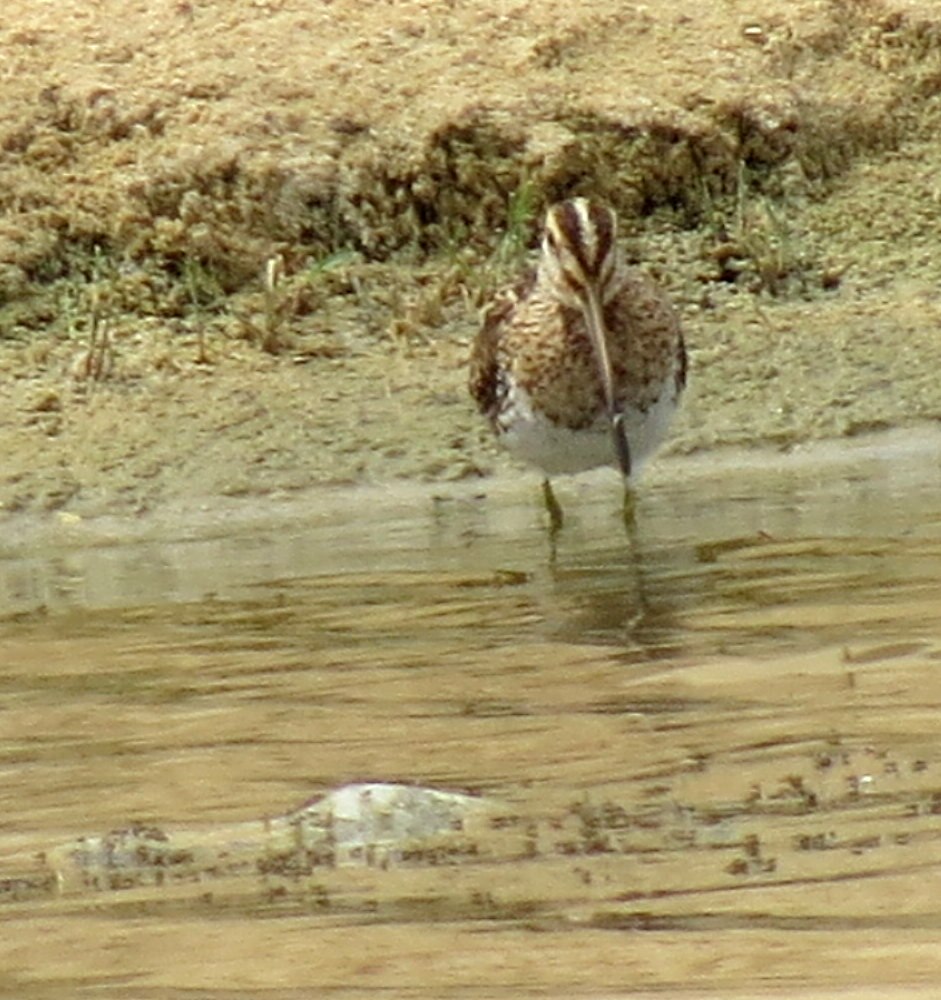
Showing posts with label curlew sandpiper. Show all posts

Sunday, 20 April 2014

Jubail on an April morning

Bernard Bracken and I made the very long day trip to Sebkhet Al Fasl near Jubail on Friday.

This place is one of the best birding sites in the kingdom. It is the result of the treated waste water from the north of city emptying out into a salt pan next to the coast. The are roughly divides into two: the saline filled salt pan and the fresh water wetland with huge reed beds and other vegetation. There is also an intermediate zone.

Bernard and I birded the salty lagoon with its mud flats in the morning.


little tern (with a little stint)

It was an abnormally hot day for April reaching 37C. Birding was tough. 

We started out by walking as far out into the mudflats as we could to observe the several hundred waders and other water birds.

Among the other birds were many tern: Caspian tern, little tern and in the intermediate salinity areas, white winged black tern.  I hadn't seen any little tern on any of my winter visits but they were the most numerous tern on Friday.

curlew sandpiper and little tern

There were hundreds of little stint and several tens of dunlin. Plumage varied from full winter to almost full breeding. There were a small number of curlew sandpiper which are much easier to separate from dunlin in their summer plumage.


mixed waders

The group above comprises two little stint, one dunlin, a ringed plover and a sleeping curlew sandpiper.

common redshank

Other waders included a few common redshank, wood sandpiper and common sandpiper.


wood sandpiper

In the deeper water were several surprisingly tame black winged stilt.

black winged stilt

In winter there are several thousand flamingo in the lagoon but none remain. In the distance we could see several reef heron who are here all year round. 

osprey

We moved on from the lagoon towards the fresh water wetland towards noon. On a wire was one of only two birds of prey seen all day. It was an osprey.
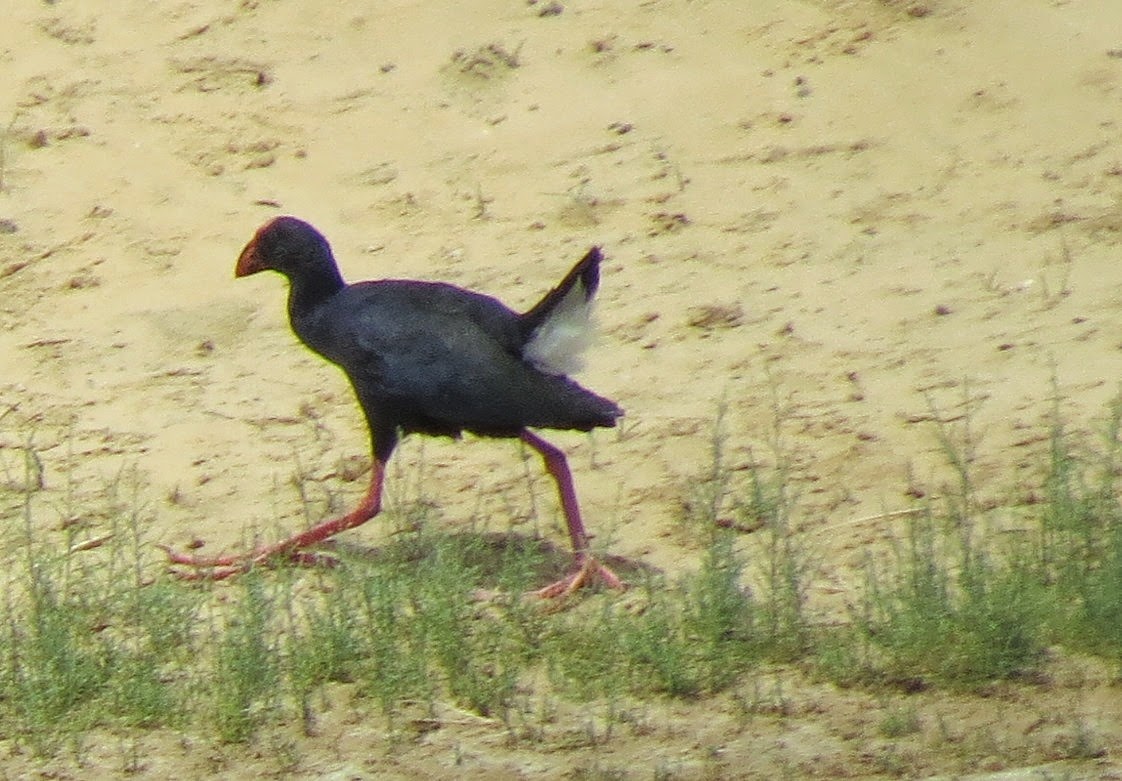
purple swamphen

The wetland is the domain of many purple swamphen. It didn't take us more than five minutes to see the first one.

slender billed gull

Both on the edge of the lagoon and in a couple of pools near the wetland, several slender billed gull were seen. Many immature slender billed gull over stay in the summer. They are the only gull usually seen seen  from mid April to mid August.

After noon we spent most of our time in the wetland where the birding was better than in the salty areas. 

I will blog about this next. 

Sunday, 17 November 2013

Wadi Al Rummah, Buraidah

Up to about 10,000 years ago apparently Wadi Rummah was a mighty river flowing from Medina in the west of Saudi Arabia all the way into the Persian Gulf by the Kuwait border. Once in a decade or so it flows as a river through much of its course. Most of the time most of it is dry.

It hadn't rained much in Buraidah by Friday but the wadi valley held a surprising amount of water as well as fish. I can only assume the water had found a way to travel from the west which had had plenty of rain.

 grey heron

The valley was lush with short reeds and grass. It was also quiet probably because it was Friday morning in a devout area.


Wadi Rummah

The large birds are often seen first. A flock of little egret were an obvious presence alongside a single grey heron. Their peace was only disturbed by us and once by a marsh harrier. 

little egret

Slightly unusually the only other member of the heron family we saw was a little bittern.

Wood sandpiper

There were plenty of waders. The most common was wood sandpiper.

wood sandpiper with yellow wagtail (lutea)

While watching three of them, Bernard bracken caught sight of a yellow wagtail. This was a strange sight. A very few yellow wagtail winter in Kharj 80 kilometres south east of Riyadh but I never expected to see one at Buraidah which is 350 kilometres north west.

It will surely move on when it realises how cold it gets at night in winter there. However there is no doubt this section of Wadi Rummah is an unusual micro habitat.

White wagtail were common not surprisingly.

wood sandpiper (front) with little stint

Little stint were the second most common wader. The picture above shows it in less usual terrain. Most were seen on the river/water's banks.

wood sandpipers with a curlew sandpiper and Temminck's stint

The third wader observed was common snipe. There were plenty  which unfortunately were always one step ahead of us.

The final waders were curlew sandpiper and Temminck's stint. Both are in the picture above. The curlew sandpiper is towards the right while the small wader at the back of the two wood sandpipers on the left is a Temminck's stint. Thanks to the people on BirdForum for help in identifying these two.

Moorhen was another water bird present.

bluethroat

The terrain looked good for bluethroat though only one was actually seen.

immature red-backed shrike

The yellow wagtail was not the only late migrant observed. A solitary barn swallow flew overhead and then we came across an immature red-backed shrike.

back view of immature red-backed shrike

It was a prime example of an immature bird. It had crescentic barring not only on the sides and mantle but also on its crown.

hoopoe

Since we were probably the first birders ever in this place, we made note of resident birds though hoopoe could be wintering or resident. 

Namaqua dove

All the same three resident doves as in Riyadh were easily seen: European collared dove, Laughing dove and Namaqua dove. We were well within the known range of black bush robin. 

white-eared bulbul

White-eared bulbul is expanding its range north and west and probably conquered this area a long time ago.

Wadi Rummah must be even more interesting now the rains have come to central Arabia. Since Saturday it hasn't stopped raining!


Saturday, 20 April 2013

The Jubail area

I visited the Jubail area in eastern province on Thursday. My plan was to find some farms and bird those. I had an idea I might see some different land-based migrants from those which go through central Arabia.

Using google earth, I had found several farms on the Kuwait road out of Dammam. There were also a couple of lakes or marshes marked there too. These were all clustered about 25 kilometres inland from Jubail.


common snipe and common sandpiper at Sebkhet al Fasl, Jubail

Actually I found these farms a bit disappointing. They were mostly market gardening such as tomato growing although there was some maize. Either way they didn't produce many interesting land birds. Graceful prinia (resident)  and common whitethroat (passage) were the most obvious in the farms. Much of the near-by land was flooded following overnight rain too.

Given everything, after a while I resorted to travelling to the coast and spent an hour or too at Sebkhet al Fasl which is a much better known birding area and away from my more speculative areas.

I'll report a little on the speculative farming area inland first though.

little stint and kentish plover

The temporary flooded areas had attracted some birds which are more normally seen on the coast such as little stint. By the way the little stint in the photo was being very aggravated by a small tick just below its eye (which you may be able to see in the picture). Just after it was taken he raised his leg to scratch it off his face. 

This water had many grey heron and little egret too.

moorhen, black winged stilt and common sandpiper

As said before, there were a couple of permanent water bodies as well with reeds and other cover. The moorhen, black winged stilt and common sandpiper were in one of these. Interestingly there were no sounds of reed warbler though graceful prinia could be heard loudly.


little tern

On one of the temporary bodies I came across several tern. These were all little tern. I managed to separate them from the similar Saunders's tern in two easy ways. First, Saunders's tern is rarely found inland- even 25 kilometres inland. Second, the white on the forehead on these birds went right to the back of the eye.

willow warbler

Migrant sightings (excluding common whitethroat already mentioned) were restricted to willow warbler and chiffchaff among the warblers.

female yellow wagtail

Other land bird migrants included yellow wagtail, Turkestan shrike and common redstart.

Turkestan shrike

After a while at the inland farming area, I moved on to Sebkhet al Fasl. This was not my first choice for the day. However,it was guaranteed to be productive albeit more so with coastal birds than necessarily with land birds. 

Unfortunately time was a little short and birding was a little hurried.


curlew sandpiper

On arrival at Sebkhet al Fasl, one of my first sightings was a curlew sandpiper heading towards breeding plumage along with 20 or little stint.

flamingo

Like the area inland, there were many additional fooded plains. One contained over 200 flamingo.

common snipe

By the side of a large pool with hundreds of barn swallow (at least one house martin) flying over was a single common snipe which gave good views in the open for several minutes.

some resting barn swallow

There wasn't time to do a full audit of the waders present at the various pools but they included common sandpiper, Terek sandpiper and ruff.

Ruff and a Terek sandpiper (on the right)

The site had both little tern and Saunders's tern although it was only by analysing my photos afterward that I have reached this conclusion.

Saunders's tern

The bird above has a slightly more restricted white forehead and darker legs. I make this a Saunders's tern. Coming from the Riyadh area, I haven't had much experience with these two!

northern wheatear

Sebkhet al Fasl does of course have some land birds as well. For example,  there were a couple of both migrant northern wheatear and whinchat seen. The reeds were also very noisy with the sound of European reed warbler- a sound noticeably lacking from the inland marshes visited earlier in the day.

purple swamphen

Finally you can't write about Sebkhet al fasl without mentioning purple swamphen. There may be plenty of moorhen and coot but the purple swamphen are everywhere!


Monday, 1 October 2012

Near Riyadh cricket club

Mansur Al Fahad showed Lou Regenmorter and me a second new important birding venue last Friday.

Close to the Riyadh Cricket club where tens of south Asians were playing in the scorching sun on very dry and flat wickets is a wetland complex.

We were shown two parts of the complex but there may have been more to it. The one part was a shallow marsh land. The other was a much deeper lake.

spotted flycatcher

We spent most of our time around the marshy area. The adjacent pools held little stint, black-winged stilt, common sandpiper, green sandpiper, little ringed plover and ruff.


ruff

One of the birds caused a bit of an identification problem at the time. However it was later identified as a curlew sandpiper.


curlew sandpiper

This one's bill was not longer than the average dunlin but its all white rump, longer legs and remnants of a summer's purple belly confirmed it as a curlew sandpiper.  This is the first time I had seen one inland in Saudi Arabia.

collared dove

On and next to the main body of shallow water in the marsh were the same waders plus wood sandpiper and spur winged lapwing. There were also over 40 black winged stilt. This was  the largest flock I have seen here.  As befits a marsh land, a female marsh harrier was patrolling menacingly overhead.

Yellow wagtail were fairly numerous on the dried out sections too.

The dried out reeds were looking posts for a spotted flycatcher, Turkestan shrike and southern grey shrike. Sand martin, barn swallow, house martin, little green bee-eater and blue-cheeked bee-eater were hawking for insects over-head.

 This area will certainly be visited regularly in the future. We arrived at mid day which isn't perfect for birding at this time of year and yet the numbers diversity of birds was still good. 

"cricket" lake

In early afternoon, we moved on to the lake. This is a very large body of water for central Arabia and we don't really know why or how is there.

great white egret and coot

However the number of species was more limited (but not uninteresting) than in the neighbouring wetland.  There were a large number of coot and little grebe. Pale crag martin were flying next to the cliffs leading down.

little grebe

A white throated kingfisher was present but we are unsure whether the lake has fish. He was'nt seen fishing. The only heron was actually the rarest one of area - a great white egret. The sandy shoreline had black -winged stilt and common sandpiper. One upset was not identifying the duck that were fleetingly present when we first arrived. Well there is always next time.

Saturday, 21 April 2012

A "lifer" among the waders

On Thursday, I spent more than half of the birding day at my new venue near al Hayer. It's the far south of the Riyadh river where the water runs slowly and forms many sandy lagoons. It's ideal for passage waders.


The good news is there were four to five times as many waders there as there were the previous Friday. it must be peak time for them. The only bad news is that the temperature reached 34C and the going on foot was arduous but worth it!

curlew sandpiper, bottom right 

As well as numbers there was a few more species diversity too. Although there were no common snipe to be seen this week. I expect that they have all finally moved on up north.

One of the species present this week but not last week was curlew sandpiper. I counted at least five. Most were in winter plumage but the one above was changing into summer plumage. 

landscape

A second species new from last week was Terek sandpiper. There was a solitary one among tens of other types of sandpiper.  I had hoped I might see one but never dared to believe it. Terek sandpiper is common in winter on the east coast of Saudi Arabia. It is less common on the west coast and I failed to see one when I visited Jizan or on an earlier visit to Jeddah.

On the other hand it is really rare to see one inland though not without precedent. It's ironic that where I saw it. It is a lifer for me too.

Terek sandpiper

The shear numbers of waders were a big surprise. Some were in single species flocks  but many were wading in mixed groups.

wood sandpiper

Wood sandpiper varied from being single birds to being in a flock of about fifteen birds.

mostly wood sandpipers

Green sandpiper numbers were similar but the group sizes were on average smaller.

green sandpiper

Again common sandpiper numbers were similar to both and it flock size was intermediate  between those of green sandpiper and wood sandpiper.

little stint with a wood sandpiper

Possibly the most abundant wader on the day was little stint.

mixed waders

I can count five wader species in the mixed group above.

black winged stilt

I counted eight black winged stilt which is the largest group I have seen in the al Hayer area. They were more flighty than the other waders. 

pied wheatear

I didn't pay much attention to the land birds in the area this time. However I did notice a late pied wheatear. The bulk of this species moved on two weeks or more ago.