Showing posts with label little tern. Show all posts

Monday, 27 March 2017

A walk to the fishing port

It is a long walk from my home to the fishing port and back but I did it on Saturday. It was manageable for several reasons. Not least it was possible because we have had unseasonably cool weather for March. Indeed, it even rained on Friday evening. Second, the walk is broken up by West Nouakchott Pools about half way. Third, there is always a chance of seeing something in the scattered bushes on the way.

West Nouakchott pools held many waders as usual. However the best was probably the two spotted redshank.

spotted redshank

DNA studies show it is closer to common greenshank than to common redshank despite its looks.

common greenshank with spotted redshank

Both these species were also present. Indeed there were high numbers of common greenshank.

wood sandpiper

Other waders included the unibiquitous wood sandpiper and little stint. Both are extremely common in water bodies in Nouakchott for at least half the year.

ruff

West Nouakchott pools gives me my best chance of anywhere in the city to see ruff.

spur-winged lapwing

By comparison, spur-winged lapwing is usually found at all sizeable inland water bodies and apparantly in all seasons.

red-billed quelea

In one of the bushes next to the pools, I found my first red-billed quelea in the city. I had speculated that this would happen as they are so numerous 30 kilometres south at the new water works. I believe the works is helping to act as a bridge for this species from its normal range near the Senegal River.

As far as I can tell, there has been at least one previous record of the species in the city and one further north near Atar.

kentish plover

On the scrubland close to the fishing port, I came across a Kentish plover which was starting to fake injury. This is a deflection tactic to move threats way from its young.

I gave it a wide bearth as soon as I saw it. There is no point stressing such a bird just to watch a display.

A short distance further but still short of the coast is a place gulls often settle in windy weather. There were plenty on Saturday.

Most of the gulls were lesser black-backed gull.

lesser black-backed gull with a ring

Two of them were young birds with the same pair of rings. I could only read one bird's rings. However I now know that this bird is from just north west of Edinburgh in Scotland. I see a large number of gulls with rings and ocassionally waders too.

When I finally arrived at the lagoons, south of the fishing port, it was apparent that the number and variety of terns was the highest since last September.

little tern

Five little tern were grouped together.

Caspian tern and a common tern

Both common tern and arctic tern pass Nouakchott on migration in large numbers though neither often land here. Indeed this is only the second common tern I have seen on land since I arrived. The previous one was in poor condition in autmn near Nouadhibou.

Arctic tern are less likely still to land. They usually migrate well out to sea. However Saturday's westerly wind was unusual. 

This bird is definitely a common tern. It's bill has a dark tip and its wings aren't long enough.

mixed species with a common tern

In the far end of the lagoons near the supply pipe, a single white-winged black tern was in the same area as a few waders including a red knot as well as several swimming slender-billed gull.

white-winged black tern

The final tern in the area was sandwich tern. Many were feeding over the water and close into shore.

sandwich tern

Gull numbers are definitely thinning out now, none more so than black-headed gull.

black-headed gull

Most slender-billed gull that remain are immatures. Surely they will over-summer as do many of their countereparts in the Gulf. At least one adult still remained though.

slender-billed gull

Apart from the red knot already mentioned, waders this time were a little disappointing.

sanderling with a little stint

Four great white pelican flying over the water were the only other birds of consequence.

I will keep visiting the fishing port over the next few weeks. Overall, things are moving pretty fast now.

Sunday, 24 April 2016

Waves of migrants at East Khawr

East Khawr (Khawr Dahariz) is a very short drive for me so it is a convenient session after work in the afternoon. I went there twice midweek last week. Taken together with sessions the week before, it is obvious that many migrants are stopping only for a day or two before carrying on. The turnover in species is plain to see.

Terns are coming and going.

little tern

Little tern are only a fraction of the terns. However in other ways they are typical. They don't breed this far south and are migrants stopping over. Separation from Saunders' tern which does breed in southern Oman is more straight forward at this time of year. The white on the top of the head elongates into a supercilium on little tern only. The legs are nearer to orange than the yellow ochre of Saunders' tern.

mostly white winged black tern

On one of the days there was a large influx of white winged black tern mostly in mid moult. The next visit there were virtually none.

whiskered tern (centre)

Whiskered tern has been present every time though they might be different individual birds. Others have included sandwich tern and gull billed tern.

greater sandplover

Most sandplover have been lesser sandplover but a few have been greater sandplover. It is much easier to recognise them when both species are together.

mostly pacific golden plover

Around 300 pacific golden plover did stay more than one day. They crowded out the main sand bar.

ruddy turnstone

In this sandy habitat I only see ruddy turnstone on passage. They can be seen all winter on the rocky shore at Raysut.

curlew sandpiper (right and centre part hidden)

Curlew sandpiper are distinctive at the moment with their red-purple fronts.

Eurasian spoonbill

I am ever vigilant with spoonbills. I alway look for a vagrant African spoonbill. However one again there were just Eurasian spoonbill present.


Elsewhere on the khawr and ironically not on the main sand bar on one of the days were a group of sanderling.


wood sandpiper

Around the margins of the khawr inland there are plenty of wood sandpiper and Temminck's stint.

Sleepy Temminck's stint

This is not necessarily a passage phenomenon as the same two species are there all winter.

In the next series of blogs, I will write about Friday's desert trip. There was more passage there too.

Sunday, 20 April 2014

Jubail on an April morning

Bernard Bracken and I made the very long day trip to Sebkhet Al Fasl near Jubail on Friday.

This place is one of the best birding sites in the kingdom. It is the result of the treated waste water from the north of city emptying out into a salt pan next to the coast. The are roughly divides into two: the saline filled salt pan and the fresh water wetland with huge reed beds and other vegetation. There is also an intermediate zone.

Bernard and I birded the salty lagoon with its mud flats in the morning.


little tern (with a little stint)

It was an abnormally hot day for April reaching 37C. Birding was tough. 

We started out by walking as far out into the mudflats as we could to observe the several hundred waders and other water birds.

Among the other birds were many tern: Caspian tern, little tern and in the intermediate salinity areas, white winged black tern.  I hadn't seen any little tern on any of my winter visits but they were the most numerous tern on Friday.

curlew sandpiper and little tern

There were hundreds of little stint and several tens of dunlin. Plumage varied from full winter to almost full breeding. There were a small number of curlew sandpiper which are much easier to separate from dunlin in their summer plumage.


mixed waders

The group above comprises two little stint, one dunlin, a ringed plover and a sleeping curlew sandpiper.

common redshank

Other waders included a few common redshank, wood sandpiper and common sandpiper.


wood sandpiper

In the deeper water were several surprisingly tame black winged stilt.

black winged stilt

In winter there are several thousand flamingo in the lagoon but none remain. In the distance we could see several reef heron who are here all year round. 

osprey

We moved on from the lagoon towards the fresh water wetland towards noon. On a wire was one of only two birds of prey seen all day. It was an osprey.

purple swamphen

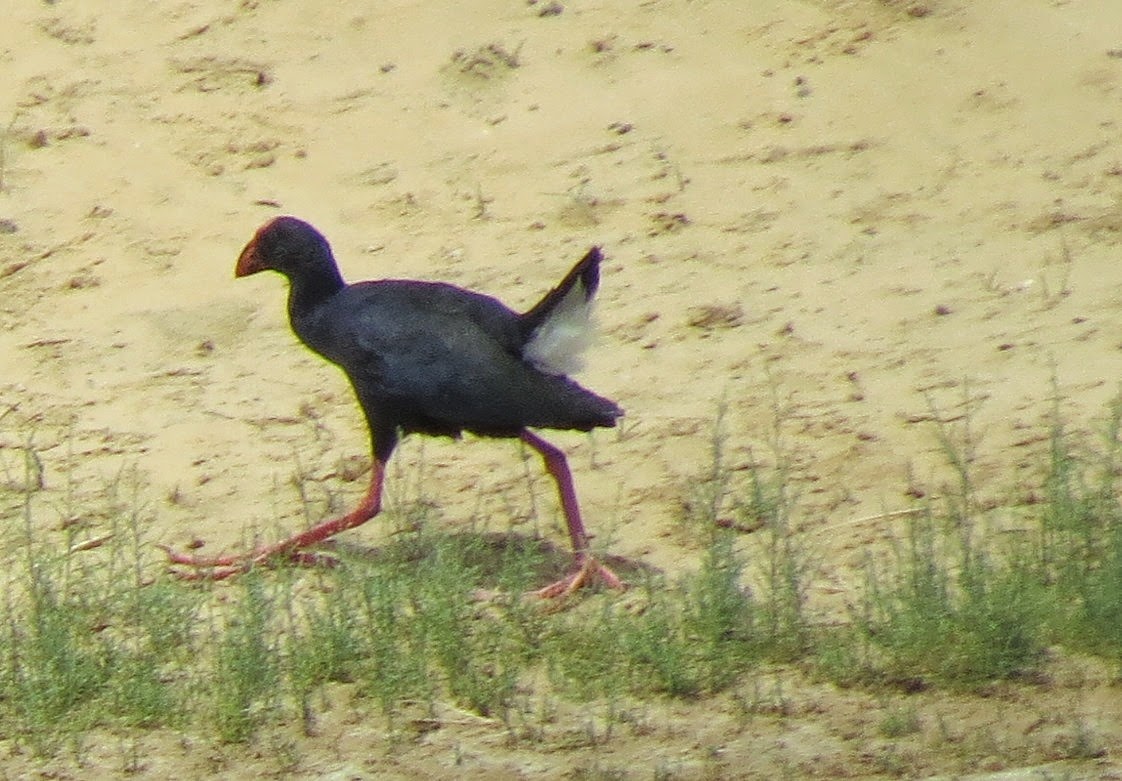
The wetland is the domain of many purple swamphen. It didn't take us more than five minutes to see the first one.

slender billed gull

Both on the edge of the lagoon and in a couple of pools near the wetland, several slender billed gull were seen. Many immature slender billed gull over stay in the summer. They are the only gull usually seen seen  from mid April to mid August.

After noon we spent most of our time in the wetland where the birding was better than in the salty areas. 

I will blog about this next. 

Saturday, 20 April 2013

The Jubail area

I visited the Jubail area in eastern province on Thursday. My plan was to find some farms and bird those. I had an idea I might see some different land-based migrants from those which go through central Arabia.

Using google earth, I had found several farms on the Kuwait road out of Dammam. There were also a couple of lakes or marshes marked there too. These were all clustered about 25 kilometres inland from Jubail.


common snipe and common sandpiper at Sebkhet al Fasl, Jubail

Actually I found these farms a bit disappointing. They were mostly market gardening such as tomato growing although there was some maize. Either way they didn't produce many interesting land birds. Graceful prinia (resident)  and common whitethroat (passage) were the most obvious in the farms. Much of the near-by land was flooded following overnight rain too.

Given everything, after a while I resorted to travelling to the coast and spent an hour or too at Sebkhet al Fasl which is a much better known birding area and away from my more speculative areas.

I'll report a little on the speculative farming area inland first though.

little stint and kentish plover

The temporary flooded areas had attracted some birds which are more normally seen on the coast such as little stint. By the way the little stint in the photo was being very aggravated by a small tick just below its eye (which you may be able to see in the picture). Just after it was taken he raised his leg to scratch it off his face. 

This water had many grey heron and little egret too.

moorhen, black winged stilt and common sandpiper

As said before, there were a couple of permanent water bodies as well with reeds and other cover. The moorhen, black winged stilt and common sandpiper were in one of these. Interestingly there were no sounds of reed warbler though graceful prinia could be heard loudly.


little tern

On one of the temporary bodies I came across several tern. These were all little tern. I managed to separate them from the similar Saunders's tern in two easy ways. First, Saunders's tern is rarely found inland- even 25 kilometres inland. Second, the white on the forehead on these birds went right to the back of the eye.

willow warbler

Migrant sightings (excluding common whitethroat already mentioned) were restricted to willow warbler and chiffchaff among the warblers.

female yellow wagtail

Other land bird migrants included yellow wagtail, Turkestan shrike and common redstart.

Turkestan shrike

After a while at the inland farming area, I moved on to Sebkhet al Fasl. This was not my first choice for the day. However,it was guaranteed to be productive albeit more so with coastal birds than necessarily with land birds. 

Unfortunately time was a little short and birding was a little hurried.


curlew sandpiper

On arrival at Sebkhet al Fasl, one of my first sightings was a curlew sandpiper heading towards breeding plumage along with 20 or little stint.

flamingo

Like the area inland, there were many additional fooded plains. One contained over 200 flamingo.

common snipe

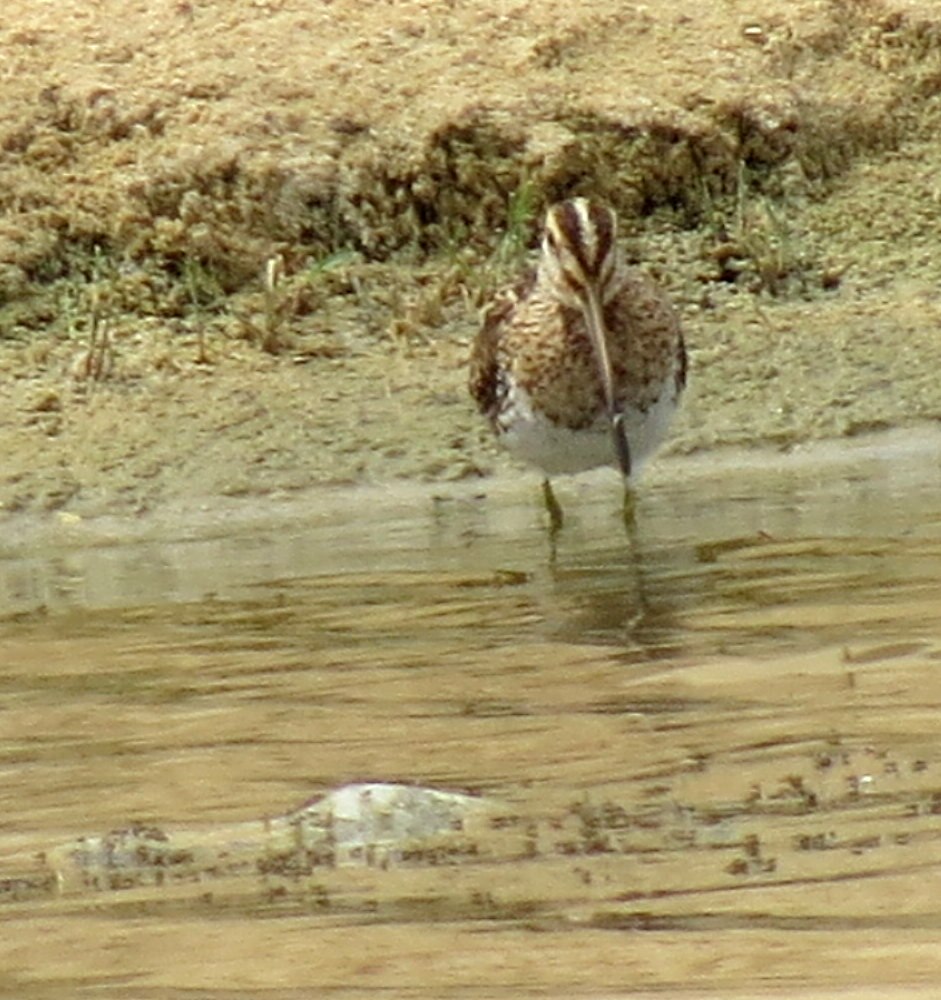
By the side of a large pool with hundreds of barn swallow (at least one house martin) flying over was a single common snipe which gave good views in the open for several minutes.

some resting barn swallow

There wasn't time to do a full audit of the waders present at the various pools but they included common sandpiper, Terek sandpiper and ruff.

Ruff and a Terek sandpiper (on the right)

The site had both little tern and Saunders's tern although it was only by analysing my photos afterward that I have reached this conclusion.

Saunders's tern

The bird above has a slightly more restricted white forehead and darker legs. I make this a Saunders's tern. Coming from the Riyadh area, I haven't had much experience with these two!

northern wheatear

Sebkhet al Fasl does of course have some land birds as well. For example,  there were a couple of both migrant northern wheatear and whinchat seen. The reeds were also very noisy with the sound of European reed warbler- a sound noticeably lacking from the inland marshes visited earlier in the day.

purple swamphen

Finally you can't write about Sebkhet al fasl without mentioning purple swamphen. There may be plenty of moorhen and coot but the purple swamphen are everywhere!