Showing posts with label eastern olivaceous warbler. Show all posts

Sunday, 10 April 2016

Once more at Al Beed

I am making a big effort to visit the desert every Friday and to stay there from dawn till dusk. However the passerine passage I have seen so far is not strong. It is weak south of the Dhofar mountains in both spring and autumn. It was quite strong in autumn north of the mountains but so far I have been disappointed this spring.

Oman is too far south and east for most mainstream Africa to Europe passage. Birds heading to Iran, Azerbaijan and south east European Russia are mostly to come this way. 

The small orchard at Al Beed farm had a small collection of warblers, all of which were concentrated in four or five trees. The rest of the orchard was barren of passage birds. I have seen this phenomenon regularly. Passage is patchy.

Eastern olivaceous warbler 1

An eastern olivaceous warbler was the most showy warbler.

Eastern olivaceous warbler 2

There was also an Upcher's warbler near-by and they sometimes crossed each other.

lesser whitethroat

There were two lesser whitethroat on site. Both were darker birds than those we normally see in Arabia. They were more akin to Sylvia curruca curruca than Sylvia curruca blythi or the now-believed hybrid Sylvia curruca/minula halimodendri. 

This set of sub-species has been a mess but is becoming clearer following more DNA work.
willow warbler

A willow warbler was the other warbler in this small patch. Elsewhere on the farm I only saw one more lesser whitethroat and one common whitethroat.

rufous bush robin

The most common passerine on passage in either season and north or on the southern foothills of the Dhofar mountains is rufous bush robin (though marsh warbler in late spring must run them close).

I counted seven at Al Beed farm. Two were in the orchard and five in patch of short palms.

rufous bush robin in palm

They are not very tame but there being so many means you will get good photos in the end.

rufous bush robin 

All the desert farms are accumulating European turtle dove. There were eight in the parts of Al Beed I visited. They don't appear to be going anywhere. These farms are likely to be their breeding grounds.

three European turtle dove

Last year I didn't visit the desert stops much and so I missed this happening.

Two European turtle dove

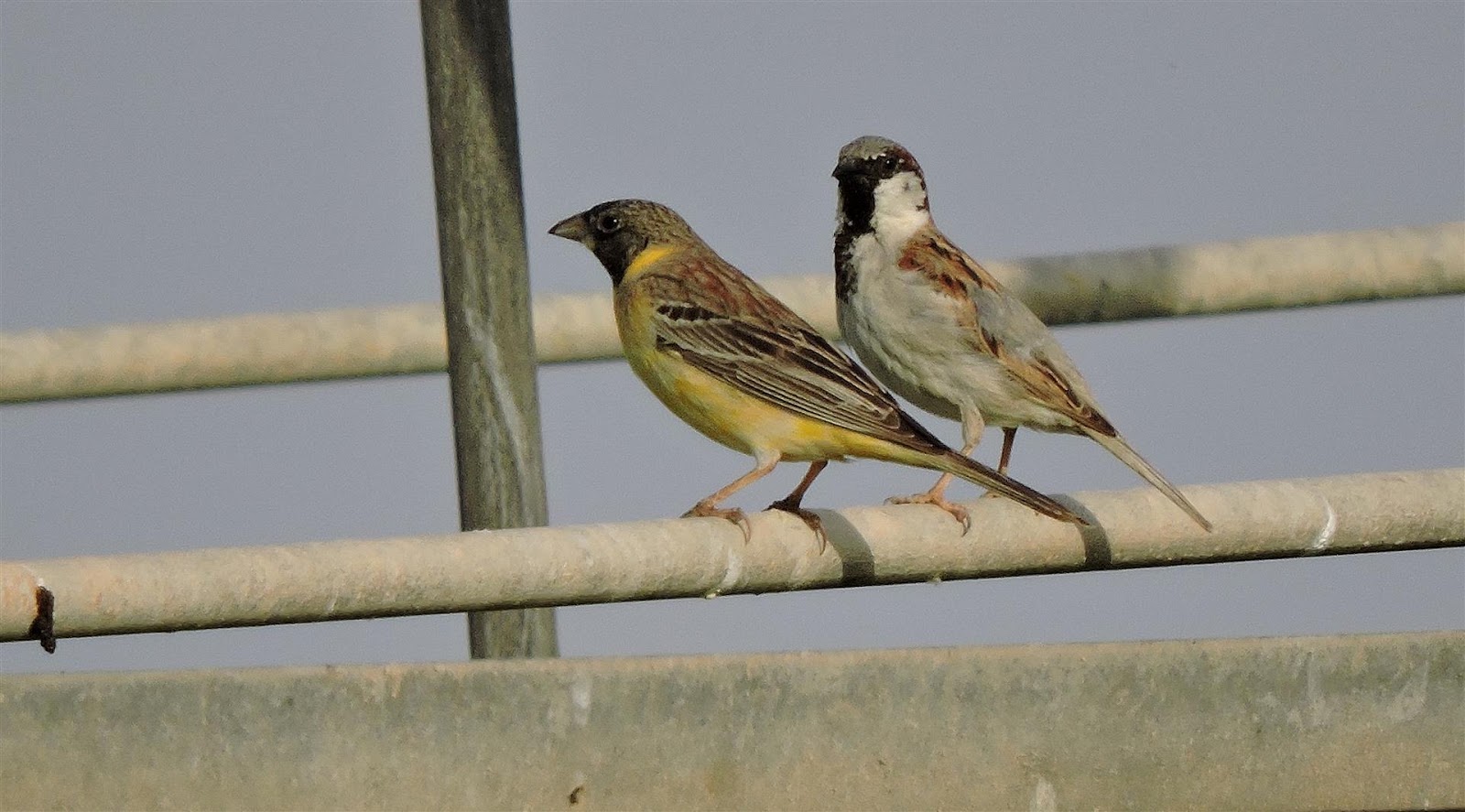
On the first field next to the farm entrance, the male black-headed bunting was still present. I have seen it continually for well over a month now.

black-headed bunting

Though it spent a lot of its time preening, most of its plumage still looks winter.

preening black-headed bunting

I counted 26 rosy starling. They have been at the farm all winter. The ready supply of locusts is fine food for this bird.

rosy starling

Next stop was once again Dowkah farm on a dull day which eventually lead to significant rain in the desert. I will blog about this next.

Friday, 3 October 2014

Khawr Mughsail

Yesterday afternoon marked the start of the Eid holiday here. I have a week off work and hope to go plenty of birding. Yesterday, I took a trip out west to Mughsail.

Here is the most western Khawr in Oman and it sometimes has vagrant African species not found anywhere else.

I wasn't that lucky but still added five birds to my ever increasing Oman list.

First up was a juvenile red-necked phalarope.

red-necked phalarope

There are thousands in the sea near-by where they winter. Luckily for me, this juvenile chose the coast presumably just before meeting up with the others.

red-necked phalarope

The scalloping on the mantle is one of the easiest ways of separating it out from the much rarer red phalarope.

note mantle of red-necked phalarope

This bird is moulting from its juvenile summer plumage into winter plumage.

oiled greater flamingo

There was a single greater flamingo in the Khawr which was another first for me in Oman. It is holding its wing down not because it is broken but because it is heavy with oil. The same was true of the other wing. It could still fly though and I hope it recovers.


dark morph western reef heron

Other birds of interest in the khawr alongside 40 or so sooty gull was a dark morph western reef heron.

Pacific golden plover

A very tame juvenile Pacific golden plover kept my attention for some time. It made me realise that the flock I have been seeing in the Salalah area doesn't contain any juveniles or if it does their plumage has already changed.

other side of Pacific golden plover

Next to the juvenile Pacific golden plover were three tame juvenile dunlin too.

Dunlin

The khawr is divided by the coast road. After finishing with the coastal wetland, I walked over the road to the more inland part. There are plenty of reeds, a few mangrove stands and two lakes.

Over head a small group of barn swallow were hawking for insects. However with them were two sand martin. These are the first I have seen in Oman.

Barn swallow

Luckily for me members of both species stopped to rest on reeds steams.

Sand martin

The wetland has attracted a female Siberian stonechat. This is a again a first for me here. The migrants are being to arrive in numbers now.

Siberian stonechat

In one of the mangroves, I glimpsed an eastern olivaceous warbler which was my final first for the day.

Eastern olivaceous warbler

Other notable birds on the inland side of the khawr was a European roller, a large flock of Tristram's startling and a kestrel. In or near the water were plenty of moorhen and at least one common snipe.

European Roller

There is a second smaller water body on the eastern edge (Salalah side) of the settlement.There is much less cover there and bird life was more limited. The best bird here was arguably a juvenile European spoonbill.

European spoonbill

Otherwise there were four grey heron and a sprinkling of waders such as common redshank.

common redshank

So the holiday begins today. I am hoping of lots of good birding.

Friday, 1 August 2014

Azadi Park, Sulaimani

On the morning of July 25th, I started my birding in Kurdistan. The start was low key with a visit to the local park in Sulaimani called Azadi. It's actually quite large but still being developed.

In this introduction to Kurdistan birding, only 10 species were seen but it gave me a first feel of what to expect in the region.

greenfinch

One of the most surprising finds for me was a greenfinch. According to my regional guide's map there is an isolated community of this northern bird around Sulaimani. It seems I found it. 

Eastern olivaeous warbler

Before that I spent some time trying to identify the relatively large number of warblers in the park. It didn't take me too long to wok out that they were all of two types. 

Eastern olivaceous warbler was extremely common. 


Menetries's warbler

Menetries's warbler was restricted to areas with low bushes. However this was still the most concentrated group of them I have ever seen. Unlike the more northerly sub species this one is quite bland especially the females. 


second view of Menetries's warbler

I had been told that white wagtail could be found at the park and so it proved. I came across a family of 2 adults and 2 juveniles next to one of the three artifical lakes. The adults were very worn.

White wagtail

The juveniles were still young enough to be begging for food. White wagtail doesn't breed much further south than this.

juvenile white wagtail

Incidentally the lakes attracted a few hawking barn swallow.

collared dove

The park's most obvious residents are the doves: collared dove, laughing dove and feral pigeon. Unfortunately there was no sign of turtle dove. The latter bird is in serious trouble throughout its range.

Laughing dove

The main problem with birding in Kurdistan at this time of year is the temperature. It reached 42C on July 26th. Birding became increasingly difficult after 9am as we walked round the park. 

hoopoe

House sparrow was everywhere as expected. Hoopoe was the only other bird seen.

house sparrow


Thanks are due to my non-birding friend Steve K who lives and works in Kuridstan and who came out on this visit with me.

After returning to Steve's place mid morning, at 4pm as the temperatures began to drop, I resumed birding in another part of the city. Still with low key birding, another seven species were added to my embryonic Kurdistan list including a lifer.

Species seen in Azadi park
Feral pigeon
Collared dove
Laughing dove
Hoopoe
Barn swallow
Eastern olivaceous warbler
Menetries’s warbler
House sparrow
White wagtail
Greenfinch

Thursday, 31 July 2014

Istanbul stopover

I was in Kurdistan visiting a friend for a few days this week.  I managed to get some birding in as well as sight seeing. I'll produce a series of blogs to report on this.

However because of poor airline connections, I had a stop over in Istanbul on July 23th.

I took the opportunity to bird around the Topkapi area (in Gulane park) which is within walking distance of my hotel. I have done this before but at different times of year. 

adult great tit bathing

The park is too well tended in a sense. There are very few bushes and low trees but lots of tall ones providing welcome shade for walkers. This configuration favours birds large birds including parakeets as against passerines. 

Nevertheless a few passerrines thrive. The most obvious is great tit which is helped by nest boxes being placed out part way up the tall trees. 

young great tit

There was plenty of evidence of young birds and so a succesful breeding season.

young great tit bathing

I struggled to find any warblers. However in one corner of the park there are smaller trees and sure enough I came across some noisy Eastern olivaceous warbler.

Eastern olivaeous warbler

It was difficult to get a straight and prolonged view.

Eastern olivaeous warbler in the sun

Other smaller birds were limtied to house sparrow, common starling and common myna.This was the first time I had seen this latter bird in Istanbul as this pest moves closer to the rest of Europe.

common starling

The park is mostly the playground of larger birds. I didn't see Alexandrine parakeet this time but rose ringed parakeet were easily seen.

house crow

Hooded crow is certainly the most common larger bird at least at this time of year.

Magpie

Numbers of magpie were much more limited.

Laughing dove

Like common myna, the range of laughing dove is still expanding. They reached Tbilisi, Baku and Istanbul over 25 years ago and its difficult to believe they wont colise southern Europe more genrally.

adult yellow legged gull

Gulane park is only 100 metres from the sea at its closest so its not surpising that yellow legged gull makle it into the park.

young yellow legged gull

The fledgling yellow legged gull above was incredibly tame.

cormorant

Over the road from the park on the coast, a single cormorant stood on a lamp post.

The visit to Gulane park was short and light relief. Ironically the first place I visited in Kurdistan was a park in central Sulaimani. That is the subject of the next blog.

Friday, 20 June 2014

Summer warblers at Al Hayer

I went to Al Hayer today for the first time in nearly two months. Yet I used to go there virtually every week until I started travelling more widely in Saudi Arabia.

It will be my last visit for some time too. I will explain why in the next blog.

As it is now generally seriously hot in central Saudi Arabia, I began birding at about 5.45 am and finished at 10.15 am. Luckily, I was helped that it turned out to be a relatively less hot morning than average for this time of year.

This blog only looks at one aspect of the visit: the summer warblers.

One of the first observations I made on arriving this morning was the huge number of Eurasian reed warbler about. It must have been a very successful breeding season.

one very cooperative Eurasian reed warbler

They weren't just keeping to the reeds either. Plenty were spilling out on to near-by bushes and even into the fields. This wandering away from the reeds was a new phenomenon for me.

At first I struggled to get clear photos until one warbler cooperated in the open.

another pose of the same bird

Before that, in classic warbler style they would move off before I could focus. 

warbler ready to fly off

Having had a chance to see many together (and regretting not looking closer before), some of reed warblers didn't look particularly different from the tones of the nominate species. This is opposed to being greyer on top and whiter below like the fuscus sub species (often called Caspian reed warbler) which dominates breeding in Arabia. 

an apparently darker, browner looking Eurasian reed warbler

For once, graceful prinia wasn't the most common warbler on show at Al Hayer.

graceful prinia

Two hours into the walk, my attention was diverted to loud calls in some dried reeds and small tamarisk bushes. These calls were between a small group of Eastern olivaceous warbler. Small numbers breed here but I rarely see them in the open. However I have rarely visited Al Hayer in June before.

eastern olivaceous warbler calling

This species can be overlooked if you are not careful. It's song is similar to a reed warbler though I think it is more pleasant. It is greyer, the bill is longer and the supercilium more obvious yet in bright sunlight, it would be possible to walk past and miss it.

closer view of eastern olivaceous warbler

Two other warblers are known to breed or have bred at Al Hayer. These are great reed warbler and moustached warbler. I personally have only seen them in the passage seasons at Al Hayer. However others have seen great reed warbler in the summer months. On the other hand, I don't think anyone has seen moustached warbler in summer among those currently birding.

second close up of an eastern olivaceous warbler

In the next blog, I report on all the other birds observed at Al Hayer.